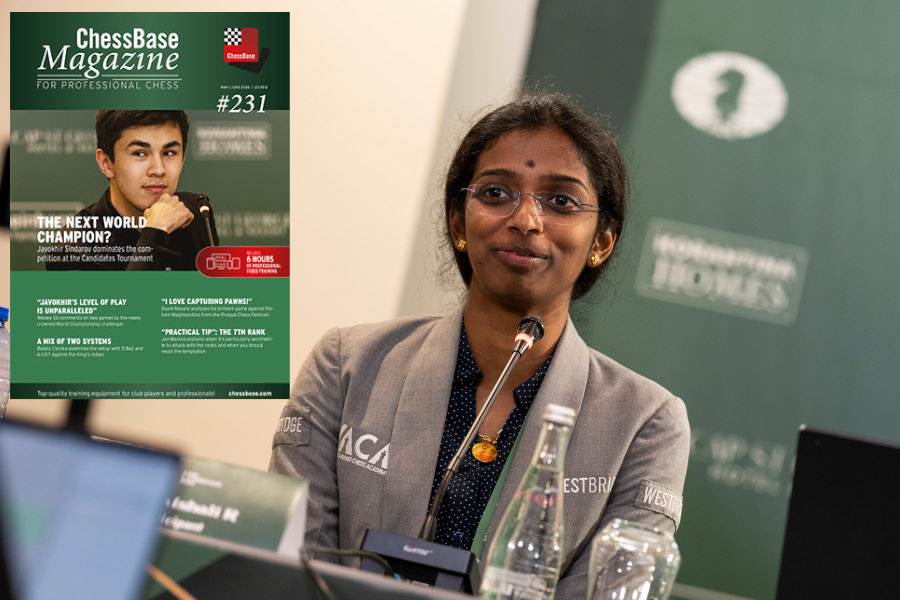
7/10/2026 – ChessBase Magazine offers a window to the world of professional chess. Nagesh Havanur takes a look at the recent issue, CBM 231. 2836 games, mainly from the Candidates Tournament and European Individual Championship. 27 annotated, 11 opening surveys, 3 opening videos, demo. lectures and several exercises for training. Annotators include Anish Giri, Wei Yi, Wesley So, Karsten Mueller and Vaishali Rameshbabu (pictured) among others. The icing on the cake is the Special feature on Magnus Carlsen offering 20 annotated games. | Photo: Nils Rohde / ChessBase
new: ChessBase Magazine 225
Chess Festival Prague 2025 with analyses by Aravindh, Giri, Gurel, Navara and others. ‘Special’: 27 highly entertaining miniatures. Opening videos by Werle, King and Ris. 10 opening articles with new repertoire ideas and much more. ChessBase Magazine offers first-class training material for club players and professionals! World-class players analyse their brilliant games and explain the ideas behind the moves. Opening specialists present the latest trends in opening theory and exciting ideas for your repertoire. Master trainers in tactics, strategy and endgames show you the tricks and techniques you need to be a successful tournament player! Available as a direct download (incl. booklet as pdf file) or booklet with download key by post. Included in delivery: ChessBase Magazine #225 as “ChessBase Book” for iPad, tablet, Mac etc.!
YOUR PERSONAL CHESS COACH - Whether you’re taking your first steps into the world of club chess, or already playing at a tournament level: with FRITZ, you can train more efficiently, intelligently and with a more personalised approach than ever before. FRITZ is more than just a chess engine – it’s a training revolution! Whether you’re taking your first steps into the world of club chess, or already playing at a tournament level: with FRITZ, you can train more efficiently, intelligently and with a more personalised approach than ever before.
The Benko Gambit is back at the very highest level - and it's easy to see why. Black sacrifices a pawn to seize the initiative on the queenside, obtaining long-lasting pressure, active pieces and open files that make life difficult for White.
€39.90
Expert commentators, in-depth analysis
The world loves the young. They have a sunny temperament. They remain happy and make others happy. They do have disappointments, but forget them soon. They recover their spirits easily, thinking, "Tomorrow is another day". It keeps them going. Young Javokhir Sindarov is a shining example. The major part of this issue is devoted to his performance and how he overcame resistance from his rivals. Quite a few observers found it hard to believe, though. "Surely, an experienced campaigner like Fabiano Caruana stood a better chance". So they thought, and they were proved wrong. In this issue, Yannick Pelletier annotates the critical encounter that set Caruana behind in the race. First, let us see the encounter "live":
Videos: Nico Zwirs examines two Petroffs from the 2026 Candidates. Robert Ris has a tip against the Caro-Kann Advance Variation with 3…c5. Fiona Sieber reveals a surprise weapon against the Najdorf. ‘Lucky Bag’ with 40 analyses by Ganguly, L'Ami et al. ChessBase Magazine Extra is the perfect complement to ChessBase Magazine. Available as a single issue or by subscription (6 issues per year). Available as a direct download. Includes ‘ChessBase Book’ for iPad, tablet, Mac, etc.!
Here is the game itself, with analysis by the Swiss grandmaster:
Caruana had an opportunity to level his score with Sindarov in the second half of the tournament. He missed it after a careful defence by his opponent. This particular game is not annotated in the issue here. However, one may find with a detailed commentary by Jonathan Speelman on the ChessBase News Page:
In a recent interview, Sindarov explained how he had a lucky start.
Every game was very important, but probably one of the most important games was the first game (against Esipenko) where I played very badly and my time management was also very bad. I was very closing to losing this game, I was being outplayed. But at one point I got lucky when he quickly played a bad move and I got some small chances. After that I started playing very fast and was lucky to win this game. And you know, in my opinion, when you start the tournament with a lucky break like this, it’s always one of the biggest steps to win a tournament. One of the biggest steps was made in the first round.
Chess is a concrete game. There is no way around training your calculation skills. Improve your visualization, pattern recognition and learn calculation techniques such as reciprocal thinking with this course. Calculation is at the heart of practical chess. Every chess concept builds on proper calculation technique. Therefore, all chess players should continuosly train the fundamental techniques, concepts and patterns this course will present. The goal isn't only to teach you to calculate, but to give you the tools and insights to keep improving long after the final lesson.
Free sample video: Introduction
At first sight, the game does not make sense at all. Surely, Esipenko was "winning" the pawn on d4, and why did he have to sacrifice the exchange? Was he really in such danger? In my annotations to the game here, I have offered a few signposts.
In the second half of the tournament, Wei Yi did set problems for Sindarov, and here is how he overcame the Chinese grandmaster. The game is annotated by Wesley So in this issue.
The game between Caruana and Anish Giri saw fluctuating fortunes, and the winner annotates the encounter in this issue:
Vaishali Rameshbabu annotates her game with her compatriot, Divya Deshmukh.
I would have loved to see the Women's Candidates winner's annotations to her decisive victory over Kateryna Lagno in the last round:
This issue also includes games from the European Individual Championship won by young Roman Dehtiarov with a score of 9/11 points ahead of Nijat Abasov, Aydin Suleymanli and Muradli Mahammad, who were half a point behind. I would have loved to see a few annotated games here.
One game that fascinated me was the following encounter:
A magic display with quiet and subtle moves that would have delighted the hyper-moderns
A Magnus special
The issue has a special feature on Magnus Carlsen, who is still ranked as the number one player in international chess. There are 20 annotated games from the World Championship 2014-2023 period.* His opponents include veterans like Vishy Anand and Vasyl Ivanchuk and younger talents like Alireza Firouzja and Vincent Keymer, among others. Here is a remarkable miniature against one of the leading grandmasters:
Opening videos
There are 3 opening videos in this issue. The first of them is by Jan Werle, who deals with the sideline 5…a6 in the French Defence, Tarrasch Variation (C08). The second is by Mihail Marin, who analyses a well-known line of the Italian Game (C53). The third is by Danny King who explores a new idea, 6…a5, in the Catalan (D06).
Take your pick.
Opening surveys
There are as many as 11 articles on the openings, ranging from the Sicilian to the Slav. Among them, I would single out Petra Papp's commentary on the 4.Nge2 line of the French Winawer Variation and Robert Ris' work on an unusual line of the Queen's Gambit Accepted.
In her analysis on the 4.Nge2 line of the Winawer Variation (C15) Petra Papp makes a case for the less known 7.Bf4 move. But I still prefer 7.d5, which sets more problems for Black. Here are her annotations to this line.
Why not 7.Bf4 then? It allows the immediate 7…Nf6, preparing …Nd5, racing to protect c7.
Perhaps the most challenging line against the Winawer is 4.Bd2!?. Admittedly, it is well analysed. It still needs a second look.
The other is an analysis of an offbeat line in the Queen's Gambit Accepted by Robert Ris. Here I have added a little more explanation for readers not familiar with opening theory.
Besides opening surveys, this issue has standard features on tactics, strategy and the endgame.
I was particularly impressed by Dorian Rogozenko's presentation of an old game between Garry Kasparov and Vishy Anand from the 1996 Euwe Memorial Tournament in Amsterdam. Many modern experts tend to see these games through the lens of engines and are often dismissive of the quality of play. Rogozenko is different. He is well-aware of the nuances of current opening theory and how Fritz can demolish old analysis. What he does is to find out how players think and why games are won and lost. Now let us return to the game.
1996 was Veselin Topalov's year. He won tournament after tournament. It also happened in the Euwe Memorial in Amsterdam. He inflicted a painful defeat on Kasparov in the first round, followed by a victory over Anand in the second round. Garry had recovered from his loss in the first round and beaten Jeroen Piket in the second round. In the third round, he met Anand. Vishy had lost to Kasparov in the World Championship match in the previous year. Tn this tournament he had yet to recover his form. In the following game he fell to Garry on account of his superior opening preparation and greater understanding of the middlegame strategy à la Nimzowitsch.
I have resisted the temptation to offer Rogozenko's commentary in this issue. Readers can draw their own conclusions after they have seen the video.
By way of postscript, I may add that Garry shared the first place with Topalov in the tournament. Vishy did not do badly, sharing third and fourth place with Nigel Short.
Grandmaster Dr. Karsten Müller, one of the world’s leading endgame experts, guides you step by step through everything you need to know in this second volume. Picture this: you’ve outplayed your opponent move by move, you’re clearly better – and then the endgame slips into a draw, simply because you lacked the crucial theoretical knowledge. That is exactly where this course comes in. Without solid endgame skills, there’s no way forward. Rook endgames are most essential: they occur more often than any other type of endgame, and often make the difference between victory and half a point. If you master them, you’ll confidently convert your advantages into wins!
Free video sample: Introduction
Free video sample: Bodycheck
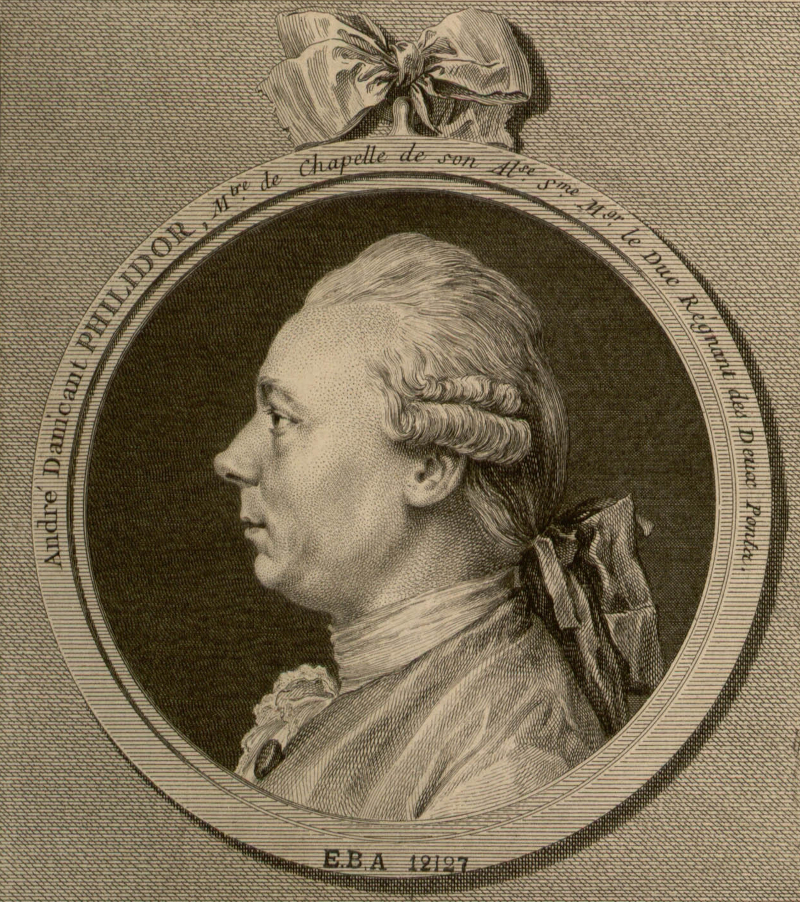
In the regular column "Fundamental Endgame Knowledge", Karsten Müller offers a video lecture on endgames with queen versus rook. For starters, he offers a position from Philidor:
This is followed by his exposition of a series of positions with the king and queen versus the rook and pawn.
In a separate section, he analyses 18 endings played by Carlsen, who is known as a virtuoso in the final phase of the game.
This section also offers the column "Readers write", in which we find contributions on the endgame by experts Zoran Petronijevic, Wolfram Schön and Jana Schneider, among others.
Summing up
The main database of the issue has 2836 games, of which 27 are deeply annotated. There is much else in this DVD that deserves to be explored. Apart from the players I have already mentioned, the commentators include Baskaran Adhiban, Michal Krasenkow and Yevgeny Postny, among others. It may be noted that there are more annotated games in the opening and training sections of this issue. Well, practice makes perfect.
Notes
1) As is known, Carlsen announced his retirement from the World Championship cycle in 2023. He remained unbeaten in the World Championship matches against Vishy Anand, Sergey Karjakin, Fabiano Caruana and Ian Nepomniachtchi.
2) There are quite a few books on the life and work of Philidor (1726-1795).
One is a pioneering biography by George Allen (1863) and there is a new edition with games updated by Carsten Hansen:
The Life of Philidor by George Allen, Alexander Game Books 2025
3) Among others, New in Chess Magazine #2 (2026) also carries an interesting report on the Candidates Tournament followed by annotated games. It also features an interesting interview with Roman Vidonyak, Sindarov's trainer:
In this video course experts examine the games of Bent Larsen. Let them show you which openings Larsen chose, where his strength in middlegames were, how he outplayed his opponents in the endgame & you’ll get a glimpse of his tactical abilities! Bent Larsen (1935–2010) was the greatest chess player in Danish history, and for a time, the second-strongest player in the Western world behind Bobby Fischer. Between 1954 and 1971, he won the Danish Championship six times, and achieved numerous international tournament victories throughout his career.
Free video sample: Introduction to Bent Larsen by Peter Heine Nielsen
Free video sample: Introduction to the Opening Section
1) Official website on the Candidates Tournaments 2026
From the 2026 Candidates Tournament, featuring a video review by Dorian Rogozenco, to Jan Werle’s opening video on the French Tarrasch Defence, and Oliver Reeh’s tactical column ‘Top Grandmasters at Work’. Analyses by Giri, So, Wei Yi and many others. ChessBase Magazine offers top-class training material for club players and professionals! World-class players analyse their finest games and explain the ideas behind the moves. Opening specialists present the latest trends in opening theory and exciting ideas for your repertoire. Master trainers in tactics, strategy and endgames show you exactly the tricks and techniques you need to become a successful tournament player! Available as a download (including the magazine as a PDF file) or as a printed magazine with a download key sent by post.
Included: CBM #231 as a “ChessBase Book” for iPad, tablet, Mac etc.! At books.chessbase.com
Nagesh HavanurProf. Nagesh Havanur (otherwise known as "chessbibliophile") is a senior academic and research scholar. He taught English in Mumbai for three decades and has now settled in Bangalore, India. His interests include chess history, biography and opening theory. He has been writing on the Royal Game for more than three decades. His articles and reviews have appeared on several web sites and magazines.
YOUR PERSONAL CHESS COACH - Whether you’re taking your first steps into the world of club chess, or already playing at a tournament level: with FRITZ, you can train more efficiently, intelligently and with a more personalised approach than ever before.
If you're looking for a dynamic alternative to the Slav, Queen's Gambit Declined, or other mainstream systems, the Chigorin Defence offers exactly what modern tournament players need.
Michael Kotyk presents a complete repertoire after 1.e4 e5, built around creative ideas, surprising move orders, and practical weapons designed to catch your opponents off guard.
Michael Kotyk presents a complete repertoire after 1.e4 e5, built around creative ideas, surprising move orders, and practical weapons designed to catch your opponents off guard.
Michael Kotyk presents a complete repertoire after 1.e4 e5, built around creative ideas, surprising move orders, and practical weapons designed to catch your opponents off guard.
“Attack with Qh5!!” – Tactical training with Oliver Reeh, “6…g5 – nothing ventured, nothing …” – Le Quang Liem comments on one of his victories in Biel, “Grischuk’s stroke of genius” – Petra Papp reveals a surprise in the Sicilian Kan Variation, and much
YOUR PERSONAL CHESS COACH - Whether you’re taking your first steps into the world of club chess, or already playing at a tournament level: with FRITZ, you can train more efficiently, intelligently and with a more personalised approach than ever before.
While tactics decide the game in concrete moments, strategy guides the entire battle. Understanding how to improve your pieces, create weaknesses, execute maneuvers, and steer the game toward favorable structures is what defines strong players.
€39.90
We use cookies and comparable technologies to provide certain functions, to improve the user experience and to offer interest-oriented content. Depending on their intended use, analysis cookies and marketing cookies may be used in addition to technically required cookies. Here you can make detailed settings or revoke your consent (if necessary partially) with effect for the future. Further information can be found in our data protection declaration.
Pop-up for detailed settings
We use cookies and comparable technologies to provide certain functions, to improve the user experience and to offer interest-oriented content. Depending on their intended use, cookies may be used in addition to technically required cookies, analysis cookies and marketing cookies. You can decide which cookies to use by selecting the appropriate options below. Please note that your selection may affect the functionality of the service. Further information can be found in our privacy policy.
Technically required cookies
Technically required cookies: so that you can navigate and use the basic functions and store preferences.
Analysis Cookies
To help us determine how visitors interact with our website to improve the user experience.
Marketing-Cookies
To help us offer and evaluate relevant content and interesting and appropriate advertisement.