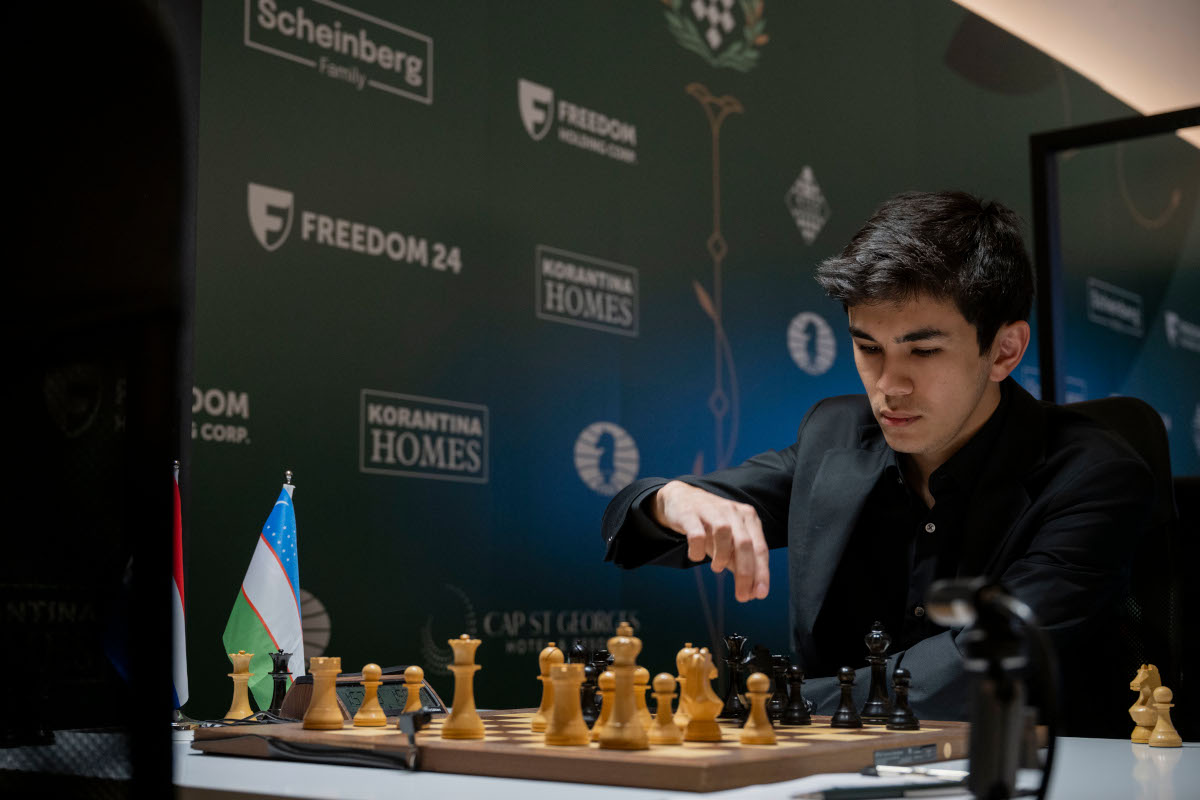
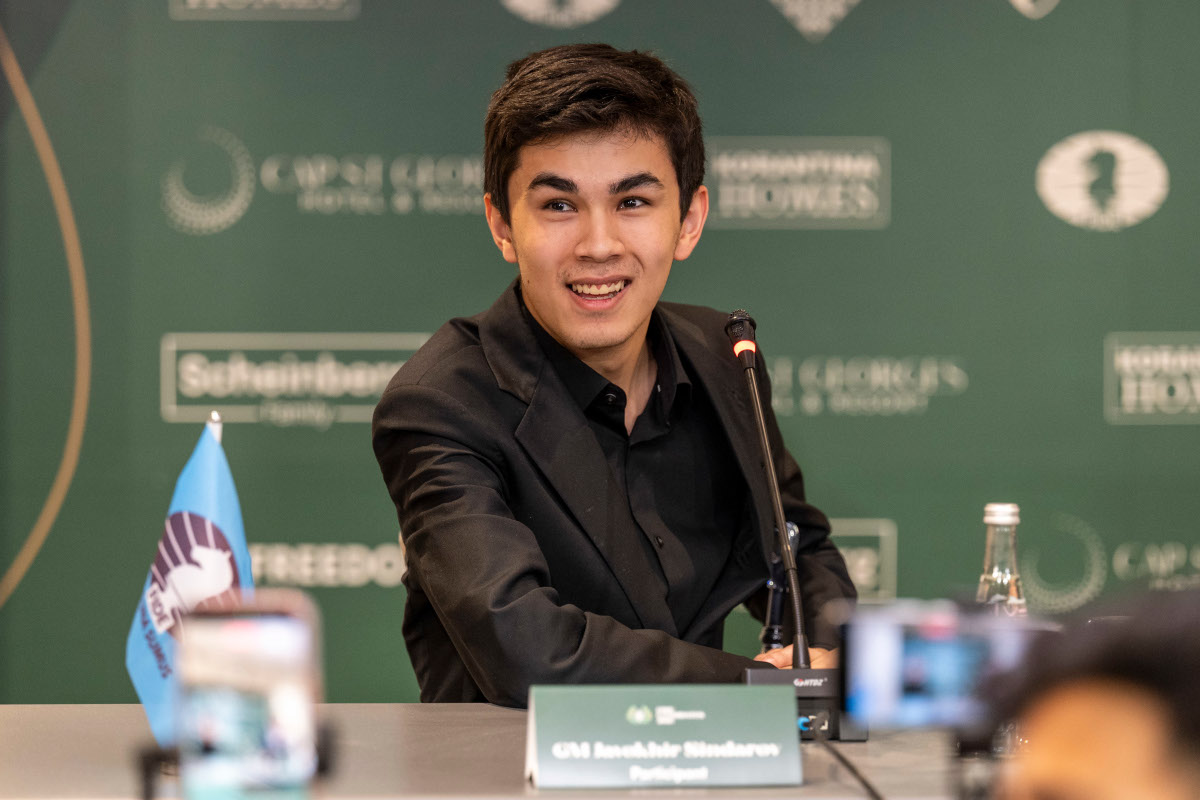
4/21/2026 – In an extensive interview after winning the Candidates, Javokhir Sindarov reflected on the key moments behind his victory, his preparation methods and his ambitions for the future. The Uzbek grandmaster discussed the importance of his draw against Fabiano Caruana in Cyprus, his work with coach Roman Vidonyak and his long-term goal of becoming world number one, while also looking ahead to the world title match against Gukesh Dommaraju. | Photo: ChessBase / Nils Rohde
new: ChessBase Magazine 225
Chess Festival Prague 2025 with analyses by Aravindh, Giri, Gurel, Navara and others. ‘Special’: 27 highly entertaining miniatures. Opening videos by Werle, King and Ris. 10 opening articles with new repertoire ideas and much more. ChessBase Magazine offers first-class training material for club players and professionals! World-class players analyse their brilliant games and explain the ideas behind the moves. Opening specialists present the latest trends in opening theory and exciting ideas for your repertoire. Master trainers in tactics, strategy and endgames show you the tricks and techniques you need to be a successful tournament player! Available as a direct download (incl. booklet as pdf file) or booklet with download key by post. Included in delivery: ChessBase Magazine #225 as “ChessBase Book” for iPad, tablet, Mac etc.!
YOUR PERSONAL CHESS COACH - Whether you’re taking your first steps into the world of club chess, or already playing at a tournament level: with FRITZ, you can train more efficiently, intelligently and with a more personalised approach than ever before. FRITZ is more than just a chess engine – it’s a training revolution! Whether you’re taking your first steps into the world of club chess, or already playing at a tournament level: with FRITZ, you can train more efficiently, intelligently and with a more personalised approach than ever before.
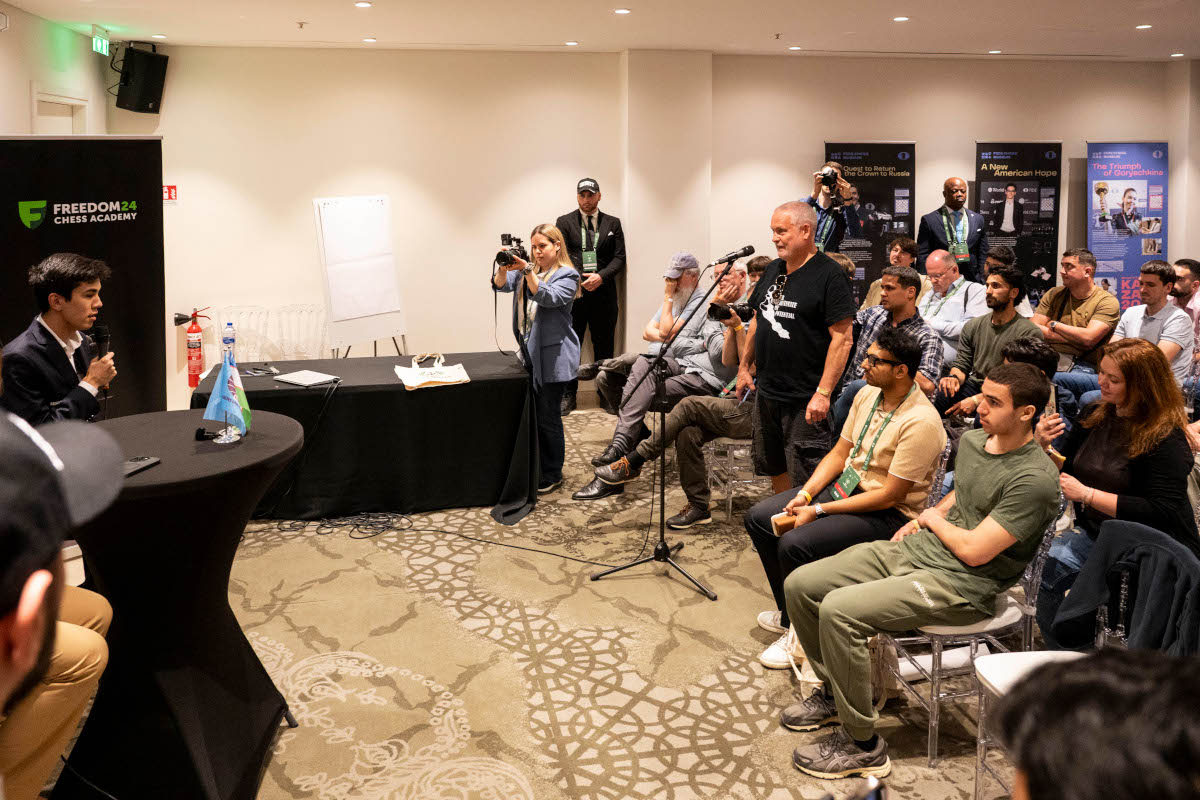
After winning the FIDE Candidates 2026, Javokhir Sindarov gave an in-depth interview to Charlyze van Zyle, in which he shared his ambitions and long-term goals. The Uzbek GM reflects on his path to victory, discusses his preparation and reveals key insights into his work with his coach. Below you will find both text and video versions of this interview.
Charlize van Zyl: I am here with Javokhir Sindarov, FIDE Candidates 2026 winner. You've had some time for this result to settle in. Congratulations once again. Take me back to the night, after round thirteen, what happened? Who was the first person you spoke to? How did the celebrations go?
Javokhir Sindarov: It was a fantastic day for me and for our country. Everyone started celebrating after the result. I received millions of messages from my friends, my parents and my family, and also from our federation and government. It's a huge victory for our country, and everyone was very happy. The next day, our president even called me to congratulate me, which really surprised me. I'm very happy to have won this tournament.
Is that something you're starting to get used to, getting congratulations from the president?
No, of course not. You need to achieve big victories to get a call like that. I'm very happy. I already won the World Cup, now the FIDE Candidates, and hopefully by the end of the year I will try to win the World Championship match as well. It gives me a lot of motivation.
In this video course, Grandmaster Ivan Sokolov explores the fascinating world of Dutch and Grünfelkd structures with colours reversed. In this video course, Grandmaster Ivan Sokolov explores one of the most intriguing and under-examined areas of modern chess: reversed opening systems, focusing on the Reversed Grünfeld and the Reversed Dutch. At first glance, these two systems seem unrelated. However, they share a common strategic challenge: the value of tempi, structure, and psychology when familiar openings are played with colours reversed. Drawing on his long professional experience, Sokolov explains why these positions are far more subtle than they appear and why traditional engine evaluations often fail to capture their true complexity.
Free sample video: Introduction
Free sample video: Larsen’s b4 Plan vs Reversed Stonewall Setups: Larsen - Spassky
Let's talk about the event. You mentioned earlier in one of the press conferences that your coach hoped for +1 at the midpoint, but you finished +6 (10/14), which is incredible. Did you ever lose confidence that that would happen? What was your goal at halfway?
Actually, my coach told me that if I finished the first half with +1, I would have good chances to win the tournament. But I finished +5. At the same time, I knew the second half would be much harder, especially with important games where I had black. These games take a lot of energy and good preparation. Probably, the key moment of the tournament was my draw against Fabi. After that, I started to feel like I could win. I was also a bit lucky - Caruana was always very close to me, he won some games in the first half, but he lost a few in the second half. Then he lost to Anish, who had good chances too. But after beating Pragg, I was ahead of Anish by two points with four rounds left. I realised that anything could still happen, but I felt 90% sure I would win. I'm very happy that I played very well with Black and I didn't lose any games. It was a very good streak, and I'm very happy with my results.
Many players say they take it game by game, but you seemed very conscious of the standings. Did that add more stress to you?
Not really. I always try to prepare very well. With white, I'm ready to fight, but in the second half, after the draw with Fabi, I thought I had to play with white also some forced solid drawish lines. I didn't need long, complicated games. I wanted to save energy for the critical ones with black.
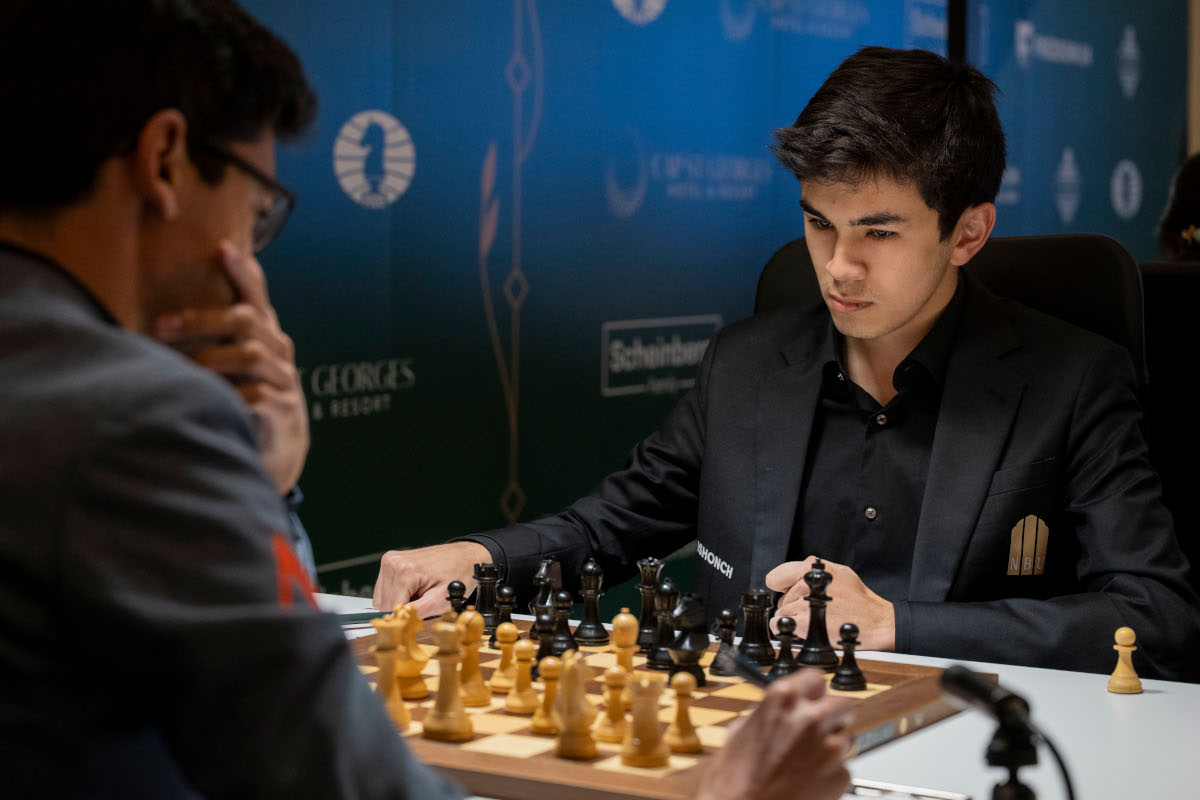
But if my opponent chose sharp lines, such as the King's Indian or Benko, I was ready to fight. On the other hand, if they played solidly, I was fine with a draw. I think this strategy worked perfectly. Against Anish I played really well, it was a nice game. Maybe if he had defeated Wei Yi the tournament situation would have changed a little bit, but after he drew I thought I had a 99% chance to win the tournament. Therefore, I made two quick draws in the last two games - everyone would have done the same. Remember that Nepo in 2022 did the same, although he did have some trouble with black in two games, whereas I had problems here only against Fabi and in the first game. I played very well, I was also lucky, of course, and I took advantage of my opponents' mistakes, which is very important.
The crucial round-thirteen confrontation between Anish Giri and eventual champion Javokhir Sindarov | Photo: ChessBase / Nils Rohde
Your game against Anish was your favourite one? Which victory are you most proud of?
I really loved my game against Fabi with white. It was a very clean game. I found the best moves, the best tactics, and managed time pressure. A fantastic game in which I showed another level, which I am capable of demonstrating.
Since our pre-event interviews, you have been very confident about your winning chances, but you mentioned last week was the most difficult of your life, sleeping, eating, and handling pressure. How did you manage that?
It's always hard when you're leading a tournament. You start thinking about the outcome. The last week was very hard for me, but after my draw against Fabi, I felt much better. The three games previous to that one went easy for me, with hardly any stress. I was well-prepared, had more than an hour on the clock, and I played positions in my style. But with Fabi the position did not suit my style, and it's hard for me to play these types of positions. That game was very long and took a lot of energy, but after surviving, I felt like I would win the tournament. After that, I slept better and didn't feel as much stress.
Let's talk about your preparation. It’s been a big talking point. You seemed to out-prepare your opponents. How does your team work? Who takes what responsibilities, and what do you do before the games?
Before the tournament, we worked very hard. Everyone in my team did their job at the highest level. We prepared many opening lines and ideas.
During the tournament, we didn't do much new work. I mainly refreshed my files, what I had already studied. The key was the preparation before the event. We were very lucky with Fabi and Hikaru, guessing their opening choices right.
In this course, we will learn how to identify passively placed pieces in any given situation and how to improve their health by bringing them into active squares.
So, during the tournament, it's mostly about reviewing rather than learning new things? Although you also mentioned training games?
Exactly. Before the tournament, we did a lot of work. During the tournament, I just repeat and make sure I don't forget anything. We play some board games as well.
All went Javokhir Sindarov's way in Cyprus | Photo: ChessBase / Nils Rohde
You will face Gukesh at the end of the year, when will your preparation for that start?
Actually, I don't know. My preparation will start from next week, to think about this match and do some small planning, but right now, I'm focussed on playing some strong tournaments, such as the Grand Chess Tour and the Olympiad.
You mentioned your coach, Roman Vidonyak. You started working with him in January 2025. He told us that you were working over the board, no computers, old school. How has your training changed with him?
Before, I worked hard, but sometimes it was boring. I would get distracted with video games and other things.
With Roman, training is always interesting. He gives puzzles and exercises, and time passes very quickly, we can work for eight hours without noticing. We often train in groups, which makes it fun and competitive. All his students love working with him.
So he made training more enjoyable?
Yes, exactly. We do a lot of interesting and fun things, but we also work very hard. Sometimes we compete solving puzzles, to see who solves faster. If you train seriously for eight hours every day without some sort of distraction, you burn out: after five days, you are done. But we balance it well.
You mentioned there was a period, when you became a grandmaster, in which you weren't as focused on chess and training. You also mentioned seeing your peers doing much better. What changed?
The quarantine changed my life. After that, I started working much harder. I scored a big win in the World Cup against a top player, Alireza Firouzja, and that gave me a lot of motivation. I was very young, only 15 years old, and he was 2750 and a top ten player. I won three games and advanced to the round of 32.
That was a key moment: I realised I could compete at the highest level. Since then, I've been working much more seriously. My life changed a lot. With Roman, I really started to work hard at chess.
Your coach mentioned a long-term goal of becoming world number one. Can you tell us about that goal?
Yes, I believe it's possible. Everyone has a chance. He has always told me that I have talent. The young generation is very strong, and we all have opportunities. My goal is to play good chess and win games - that's what drives me.
I am eager to win in any game: if I play Counterstrike, I don't play for fun, I always play to win, card games, board games – it doesn't matter.
My next step is to try and win the World Championship, but I have to work hard and in a few years my goal is to become the best player in the world.
Become a master of chess strategy – get Robert Ris’s complete bundle now at a special price! Become a master of chess strategy – get Robert Ris’s complete bundle now at a special price!
Already a chess superstar! | Photo: ChessBase / Nils Rohde
There's already hype about your potential World Championship match being one of the youngest ever. Does that historical weight mean anything to you?
Not really. It's not a big surprise to me. After the previous era, it's natural that the younger generation takes over. We are two very strong grandmasters, and I'm just part of that generation. After Carlsen, right now the young generation is emerging rapidly.
You mentioned that you would like the match to be played in a sunny place, such as Cyprus. How did you enjoy your time here?
Everything was fantastic. The place is beautiful, and the weather was fantastic. The hotel and the conditions were all great. We had time to play tennis and video games and relax. I really enjoyed it.
YOUR PERSONAL CHESS COACH - Whether you’re taking your first steps into the world of club chess, or already playing at a tournament level: with FRITZ, you can train more efficiently, intelligently and with a more personalised approach than ever before.
The Nimzo-Indian has stood the test of time for over a century: Still a top choice for elite players today, from Magnus Carlsen to Praggnanandhaa, it remains one of Black's most reliable ways to fight for real chances against 1.d4 2.c4 3.Nc3.
1.c4 e5 2.Nc3 Bb4!? is an opening idea well worth considering. Black immediately threatens to double the pawns on c3 in the style of the Trompowski or Sicilian Grand Prix attack.
Italian Game Powerbase 2026 is a database and contains 8571 top class games from Mega 2026 and the Correspondence Database 2026, of which 479 are annotated.
Videos: Nico Zwirs discusses the Sicilian with 2…e6 3.d4 cxd4 4.Qxd4 Nc6 5.Qe3 Nf6 6.Nc3. Mihail Marin examines Sindarov’s 6.Ne5 in the Queen’s Pawn Defence. Plus the ‘Lucky bag’ featuring 41 analyses by Berg, Ftacnik, Gupta and many others.
If you're looking for a dynamic alternative to the Slav, Queen's Gambit Declined, or other mainstream systems, the Chigorin Defence offers exactly what modern tournament players need.
€34.90
We use cookies and comparable technologies to provide certain functions, to improve the user experience and to offer interest-oriented content. Depending on their intended use, analysis cookies and marketing cookies may be used in addition to technically required cookies. Here you can make detailed settings or revoke your consent (if necessary partially) with effect for the future. Further information can be found in our data protection declaration.
Pop-up for detailed settings
We use cookies and comparable technologies to provide certain functions, to improve the user experience and to offer interest-oriented content. Depending on their intended use, cookies may be used in addition to technically required cookies, analysis cookies and marketing cookies. You can decide which cookies to use by selecting the appropriate options below. Please note that your selection may affect the functionality of the service. Further information can be found in our privacy policy.
Technically required cookies
Technically required cookies: so that you can navigate and use the basic functions and store preferences.
Analysis Cookies
To help us determine how visitors interact with our website to improve the user experience.
Marketing-Cookies
To help us offer and evaluate relevant content and interesting and appropriate advertisement.