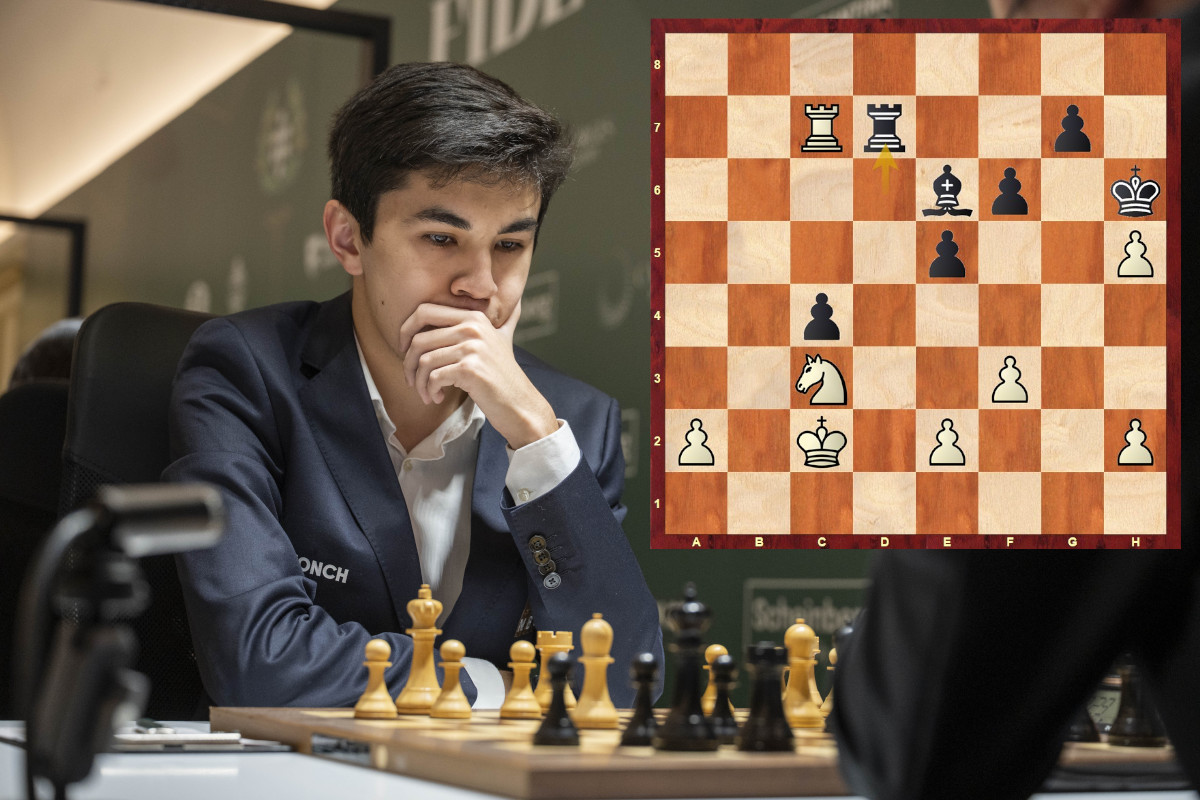
5/10/2026 – Following Javokhir Sindarov's victory at the Candidates Tournament, GM Jon Speelman examines the emergence of a new generation of World Championship contenders ahead of his expected title match against Gukesh Dommaraju. Particular attention is given to Sindarov's defensive draw against Fabiano Caruana, a game presented as a key moment of the tournament and an illustration of his preparation, resilience and practical decision-making under pressure. | Photo: ChessBase / Nils Rohde
new: Fritz 20
Your personal chess trainer. Your toughest opponent. Your strongest ally. FRITZ 20 is more than just a chess engine – it is a training revolution for ambitious players and professionals. Whether you are taking your first steps into the world of serious chess training, or already playing at tournament level, FRITZ 20 will help you train more efficiently, intelligently and individually than ever before.
YOUR PERSONAL CHESS COACH - Whether you’re taking your first steps into the world of club chess, or already playing at a tournament level: with FRITZ, you can train more efficiently, intelligently and with a more personalised approach than ever before. FRITZ is more than just a chess engine – it’s a training revolution! Whether you’re taking your first steps into the world of club chess, or already playing at a tournament level: with FRITZ, you can train more efficiently, intelligently and with a more personalised approach than ever before.
The Benko Gambit is back at the very highest level - and it's easy to see why. Black sacrifices a pawn to seize the initiative on the queenside, obtaining long-lasting pressure, active pieces and open files that make life difficult for White.
€39.90
Extremely young title contenders
[Note that Jon Speelman also looks at the content of the article in video format, here embedded at the end of the article.]
It's now well over 60 years since my cousin taught me the rules of chess on Boxing Day (December 26th) 1962 - the day when the Big Freeze began, which left England with the odd thaw under snow until March.
Of course, he introduced me to the joys of Scholar's Mate (4.Qxf7) and I have a very vague and, possibly, false memory that he started with Qf3xf7 and perhaps having shown me how to defend along the file then switched to Qh5xf7.
Undeterred I got my mum to buy me what turned out to be the excellent Chess for Children by Raymond Bott and Stanley Morrison, and I think that finding it useful I learnt to read properly from it. Later she got me the sequel, The Chess Apprentice, but my first "proper" chess book, presumably from some time late in 1963, was Bob Wade's account of the Botvinnik v. Petrosian World Championship match. Of course, it was much too much for me then, but I have dipped into it with pleasure many times since.
Considered a master of prophylaxis, Petrosian sensed dangers long before they actually became acute on the board. In his prime, Petrosian was almost invincible. Let our authors introduce you into the world of Tigran Petrosian.
Botvinnik won game one when Petrosian was like a rabbit in the headlights, but the latter equalised in the famous game five when they adjourned with the white king on g7 and subsequently won. Because the Armenians had sufficient leverage in the Kremlin, Botvinnik had lost his right to a return match and Petrosian beat Boris Spassky the first time round before losing in 1969, after which Spassky in his turn lost the famous match to Bobby Fischer in Reykjavík 1972.
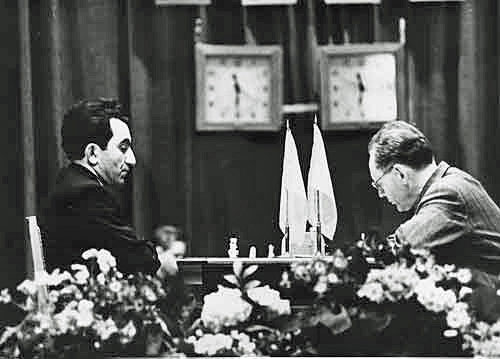
Checking now (not in fact from the book, but a database) I see that the 1963 match was played in the spring, which means that Mikhail Botvinnik was 51 and Tigran Petrosian was 33. Of course, chess players mature much younger nowadays, but it's still notable that when Gukesh Dommaraju defends his title at the end of the year against Javokhir Sindaroiv he will be 20 and Sindarov either 20 or 21 depending on whether they play before during or after his birthday on December 8th. Their combined ages will therefore be a decade short of Botvinnik's and well short of half of their combined ages.
Tigran Petrosian facing Mikhail Botvinnik in 1963 | Photo: Chess in Armenia Magazine
After Sindarov's incredible performance in the Candidates, it seems almost a forced move to talk about in this time. In advance, I had imagined that he would be dangerous but simply too inexperienced to mount a viable challenge - but how wrong I was. Backed by an obviously tremendous team, he not only played great chess at the board but demonstrated fantastic preparation and remarkable understanding of the tournament situation as it unfolded. His six wins were fantastic, and he was in serious trouble only twice: against Andrey Esipenko in the first round (how different the tournament might have been if Esipenko had kept his nerve) and against Fabiano Caruana.
For all the wins, the game that impressed me most of all was the draw with Caruana when he got into a really foul position and managed to defend himself - something which I think most of the world's top players would have failed to do. So I'm revisiting it here, concentrating on the decision-making by both players.
Over the last few days (I'm late writing this because of the 4NCL last weekend), Sindarov (whom my infuriating voice-recognition software has just rendered as "Cinderella of") has been out of sorts at the Super Rapid & Blitz in Warsaw, but that's hardly the point. When he does play Gukesh, he will presumably be the favourite, though I'm sure that in single combat to defend his title, Gukesh will be a formidable adversary.
Like all top players, Sindarov is a wonderful tactician, though this may manifest itself in different ways. Going back to Petroian, he somehow projected his prowess onto the enemy, fearing that they would find the moves that he himself would have played and therefore normally preferred to avoid the mess. Sindarov, though, is more than happy to mix it when the time is right. I thought I'd end with a vignette from Warsaw, where Sindarov did play badly in the rapidplay tournament, but at least had this nice finish.
50...e5 blocked the long diagonal. What did this prepare?
Select an entry from the list to switch between games
Grandmaster Dr. Karsten Müller, one of the world’s leading endgame experts, guides you step by step through everything you need to know in this second volume. Picture this: you’ve outplayed your opponent move by move, you’re clearly better – and then the endgame slips into a draw, simply because you lacked the crucial theoretical knowledge. That is exactly where this course comes in. Without solid endgame skills, there’s no way forward. Rook endgames are most essential: they occur more often than any other type of endgame, and often make the difference between victory and half a point. If you master them, you’ll confidently convert your advantages into wins!
Free video sample: Introduction
Free video sample: Bodycheck
Jonathan SpeelmanJonathan Speelman, born in 1956, studied mathematics but became a professional chess player in 1977. He was a member of the English Olympic team from 1980–2006 and three times British Champion. He played twice in Candidates Tournaments, reaching the semi-final in 1989. He twice seconded a World Championship challenger: Nigel Short and then Viswanathan Anand against Garry Kasparov in London 1993 and New York 1995.
YOUR PERSONAL CHESS COACH - Whether you’re taking your first steps into the world of club chess, or already playing at a tournament level: with FRITZ, you can train more efficiently, intelligently and with a more personalised approach than ever before.
The Nimzo-Indian has stood the test of time for over a century: Still a top choice for elite players today, from Magnus Carlsen to Praggnanandhaa, it remains one of Black's most reliable ways to fight for real chances against 1.d4 2.c4 3.Nc3.
1.c4 e5 2.Nc3 Bb4!? is an opening idea well worth considering. Black immediately threatens to double the pawns on c3 in the style of the Trompowski or Sicilian Grand Prix attack.
Italian Game Powerbase 2026 is a database and contains 8571 top class games from Mega 2026 and the Correspondence Database 2026, of which 479 are annotated.
Videos: Nico Zwirs discusses the Sicilian with 2…e6 3.d4 cxd4 4.Qxd4 Nc6 5.Qe3 Nf6 6.Nc3. Mihail Marin examines Sindarov’s 6.Ne5 in the Queen’s Pawn Defence. Plus the ‘Lucky bag’ featuring 41 analyses by Berg, Ftacnik, Gupta and many others.
If you're looking for a dynamic alternative to the Slav, Queen's Gambit Declined, or other mainstream systems, the Chigorin Defence offers exactly what modern tournament players need.
€34.90
We use cookies and comparable technologies to provide certain functions, to improve the user experience and to offer interest-oriented content. Depending on their intended use, analysis cookies and marketing cookies may be used in addition to technically required cookies. Here you can make detailed settings or revoke your consent (if necessary partially) with effect for the future. Further information can be found in our data protection declaration.
Pop-up for detailed settings
We use cookies and comparable technologies to provide certain functions, to improve the user experience and to offer interest-oriented content. Depending on their intended use, cookies may be used in addition to technically required cookies, analysis cookies and marketing cookies. You can decide which cookies to use by selecting the appropriate options below. Please note that your selection may affect the functionality of the service. Further information can be found in our privacy policy.
Technically required cookies
Technically required cookies: so that you can navigate and use the basic functions and store preferences.
Analysis Cookies
To help us determine how visitors interact with our website to improve the user experience.
Marketing-Cookies
To help us offer and evaluate relevant content and interesting and appropriate advertisement.