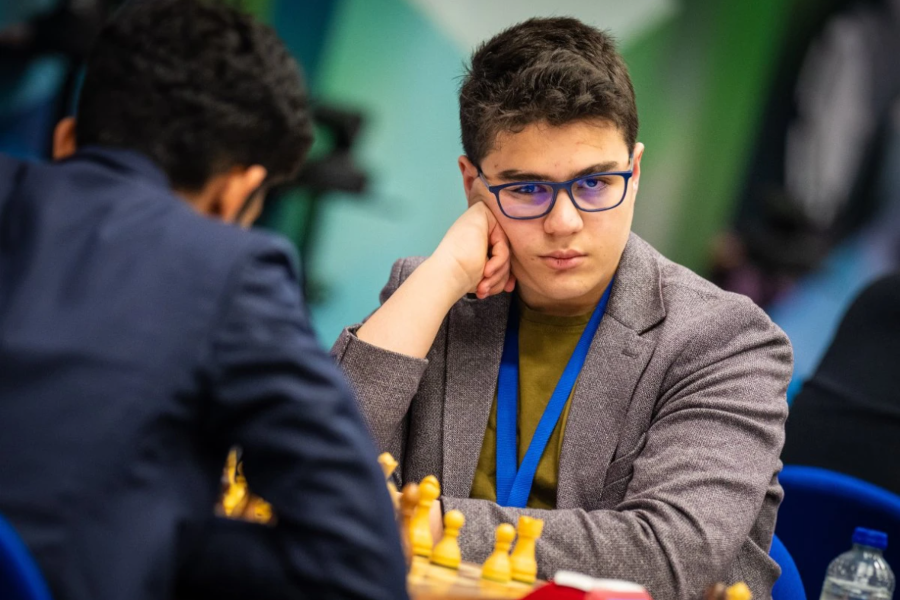
2/3/2026 – In this analytical column, GM Jon Speelman explores how winning lines can hide behind unexpected variations, even when a position appears manageable. Drawing on a missed opportunity from his own 4NCL game and a sharp encounter from Wijk aan Zee between Matthias Bluebaum and prodigy Yagiz Kaan Erdogmus (pictured), he examines overlooked tactics, defensive ingenuity and the practical difficulty of finding precise moves over the board. | Photo: Tata Steel Chess / Lennart Ootes
new: Fritz 20
Your personal chess trainer. Your toughest opponent. Your strongest ally. FRITZ 20 is more than just a chess engine – it is a training revolution for ambitious players and professionals. Whether you are taking your first steps into the world of serious chess training, or already playing at tournament level, FRITZ 20 will help you train more efficiently, intelligently and individually than ever before.
YOUR PERSONAL CHESS COACH - Whether you’re taking your first steps into the world of club chess, or already playing at a tournament level: with FRITZ, you can train more efficiently, intelligently and with a more personalised approach than ever before. FRITZ is more than just a chess engine – it’s a training revolution! Whether you’re taking your first steps into the world of club chess, or already playing at a tournament level: with FRITZ, you can train more efficiently, intelligently and with a more personalised approach than ever before.
In this two-volume course GM Ganguly turns calculation into a trainable skill with a structured path for any level.
€39.90
Unexpected variations
[Note that Jon Speelman also looks at the content of the article in video format, here embedded at the end of the article.]
Just under a month ago at the 4NCL, I forced the draw in a position which - when the engines were let loose on it - turned out to be winning. Obviously this wasn't ideal, and I was a little displeased with myself, but the winning line was sufficiently unexpected that I felt that it was very "missable". In the moves leading up to the final position I had missed a couple of my opponent's moves and also, in my mind's eye, put my queen en prise in one variation so it was really fair enough. The game appears in the pgn and these two diagrams encapsulate the critical phase.
Here I played
23.d5
almost instantly, and was very annoyed with myself when I realised that after
23...cxd5
if 24.Bc3, Black has ...Ne4, which is obviously unclear. After a while, I decided on the sacrifice
24.Bxh6
which is clearly enough to draw, hoping that when I got there, I would find something more. It continued
24...gxh6 25.Qd2 Ng8
Of course not 25...Kg7? 26.Rxc8
26.Qd3 Nf6 27.Qe3 Ng8
And here I bit the bullet and played
28.Qd3?
to force the draw.
It's pretty obvious that to continue the attack, you have to play
In this video course, experts (Pelletier, Marin, Müller and Reeh) examine the games of Viktor Korchnoi. Let them show you which openings Korchnoi chose to play, where his strength in middlegames were, or how he outplayed his opponents in the endgame.
but regaining the exchange looked unclear, and I couldn't see anything else. Can you do better and find the next move and crucially what it threatens? The idea is both very simple and conceptually difficult in the midst of a sacrificial attack.
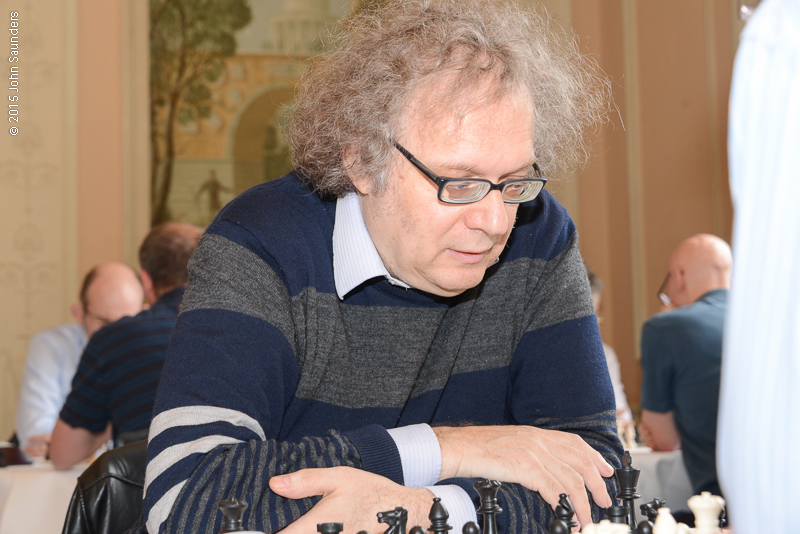
Jon Speelman | Photo: John Saunders / John Nunn 60th Birthday Blitz Tournament (2015)
I'm writing(a day late) just after the end of Wijk aan Zee. I've watched so many tournaments over the years but this must be one of the very best that I've ever seen. With such a young and ambitious lineup, the majority of games have been fiercely fought, often in positions which were unfamiliar - at least to me.
The meta story was of the two Uzbek players being on fire, the Indians under par, and youth very much on the ascendant (there was little else on offer). Most notably, 14-year-old Yagiz Kaan Erdogmus, whom Magnus Carson has dubbed "the strongest 14-year-old in history".
I don't stream very much any more, but I did do a couple of rounds including the final one on Sunday, and Erdogmus' defence in a very dangerous looking position was very impressive.
21.Rxf7!
Morally forced since otherwise ...Be6 will equalise.
21...Rxf7 22.Qg6
Now there is only one defence. Can you find it? It's
EXPAND YOUR CHESS HORIZONS Data, plans, practice – the new Opening Report In ChessBase there are always attempts to show the typical plans of an opening variation. In the age of engines, chess is much more concrete than previously thought. But amateurs in particular love openings with clear plans, see the London System. In ChessBase ’26, three functions deal with the display of plans. The new opening report examines which piece moves or pawn advances are significant for each important variation. In the reference search you can now see on the board where the pieces usually go. If you start the new Monte Carlo analysis, the board also shows the most common figure paths.
While streaming, I thought that 23.Qxg4 was better. Can you find the answer to 23...Raf8 (which seemed obvious to me)? And can you find the clever defence that Black should play to equalise completely?
In this video course, Grandmaster Ivan Sokolov explores the fascinating world of King’s Indian and Pirc structures with colours reversed, often arising from the French or Sicilian. The King’s Indian Defence is one of the most dynamic openings in chess - and Pirc structures share much of the same DNA. With colours reversed (the King’s Indian Attack), these setups can be just as powerful. What may look modest at first often transforms into highly complex middlegames, where timing, precision, and a deep feel for dynamics make all the difference.
Free video sample: Introduction
Free video sample: Misplaced Pieces
Jonathan SpeelmanJonathan Speelman, born in 1956, studied mathematics but became a professional chess player in 1977. He was a member of the English Olympic team from 1980–2006 and three times British Champion. He played twice in Candidates Tournaments, reaching the semi-final in 1989. He twice seconded a World Championship challenger: Nigel Short and then Viswanathan Anand against Garry Kasparov in London 1993 and New York 1995.
YOUR PERSONAL CHESS COACH - Whether you’re taking your first steps into the world of club chess, or already playing at a tournament level: with FRITZ, you can train more efficiently, intelligently and with a more personalised approach than ever before.
How grandmasters win without fireworks: GM Jan Markos shows you 11 very practical tips from "How to play in a lost position" to "Be patient like Carlsen" that will improve your tournament chess.
The Nimzo-Indian has stood the test of time for over a century: Still a top choice for elite players today, from Magnus Carlsen to Praggnanandhaa, it remains one of Black's most reliable ways to fight for real chances against 1.d4 2.c4 3.Nc3.
1.c4 e5 2.Nc3 Bb4!? is an opening idea well worth considering. Black immediately threatens to double the pawns on c3 in the style of the Trompowski or Sicilian Grand Prix attack.
Italian Game Powerbase 2026 is a database and contains 8571 top class games from Mega 2026 and the Correspondence Database 2026, of which 479 are annotated.
Videos: Nico Zwirs discusses the Sicilian with 2…e6 3.d4 cxd4 4.Qxd4 Nc6 5.Qe3 Nf6 6.Nc3. Mihail Marin examines Sindarov’s 6.Ne5 in the Queen’s Pawn Defence. Plus the ‘Lucky bag’ featuring 41 analyses by Berg, Ftacnik, Gupta and many others.
€14.90
We use cookies and comparable technologies to provide certain functions, to improve the user experience and to offer interest-oriented content. Depending on their intended use, analysis cookies and marketing cookies may be used in addition to technically required cookies. Here you can make detailed settings or revoke your consent (if necessary partially) with effect for the future. Further information can be found in our data protection declaration.
Pop-up for detailed settings
We use cookies and comparable technologies to provide certain functions, to improve the user experience and to offer interest-oriented content. Depending on their intended use, cookies may be used in addition to technically required cookies, analysis cookies and marketing cookies. You can decide which cookies to use by selecting the appropriate options below. Please note that your selection may affect the functionality of the service. Further information can be found in our privacy policy.
Technically required cookies
Technically required cookies: so that you can navigate and use the basic functions and store preferences.
Analysis Cookies
To help us determine how visitors interact with our website to improve the user experience.
Marketing-Cookies
To help us offer and evaluate relevant content and interesting and appropriate advertisement.