.jpeg)

[Note that Jon Speelman also looks at the content of the article in video format, here embedded at the end of the article.]
The British have always had something of a soft spot for heroic failure, none more so in recent times than "Eddie the Eagle" - Michael David Edwards - who came last in both ski jumping events, Normal Hill and Large Hill, when representing Great Britain at the Winter Olympics in Calgary 1988.
Of course Edwards was extremely good at this tremendously dangerous sport, just massively worse than the Olympians from countries where ski jumping was endemic. He became a media sensation with all sorts of nonsense written about him and later, according to Wikipedia, became a stunt jumping world record holder by jumping over six buses.
I've started with him as part of a rather appalling segue from sliding down the ramp to "sliding moves" in chess or what are perhaps more commonly known as "creeping moves", in which a piece, typically the queen, moves just one or two squares creating a massive effect. There was one such in the final of the Tech Mahindra Global Chess Lague in Mumbai a couple of weeks ago, which set me on my way.
In a very complicated position, Firouzja hit Caruana with 19.Ne4, which was very obviously a nasty surprise. After several minutes Caruana replied 19...Nxe4 20.Bxb2 Qd2 and it was Firouzja's turn to think.
Can you see what he came up with?
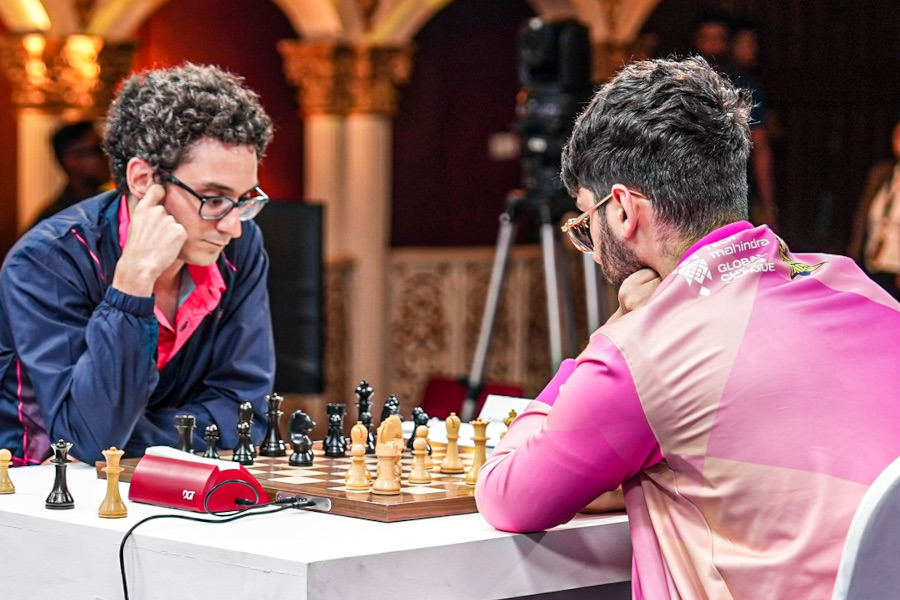
Fabiano Caruana facing Alireza Firouzja | Photo: Tech Mahindra Global Chess League
For my next example, I wanted to use a "famous game by Smyslov in which he played something like Qc5". I couldn't quite place it and so set to work with the wonders of AI, which eventually, after some refinement, slid me back to myself here just under five years ago!
This was in an article entitled "Australian rules" (a rather ghastly pun about the number of creepy crawlies on that continent), where I'd made almost exactly the same claim without successfully locating it. After reading the comments, I realised that it was actually Spassky v. Korchnoi the game which I used then, and which I am repeating with slightly updated notes with Stockfish's help.
Can you find the evil antipodean creature which Spassky now unearthed?
Can you see the "pseudo-creeping move" Kasparov played here?
Creeping moves tend to be surprising because such an effect is created with apparently so little effort. My final example above involves a rook sliding just a couple of squares, but to be honest, it is completely different because, in doing so, it creates an obvious direct threat. Still, it's the sort of move which I sometimes miss and indeed not only had I missed another rook move that used the e3 pawn as a hook a few moves earlier, but I was also unpleasantly surprised when Garry Kasparov played it here. However, I did rally and hold - the best I ever managed against him at classical chess, though I did once beat him at rapidplay.
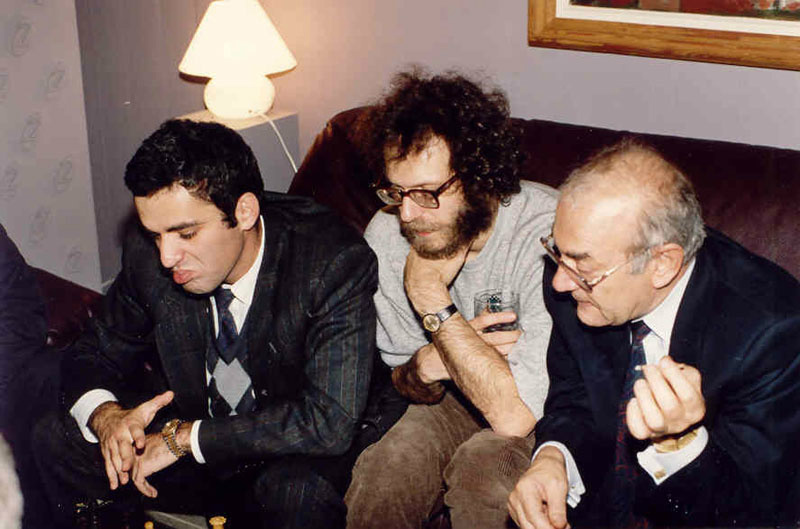
Garry Kasparov, Jon Speelman and Viktor Korchnoi in Reykjavík, 1988
Select an entry from the list to switch between games