
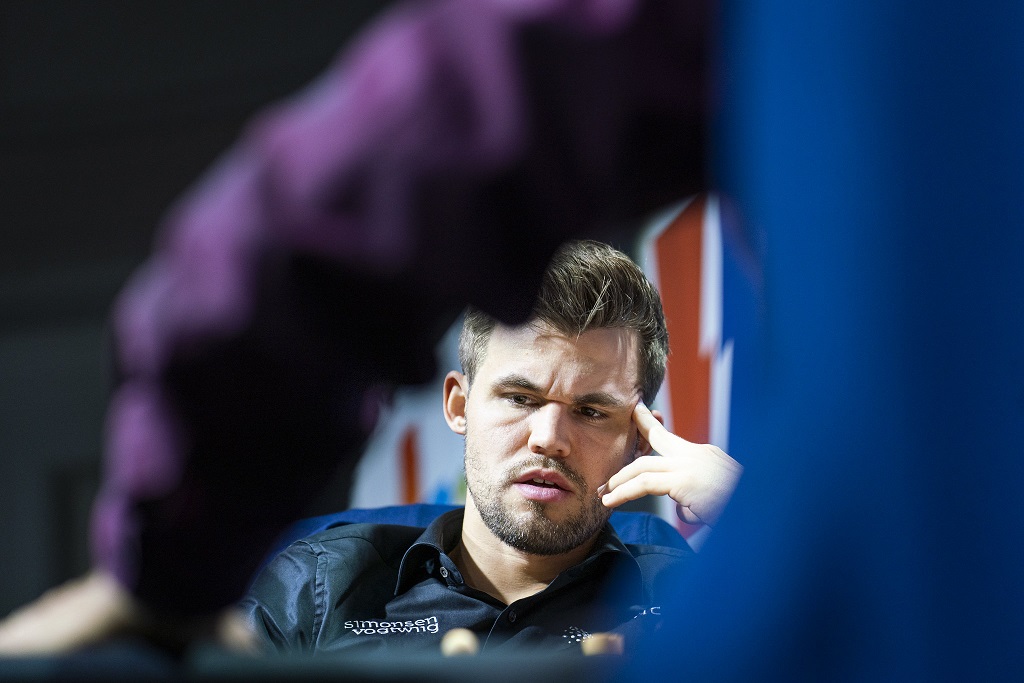

At some point during round nine of the Zagreb GCT, it seemed like Magnus Carlsen was making headway towards another early tournament victory — he had the initiative in a complex position against Levon Aronian while Wesley So was in dire straits against Ian Nepomniachtchi. Had Carlsen won and So lost at the end of the day, the world champion would have arrived in Saturday's penultimate round one and a half points ahead of his pursuer (a draw would have been enough to secure first place in that scenario).
But none of that happened, as both ended up signing draws. Nevertheless, if Carlsen beats So in their round ten direct encounter, he will get the title with a round to spare.
Meanwhile, Shakhriyar Mamedyarov left the cellar of the standings table by defeating Vishy Anand with the white pieces, after the Indian was overpowered in the middlegame and could not find a precise defensive manoeuvre later on. In all three remaining draws (as well as So's safe against Nepomniachtchi), coincidentally, the games finished with one of the players finding a way to give perpetual check with the queen.
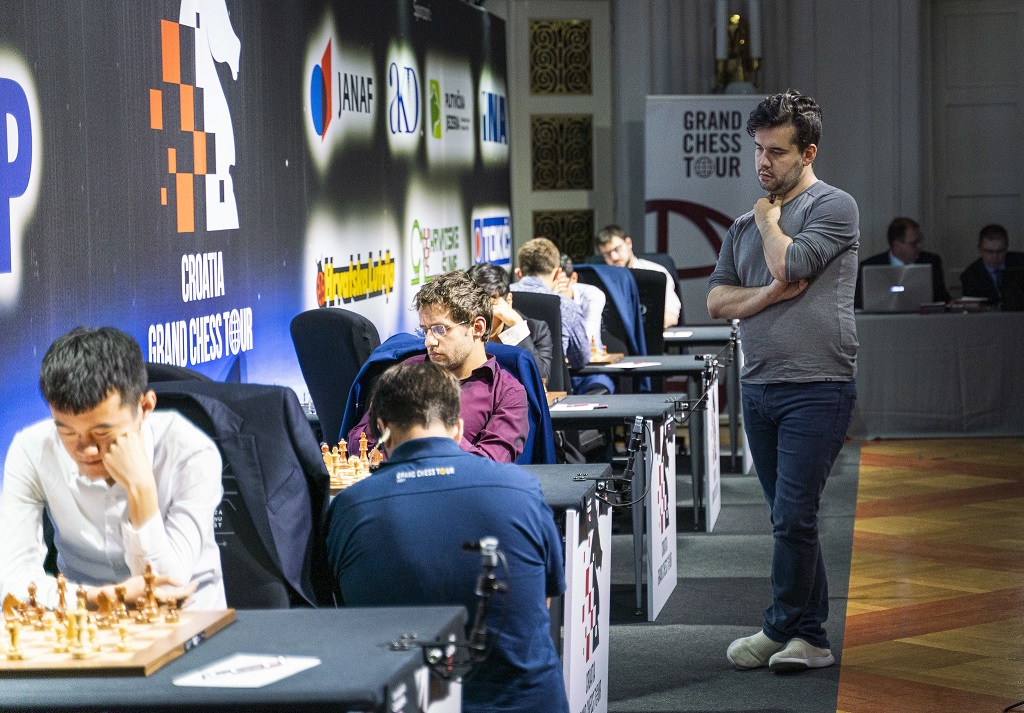
Ian Nepomniachtchi decided to wear a more casual outfit on Friday's ninth round | Photo: Lennart Ootes / Grand Chess Tour
As stated so many times by a host of chess experts, if first-level players simply decide to show their best skills while fighting to get wins, it is almost certain that the fans will enjoy a fine show. And that is precisely what happened in the encounter between Magnus Carlsen and Levon Aronian. The world champion went for a sharp line of the Vienna Variation and, on move 15, decided to raise the stakes with an audacious novelty:
The players had been following theory up to this point and there were over forty predecessor games that had reached this position. Nobody, however, had opted for Carlsen's 15.0-0-0, undoubtedly a call to arms by the world champion.
Aronian started taking his time but did not seem overly fazed by his opponent's bold play. The Armenian, in fact, reacted appropriately, looking for counterplay on the queenside:
Carlsen had just lifted his h-file rook, a key piece in the subsequent battle, but Aronian fearlessly responded with 19...b5, with the idea of undermining White's king position. The game continued 20.♖g3+ ♚h8 21.♖g4 a5 22.♖f4 ♛g7 23.♖xd8+ ♜xd8:
Both players continued to expand on "their" flanks, as there followed 24.g4 b4 25.g5. Black needed to create threats against the white monarch to avoid simply being steamrolled on the kingside. Aronian kept finding resources to maintain the balance — by the time he got to activate his rook, it already seemed like a draw was a likely outcome:
White's pieces and kingside pawns are certainly menacing, but Black brought another piece to the defence with 33...♜c4. Aronian did not falter in the subsequent fifteen moves and signed what can only be described as a first-class draw.

World champion Magnus Carlsen looking for the hidden win | Photo: Lennart Ootes / Grand Chess Tour
During the post-game interview, Carlsen showed some disappointment as he thought there should have been some way to break through with White. Perhaps he could have found some nuanced manoeuvre that would have given him more chances, but the truth of the matter is that it simply was a well-played game by two formidable professionals.
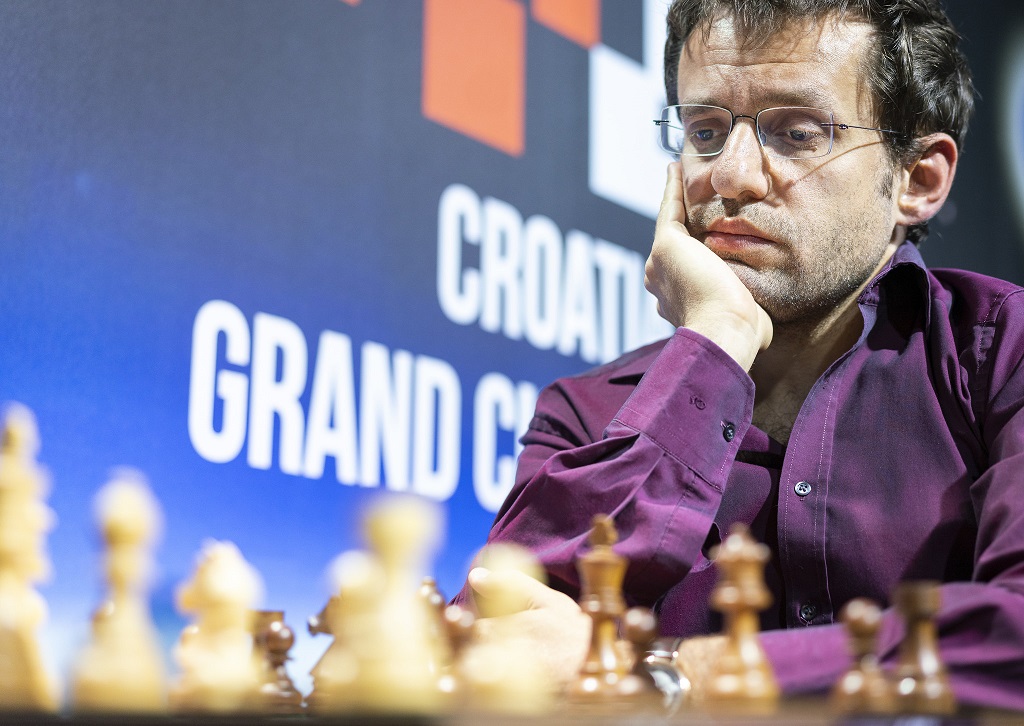
Levon Aronian prevented Carlsen from winning a fourth game in a row | Photo: Lennart Ootes / Grand Chess Tour
In the other big match-up of the day, Ian Nepomniachtchi went for an Anti-Berlin structure with 4.d3 against Wesley So. Both players showed good preparation and reached a dynamically balanced middlegame position — however, White's passed d-pawn looked more dangerous than Black's potential counterplay on the queenside:
22.d6 ♛d7 23.e5 followed, and Black then decided to exchange the minor pieces with 23...♝xf3. Only heavy pieces were left on the board, with White having the initiative thanks to his advanced central passer. More exchanges followed: 24.gxf3 fxe5 25.♖xe5 ♜xe5 26.♕xe5.
So did not think much before going for the natural 26...♜e8, but this was actually a crucial imprecision, as 26...♛f7, preventing White from putting his queen on d5 was called for. Nepomniachtchi found 27.♕d5+ and went on to improve his position until getting a winning advantage.
But when queens are still on the board there is always a looming danger — the losing side finding a perpetual check. And that is exactly what happened on move 36:
Instead of 36.♕e2, Nepomniachtchi needed to opt for 36.♕d5. After the text, there was no way to escape the checks, with the game finishing after 36...♛h2+ 37.♔Ke3 ♛g1+ 38.♔d3 ♛b1+, etcetera.
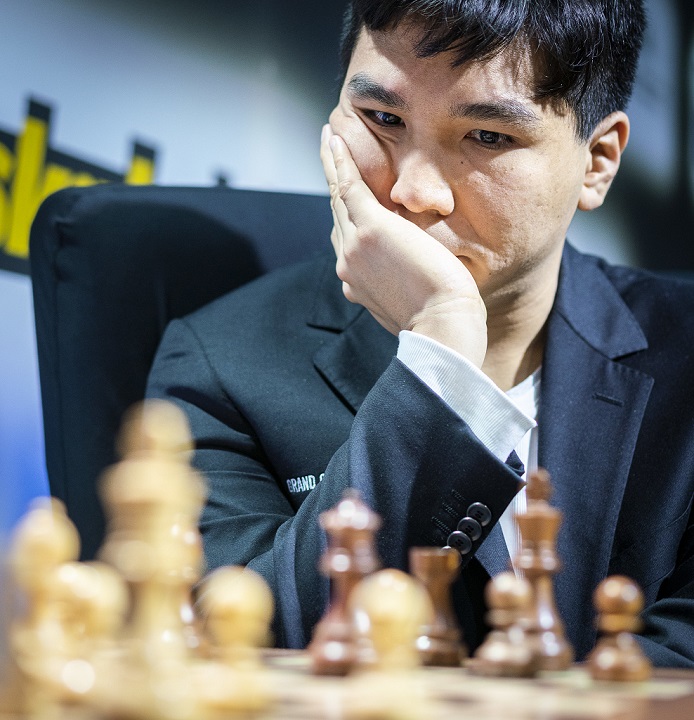
Wesley So still has chances to take the title | Photo: Lennart Ootes / Grand Chess Tour
Shakhriyar Mamedyarov has not been having a good year so far, as he has fallen to the 14th place in the live ratings list after a 'minus three' performance in the first eight rounds of this tournament. Against Vishy Anand, however, he got a good centralized position out of the opening, with both bishops pointing to Black's king position. By move 26, Anand had a wrecked pawn structure, and Mamedyarov decided it was high time to give up an exchange to open more lines for his bishops:
27.♖xd5 was a stunning shot. Anand accepted the challenge with 27...♝xd5 28.exd5 and White's onslaught continued. The attack was bearing fruit, with one of Black's rooks far from the action, but suddenly Anand was given a chance to save the half point:
Mamedyarov had just captured on e5, banking on the pin along the sixth rank. There followed 38...♜xe5 39.♖xe5 fxe5 40.♕xa6 ♛f2 and resignation came five moves later. However, Anand could have gone for an immediate 38...♛f2, when Black manages to keep things under control with 39.♕xf4+ ♛e1 40.♔h2 ♜xe5 41.♖xf6 ♜xf6 42.♕xf6 h4:
White cannot make progress without allowing a perpetual check.
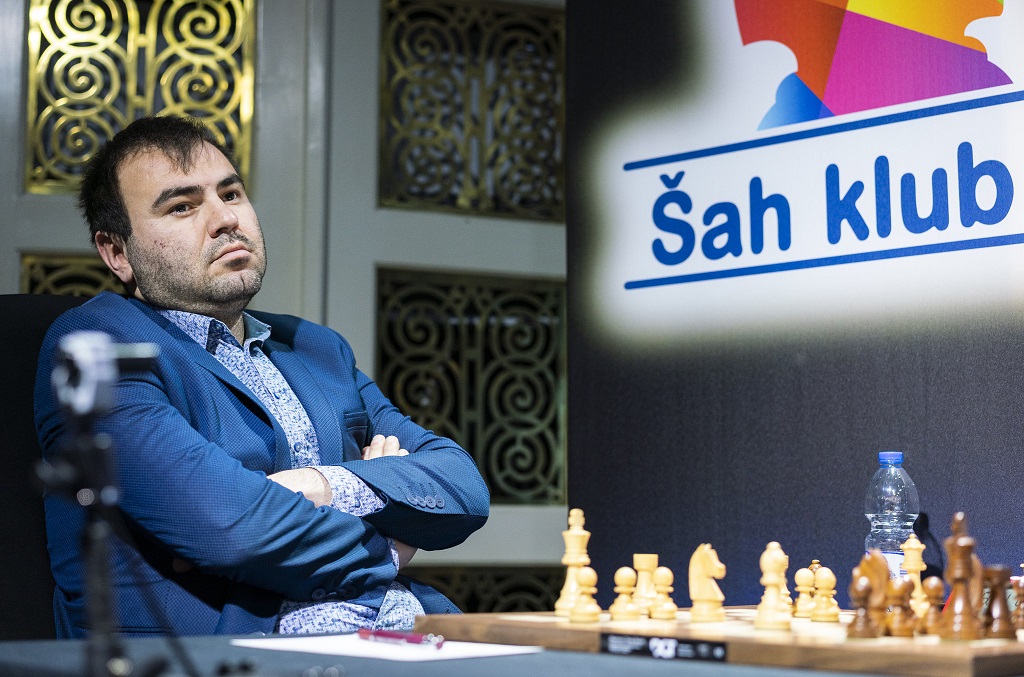
Shakhriyar Mamedyarov got a nice win over former world champion Vishy Anand | Photo: Lennart Ootes / Grand Chess Tour
Interestingly, the three remaining games finished with a player finding a perpetual check with the queen. Perhaps the most interesting one was Fabiano Caruana v Ding Liren, in which the Chinese grandmaster was two pawns to the good, but had all his pawns 'blocking' his dark-squared bishop mobility:
Ding opened up the position with 43...d5 but could never break through. The game finished after 58 moves.
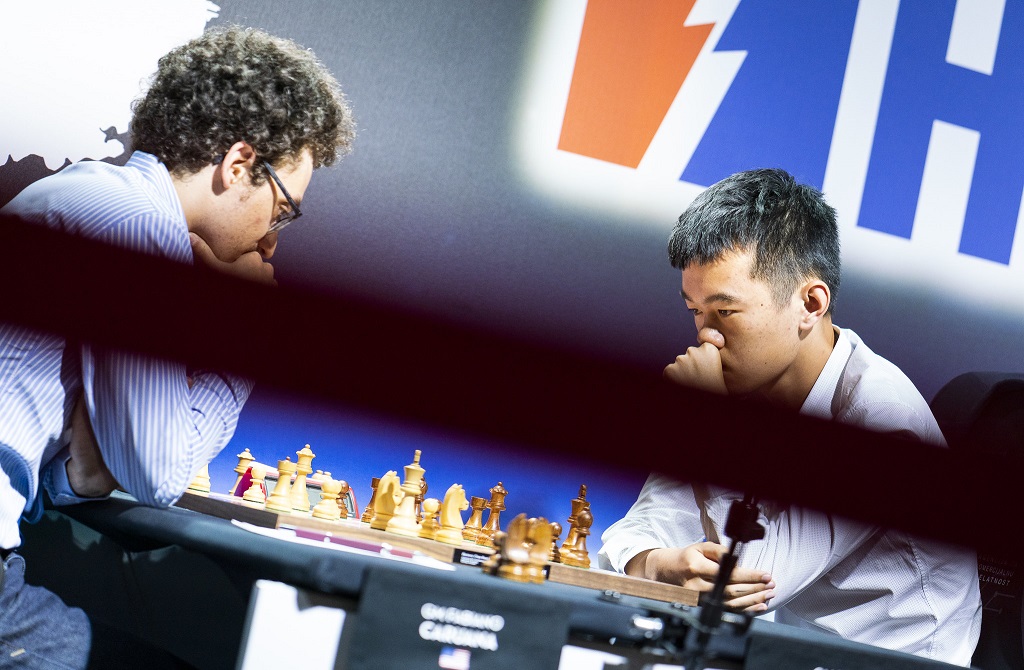
Numbers two and three in the world, Fabiano Caruana and Ding Liren | Photo: Lennart Ootes / Grand Chess Tour
Round ten will see the crucial match-up of the tournament, with Wesley So having the white pieces against Magnus Carlsen. By now, only a miracle would allow Caruana, Nepomniachtchi or Aronian to catch up with the Norwegian or the American, so we can already call this a two-horse race.
Commentary by GM Yasser Seirawan, IM Jovanka Houska and GM Alejandro Ramirez