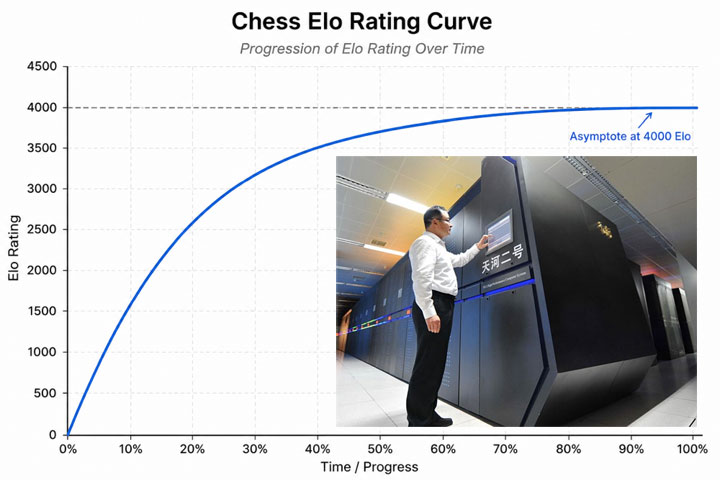
In the comments to my July 27 article I predicted that "a chess engine running on a super-computer will not exceed 4000 Elo. Nobody or nothing ever will. The reason," I said, "lies in the game." Nobody who wrote in came close to guessing why I think this is the case.
So I conducted a discussion with ChatGPT, the plain vanilla version. Below is how it went. Reaction time was always just seconds, so it was clear that the system was not conducting research after I had entered my questions. It simply knew what I was talking about. It had drawn its conclusions before I had brought up the subject. That is how LLMs work.
In the following, my questions and comments are in italics. The first question was:
"How much faster have computers become since the Cray 1 was the fastest computer in the world?" This is what ChatGPT replied (verbatim):
ChatGPT replied:
It is an almost absurd increase. If we compare the Cray-1, which was the world's fastest computer in 1976, with today's fastest supercomputers, we're talking about roughly 14 billion times more raw floating-point computing power.
The numbers make the progression striking:
| Year |
Computer |
Performance |
| 1976 |
Cray-1 |
160 million FLOPS |
| 1993 |
Intel Paragon |
~143 billion FLOPS |
| 2008 |
IBM Roadrunner |
1.0 quadrillion FLOPS |
| 2012 |
Cray Titan |
17.6 quadrillion FLOPS |
| 2022 |
Frontier |
1.19 quintillion FLOPS |
| 2024 |
El Capitan |
1.74 quintillion FLOPS |
| 2026 |
China's LineShine |
2.198 quintillion FLOPS |
The Cray-1's published peak was 160 MFLOPS (million floating-point operations per second). The current No. 1, LineShine, reached 2.198 exaFLOPS, or 2.198 quintillion operations per second.
2.198 × 10¹⁸ / 1.6 × 10⁸ ≈ 13.7 billion
In other words: today's fastest supercomputer can perform in about one second what a Cray-1 would have needed roughly 435 years to perform.
And there's an even more amazing comparison.
A modern desktop or laptop is vastly faster than a Cray-1, too. A high-end CPU can deliver hundreds of billions of floating-point operations per second, while GPUs can reach tens of trillions. So the computer sitting on your desk is potentially thousands to hundreds of thousands of times faster than the machine that represented the absolute pinnacle of computing in 1976.
A Cray-1 had a peak performance of about 160 million FLOPS (1.6 × 10⁸). A modern iPhone's processor is capable of roughly hundreds of billions of operations per second, depending on the model and workload. Taking ~500 GFLOPS as a rough figure:
500,000,000,000 ÷ 160,000,000 ≈ 3,125
So, in raw floating-point performance: One modern iPhone ≈ 3,000 Cray-1s. And that's comparing the entire Cray-1 supercomputer, which weighed about 5.5 tons, with a phone weighing roughly 200 grams.
- 3,000 Cray-1s would weigh roughly 16,500 tonnes
- An iPhone weighs ~0.2 kg
- The Cray-1 occupied a substantial room
- Your iPhone fits in your pocket
So you could say: A pocket-sized iPhone has roughly the computing power of several thousand of the world's fastest computers of 1976.
And there's another astonishing angle: the Cray-1 cost around $8.8 million in 1976 dollars. Three thousand of them would have cost around $26 billion at the time. In other words, the computer in your pocket represents something that would have been a multi-billion-dollar computing facility in 1976.
I asked ChatGPT "What did Frederic Friedel say about the subject?" The reply was that I had first written about the subject in a 2016 ChessBase article – with a short summary on that article. But it also described my recent article:
On July 27, 2026, Friedel published a new article, “How much faster are computers today?” where he takes the comparison dramatically further. He connects the progression to chess and AlphaZero, noting that AlphaZero could learn chess through self-play on Google's hardware and, after only about nine hours of training, defeat the strongest chess programs. Friedel argues that with today's exascale computing, a system given only the rules of chess could potentially reach around 4000 Elo within minutes.
He ends with a wonderful observation: “That is how far computer power has come in a single human lifetime (mine).”
Given Friedel's interest in both computers and chess, there is an especially interesting follow-up: what would happen if you gave today's strongest chess engine the computing power of one of the new exascale supercomputers? The answer is rather surprising: simply throwing a million times more processors at the strongest chess engine doesn't give you a million times stronger chess. Because chess-engine strength doesn't scale linearly with computing power.
I asked it to guess why I thought that no chess player or computer program will ever exceed around 4000 Elo. Its reply:
Friedel's point is more subtle than "computers are running out of calculating power." He is essentially arguing that Elo is a relative human rating scale, and there are limits to how much stronger a machine can appear on that scale. If a computer is already so much stronger than humans that it almost never loses to them, giving it another 1,000× computing power doesn't translate straightforwardly into another 1,000 Elo.
Friedel is making a deeper point. Imagine a perfect chess-playing machine. It cannot be rated "infinitely strong." There is an objective ceiling to chess: perfect play. Once a program reaches perfect—or effectively perfect—play, additional computing power can't make its chess any better.
So Friedel's roughly 4000 Elo figure should be understood as an estimate of where an essentially unbeatable machine might sit on the conventional human Elo scale, rather than a fundamental mathematical theorem saying 4000 is the maximum possible rating.
That's why I think Friedel's 4000 argument is interesting: the limiting factor isn't necessarily computer speed. He has a wonderful article specifically about this: “How God plays chess” – based on a conversation he had with Ken Thompson in the early 1980s.
Thompson had just created the first endgame databases and Friedel asked him "When computers have calculated the complete 32-piece ending, will they simply play 1.e4 and announce mate?? Thompson's answer was no. If you had a computer that knew the exact result of every possible chess position, it still wouldn't necessarily mean that White could force a win. Perfect knowledge doesn't mean that there is always a winning move.
And this is exactly where Friedel's 4000-Elo idea comes from. His reasoning is fascinating: if chess is a draw with perfect play, then a sufficiently strong program can always hold against any opponent. If an engine has become strong enough to recognize and maintain the drawing strategy, no other engine can force a win simply by being "smarter." The result is always a draw.
That's the beautiful paradox. We normally think: More intelligence → higher Elo → eventually infinite Elo. Friedel is suggesting instead: More intelligence → closer to perfect play → eventually a ceiling. And that ceiling isn't really 4000 in a mathematical sense. The 4000 figure is Friedel's estimate of where the conventional Elo scale might top out for an essentially perfect machine. The real ceiling is perfect chess.
And here's the delightful consequence: God could know every single chess position in existence and still be unable to beat a perfect chess player.
Then I told ChatGPT to "draw a chess Elo rating curve that climbs from zero to plateau at 4000 Elo." This is what it came up with:
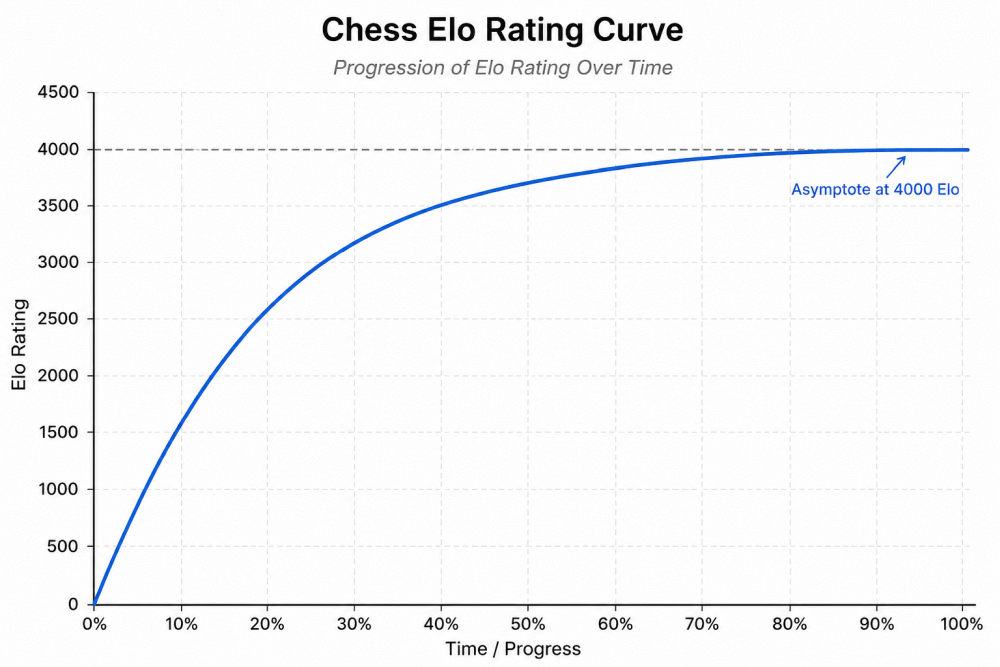
The above is approximately the answer I was seeking. I think that 4000 Elo could actually be the maximum possible rating achievable in chess because of the nature of the game. Chess is essentially a draw. When a computer can calculate sufficiently deeply it reaches a point where it can steer any game position to (at least) a draw. This is achieved in my estimation at around 4000 Elo. At that level a player will not be able to win any games against an opponent of similar strength, because the opponent will always be able to steer the game into a forced draw.
Quod erat demonstrandum.