Kasparov on machine intelligence

by Frederic Friedel
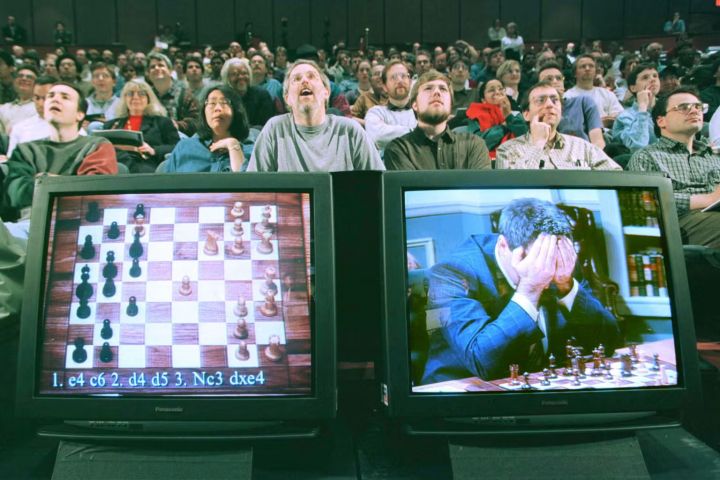
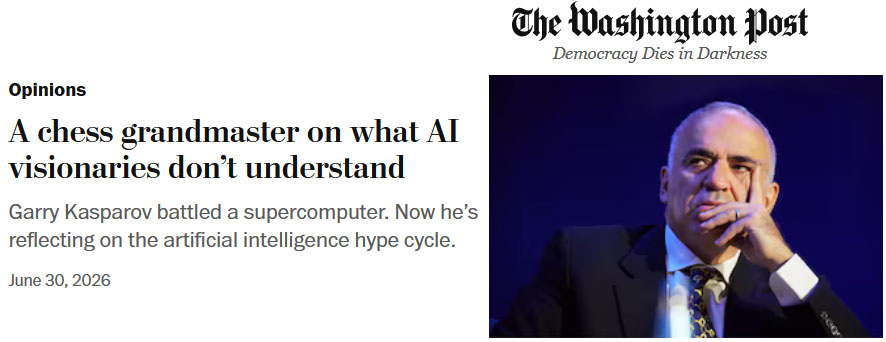
8/24/2026 – In 1997, World Champion Garry Kasparov was defeated 3½–2½ by Deep Blue, an IBM supercomputer in New York. The loss in their second encounter marked the first time a machine beat a world champion in a standard tournament play. It was an historic moment that reshaped global perceptions of artificial intelligence. Almost three decades later, Kasparov has described his perception of AI and what he thinks about its future, in a Washington Post interview. Here are some excerpts.

YOUR PERSONAL CHESS COACH - Whether you’re taking your first steps into the world of club chess, or already playing at a tournament level: with FRITZ, you can train more efficiently, intelligently and with a more personalised approach than ever before.
FRITZ is more than just a chess engine – it’s a training revolution! Whether you’re taking your first steps into the world of club chess, or already playing at a tournament level: with FRITZ, you can train more efficiently, intelligently and with a more personalised approach than ever before.

I was part of the Kasparov team and witnessed the traumatic loss first hand, and had numerous discussions with Garry on the subject of computer intelligence. Here are a few excerpts from the WP interview – with my comments in italics: 

The things we think of as hard — like computation and chess — turn out to be relatively easy for machines, while the things we consider easy — the stuff a toddler does effortlessly, like walking, recognizing a face or picking up an object — turn out to be extraordinarily difficult to automate.

As a science journalist, I had worked on the subject AI for years for a documentary the TV channel was planning – and made some daring predictions. Boy was I wrong!

Fifty years ago, a Cray supercomputer was one of the wonders of the world, yet the phones in our pockets are thousands of times faster. The scale of improvement in AI was impossible to conceive. Brute computing force is ruling the world of AI.

Indeed. In a recent article on our news page (How much faster are computers today?) I provided stunning details.

Machines are making progress, but the danger comes from humans — bad actors. Humans still have a monopoly on evil. The machine is an amplifier. It can amplify good, and it can amplify bad.

This is the subject of discussion that permeates the media today. Leading experts tell us that in just a few years we will have Artificial General Intelligence (AGI), digital systems that can match or beat human thinking on any intellectual task. Not just chess, where they already play at a 3600 Elo level, but in any cognitive job humans can do.


ChessBase is re-releasing this timeless classic in the modern ChessBase Media format - complete with brand-new training features. Get ready to rediscover a masterpiece of chess instruction!
In 2004, 13th World Chess Champion Garry Kasparov recorded a best-selling video course on the Queen‘s Gambit. Now, ChessBase is re-releasing this timeless classic in the modern ChessBase Media format - complete with brand-new training features. Get ready to rediscover a masterpiece of chess instruction!
Free sample video: Introduction
Free sample video: Hanging pawns d5/c5


Editor-in-Chief emeritus of the ChessBase News page. Studied Philosophy and Linguistics at the University of Hamburg and Oxford, graduating with a thesis on speech act theory and moral language. He started a university career but switched to science journalism, producing documentaries for German TV. In 1986 he co-founded ChessBase.
Discussion and Feedback Submit your feedback to the editors


Discuss

Rules for reader comments


Not registered yet? Register

physica physica 1 hour ago
In rule-based and numerical mathematics, I suppose AI beats humans without a doubt. When it comes to inventive, creative, or abstract problem-solving, current models fall short because they haven't been taught to do that—or at least not the commercial models they tell us exist.

But it's certain that the few companies and countries with the know-how and resources already have some initial steps toward 'inventive-creative reasoning' in the works.

That being said, it's interesting to see how AI will accelerate computational sciences in general. For the survival of mankind, we cannot afford to wait for an individual or research group to have the honor of solving key problems.
arzi arzi 8/24/2026 11:46
A Finnish IT magazine tested six different AI programs. One of the tasks involved a verbal description of an object, accompanied by a picture of it. The description went roughly like this: "The bottom part of the semi-closed tube is open. Suggest a use for it. An image of the object is attached."

None of the programs understood that the object in question was an upside-down drinking cup.
arzi arzi 8/24/2026 11:32
In a 100-meter race between robots in China, the winner beat Usain Bolt's world record with a time of 9.39 seconds.

https://yle.fi/a/74-20242426

In mathematics, AI has not yet surpassed humans. However, AI has aided in resolving mathematical conjectures that had remained unsolved for decades. For AI to surpass humans—for instance, by formulating new mathematical theories—it must also comprehend the subject matter. AI cannot retrieve information from a database if the relevant terminology does not yet exist there, nor can it generate new knowledge if the necessary informational components are missing. It is also important to remember that a human must be able to verify any new theory produced by AI before it can be put to use; one must be able to distinguish between the facts and the hallucinations generated by the AI.
1