“In tennis, cricket, etc., at least 80% of a player’s skill is purely mechanical ... And in chess ... [even though] intelligence and the ability to reason play much bigger parts than in other games – it is still quite large.” Cecil Purdy.
“The process of rating players can be compared to the measurement of the position of a cork bobbing up and down on the surface of agitated water with a yard stick tied to a rope which is swaying in the wind.” Arpad Elo.
“... and held by a trembling hand.” Elmer Sangalang.
A skill is a coordination of perception and action, a link honed by practice. Most human activities involve skill learning and/or use and an active sub-field of psychology has researched the topic since the 19th Century. Applications include improving training methods, reducing skill performance errors, and designing easy- to- learn- and- use machines.
This field traditionally has tapped some scientific research on chess skill, such as that in De Groot’s 1965 book Thought and Choice in Chess. Scientific research on skills now draws from a plethora of new data from chess and other games, enabled by sophisticated computer analysis techniques and enhanced computer processing power. Psychologists are busily mining the vast archival chess data troves from FIDE and national ratings systems, from game databases such as ChessBase, and from millions of games on online playing sites. Other fields increasingly tap these data sources; labour economics, computer science, sports science, education and even sociology.
This article briefly surveys some interesting recent and not- so- recent research findings.
The nature of chess skill
Chess-playing at elite level is a hyper-complex skill, with many automated and conscious components and reliance on continual knowledge updating. As the Purdy quote above suggests, chess- playing partly rests on automatic pattern recognition. The unconscious mind stores thousands of patterns acquired from playing games and from study, such as smothered mate combinations, outside passed pawn positions, and back rank mates. These stored patterns enable play mainly on automatic pilot. In one minute games, conscious thought mostly is too slow to rely on and the unconscious mind rapidly generates moves and variations. Indeed, such automatic patterns even may interfere with conscious thought. One study instructed skilled players to find the quickest win in various positions. One position had a five move smothered mate, a pattern so salient that it hindered their finding a simpler three move mate. But slow games also require conscious planning, strategy and tactics, and mental simulations of variations.
Measuring chess skill
The Elo rating system dates from the 1950s, when physicist Arpad Elo improved the United States Chess Federation (USCF) system devised by Kenneth Harkness. The USCF published its first Elo national rating list in 1960 and FIDE implemented the system in 1970.
Elo ratings are much of the spice of organized chess but are a very broad gauge measure of skill, relying just on relative opponent strengths and game results. They also can be gamed. A striking example comes from 1997, when unknown player Claude F. Bloodgood unexpectedly took the number two spot on the USCF rating list with a 2789 rating. Who was he? He was a former tournament director and actually was in prison. He had organized many events with a very small pool of lowly‑rated prisoners and quickly accumulated hundreds of extra rating points. A writer who looked at his games estimated that his real strength was no more than 2300 on a good day with a fair following wind.
Over the last few decades, researchers have been using new methods of gauging skill level, such as comparing all of a player’s game moves against computer- generated ones and using machine-learning techniques.
Research on FIDE rating inflation
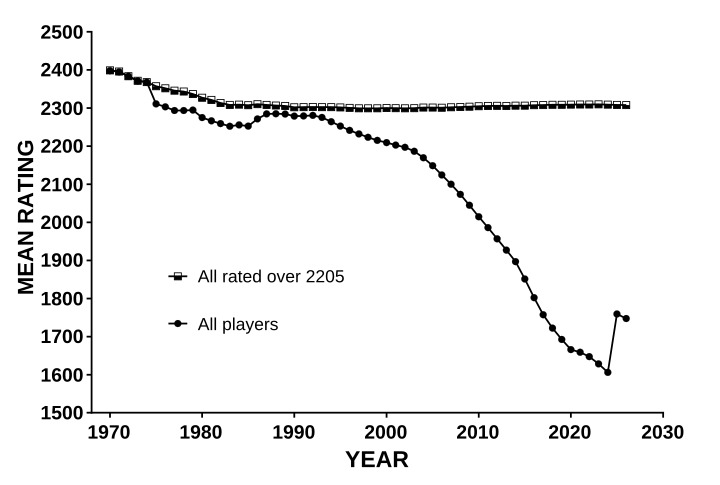
FIDE periodically adjusts Elo rating algorithms and the criteria to enter the list. Males once needed a minimum 2205 rating and females needed 1800 but from 1993 the thresholds progressively dropped to a very modest 1000, and in 2024 rose to 1400. FIDE also sometimes adjusts the system by awarding free points to various players; 100 points to almost all females in 1987 and varying numbers to players rated under 2000 in 2024.
One perennial concern is rating inflation and deflation. Figure 1 shows the mean rating of all players on the first FIDE list each year from 1970 to 2026. The mean rating decreased precipitously with the rating floor drops but that of all male and female players rated at least 2205, the initial male threshold, stayed roughly constant since the early 1980s.
Figure 1
The inflation numbers at the top seem stark. In the early 1970s, only Robert Fischer and Anatoly Karpov even cracked 2700 and in some 1970s lists no player even reached 2700. But the July 2026 list has 35 players rated over 2700. Garry Kasparov was the first to breach 2800, in January 1990, and by July 2026, 15 players had exceeded 2800 in at least one list.
Figure 2 illustrates the rise, with the mean rating of the top ten and top 50 players on the first list each year until 2026. Inflation began in the late 1980s, steadily rose, but levelled off in the last few decades.
Figure 2
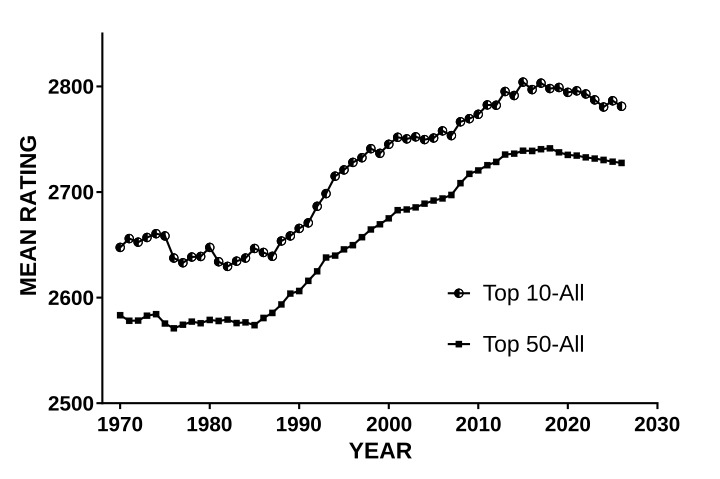
The rise has various explanations, one being the statistical impact of a vast influx of new players. The first FIDE list had just 555 players and the July 2026 list has around 560,000. But researchers using move- by- move computer analysis of games and machine-learning analysis suggest that there has been no real inflation. A 2700 player today is equivalent to a 2700 player in 1971. Top players really just got stronger, perhaps partly due to the myriad ways in which computers have enhanced skill and have speeded up expertise development.
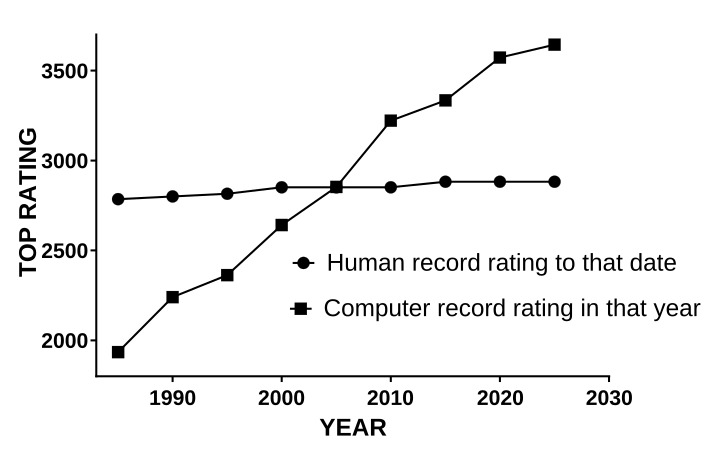
But we may be near the limits of the very best human player. Magnus Carlsen’s peak standard rating of 2882 has stood since May 2014, while computers get ever stronger. Figure 3 shows the highest human rating to date in five year intervals, starting with Fischer’s peak of 2785 set in July 1972, then Garry Kasparov’s various peaks up to his top of 2851 in January 1999, and Carlsen’s 2882. The top computer rating estimates are from the Swedish Computer Chess Association, with Stockfish heading in 2025. The best computers equalled the very best human decades ago and now are widely seen as in a completely different league.
Figure 3
Learning curves
Researchers study skill learning curves to examine individual differences in learning rates, to monitor training regimes, and for clues about underlying learning processes. Individual chess players may use one to assess their own progress. Such curves, regardless of the actual skill, typically show a similar pattern; early rapid improvement with practice which progressively diminishes and then plateaus. People have an intuitive idea that this is so but are hazy about curve starting and end points and improvement rates.
Figure 4 shows a chess skill learning curve with Elo ratings over numbers of FIDE-rated games. It is based on the mean rating of 223 eventual grandmasters who entered the FIDE rating list in July 1985 or later, when FIDE first gives game counts, aged 12 years old or less. All had played at least 1200 rated games. The initial improvement rate is great, but it levels off and eventually plateaus. Figure 5 shows the same pattern at different rating levels for IM and WGM holders, also playing at least 1200 games, and who had not graduated to a higher title by July 2025.
The curves plateau but what is their fate after much time and an astonishingly large games count? Figure 6 presents individual curves for two extremely active players. One is the late Russian grandmaster Igor Naumkin, the record-holder for number of FIDE-rated games played since July 1985 with an astronomical 5,316 count. Both curves ascend to a plateau, fluctuate within a
Figure 4
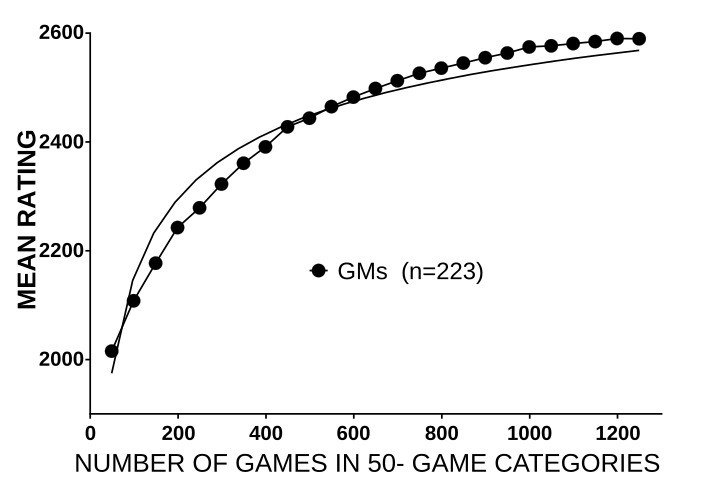
Figure 5
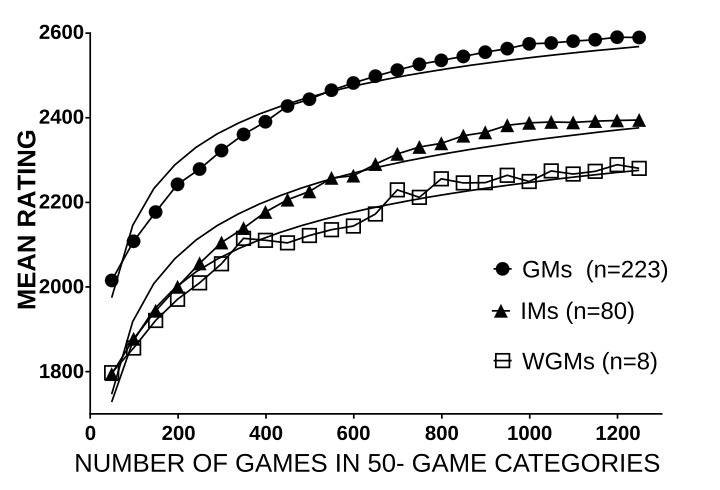
Figure 6
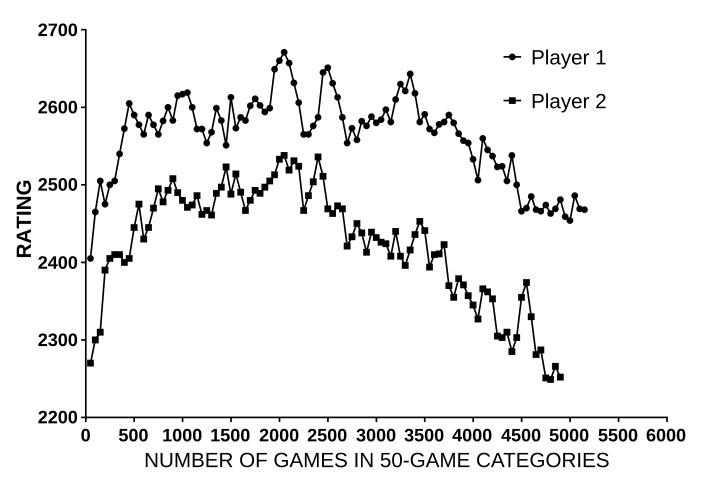
range for many games, and then steadily decline, possibly due to aging and/or declining motivation.
Titles
The grandmaster title dates back to 1838, when a respondent to the British newspaper Bell’s Life referred to “our past grand master Lewis”. Its award was informal until FIDE made it and two other titles official in 1950 and later added five more monikers. Gino Di Felice estimated that FIDE awarded over 18,000 titles from 1950 to the end of 2016. My own count up to July 2025 is 31,730 titles, bestowed upon 24,639 players.
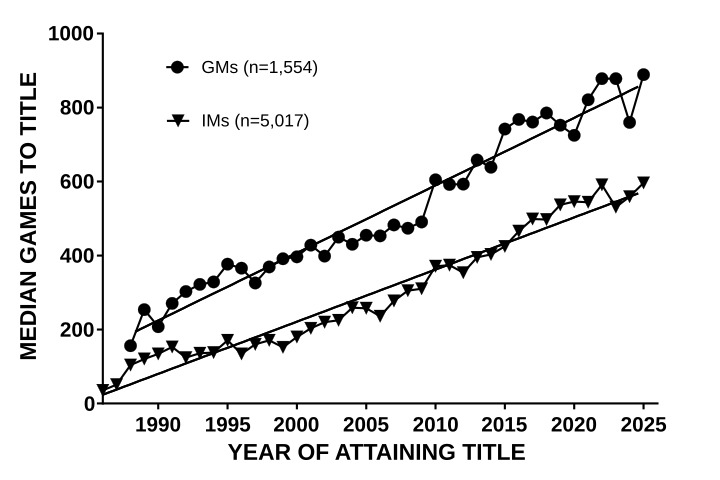
The age records for youngest title-holders have been getting astoundingly young but the trend for number of games needed for the two most prestigious titles has steadily risen. Figure 7 presents the median number of games needed to win the IM and GM titles, showing a steady rise.
Figure 7
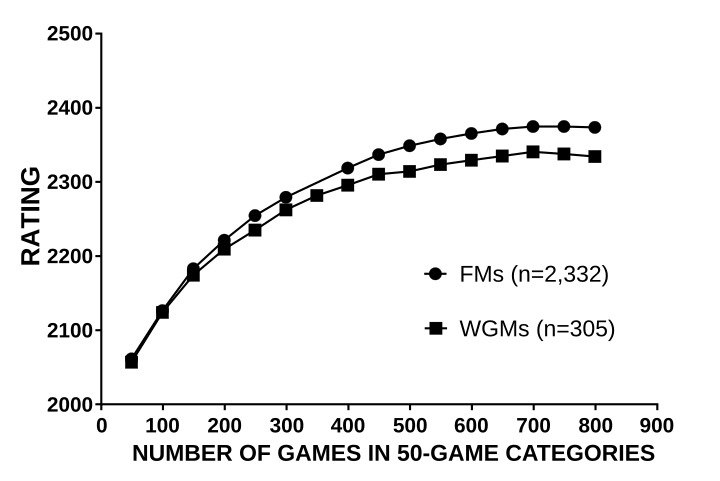
Some consider the highest female-only title of WGM to be about equivalent to an IM title but rating data suggest that it is closer to an FM title. Figure 8 shows mean ratings of all WGM and male FM title holders who had not graduated to a higher title by July 2025 and who had played at least 750 games from July 1985 to July 2025. The curves overlap for many games and then slightly diverge.
Sex differences at the top
Chess organizers continually try to recruit more female players but perhaps tacitly admit that males on average have more natural talent for and interest in the game. FIDE still maintains female- only titles and events, with more lax award criteria than for the open titles.
Figure 8
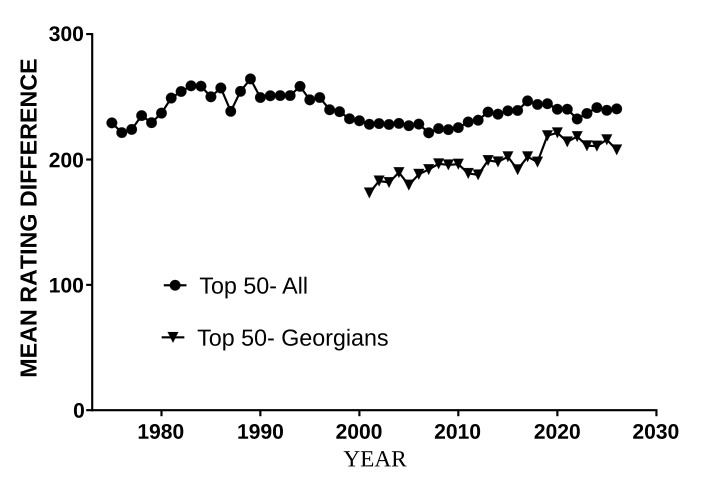
In 2014, I updated a study looking at the sex rating difference at the top since 1975. The study looked at the difference between the mean ratings of the top 50 males and top 50 females on the first list each year, which averaged about a hefty 250 points. Figure 9 updates it to January 2026 and again shows no convergence. There were predictions that the sexes ultimately would converge at the top but the difference seems intractable.
One popular explanation is such social factors as an unwelcoming male-dominated environment for females and “erroneous” views that females have less talent for chess that discourage female participation. Another explanation is many fewer females playing. The Caucasus nation of Georgia traditionally strongly encourages females to play and has produced several female world champions. In 2026, its female participation rate was about 25% versus the overall FIDE average of 11%.
Figure 9 presents the mean sex rating difference for Georgians from the first year that it had 50 females. The difference is a bit lower than for all players but still is large and rises slightly.
Figure 9
Peak skill performance age
Arpad Elo estimated the peak age for chess skill to be around 35 years old but studies using computer move-by-move analysis suggests that it is down to around age 30 nowadays.
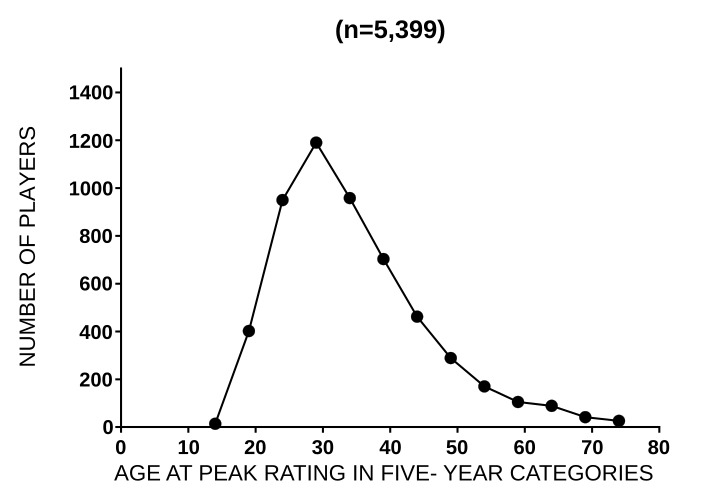
Figure 10 gives a distribution of peak rating age for players who had played at least 800 FIDE- rated games, in five year categories. Again, the peak seems on average to be around age 30.
Natural talent for chess?
Natural talent is any aspect of genetic endowment that enables faster skill learning and a higher ultimate performance level. There was a debate over whether talent even exists or is unimportant, that practice alone is key. Journalist Malcolm Gladwell coined the ubiquitous 10,000 hours meme, that 10,000 hours of practice is necessary and sufficient for almost anyone to become an expert in any domain. Some believe that the famous Polgar Sisters case showed that practice alone is key to developing
Figure 10
chess skill. However, when examined closely, the case actually shows the importance of natural talent.
Most players are firm believers in natural talent for chess skill, and it probably consists of many ability and propensity factors; IQ, spatial ability, excellent memory, determination, and a strong will to win.
My analysis of ratings data using a statistical technique called factor analysis suggests that a player needs much natural talent to become a GM or WGM, but perhaps much less to reach IM level. Possibly it mostly is enough to cram the unconscious mind with patterns and strategies to reach IM level, but that question needs more research.
From the book CHESS SKILL: Elements, measurement, records, trends, learning curves, scientific research and computer enhancement, by Robert Howard and published in 2026 by Diamond Island Books. Electronic and paperback editions are available on Amazon.com.
More articles by Robert Howard...
















.jpeg)

.jpeg)