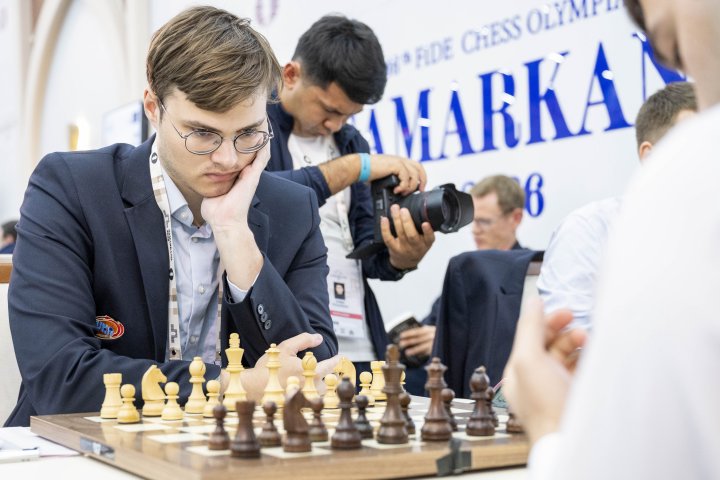
10/7/2026 – Two Olympiads, thirteen wins, seven draws, no defeats, two individual gold medals and a team bronze - Frederik Svane's Olympiad record is impressive. At the 2026 Chess Olympiad in Samarkand, he also set a low-key record: never before had a German player won two Olympiad gold medals for the best performance on his board. | Photo: Nils Rohde
new: ChessBase Magazine 225
Chess Festival Prague 2025 with analyses by Aravindh, Giri, Gurel, Navara and others. ‘Special’: 27 highly entertaining miniatures. Opening videos by Werle, King and Ris. 10 opening articles with new repertoire ideas and much more. ChessBase Magazine offers first-class training material for club players and professionals! World-class players analyse their brilliant games and explain the ideas behind the moves. Opening specialists present the latest trends in opening theory and exciting ideas for your repertoire. Master trainers in tactics, strategy and endgames show you the tricks and techniques you need to be a successful tournament player! Available as a direct download (incl. booklet as pdf file) or booklet with download key by post. Included in delivery: ChessBase Magazine #225 as “ChessBase Book” for iPad, tablet, Mac etc.!
YOUR PERSONAL CHESS COACH - Whether you’re taking your first steps into the world of club chess, or already playing at a tournament level: with FRITZ, you can train more efficiently, intelligently and with a more personalised approach than ever before. FRITZ is more than just a chess engine – it’s a training revolution! Whether you’re taking your first steps into the world of club chess, or already playing at a tournament level: with FRITZ, you can train more efficiently, intelligently and with a more personalised approach than ever before.
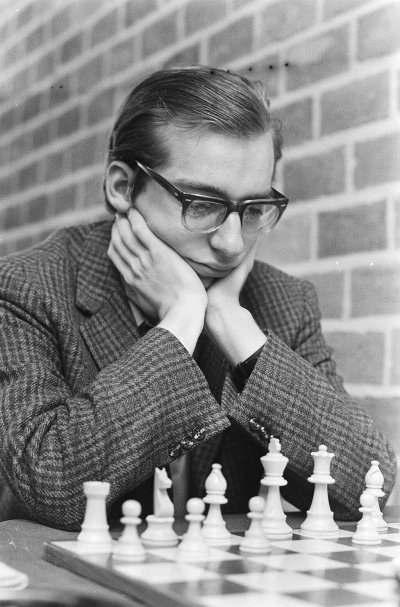
Before Svane, only one German player had ever won two gold medals at an Olympiad: Dr Robert Hübner. In 1972 in Skopje, he scored 15 points from 18 games, or 83.3 percent, to win gold on board one. Eighteen years later, in 1990 in Novi Sad, he won gold again. Hübner scored 7 points from 10 games on board one and therefore finished "only" fifth in the board-one standings, but with a performance rating of 2734 he achieved the best result of all Olympiad participants and received his second gold medal for it.
Top trainers strongly recommend regular study of well-explained classical games to improve your understanding of chess in the long term. 33 modern classics are explained in details on this video course.
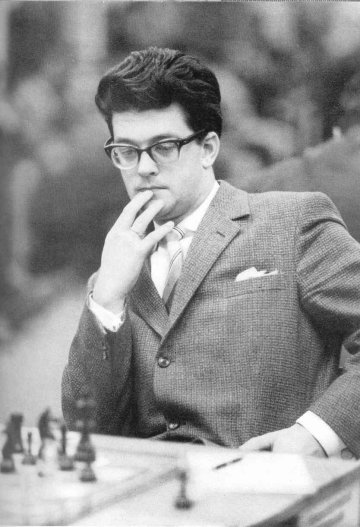
Robert Hübner in 1971 | Photo: Bert Verhoeff, Anefo
In fact, the rules for awarding medals for the best individual performances at Chess Olympiads have changed several times over the course of history. At the first official Olympiad in London in 1927, there was no fixed board order. The best individual results in the tournament as a whole were rewarded. A similar system was used in 1928, but in Hamburg in 1930 the absolute number of points scored was what counted. That is why Akiba Rubinstein, Poland's board one, won gold with 15/17. Had the medals been awarded according to percentage score, Alexander Alekhine, who played on board one for France, would have won gold with 9/9.
From 1931 onwards, however, the percentage score was decisive, although special rules were introduced from time to time over the decades. From 1984 through to 2006, not only were gold, silver and bronze medals awarded for the best percentage scores on the individual boards, but three additional medals were also awarded for the best tournament performance ratings in the tournament as a whole. This meant that a player could win three medals at a single Olympiad: one with the team, one for one of the three best results on his board and one for his performance rating.
John Nunn achieved this feat at the 1984 Olympiad in Thessaloniki. With England, he won silver in the team competition, scored 10 points from 11 games to win gold on board two, and also won gold for the best performance rating of the entire tournament with a TPR of 2868.
The aim of these Dvd's is to build a repertoire after 1.c4 and 2.g3 for White. The first DVD includes the systems 1...e5, the Dutch and Indian setups. The second DVD includes the systems with 1...c5, 1...c6 and 1...e6.
In 2008, however, the additional performance classification was abolished again, and since then the best performance rating on each individual board has counted.
According to the OlimpBase database, neither Frederik Svane nor Dr Robert Hübner holds the German record for the most board prizes. That distinction belongs to Karl-May-Magazin publisher and arbiter Lothar Schmid, who won silver on board two four times: in Dubrovnik in 1950, Helsinki in 1952, Lugano in 1968 and Siegen in 1970. This comparison includes all players who represented Germany from the first official Chess Olympiad in 1927 onwards: during the Weimar Republic, the Nazi era, for West Germany and East Germany, and for reunified Germany.
Lothar Schmid at the 1960 Chess Olympiad in Leipzig | Photo: Tournament book
But Schmid's record could also be broken sooner or later by Frederik Svane, who is only 22. The next Chess Olympiad will take place in Abu Dhabi in 2028.
At the ChessBase Olympiad stand in Samarkand: Frederik Svane shows Bahne Fuhrmann his round-seven victory over Isik Can from Türkiye
The premiere chess database with over 11.7 million games The ChessBase Mega Database 2026 is the premiere chess database with over 11.7 million games from 1475 to 2025 in high quality.
Johannes FischerJohannes Fischer was born in 1963 in Hamburg and studied English and German literature in Frankfurt. He now lives as a writer and translator in Nürnberg. He is a FIDE-Master and regularly writes for KARL, a German chess magazine focusing on the links between culture and chess. On his own blog he regularly publishes notes on "Film, Literature and Chess".
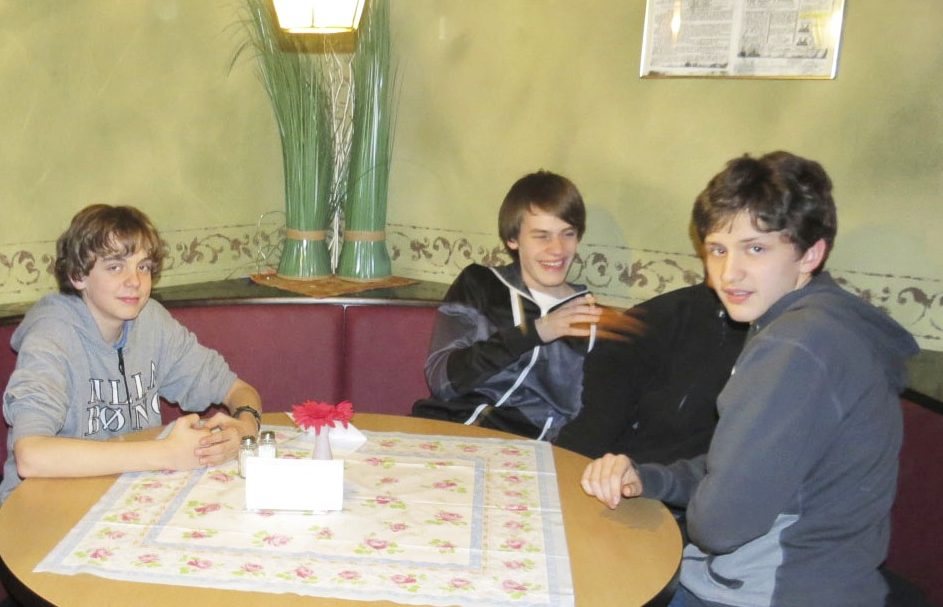
10/6/2026 – The success of the German national team has something to do with Thuringia. The foundations were laid almost 20 years ago, when national youth coach Bernd Vökler entered a youth team as Germany's second squad at the Chess Olympiad in Dresden. The "Princes' Group" was born. Axel Eger reported for the Thüringer Allgemeine. | Photo: German Chess Federation
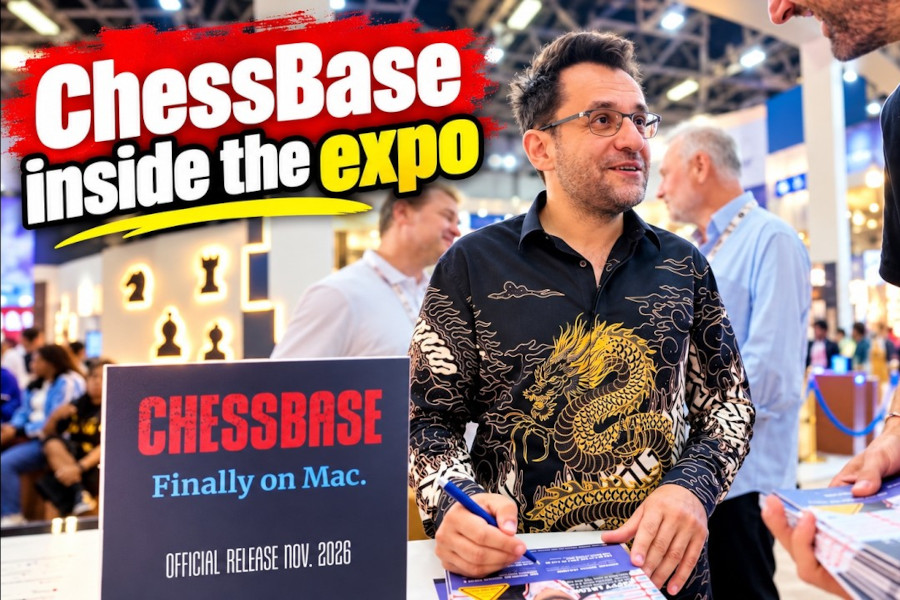
9/30/2026 – Arne Kähler sets off by golf cart from the entrance gate to the exhibition area at the Chess Olympiad in Samarkand. He shows the stands of WR Chess, DGT and ChessBase, while also passing the ChessBase India workspace, the food court and the souvenir shop. Arne then visits the press area and the game zone before meeting a special guest at the ChessBase stand - elite grandmaster Levon Aronian! | Photo: ChessBase
This entry into the 60 minutes series concentrates on the Modern variation of the Italian game where White opens the centre early : 1 e4 e5 2 Nf3 Nc6 3 Bc4 Nf6 4 d4 exd4 5 e5!. This line can be reached by various move orders, most frequently from the Scotch 3 d4 exd4 4 Bc4. It's a sharp variation and Grandmasters such as Evgeny Sveshnikov have used it frequently,with very good results. It's a perfect line for club players to adopt which is relatively easy to learn and which contains many traps. All the main responses are covered here, including 5...d5, 5...Ng4 and 5...Ne4 and the conclusion is that is is difficult for Black to equalize in a straightforward way. Problems are being posed, which over the board might prove tough to solve.
YOUR PERSONAL CHESS COACH - Whether you’re taking your first steps into the world of club chess, or already playing at a tournament level: with FRITZ, you can train more efficiently, intelligently and with a more personalised approach than ever before.
Most players don’t lack the urge to attack, they just strike at the wrong moment, and GM Sipke Ernst shows you which signals tell you to go for the king and which tell you to choose another plan.
How grandmasters win without fireworks: GM Jan Markos shows you 11 very practical tips from "How to play in a lost position" to "Be patient like Carlsen" that will improve your tournament chess.
The Nimzo-Indian has stood the test of time for over a century: Still a top choice for elite players today, from Magnus Carlsen to Praggnanandhaa, it remains one of Black's most reliable ways to fight for real chances against 1.d4 2.c4 3.Nc3.
1.c4 e5 2.Nc3 Bb4!? is an opening idea well worth considering. Black immediately threatens to double the pawns on c3 in the style of the Trompowski or Sicilian Grand Prix attack.
Italian Game Powerbase 2026 is a database and contains 8571 top class games from Mega 2026 and the Correspondence Database 2026, of which 479 are annotated.
€9.90
We use cookies and comparable technologies to provide certain functions, to improve the user experience and to offer interest-oriented content. Depending on their intended use, analysis cookies and marketing cookies may be used in addition to technically required cookies. Here you can make detailed settings or revoke your consent (if necessary partially) with effect for the future. Further information can be found in our data protection declaration.
Pop-up for detailed settings
We use cookies and comparable technologies to provide certain functions, to improve the user experience and to offer interest-oriented content. Depending on their intended use, cookies may be used in addition to technically required cookies, analysis cookies and marketing cookies. You can decide which cookies to use by selecting the appropriate options below. Please note that your selection may affect the functionality of the service. Further information can be found in our privacy policy.
Technically required cookies
Technically required cookies: so that you can navigate and use the basic functions and store preferences.
Analysis Cookies
To help us determine how visitors interact with our website to improve the user experience.
Marketing-Cookies
To help us offer and evaluate relevant content and interesting and appropriate advertisement.










_in_aktie%2C_Bestanddeelnr_931-9184.jpg)