.jpeg)

Uzbekistan completed their home Olympiad with gold after defeating Ukraine 2½–1½ in Sunday's final round in Samarkand. The hosts finished on 20/22 match points, two clear of India and Germany, to claim their second Olympiad title after their breakthrough victory in Chennai four years ago.
The decisive point against Ukraine came on board four, where Mukhiddin Madaminov defeated 18-year-old European champion Roman Dehtiarov. The other three games ended drawn: Nodirbek Abdusattorov shared the point with Igor Kovalenko, Javokhir Sindarov drew Vasyl Ivanchuk and Nodirbek Yakubboev was held by Ihor Samunenkov.
Uzbekistan therefore finished with ten match wins and a single defeat, against Germany in round eight. Their campaign was built not only on the results of their highest-rated players, but on a remarkably balanced lineup which repeatedly produced points on all four boards.
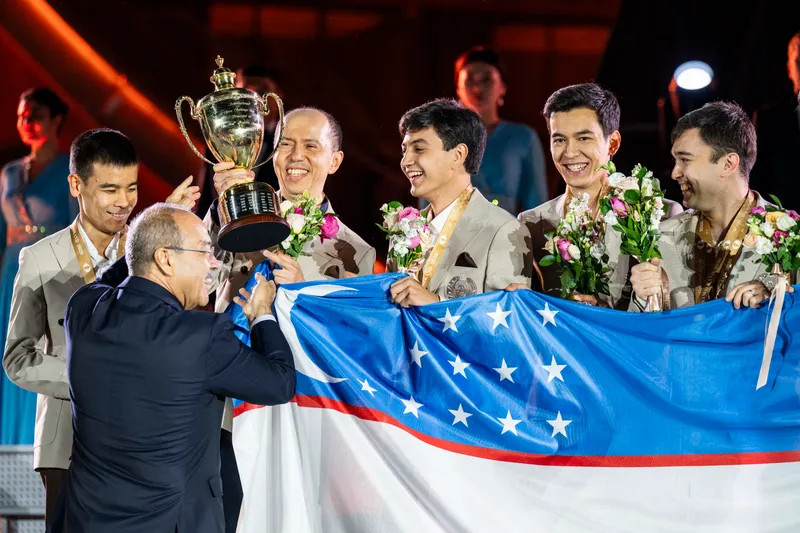
Time to celebrate! The Uzbek team headed by team captain (and 2004 FIDE World Championship winner) Rustam Kasimdzhanov | Photo: Nils Rohde / ChessBase
The title has a clear link with Uzbekistan's first Olympiad triumph in Chennai in 2022. Four members of this year's five-player squad - Abdusattorov, Yakubboev, Sindarov and Shamsiddin Vokhidov - were also part of that gold-medal team. The current squad is still exceptionally young. All five players are between 19 and 24 years old, with Yakubboev and Vokhidov the oldest members at 24.
Abdusattorov was again the leading figure. He played in all eleven rounds and finished unbeaten on 8½/11, taking individual gold on board one with a 2869 TPR. He had previously won individual silver on the top board at both the 2022 and 2024 Olympiads. Speaking to chess.com's Mike Klein, the Uzbek star noted:
This is the proudest moment in my life. It's been a tremendous achievement for our team, for Uzbekistan. I'm truly happy.
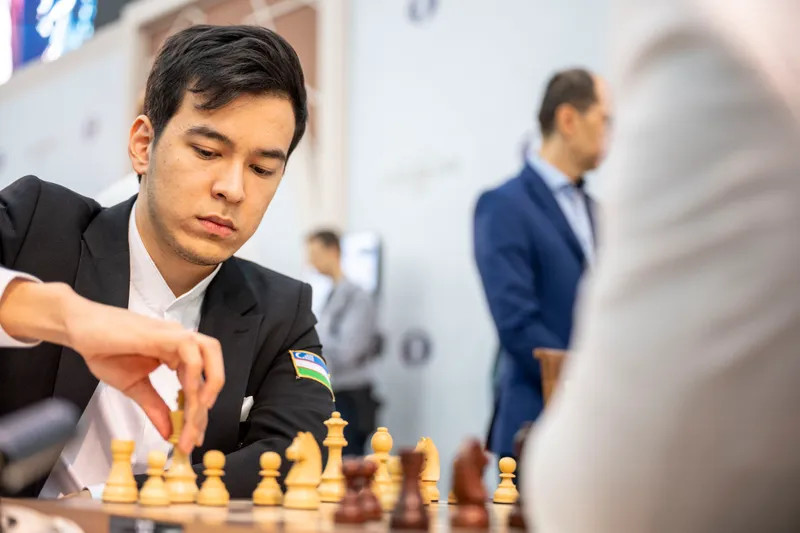
It was a dream tournament for Nodirbek Abdusattorov | Photo: Nils Rohde / ChessBase
There were individual medals further down the Uzbek lineup as well. Sindarov took bronze on board two, while Yakubboev collected silver on board three.
Four of the five Uzbek players also gained rating in Samarkand, with Vokhidov the lone exception. Abdusattorov gained 18.0 Elo points and Yakubboev 14.4. Sindarov and Abdusattorov now occupy 4th and 5th place respectively in the live world rankings, while Yakubboev has entered the 2700 club and sits 26th on 2712.
Dehtiarov v. Madaminov
Madaminov converted this pawn-up rook endgame to get the crucial win for the local heroes. Dehtiarov here faltered with 33.b4?, when 33.Re5 was the only move that would have kept drawing chances for White (rook endgames often require extreme precision!).
The black king soon gained activity in the centre, and Madaminov continued to play precisely until simplifying into an endgame with rook against rook and pawn.
This is the position after 46...Kd4. Madaminov correctly calculated that he can give up his pawn on f4 in order to capture the white lone solider on b4.
The rest was simple for the 19-year-old Uzbek grandmaster, who is likely to remember this endgame by heart for the rest of his life!
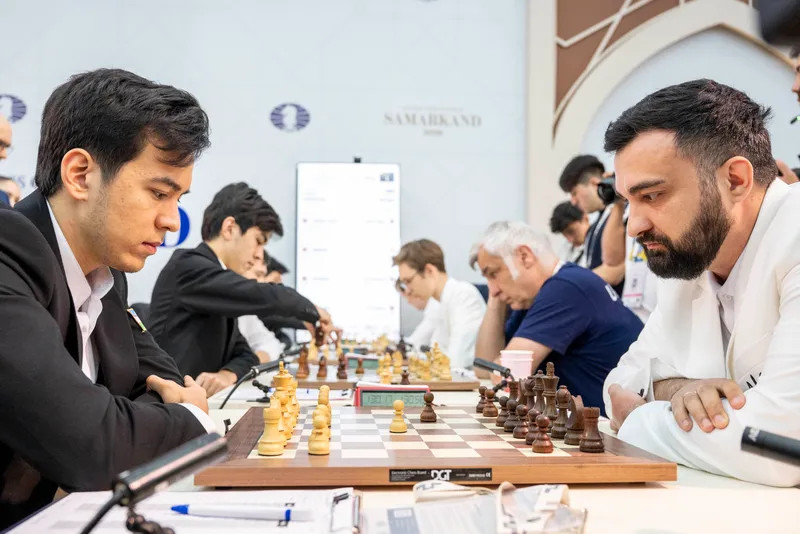
Uzbekistan facing Ukraine | Photo: Nils Rohde / ChessBase
Given Uzbekistan's consistency, India's silver medal represented a strong result for the second seeds. Their final match against Hungary ended 2–2, although the result came in an unexpected fashion. Praggnanandhaa Rameshbabu drew Richard Rapport and Nihal Sarin shared the point with Benjamin Gledura, while the remaining two games were decisive.
Gleb Dudin defeated Gukesh Dommaraju on board four, while Arjun Erigaisi beat Peter Leko to restore equality and secure the match point India needed for silver.
Gukesh had arrived at the final round with an exceptional 8½/10 score, but Dudin's win pushed him down to individual silver on board four. The result ended a sequence in which Gukesh had taken gold for his individual performances on board one at both Chennai 2022 -when he represented India 2 - and Budapest 2024.
The defeat cost Gukesh 6.9 rating points on the day, although he still gained 7.1 Elo points over the Olympiad as a whole. He leaves Samarkand ranked 29th in the world and 72 points behind 2782-rated Sindarov, his opponent in the World Championship match that begins in Geneva in less than two months.
Praggnanandhaa also left Samarkand with an individual medal, taking bronze on board one with a 2772 performance rating.
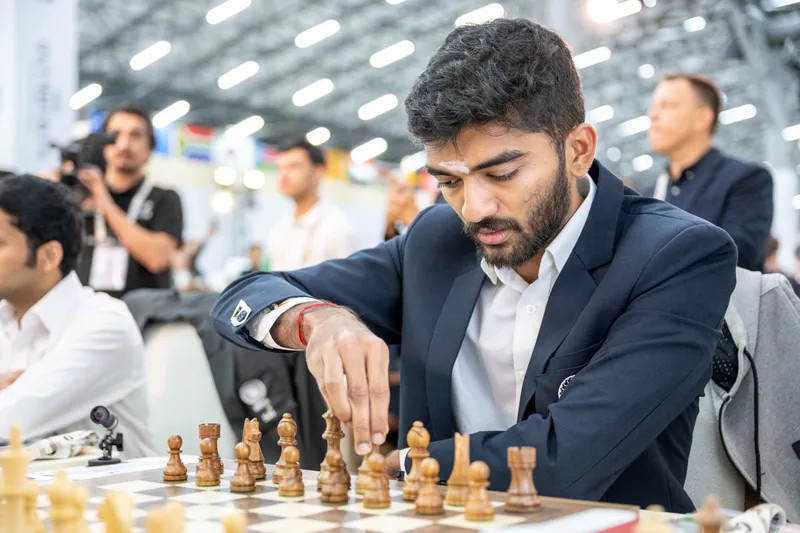
Reigning world champion Gukesh Dommaraju | Photo: Nils Rohde / ChessBase
Dudin v. Gukesh
Gukesh's handling of a rather double-edged Sicilian was rather adventurous. By move 10, he had lost the right to castle, while by move 21 he was already a pawn down.
In the diagram above, Dudin had already consolidated his position, with the pair of knights a much stronger duo than the black bishop pair - after 26.c5, the outpost on d6 becomes the key factor in the position.
Dudin patiently improved his position in the ensuing manoeuvring phase. By move 41, he was already two pawns up with a strong passer on d6.
Gukesh continued playing until move 59, but he would have probably resigned earlier had this not been a team event.
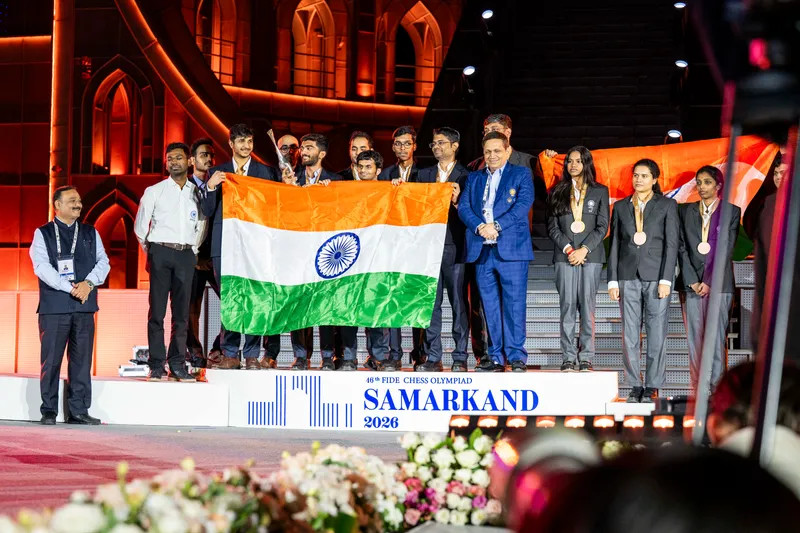
The golden generation of Indian chess won the 2024 Olympiad and now took silver in Samarkand | Photo: Nils Rohde / ChessBase
Germany took bronze after beating the Netherlands 2½–1½, finishing level with India on 18/22 but behind the defending champions on tiebreaks.
Matthias Bluebaum scored the decisive point by defeating Jorden van Foreest on board two, while Anish Giri drew Vincent Keymer, Loek van Wely drew Frederik Svane and Casper Schoppen shared the point with Rasmus Svane.
The medal ends a 26-year wait for Germany. Their previous team medal in the open section of a Chess Olympiad came in Istanbul 2000, when a team headed by Artur Yusupov and the late Robert Hübner took silver.
Germany's path to bronze featured nine match victories and two losses, without a single draw. Those defeats came against China and India, while they were the only team in the tournament to defeat eventual champions Uzbekistan.
Frederik Svane was their standout performer for a second Olympiad in a row. He played in all eleven rounds and finished undefeated on 8½/11, corresponding to a 2796 performance rating and individual gold on board three. It was his second successive individual Olympiad gold, after he had scored 8/9 on board five in Budapest two years ago.
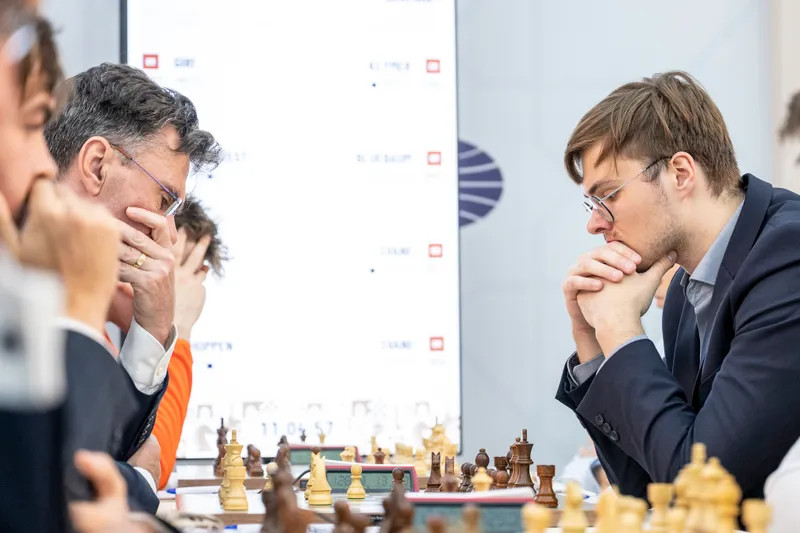
Frederik Svane (right) took home individual gold in two consecutive editions of the Chess Olympiad! | Photo: Nils Rohde / ChessBase
Bluebaum v. Van Foreest
The game developed in Bluebaum's favour when Van Foreest had to give up the exchange in the endgame. The sequence began with an exchange in which the German grandmaster gave up two pieces for a rook.
The sequence would not have been a problem for Van Foreest had it not been followed by Bluebaum's key move: 29.Qa3!, with a double attack on the knight and bishop.
Black also picked up the a-pawn for the bishop, but the Dutchman could no longer save the game. The encounter ended after 64 moves in a pawn ending that was lost for Black.
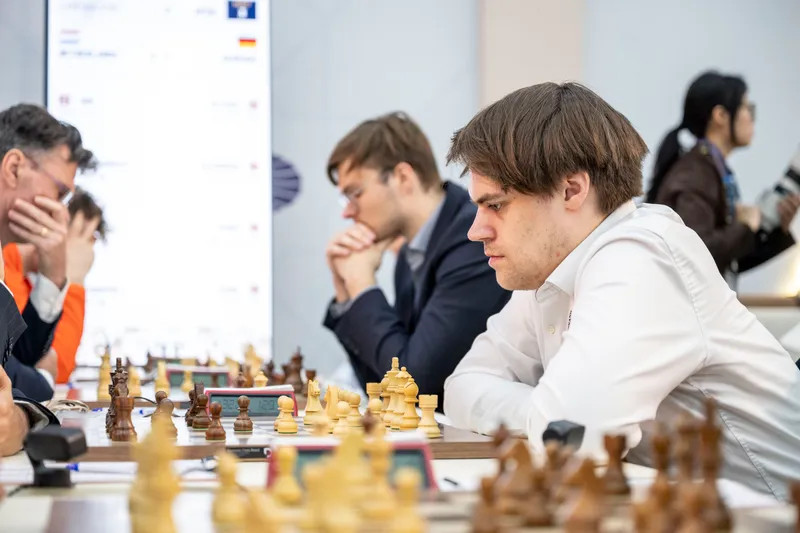
Matthias Bluebaum was Germany's hero in round eleven | Photo: Nils Rohde / ChessBase
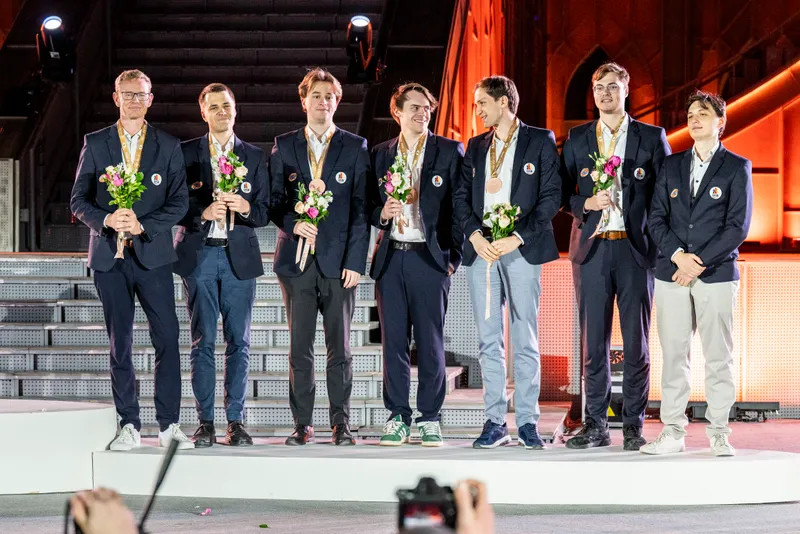
Germany reached the podium in the Olympiad for the first time in 26 years! | Photo: Nils Rohde / ChessBase
Four teams ended a match point behind India and Germany on 17/22: the United States, Azerbaijan, Armenia and Hungary. The Americans took fourth place on tiebreaks.
For the top-seeded United States, fourth place will inevitably look less impressive than their starting position suggested. They were never quite able to rejoin the fight for first place after losing to Germany in round five and drawing Armenia in round seven. They nevertheless finished with a clear 3–1 victory over Türkiye, as Hans Niemann and Levon Aronian scored wins on the bottom two boards.
Aronian finished the event strongly, winning his final two games and collecting individual bronze on board four with 6/8.
Azerbaijan and Armeania also ended the event with match victories, defeating Serbia 2½–1½, and Croatia 3–1, respectively.
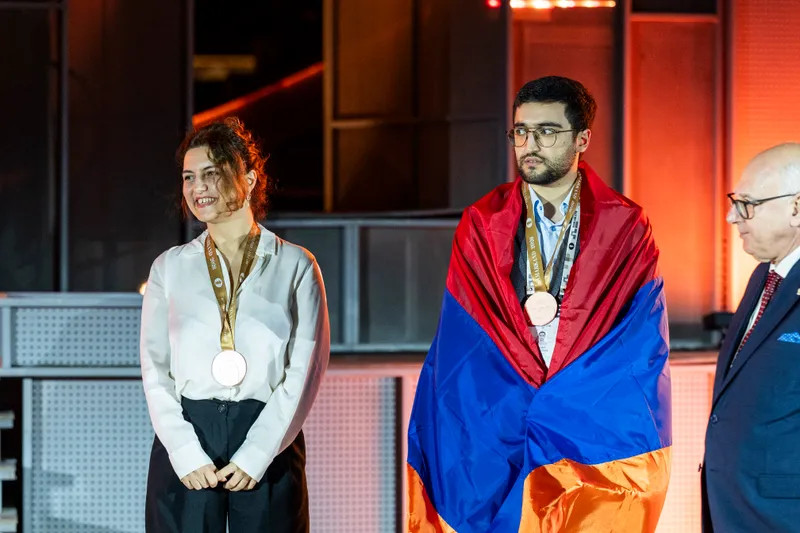
Armenia's Shant Sargsyan took individual bronze on board three, with 8/11 and a 2745 TPR | Photo: Nils Rohde / ChessBase
Hungary's seventh-place finish, one position above their seeding, was built in large part on the form of reserve player Gleb Dudin.
Dudin played ten of the eleven rounds and scored 8/10, impressively closing the Olympiad with five consecutive victories. His final win over Gukesh was the most significant of the sequence and secured him individual gold on board five with a 2738 performance rating. For a player rated, defeating the reigning world champion was an appropriate conclusion to one of the strongest individual performances of the event.
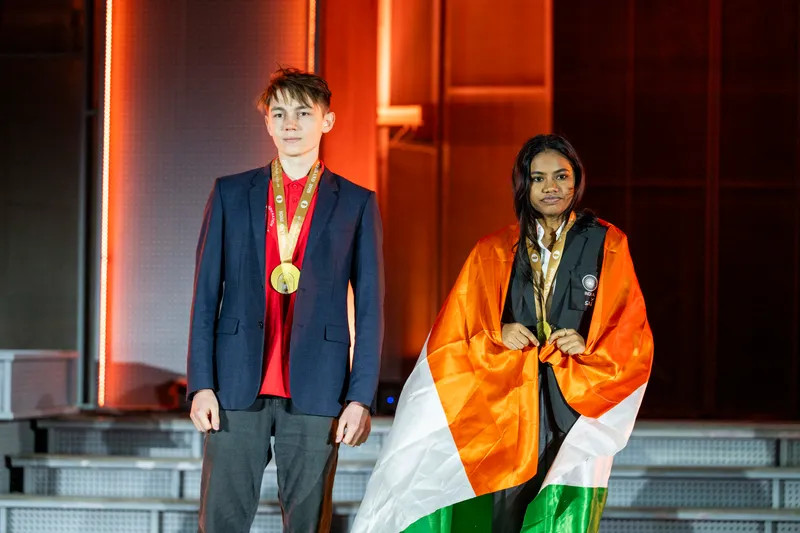
21-year-old Gleb Dudin receiving individual gold for his performance on board five alongside India's Savitha Shri | Photo: Nils Rohde / ChessBase
As it is the case in every edition of the Olympiad, players away from the medal-winning teams also produced notable individual results.
Yagiz Kaan Erdogmus, aged 15, scored 8/10 for Türkiye with a 2839 TPR, earning individual silver on board one behind Abdusattorov. He gained 15.1 rating points in Samarkand and climbed to 17th place in the live rankings, making him the highest-rated under-20 player in the world, ahead of Gukesh.
Jorden van Foreest also had an outstanding event for the Netherlands, scoring 8/10 with a 2798 TPR on board two. His tournament ended abruptly, however, when a one-move blunder against Bluebaum turned a drawn position into a final-round defeat. Van Foreest still took individual silver on board two. He finished with the same TPR as China's Wei Yi, but Wei played one additional game and took gold.
Another notable individual gold went to 17-year-old Ihor Samunenkov of Ukraine. His final-round draw against Yakubboev left him on 8/10 and gave him first place on board four, surpassing Gukesh at the last hurdle.

Jorden van Foreest and Armenia's Mariam Mkrtchyan | Photo: Nils Rohde / ChessBase
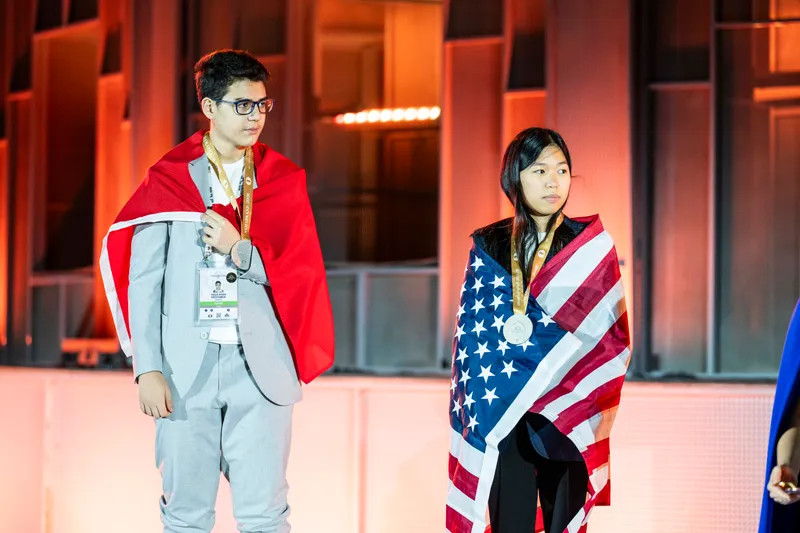
Two well-known rising starts in the chess circuit Yagiz Kaan Erdogmus and Carissa Yip | Photo: Nils Rohde / ChessBase
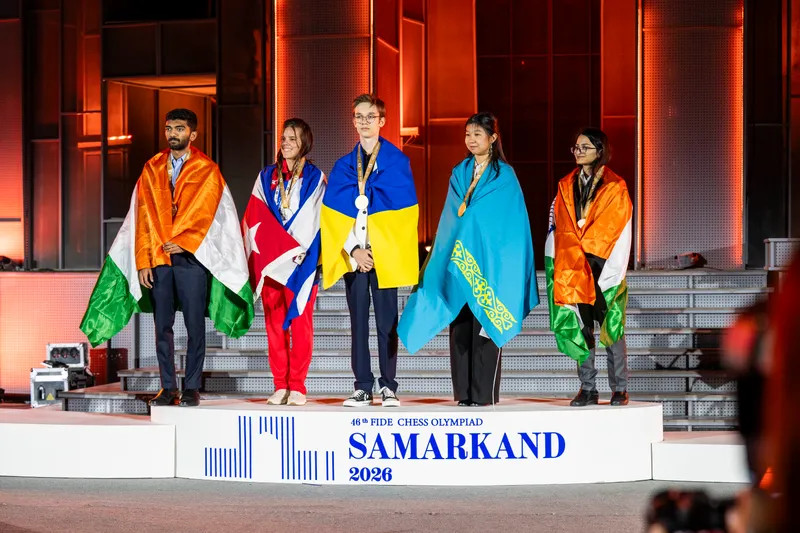
Ukrainian ace Ihor Samunenkov edged Gukesh Dommaraju to claim individual gold on board four | Photo: Nils Rohde / ChessBase
| Rk. | SNo | FED | Team | Group | Games | + | = | - | TB1 | TB2 | TB3 | TB4 | |
|---|---|---|---|---|---|---|---|---|---|---|---|---|---|
| 1 | 3 | UZB | Uzbekistan | A | 11 | 10 | 0 | 1 | 20 | 455,5 | 32,5 | 161 | |
| 2 | 2 | IND | India | A | 11 | 8 | 2 | 1 | 18 | 405,5 | 28,5 | 162 | |
| 3 | 5 | GER | Germany | A | 11 | 9 | 0 | 2 | 18 | 386,5 | 28,5 | 160 | |
| 4 | 1 | USA | United States of America | A | 11 | 8 | 1 | 2 | 17 | 391,5 | 29 | 157 | |
| 5 | 7 | AZE | Azerbaijan | A | 11 | 7 | 3 | 1 | 17 | 364,5 | 28,5 | 151 | |
| 6 | 10 | ARM | Armenia | A | 11 | 7 | 3 | 1 | 17 | 339,5 | 27 | 154 | |
| 7 | 8 | HUN | Hungary | A | 11 | 7 | 3 | 1 | 17 | 320,5 | 24,5 | 152 | |
| 8 | 4 | CHN | China | A | 11 | 7 | 2 | 2 | 16 | 374,5 | 28 | 160 | |
| 9 | 9 | FRA | France | A | 11 | 6 | 4 | 1 | 16 | 366,5 | 28,5 | 151 | |
| 10 | 13 | ESP | Spain | A | 11 | 8 | 0 | 3 | 16 | 354,5 | 28,5 | 147 | |
| 11 | 12 | UKR | Ukraine | A | 11 | 8 | 0 | 3 | 16 | 350,5 | 28 | 148 | |
| 12 | 11 | ENG | England | A | 11 | 7 | 2 | 2 | 16 | 335,5 | 27,5 | 145 | |
| 13 | 14 | TUR | Turkiye | A | 11 | 7 | 1 | 3 | 15 | 361,5 | 27,5 | 152 | |
| 14 | 16 | POL | Poland | A | 11 | 6 | 3 | 2 | 15 | 348 | 28,5 | 146 | |
| 15 | 18 | IRI | Iran | A | 11 | 6 | 3 | 2 | 15 | 348 | 28,5 | 143 | |
| 16 | 6 | NED | Netherlands | A | 11 | 7 | 1 | 3 | 15 | 342,5 | 26 | 153 | |
| 17 | 23 | ROU | Romania | A | 11 | 5 | 5 | 1 | 15 | 339,5 | 28 | 143 | |
| 18 | 30 | UZB | Uzbekistan 2 | A | 11 | 7 | 1 | 3 | 15 | 332 | 25,5 | 154 | |
| 19 | 47 | VIE | Vietnam | B | 11 | 6 | 3 | 2 | 15 | 326,5 | 30,5 | 130 | |
| 20 | 17 | CRO | Croatia | A | 11 | 7 | 1 | 3 | 15 | 321,5 | 29 | 132 | |
| 21 | 20 | CZE | Czech Republic | A | 11 | 6 | 3 | 2 | 15 | 321 | 27 | 144 | |
| 22 | 15 | SRB | Serbia | A | 11 | 7 | 1 | 3 | 15 | 313 | 26 | 144 | |
| 23 | 24 | ARG | Argentina | A | 11 | 7 | 1 | 3 | 15 | 311,5 | 27 | 141 | |
| 24 | 22 | ISR | Israel | A | 11 | 7 | 1 | 3 | 15 | 304 | 25,5 | 139 | |
| 25 | 35 | KAZ | Kazakhstan | A | 11 | 6 | 3 | 2 | 15 | 299 | 27,5 | 132 | |
| 26 | 51 | MGL | Mongolia | B | 11 | 7 | 1 | 3 | 15 | 292,5 | 27,5 | 127 | |
| 27 | 39 | BLR | Belarus | A | 11 | 6 | 2 | 3 | 14 | 330,5 | 29 | 139 | |
| 28 | 29 | GEO | Georgia | A | 11 | 6 | 2 | 3 | 14 | 326 | 28 | 140 | |
| 29 | 26 | ITA | Italy | A | 11 | 6 | 2 | 3 | 14 | 320,5 | 28,5 | 136 | |
| 30 | 19 | GRE | Greece | A | 11 | 6 | 2 | 3 | 14 | 318,5 | 26,5 | 145 |
Find all games on Live.ChessBase.com


| Advertising |