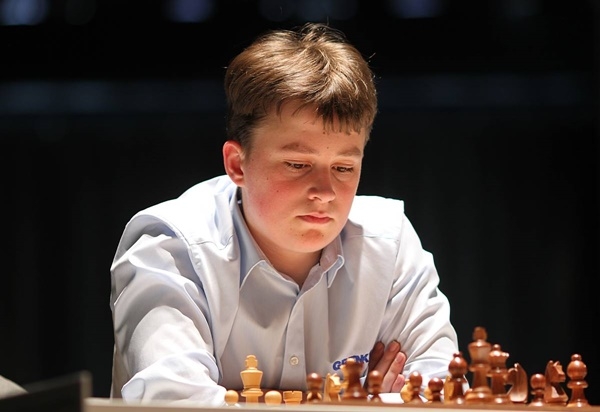
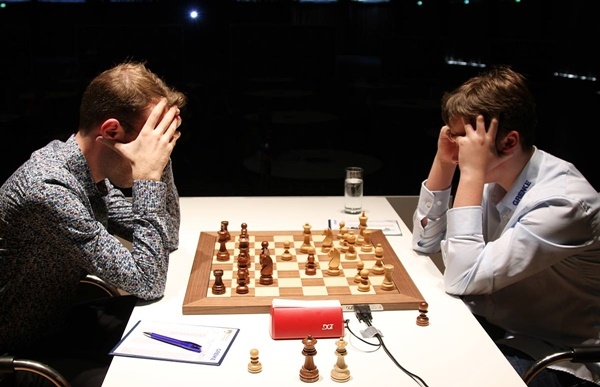
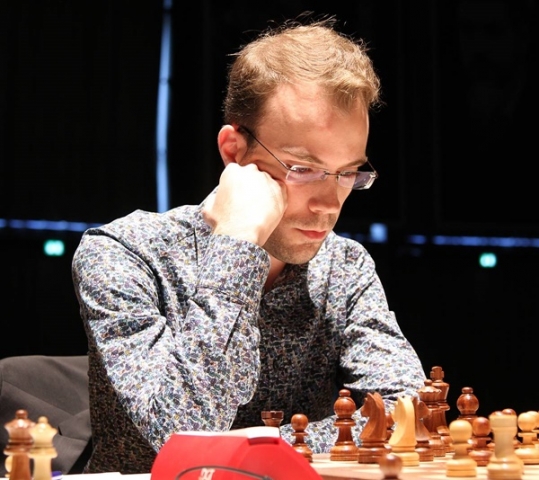
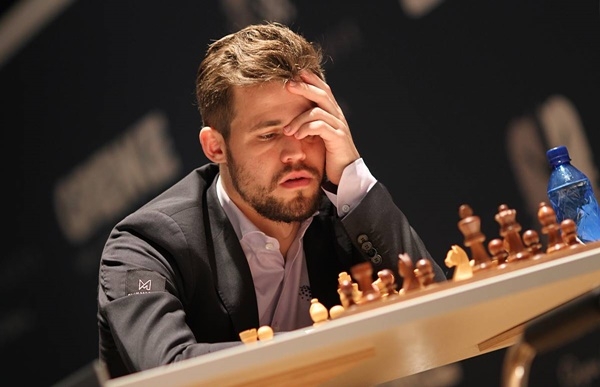
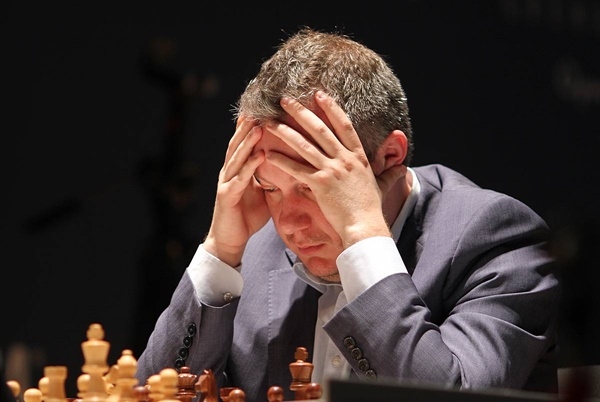
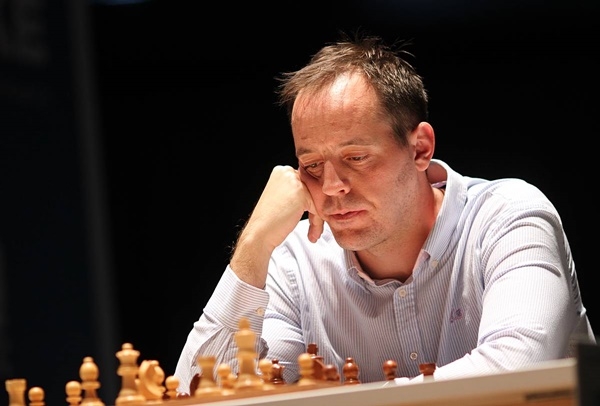
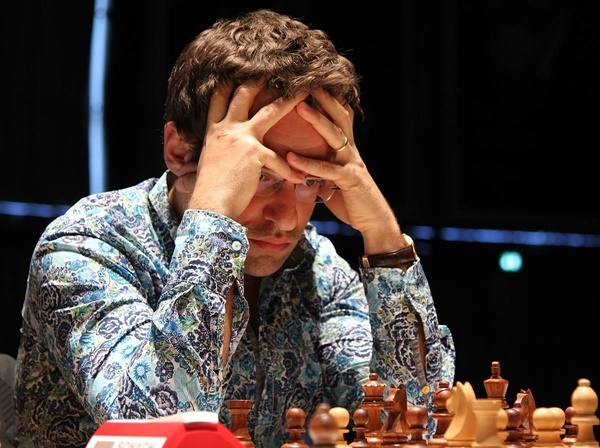
4/25/2019 – Vishy Anand and Magnus Carlsen drew games of very different nature to maintain the lead at the 2019 GRENKE Chess Classic; Peter Svidler could not make the most of an opening edge against Paco Vallejo; while Maxime Vachier-Lagrave and Levon Aronian repeated the position three times in the early middlegame. In the meantime, after having lost four games in a row, Vincent Keymer got his first super-tournament victory, a welcomed reward for his uncompromising play so far in Karlsruhe. | Photo: Georgios Souleidis
new: Fritz 20
Your personal chess trainer. Your toughest opponent. Your strongest ally. FRITZ 20 is more than just a chess engine – it is a training revolution for ambitious players and professionals. Whether you are taking your first steps into the world of serious chess training, or already playing at tournament level, FRITZ 20 will help you train more efficiently, intelligently and individually than ever before.
YOUR PERSONAL CHESS COACH - Whether you’re taking your first steps into the world of club chess, or already playing at a tournament level: with FRITZ, you can train more efficiently, intelligently and with a more personalised approach than ever before. FRITZ is more than just a chess engine – it’s a training revolution! Whether you’re taking your first steps into the world of club chess, or already playing at a tournament level: with FRITZ, you can train more efficiently, intelligently and with a more personalised approach than ever before.
IM Andrew Martin shows why this 19th-century opening weapon still is a fantastic choice for club players. The Evans produces exciting chess and teaches the art of attack.
€39.90
Three queens on the board
With so many chess prodigies coming up in the chess world, we sometimes forget how difficult it must be for the youngsters to sit in front of experienced, toughened up opponents on a big stage. Vincent Keymer, for example, certainly showed — by getting enviable positions — that he arrived in Karlsruhe well-prepared and ready to battle against the best players in the world...but he lost his first four encounters all the same.
Luckily for him, he managed to turn the tables in the last round prior to the rest day, as four more grandmasters — hungry for victories — await to face him in Baden-Baden starting Friday. Being out-rated by more than a hundred points by every single player in the event, getting a couple of points in the second half will be a good result for the 14-year-old.
The local players crossed swords on Wednesday | Photo: Georgios Souleidis
Vincent had the white pieces against his compatriot Georg Meier, who apparently saw this as his big chance to bounce back after losing two in a row — against Svidler and Vachier-Lagrave. Meier showed his intentions by pushing his kingside pawns early in the game:
The Vienna Variation is a particular and independent system of the Queen's Gambit. It arises after 1.d4 d5 2.c4 e6 3.Nf3 Nf6 4.Nc3 dxc4, when Black's capture on move 4 is strongly reminiscent of the Queen's Gambit Accepted.
Georg followed 12...h6 13.♖d1 g5, an ambitious manoeuvre reproved by the computers — had he won the game, however, we would be calling this a "well-timed risky strategy". After this sequence of moves, Keymer grabbed the initiative with a precise handling of the position, pushing his opponent to limit himself to defensive tasks. On move 25, however, the youngster could have increased the pressure more poignantly:
White gained a pawn with 25.♕f5+ ♚b8 (25...♚d8 would lead to a quick defeat after 26.♗xb6!) 26.♕d7 c5 27.♕xd5 and the queens were exchanged: 27...♛xd5 28.♖xd5. However, Meier confessed after the game that he was afraid of 25.b4, with the idea of b6-Rc6, getting a strong bind on the queenside.
Georg Meier got hopeful nearing the time control | Photo: Georgios Souleidis
Keymer kept pushing while up material, but Meier seemed to be well on his way to save the half point thanks to his meticulous defensive technique...until disaster struck:
When we are starting out in chess we are told that knights and bishops both have a value of three points, but it is quite clear that in some positions a bishop is clearly superior to a knight - and vice versa. After watching this 8th Power Play DVD you’ll have a better idea of how to play positions with knights and bishops – what to look for, what to avoid, and how to place your pawns.
Georg blundered with 42...h4?, allowing 43.♗c3, when Black s forced to exchange bishops and go into a losing difficult pawn endgame [as GM Daniel King shows below, the endgame was technically still holdable -Ed.]: 43...♝xc3 44.♔xc3 ♚xf5. The correct way to go was the simpler 42...♚xf5, when Black can defend his pawns on the dark squares from c8.
The task of winning that pawn endgame — which always meant calculating different scenarios with queens on the board — was not so simple though. Just to give an example, Keymer could have fallen for a stalemate trick on move 60:
Vincent correctly pushed his pawn with 60.b4, instead of playing 60.bxc4?, when Black can force a draw with 60...g1♛+ 61.♕xg1 stalemate. The young German kept playing carefully, and by move 75 he had two queens on the board:
Meier kept looking for some kind of perpetual until move 81, but by then it was clear Keymer was going to get his first win in a super-tournament.
The continuous stream of new ideas in the Sicilian makes 1..c5 the most popular answer to 1.e4. On this DVD I do give an introduction to the most important Sicilian systems.
Endgame analysis by GM Daniel King
GM Daniel King took a closer look at this endgame on his PowerPlay channel
Fighting draws
Magnus Carlsen's games averaged exactly 72 moves until round four, and he only lost the "privilege" of being the last one on stage on Tuesday, when Vachier-Lagrave and Meier were left alone playing until move 94. In round five, however, Magnus went back to playing the longest game of the day — a 60-move draw with the white pieces against Arkadij Naiditsch.
Magnus has been working hard this week | Photo: Georgios Souleidis
In his second game with White in Karlsruhe, the world champion once again opened with 1.c4, and Naiditsch showed he was well-prepared to face the English, as he got a decent advantage on the clock. By move 24, the d-pawns alternated in the centre of the board, creating a peculiar setup:
The aim of these Dvd's is to build a repertoire after 1.c4 and 2.g3 for White. The first DVD includes the systems 1...e5, the Dutch and Indian setups. The second DVD includes the systems with 1...c5, 1...c6 and 1...e6.
A dynamically balanced struggle ensued and, when the queens had left the board, Black was a pawn up, but it was not clear who was playing for a win — in fact, the commentators had a split of opinion regarding whether it was better to have the material or the initiative:
In the final phase of the game, Magnus was the one pushing after capturing one of Black's pawns. However, Naiditsch handled the pressure with competence and managed to secure the half point.
It is never easy against the world champion | Photo: Georgios Souleidis
When Francisco Vallejo Pons is participating in an event, fighting games are guaranteed to take place, and his round five encounter against Peter Svidler was no exception. The players started taking their time as early as move 9, after Black had decided to fianchetto his dark-squared bishop and advance his kingside pawns out of an Italian setup. Shortly afterwards, a battle in the centre unfolded:
In this DVD Sam Collins provides a complete and detailed repertoire for Black. Numerous novelties and improvements are suggested, with the conclusion that White has no clear route to an opening advantage.
Svidler thought for nine minutes before pushing 11.d4, and after 11...exd4 the Russian chose the dynamic 12.♘f5, creating a sharp struggle in the early middlegame. Both players needed to calculate long sharp lines in order to avoid putting a foot wrong. But this is precisely what both fighters are known for.
White had only a nominal advantage throughout, and the game finished with Svidler two pawns up — nevertheless, due to the presence of opposite-coloured bishops, it was clear that none of the contenders would leave the stage with a full point.
Vallejo's fighting spirit is always welcomed | Photo: Georgios Souleidis
Perhaps the most anticipated match-up of round five was Vishy Anand v Fabiano Caruana, with the former world champion in the lead and the American in position to surpass him. However, the Berlin Defence put forth by Caruana — notice that he did not play the Petroff — indicated a high likelihood of a draw. By move 21, most pieces had been traded, but the players continued until move 40, when the peace treaty was finally signed.
Aronian drew Vachier-Lagrave with Black in 25 moves | Photo: Georgios Souleidis
Round-up show
GM Yannick Pelletier analysed the action from Round 5
Antonio PereiraAntonio is a freelance writer and a philologist. He is mainly interested in the links between chess and culture, primarily literature. In chess games, he skews towards endgames and positional play.
YOUR PERSONAL CHESS COACH - Whether you’re taking your first steps into the world of club chess, or already playing at a tournament level: with FRITZ, you can train more efficiently, intelligently and with a more personalised approach than ever before.
The Nimzo-Indian has stood the test of time for over a century: Still a top choice for elite players today, from Magnus Carlsen to Praggnanandhaa, it remains one of Black's most reliable ways to fight for real chances against 1.d4 2.c4 3.Nc3.
1.c4 e5 2.Nc3 Bb4!? is an opening idea well worth considering. Black immediately threatens to double the pawns on c3 in the style of the Trompowski or Sicilian Grand Prix attack.
Italian Game Powerbase 2026 is a database and contains 8571 top class games from Mega 2026 and the Correspondence Database 2026, of which 479 are annotated.
Videos: Nico Zwirs discusses the Sicilian with 2…e6 3.d4 cxd4 4.Qxd4 Nc6 5.Qe3 Nf6 6.Nc3. Mihail Marin examines Sindarov’s 6.Ne5 in the Queen’s Pawn Defence. Plus the ‘Lucky bag’ featuring 41 analyses by Berg, Ftacnik, Gupta and many others.
If you're looking for a dynamic alternative to the Slav, Queen's Gambit Declined, or other mainstream systems, the Chigorin Defence offers exactly what modern tournament players need.
€34.90
We use cookies and comparable technologies to provide certain functions, to improve the user experience and to offer interest-oriented content. Depending on their intended use, analysis cookies and marketing cookies may be used in addition to technically required cookies. Here you can make detailed settings or revoke your consent (if necessary partially) with effect for the future. Further information can be found in our data protection declaration.
Pop-up for detailed settings
We use cookies and comparable technologies to provide certain functions, to improve the user experience and to offer interest-oriented content. Depending on their intended use, cookies may be used in addition to technically required cookies, analysis cookies and marketing cookies. You can decide which cookies to use by selecting the appropriate options below. Please note that your selection may affect the functionality of the service. Further information can be found in our privacy policy.
Technically required cookies
Technically required cookies: so that you can navigate and use the basic functions and store preferences.
Analysis Cookies
To help us determine how visitors interact with our website to improve the user experience.
Marketing-Cookies
To help us offer and evaluate relevant content and interesting and appropriate advertisement.