
The following list is merely a selection, a suggestion - after all, over the course of 140 years and 44 World Championship matches (1886–2024), 871 games at classical time controls and 19 rapid games have been played. It begins, however, not with a brilliant game, but with one of the most astonishing blunders in World Championship history.
Before the final game of the match between world champion Wilhelm Steinitz and challenger Mikhail Chigorin, Steinitz led by 9 wins to 8. Here, however, Chigorin is winning, but he played 32.Bb4? and allowed mate in two. Chigorin resigned after 32...Rxh2+. The match was over and Steinitz had defended his title.
In the World Championship match between long-time rivals Dr Emanuel Lasker and Dr Siegbert Tarrasch, defending champion Lasker found himself on the defensive after a poor opening. In this position, Lasker sacrificed a pawn with 14...Ng4!?, which Tarrasch gratefully accepted with 15.Bxg7! Nxf2! 16.Kxf2? Kxg7 17.Nf5+ Kh8 18.Qd4+ f6 19.Qxa7 - although perhaps he should instead have played for the attack with 16.Qd4! Lasker obtained unexpectedly rich compensation for the pawn and outplayed Tarrasch, who, surprised by the sudden turn of events, failed to find a good defence. Lasker won the match convincingly by 10½-5½.

Emanuel Lasker (left) and Siegbert Tarrasch during the 1908 World Championship match | Photo source: L. Hoffer, ed. (1908), The Championship Match: Lasker v. Tarrasch, London: E.A. Michell & Frank Hollings
In his World Championship match against Carl Schlechter, Lasker's title, which he had won by defeating Steinitz in 1894, came under serious threat. After 9 of the 10 games, Lasker trailed 4-5 and absolutely had to win the final game. Yet in the diagrammed position, Schlechter could have forced perpetual check with 39...Qh4+. Instead, he played 39...Qh1+? and allowed the white king to escape. Lasker won the game, the match ended in a 5-5 draw and Lasker remained world champion.
Before his World Championship match against defending champion Capablanca, Alekhine had never beaten him. Yet that is exactly what he managed in the very first game of the match. In the diagrammed position, he won an important pawn with 16...Nxc2! 17.Rxc2 Qxf4. Capablanca, who had probably underestimated both his opponent and the challenges of such a match, never really found his footing afterwards and lost both the match and his title after 34 games (+6, -3, =25 in favour of Alekhine).
The World Championship match between the Dutchman Max Euwe, an amateur who worked as a teacher, and full-time professional Alekhine also produced a surprise. The most famous game of the match is the so-called "Pearl of Zandvoort", which Euwe won with the attractive knight sacrifice 21.Nxf5!. Euwe won the match 15½-14½ and thus became the fifth world champion in chess history. Two years later, however, he lost the title back to Alekhine in the return match. Alekhine remained world champion until his death in 1946, making him the only one of the 18 world champions so far to have died while holding the title.
Tal played 21...Nf4!, producing one of the most famous sacrifices in chess history. Tal won the World Championship match against Botvinnik 12½-8½ and became the youngest world champion ever at the time. The knight sacrifice for attacking chances and long-term compensation was typical of Tal's sacrificial style, which made him famous. Botvinnik regained the title a year later in the return match.

Mikhail Botvinnik (left) and Mikhail Tal at the 1960 Chess Olympiad in Leipzig | Photo: tournament book
Tigran Petrosian became world champion in 1963 by defeating Botvinnik, and in 1966 he defended his title against Spassky. In the most famous game of the match, Petrosian sacrificed the exchange twice and finally ended the game with the attractive queen sacrifice 30.Qh8+. The match ended 12½-11½ narrowly in Petrosian's favour, but three years later Spassky took revenge at the second attempt and became the new world champion.
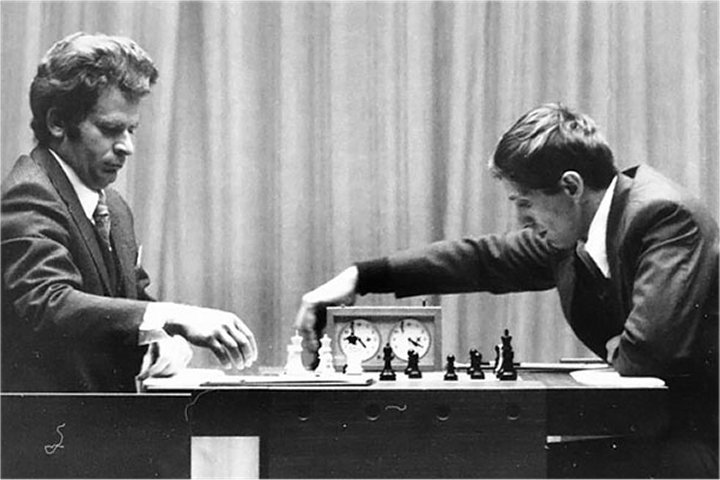
In the first game of the legendary World Championship match in Reykjavik between Boris Spassky and Bobby Fischer, Fischer captured an undefended pawn in a completely equal position with 29...Bxh2?, almost as if he had failed to see that his bishop would be trapped by 30.g3. Matters were more complicated than that, but the move is nevertheless regarded as a serious mistake. Fischer did not appear for the second game and lost by forfeit. In the end, he won the match 12½-8½ and became the first non-Soviet world champion since the Second World War.

Fischer captures the poisoned pawn on h2. | Photo: screenshot from film footage of the match
Fischer's victory in game six is regarded as a positional masterpiece. Spassky was far from his best form, but was so impressed that he applauded at the end. With this victory, Fischer took the lead in the match for the first time after starting 0-2.
The World Championship match between world champion Anatoly Karpov and challenger Viktor Korchnoi in Baguio City was a bitter and dirty contest, fought inventively and with numerous psychological tricks by both sides both at the board and away from the board. Karpov represented the Soviet Union, while the Leningrad-born Korchnoi had fled the Soviet Union in 1976 and had since been regarded there as persona non grata. The Soviet political system would have regarded a victory by the dissident as a serious defeat. Karpov took a 5-2 lead in wins, but Korchnoi managed to level the score at 5-5. The match was played to six wins, and in game 32 Karpov finally managed to win and defend his title. In the diagrammed position, he sacrificed a pawn with 25.e5!, after which Black's position quickly collapsed.
Garry Kasparov at his best: after a double-edged pawn sacrifice in the opening, challenger Kasparov comprehensively outplayed world champion Karpov - rarely had Karpov's pieces looked so uncoordinated. With this victory, Kasparov took the lead in the match, which he eventually won 13-11.
The game with which Kasparov became world champion. The first World Championship match between world champion Karpov and challenger Kasparov was stopped when Karpov was leading 5-3, without a winner being declared and under circumstances that have never been fully clarified to this day. In the second match, Kasparov led 12-11 before the final game. Karpov had to win to retain his title, but Kasparov won with black and took the match 13-11. At the age of 22, he became the youngest world champion in history at the time.

Garry Kasparov is world champion | Photo: Tass Archive
Before the final game of the World Championship match in Seville, challenger Karpov led world champion Kasparov 12-11. Kasparov had to win with white to defend his title. But instead of desperately trying to force a win and create tactical complications at all costs, Kasparov chose to keep Karpov under prolonged and sustained pressure in a complicated, slightly better position. The plan worked: while searching for a safe route to a draw, Karpov ran into time trouble and drifted into a lost position. After 64.Kg2, he resigned and Kasparov remained world champion.
Vladimir Kramnik entered the World Championship match against Kasparov as the underdog, but he was well-prepared and ultimately won 8½-6½ - Kasparov failed to win a single game in 15. The diagram shows the decisive position from game two. Kramnik played 38.Rb6+ and after 38...Ke7? (after 38...Kg7 White is better, but not yet winning) 39.Bd5, he won a piece and the game. The match also became famous for Kramnik's strategy of neutralising Kasparov's famously strong opening preparation with the Berlin Defence, which at the time was regarded as theoretically dubious.
Four years after winning the title, Kramnik struggled to defend it in his World Championship match against Peter Leko. Kramnik trailed by one point before the final game and absolutely had to beat the famously solid Leko in order to retain his title. And he managed it: in the diagrammed position, he transformed a better position into a winning one with 25.b6!. The match ended 7-7, and Kramnik remained world champion.
Two of the greatest players of all time suffer from chess blindness. World champion Magnus Carlsen played 26.Kd2? in this position and overlooked the relatively simple tactical trick 26...Nxe5, at least for a player of his level. After 27.Rxg8, Black has the intermediate check 27...Nxc4 and emerges with two extra pawns. But Viswanathan Anand also missed this opportunity - he lost the game and with it a good chance. Carlsen won the match 6½-4½ and defended the title he had taken from Anand in 2013.

Magnus Carlsen in 2014 | Photo: Ahmed Mukhtar, ChessBase India
The World Championship match between Carlsen and challenger Sergey Karjakin was tied 6-6 after 12 games. Carlsen won the rapid tiebreak 3-1 and ended the final game, and with it the World Championship match, with the spectacular queen sacrifice 50.Qh6+. The game was played on 30 November, Carlsen's birthday.
The longest game in World Championship history: 136 moves, almost eight hours, an epic endgame - and in the end, once again, Carlsen won. After five draws, this was his first victory against challenger Ian Nepomniachtchi. Carlsen eventually won the match 7½-3½, and after this defeat very little went right for Nepomniachtchi.
After 14 classical games, the World Championship match between Ian Nepomniachtchi and Ding Liren was tied 7-7. In the fourth rapid game of the tiebreak, Ding avoided the perpetual check that was possible after 46...Kg8 and instead placed his rook in the dangerous-looking self-pin with 46...Rg6!, playing for the win. His willingness to take a risk was rewarded: Ding won the game and the tiebreak and became the first Chinese world champion. Nepomniachtchi and Ding were able to play for the title because Carlsen had declined to defend it.
Challenger Gukesh Dommaraju was considered the favourite in his match against world champion Ding Liren because Ding had appeared mentally fragile in the period before the match. But the match was only decided in the 14th and final game, when Ding threw away a drawn endgame in one move with 55.Rf2?. Gukesh won the match 7½-6½ and, at the age of 18, became the youngest world champion in history.
The games to replay


| Advertising |




.jpeg)