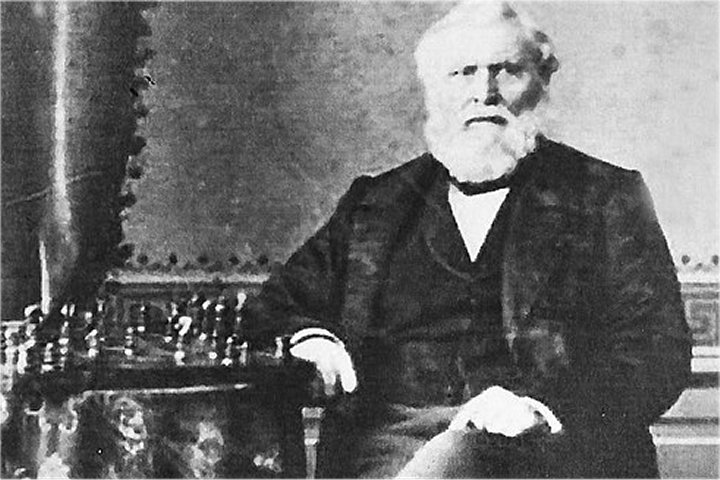

One of the best-known games featuring the Evans Gambit is Adolf Anderssen's victory over Jean Dufresne in 1852, the so-called "Evergreen Game". Garry Kasparov has annotated it.
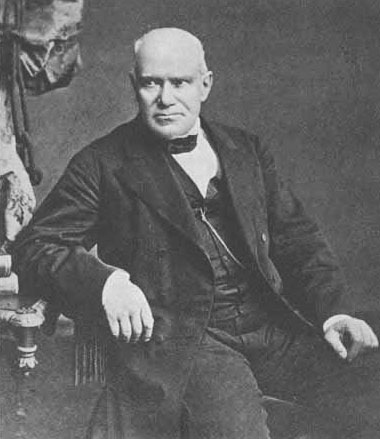
Adolf Anderssen (1818-1879)
Over time, however, Black found ways to respond to the Evans Gambit and, like the King's Gambit, it became an increasingly rare sight in grandmaster practice. The Evans Gambit never disappeared completely, though. Modern grandmasters still use it from time to time, as a surprise weapon - but perhaps also as a tribute to the games of the old masters that inspired them at the start of their chess careers.
Some modern world champions have occasionally turned to the Evans Gambit, although mostly in simultaneous exhibitions or in rapid and blitz chess. One of the best-known modern games featuring the Evans Gambit was played by Bobby Fischer. It became famous because Fischer included it in his book My 60 Memorable Games under the title "Shock Treatment" In his introduction to the game, Larry Evans writes:
After becoming one of the world's leading players, Fine gave up chess at the height of his career in 1945 to become a practising psychoanalyst; but he has lost none of his love for the game and little of his brilliance. The following game was one of seven or eight casual games played at his home in New York. Dr Fine appears, as far as one can judge, to have kept himself in reasonable form.
Here Fischer departs for the first time from his beloved Ruy Lopez and employs the daring gambit introduced a century earlier by Captain Evans. This tricky line has almost disappeared from the scene. Fine, although the author of several opening books, is understandably rusty, and once caught, he is unable to escape from his difficulties. Fischer produces a brilliant finish in 17 moves.
Fischer never played the Evans Gambit in a tournament game at classical time controls, however.
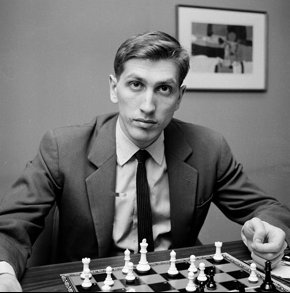
Bobby Fischer in 1962
Garry Kasparov, by contrast, did. In 1995, he used it to defeat Vishy Anand in just 25 moves at the Tal Memorial in Riga.
After his victory over Anand, Kasparov played the Evans Gambit once more in 1995 and defeated Jeroen Piket in 29 moves.

Garry Kasparov realised early on that databases would change the world of competitive chess | Photo: ChessBase
How much confidence Kasparov actually had in the Evans Gambit is difficult to say, however. After this game, he never tried it again with white, perhaps because he had found a line he did not like, or perhaps because the surprise value had worn off after his wins over Anand and Piket. Kasparov was known for taking openings seriously. Frivolous experiments with variations he did not believe in were not his style.
Magnus Carlsen is quite different. Carlsen is known for playing virtually anything and has tried all 20 possible first moves, from 1.a3 to 1.h4, in blitz games. Given that Carlsen knows chess history and the games of the old masters well, it is no surprise that he has also used the Evans Gambit. He scored a convincing win with it in a Banter Blitz match against Sanan Sjugirov.
Against Sjugirov, Carlsen played the Evans Gambit voluntarily; at an unusual tournament in Casablanca in 2024, he "had to" play the variation. At that event, the four participants - Carlsen, Anand, Hikaru Nakamura and Bassem Amin - were shown positions from historic World Championship matches, which they first had to identify and then continue in rapid games. Once again, Carlsen impressed with his strong chess memory and extensive knowledge of chess history. He knew that the position he was shown came from a World Championship match between Steinitz and Chigorin, and then went on to defeat Anand from that position in just 25 moves.

Motivated - Magnus Carlsen | Photo: Lennart Ootes (archive)
With a new ChessBase course and a new book, well-known English trainer and author Andrew Martin now invites players to follow in the footsteps of masters past and present and give the Evans Gambit a try. And who knows - perhaps it will lead to a winning or brilliant game or two. It does not need to be an "Evergreen" straight away.
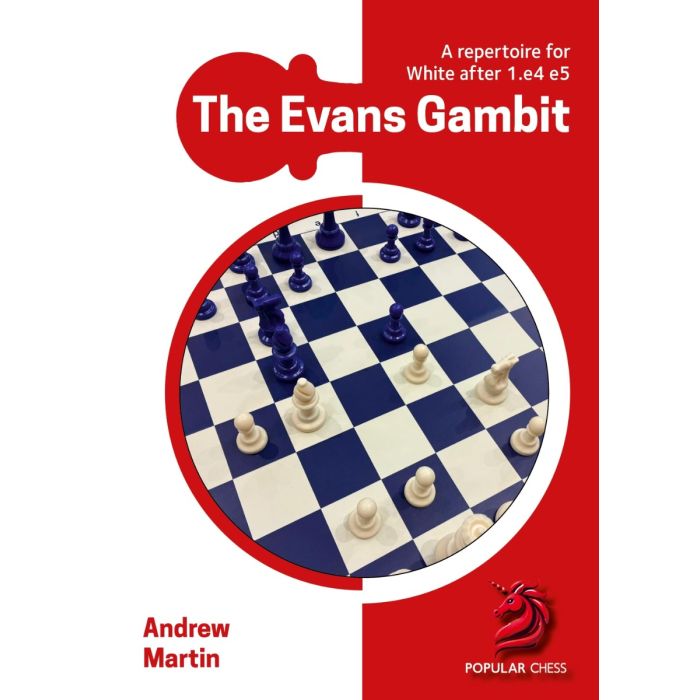
Andrew Martin: The Evans Gambit, A repertoire for White after 1.e4 e5, approx. €27.99