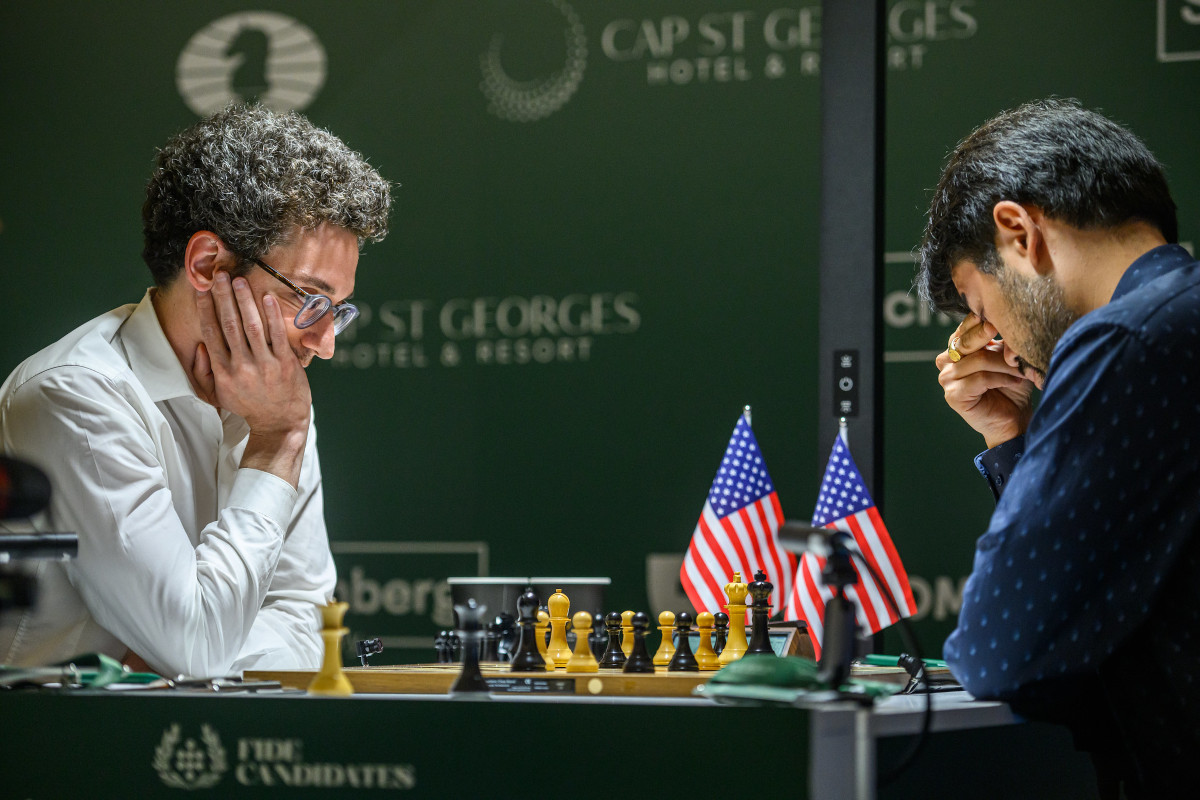
4/5/2026 – Drawing on a game from the previous Candidates, Hikaru Nakamura's win over Alireza Firouzja is revisited through a detailed analytical lens, leading to a study-like endgame. The position, refined after further work, offers a challenging exercise inspired by practical play. Alongside this, a brief statistical note highlights recurring opposite-coloured bishop endings in encounters involving Fabiano Caruana, adding context to recent Candidates battles. | Photo: FIDE / Michal Walusza (Candidates 2024)
new: ChessBase Magazine 225
Chess Festival Prague 2025 with analyses by Aravindh, Giri, Gurel, Navara and others. ‘Special’: 27 highly entertaining miniatures. Opening videos by Werle, King and Ris. 10 opening articles with new repertoire ideas and much more. ChessBase Magazine offers first-class training material for club players and professionals! World-class players analyse their brilliant games and explain the ideas behind the moves. Opening specialists present the latest trends in opening theory and exciting ideas for your repertoire. Master trainers in tactics, strategy and endgames show you the tricks and techniques you need to be a successful tournament player! Available as a direct download (incl. booklet as pdf file) or booklet with download key by post. Included in delivery: ChessBase Magazine #225 as “ChessBase Book” for iPad, tablet, Mac etc.!
YOUR PERSONAL CHESS COACH - Whether you’re taking your first steps into the world of club chess, or already playing at a tournament level: with FRITZ, you can train more efficiently, intelligently and with a more personalised approach than ever before. FRITZ is more than just a chess engine – it’s a training revolution! Whether you’re taking your first steps into the world of club chess, or already playing at a tournament level: with FRITZ, you can train more efficiently, intelligently and with a more personalised approach than ever before.
In this course, IM Nico Zwirs presents the Reversed Sicilian as a powerful and practical weapon for White
€39.90
A study-like endgame
[Note that Jon Speelman also looks at the content of the article in video format, here embedded at the end of the article.]
A fortnight ago, I was wondering which game(s) to put in my column in (the weekly British newspaper) The Observer, alongside a preview of the Candidates on the day of the first round. Normally, I would have used some battles between the two Americans, but since they were actually playing live that seemed odd. So instead I looked at their games from the previous Candidates in Toronto and also Praggnanandhaa's and eventually settled on Vidit Gujrathi's brilliant win as Black against Hikaru Nakamura, which went a long way to denying Nakamura tournament victory.
After more than a week of analysis on and off, I decided on this version of a study based on the game. There's also a second version with quite a long intro beforehand, which engines confirm is sound but is rather complicated. Please have a look and see where you can get with it. As you'll see, his White Majesty goes on quite a journey.
(After the introduction, you can always consult a tablebase if the resultant ending is too daunting.)
Grandmaster Dr. Karsten Müller, one of the world’s leading endgame experts, guides you step by step through everything you need to know in this second volume. Picture this: you’ve outplayed your opponent move by move, you’re clearly better – and then the endgame slips into a draw, simply because you lacked the crucial theoretical knowledge. That is exactly where this course comes in. Without solid endgame skills, there’s no way forward. Rook endgames are most essential: they occur more often than any other type of endgame, and often make the difference between victory and half a point. If you master them, you’ll confidently convert your advantages into wins!
Free video sample: Introduction
Free video sample: Bodycheck
I've analysed these in detail in the pgn below and on the video, and added the stem game Firouzja v. Nakamura.
I hope you are enjoying watching the Candidates as much as I am. One interesting thing I noticed is that in the first round, both now and in Vancouver, Caruana ended up with a queen, rook and white-squared bishop against Nakamura's queen, rook and dark-squared bishop.
I also remember Nakamura winning at least one game against Caruana when he had the dark-squared bishop as White, and wondered whether they have more games with opposite bishops than the average. I did a pretty crude test in my database and found that out of 300 odd games between them (no doubt many of then blitz), 80 odd had opposite bishops at some stage. So a bit more than 26%, which is a little more than average, I think.
The first-round battle between Fabiano Caruana and Hikaru Nakamura at this year's Candidates Tournament in Cyprus | Photo: FIDE / Michal Walusza
Select an entry from the list to switch between games
In this video course, Grandmaster Ivan Sokolov explores the fascinating world of King’s Indian and Pirc structures with colours reversed, often arising from the French or Sicilian. The King’s Indian Defence is one of the most dynamic openings in chess - and Pirc structures share much of the same DNA. With colours reversed (the King’s Indian Attack), these setups can be just as powerful. What may look modest at first often transforms into highly complex middlegames, where timing, precision, and a deep feel for dynamics make all the difference.
Free video sample: Introduction
Free video sample: Misplaced Pieces
Jonathan SpeelmanJonathan Speelman, born in 1956, studied mathematics but became a professional chess player in 1977. He was a member of the English Olympic team from 1980–2006 and three times British Champion. He played twice in Candidates Tournaments, reaching the semi-final in 1989. He twice seconded a World Championship challenger: Nigel Short and then Viswanathan Anand against Garry Kasparov in London 1993 and New York 1995.
YOUR PERSONAL CHESS COACH - Whether you’re taking your first steps into the world of club chess, or already playing at a tournament level: with FRITZ, you can train more efficiently, intelligently and with a more personalised approach than ever before.
The Nimzo-Indian has stood the test of time for over a century: Still a top choice for elite players today, from Magnus Carlsen to Praggnanandhaa, it remains one of Black's most reliable ways to fight for real chances against 1.d4 2.c4 3.Nc3.
1.c4 e5 2.Nc3 Bb4!? is an opening idea well worth considering. Black immediately threatens to double the pawns on c3 in the style of the Trompowski or Sicilian Grand Prix attack.
Italian Game Powerbase 2026 is a database and contains 8571 top class games from Mega 2026 and the Correspondence Database 2026, of which 479 are annotated.
Videos: Nico Zwirs discusses the Sicilian with 2…e6 3.d4 cxd4 4.Qxd4 Nc6 5.Qe3 Nf6 6.Nc3. Mihail Marin examines Sindarov’s 6.Ne5 in the Queen’s Pawn Defence. Plus the ‘Lucky bag’ featuring 41 analyses by Berg, Ftacnik, Gupta and many others.
If you're looking for a dynamic alternative to the Slav, Queen's Gambit Declined, or other mainstream systems, the Chigorin Defence offers exactly what modern tournament players need.
€34.90
We use cookies and comparable technologies to provide certain functions, to improve the user experience and to offer interest-oriented content. Depending on their intended use, analysis cookies and marketing cookies may be used in addition to technically required cookies. Here you can make detailed settings or revoke your consent (if necessary partially) with effect for the future. Further information can be found in our data protection declaration.
Pop-up for detailed settings
We use cookies and comparable technologies to provide certain functions, to improve the user experience and to offer interest-oriented content. Depending on their intended use, cookies may be used in addition to technically required cookies, analysis cookies and marketing cookies. You can decide which cookies to use by selecting the appropriate options below. Please note that your selection may affect the functionality of the service. Further information can be found in our privacy policy.
Technically required cookies
Technically required cookies: so that you can navigate and use the basic functions and store preferences.
Analysis Cookies
To help us determine how visitors interact with our website to improve the user experience.
Marketing-Cookies
To help us offer and evaluate relevant content and interesting and appropriate advertisement.




.jpeg)