





Part II · The Opening Courses
From Fundamentals to Theory
As with his series on calculation, Robert Ris is gradually building his portfolio into a collection of courses. While he initially produced individual opening courses, the release of Mastering Pattern Recognition in the Opening and Basic Opening Strategy marked a shift towards covering other important aspects of opening study. Alongside concrete opening theory, Ris now also teaches the strategic foundations needed to understand the openings. After all, only those who understand the ideas behind an opening can truly grasp it and, above all, respond effectively when an opponent deviates from known lines.
Ris is a true opening theory specialist who keeps up with new ideas and provides his viewers with concrete repertoires. At the same time, he regularly incorporates important aspects of strategic and positional play, such as which pieces to exchange, which pawn breaks determine the character of a position, where the typical tactical opportunities arise, and how to make the transition to the middlegame. This makes his courses highly interactive, encouraging viewers to think rather than simply follow variations. In doing so, he highlights what opening study should really be about: improving one's understanding of the middlegame.
Given the large number of Robert Ris's opening courses available on ChessBase, it was necessary to divide them into categories. This review therefore focuses on the fundamentals and the individual opening families (1.e4, 1.d4, etc.).
 In Mastering Pattern Recognition in the Opening (2019), Ris examines ten universal opening themes: the centre, lead in development, the king in the centre, neglected kingside development, poisoned pawns, captures towards the centre, premature castling, flank attacks, misplaced pieces and space advantage. The theoretical examples are followed by more than fifty interactive exercises and an additional database of illustrative games. Ris thus provides a kind of grammar of the opening. When faced with a surprise, players should not desperately search their memory for moves they have learned, but instead think in terms of positional features. This is the educational foundation of his entire opening series: teaching concepts rather than simply encouraging players to memorise moves.
Basic Opening Strategy (2023) takes an even more fundamental approach. In just over four hours, Ris explains the golden rules of opening play, the centre, development, king safety, the dangers of bringing out the queen too early, and the particular vulnerability of the f-pawn. Fifty exercises ensure that these rules do not become unquestioned dogmas. It is important to understand that chess is a highly concrete game, but one that follows certain general principles. Players who regularly leave their king in the centre risk having it stranded there and becoming the target of an attack.
The course is useful for beginners and lower-rated club players, while more advanced tournament players may find it more interesting as teaching material. Its strength lies less in original insights than in its systematic approach: first understand the rule, then examine the exceptions, and finally assess the specific position.
While the strategic fundamentals are essential for developing an understanding of chess positions, at the other end of the spectrum are concrete opening recommendations with precise analysis, which no serious player can do without. A Complete Black Repertoire against 1.d4 is based on the Queen’s Gambit Accepted and offers active solutions against the Trompowsky, London, Jobava, Torre, Colle, Veresov and Blackmar-Diemer systems. Around seven hours of video, twenty interactive exercises, ten training positions and more than 150 model games make for a remarkably comprehensive training package. Ris has not hesitated to include plenty of material, setting a standard he would follow in many of his later courses.
The choice of the Queen’s Gambit Accepted is particularly convincing. It allows Black to develop their pieces freely while requiring them to challenge White’s centre actively. This fits Ris’s general approach of playing solid openings with an active rather than passive mindset.

This approach is also evident in his various 60-minute courses, in which he presents numerous ideas against 1.d4.
Alongside an addition to his repertoire, there is a course on the central variation of the Queen’s Gambit Accepted, in which he examines 3.e4 b5!?. He also ventures into the Budapest Gambit, showing how Black can seize the initiative with the Fajarowicz Gambit.
From White’s perspective, he offers a short course on the Fianchetto Variation against the Semi-Slav. It provides a good overview of the main theoretical lines, although the 60-minute format naturally limits how comprehensively they can be covered.
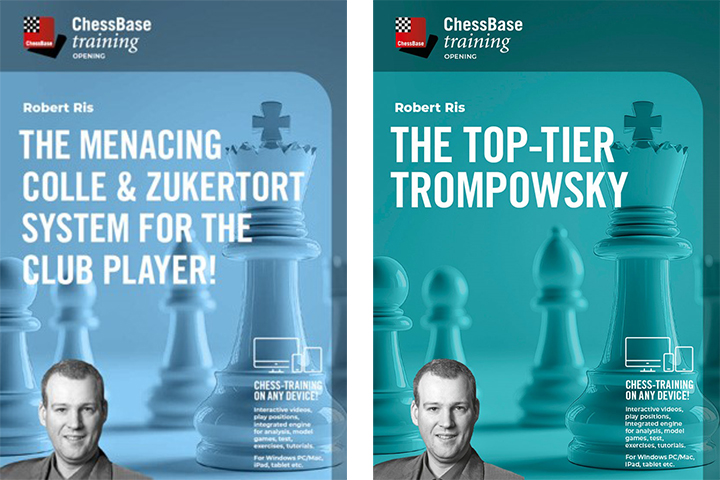 He achieves this, however, with The Menacing Colle & Zuckertort System for the Club Player, which offers a repertoire requiring little theoretical knowledge and based on understanding. What makes this course particularly appealing is that it does more than teach theory. In my view, it is organised around key themes, clearly illustrating the typical plans in the various structures Black can adopt. I consider it one of his best courses. The repertoire is complemented by The Top-Tier Trompowsky, which allows White to avoid these setups after 1...Nf6.
Opening Courses after 1.e4
Robert Ris has also produced a wide range of courses on openings beginning with 1.e4. While he explores a variety of individual ideas, a consistent approach and a preference for active play and the initiative run through all these courses.
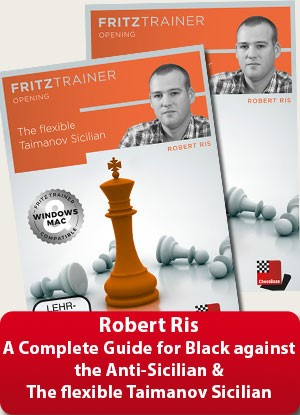 The Sicilian repertoire is similarly comprehensive, combining The Flexible Taimanov Sicilian and A Complete Guide for Black against the Anti-Sicilian, both from 2024. The Taimanov Variation offers Black winning chances without the structural commitments required by some of the sharper Sicilian lines. The accompanying Anti-Sicilian course fills a gap that often causes problems with opening repertoires in practice. The Alapin, Closed Sicilian, Grand Prix Attack and other sidelines occur more frequently in club chess than the attention devoted to the major main lines might suggest. The fact that Ris does not treat these sidelines as inconvenient footnotes, but devotes an entire course to them, is a clear mark of quality.
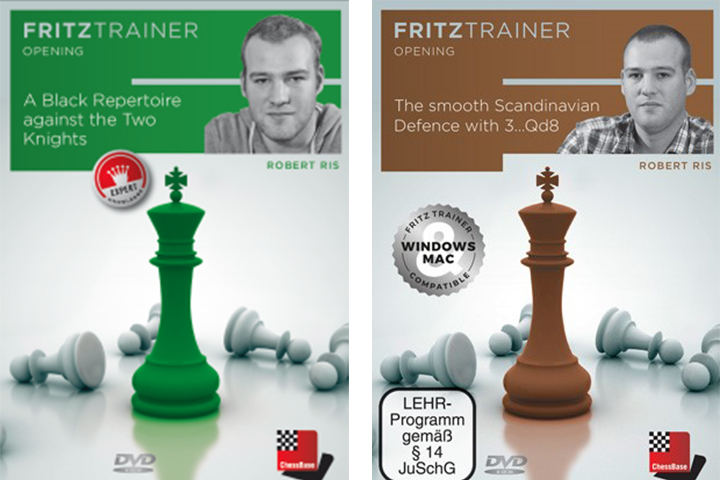 His preference for the Sicilian Defence is also evident in his recently released course on the Accelerated Dragon, which is reviewed separately. Beyond 1...c5, however, Ris also covers other openings, such as 1...e5 and the Open Games, as well as the Scandinavian Defence. In each case, he has developed ideas for Black in a full-length course, offering ready-made solutions against the king's pawn opening.
 The numerous 60-minute courses – for example, against the French Defence and the Philidor, or on the Delayed Schliemann Variation – form the more experimental side of his work. They show Ris as a collector of ideas and a tactical entertainer. Their purpose is clear: surprise weapons, blitz repertoires and creative additions. As the foundation of a long-term repertoire, they are considerably less suitable than his larger, more comprehensive courses. Buyers should therefore make a conscious distinction between a core repertoire and an occasional surprise weapon.
Additional Materials
The exercises and model games are particularly valuable because they can turn passive video watching into interactive training. An opening course has only been properly studied when a player can assess key positions without the help of a commentator. Ris generally provides better opportunities for this than authors who simply deliver lengthy lectures on opening theory.
One concern is how quickly concrete opening theory becomes outdated. A course from 2015 or 2019 may still be excellent in terms of concepts, while individual variations have since become obsolete. This applies to the Tactic Toolbox on the Meran Variation just as much as to any sharp repertoire recommendation. Ris's courses based on general themes age slowly; concrete main lines age quickly. Ideally, players should therefore treat the courses as an explained framework and use up-to-date reference databases to keep their repertoires current. Those unwilling to put in this work would be better off choosing courses on solid, reliable systems rather than the sharpest Sicilian variations.
Conclusion
Robert Ris has established a clear focus in his work, as reflected in his complete repertoires against both 1.d4 and 1.e4. The International Master also offers plenty of individual ideas and surprise weapons for players looking to expand their repertoires, although they should be aware of the risks associated with some of these variations.
 International Master Robert Ris (born in 1988) has represented his native Netherlands successfully at numerous youth championships. Today, he mainly works as a chess coach in schools and chess clubs and teaches students from various countries online at playchess.com. He has also worked as a live commentator at the Dutch Championship and the traditional tournament in Wijk aan Zee.
Robert Ris in the ChessBase Shop


| Advertising |











.jpeg)