Training calculation skills
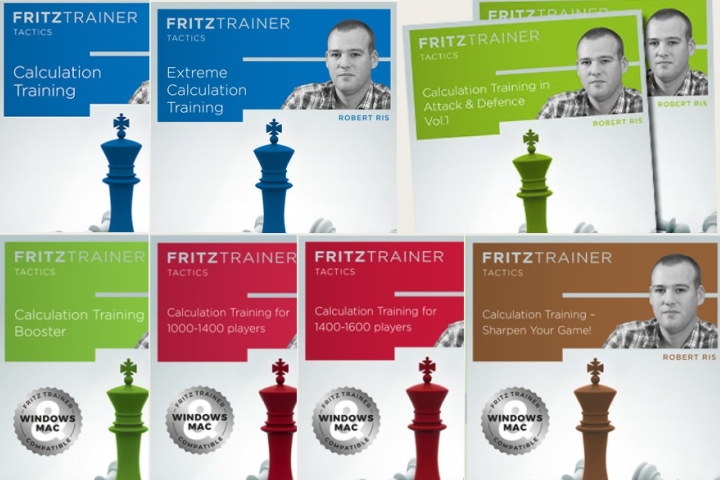
A look at Robert Ris' portfolio quickly shows that, alongside opening courses and an increasing number of middlegame courses on strategy, he has also expanded his work on calculation. Together with the other areas mentioned, this has become one of the main pillars of his course work for ChessBase.
While Robert Ris' body of work undoubtedly reveals an affinity for opening preparation, his courses devoted to training calculation technique also deserve considerable recognition. It should be noted that these largely cover the field of tactics, which applies both to his calculation courses and to his two-part series on mating attacks.
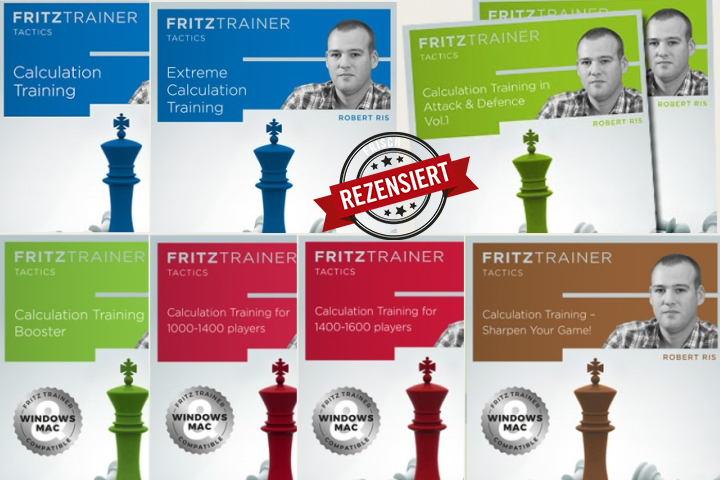
For an overview of Ris' various works, let us first list those that fall under the category of tactics and calculation:
- The Chess Player's Mating Guide Vol. 1: The King in the Centre
- The Chess Player's Mating Guide Vol. 2: Weakened Kingside
- Calculation Training
- Extreme Calculation Training
- Calculation Training in Attack & Defence Vol. 1
- Calculation Training in Attack & Defence Vol. 2
- Calculation Training Booster
- Calculation Training for 1000-1400 Players
- Calculation Training for 1400-1600 Players
- Calculation Training – Sharpen Your Game
What we see here is not a collection of unrelated individual courses, but rather a carefully designed, progressive training programme for calculation technique, an area that has received a genuine boost in popularity thanks to the generation of top Indian players including Praggnanandhaa, Erigaisi, Sarin and Vidit.
While the more recent courses are all intended to teach, deepen and refine calculation techniques, this somewhat older publication deals with two dynamic aspects that require precise calculation.
With Chess Player's Mating Guide, the title says it all: at the slightest sign of weakness, the opponent's king is to be dealt with quickly.
Ris distinguishes between two strategic situations that belong to a player's fundamental training:
- The uncastled or stranded king in the centre
- The attack against a weakened king position (primarily the castled position)
The attention will be paid to the castled king and in particular on ways of exploiting the weakened kingside. Several well-known themes, pawnformations and other attacking weapons are covered in 8 chapters.
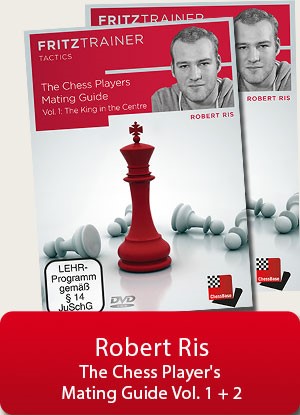 Here Ris teaches the fundamental techniques to bear in mind when attacking an uncastled king or a castled position. Various game examples are presented to demonstrate the different ways in which such advantages can be exploited. For example, how an uncastled king, where dynamic factors predominate, can be turned into a stranded king that represents a long-term weakness.
My personal favourite of the two volumes is undoubtedly the second, which examines attacks against a weakened king position. It offers a well-structured series of lessons that deeply investigates all kinds of weaknesses in the castled position. Where the opponent may see only a luft square, the diligent student will already sense attacking chances and recognise various patterns for launching an assault.
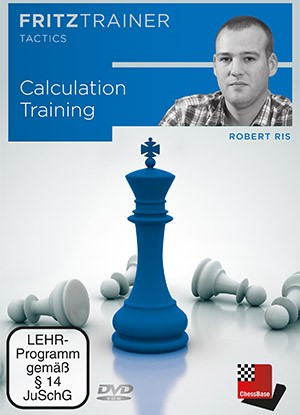
In March 2018, Robert Ris published his first FritzTrainer on calculation under the title Calculation Training, which could hardly have been simpler. I did not realise at the time that this course would not merely be an excursion into a new sub-area of tactics, but would instead mark the beginning of an entire series of courses.
This DVD emphasizes the importance of training your calculation skills. Dutch IM Robert Ris made a selection of training material which he uses in lessons with students ranging from 1400 to 2400.
The course follows the standard approach to training calculation in exemplary fashion. Rather than immediately overwhelming the student with exercises, the focus is placed on the craft itself, together with the various techniques that have proved useful and important when calculating.
The following techniques form the basic framework of a comprehensive approach to calculation, consistent with other publications:
 Forcing moves (checks, captures, threats)
- Method of elimination
- Visualisation
The basic course works with two main methods:
- First, forcing moves – checks, captures and threats – are examined systematically.
- Second, candidate moves are compared through elimination, so that the decision-making process does not become lost in a forest of seemingly equivalent possibilities.
This sounds elementary, but it is highly relevant for club players. In my many years of work as a trainer, I repeatedly see students make the mistake of following the first impulse that comes to mind and simply ignoring alternatives. Calculation errors often arise not because a long variation is technically impossible to work out, but because the wrong candidate move is chosen, the opponent's reply is underestimated, or the calculation is stopped too early.
Overall, this is a highly successful introductory course for further, long-term work on calculation, addressing what is essentially the core problem faced by many players. Many players invest considerable time in analysing openings with engines, but neglect the skill that makes every variation usable over the board in the first place. Ris therefore calls for the requirements of the position to be identified before calculation begins.
Extreme Calculation Training appeared later in 2018 as a follow-up course. It expands on the basic course with intermediate moves, quiet moves, sacrifices on empty squares, mating patterns, ignoring the opponent's threats, defensive calculation and the comparison method. Fifty interactive examples make clear that calculation is not synonymous with constantly forcing play. Quiet moves and prophylactic resources in particular compel the student to continue calculating beyond the first attractive-looking idea.
Special attention will be paid to Intermediate Moves, Quiet Moves, Sacrifices on Empty Squares, Mating Patterns, Ignoring Opponents Threat, Calculation in Defence and Method of Comparison. Plus 50 interactive examples to test your knowledge.
From a teaching perspective, this volume is more challenging. The demands placed on the student are higher. Rather than merely finding ideas, the aim is to understand calculation as a fluid process. This is another all-too-familiar and typical mistake: one finds a strong idea, assumes that it works, and fails to check either the opponent's best resistance or a surprising intermediate resource. Ris' role is to identify the point at which a player would normally stop calculating and become careless. As a result, the exercises imitate tournament decisions better than thematically pre-sorted tactical problems, where one already knows that a combination exists. A demanding but certainly worthwhile course.
Calculation Training in Attack & Defence Vol. 1 and 2 shifts the focus towards reciprocal thinking. The guiding question that I take from the course is whether one should respond to the opponent's threat, ignore it or turn the tables with a counterattack. Across 66 exercises with multiple questions, the student is asked not only to look for their own opportunities, but also to find defensive resources, counterchances and refutations of tempting replies.
This DVD emphasizes the importance of training your calculation skills. Dutch IM Robert Ris made a selection of training material which he uses in lessons with students ranging from 1400 to 2400.
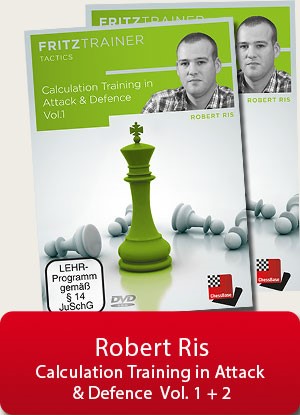 Attack and defence are generally phases of a game in which determination and accuracy are rewarded. If one commits only half-heartedly to an attack, it may prove insufficient or even backfire. Conversely, if one does not defend accurately enough, even a small mistake can trigger an avalanche from which there is no escape. Ris has created a demanding course on this subject which, from a trainer's perspective, is particularly interesting because many of the examples can be used both for calculation training and for studying the various motifs of attacking and defensive play. A treasure trove, in my view.
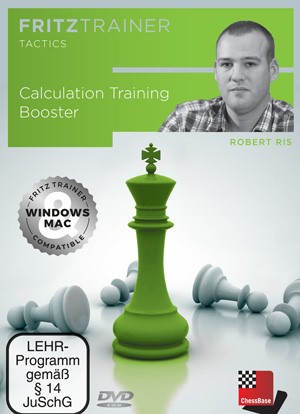 Calculation Training Booster, published in 2022, is designed to provide additional training material. Twenty-nine complex examples with multiple questions guide the student step by step through the demands faced by both sides. The title is by no means simply an exercise in recycling - instead, it offers fresh material within the established method. This makes sense from a teaching perspective. Rather than recycling exercises already used and, in the worst case, merely activating dormant memories, the aim is to deepen calculation skills with new material.
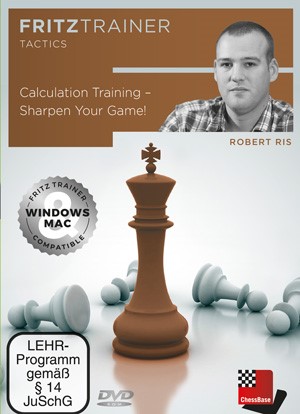
Calculation Training – Sharpen Your Game!, published in 2024, is a more extensive new version of this concept. Seventy-three examples and more than 160 questions are divided into blocks of increasing difficulty.
The themes range from simple tactics and trapped pieces to short variations, identifying weaknesses, defensive exercises and genuinely difficult tactical challenges.
The rating-based volumes: 1000-1400 & 1400-1600
Useful differentiation with blurred boundaries
The courses for players rated 1000–1400 and 1400–1600, published in 2023, fill an important gap. The first volume begins with double attacks, pins, discovered attacks, trapped pieces, interference and mating motifs. The second raises the level with, among other things, elimination of the defender, intermediate moves, combinations of motifs and longer variations. Together, they offer several hundred interactive questions and considerably more active training time than the nominal video length might suggest.
This differentiation is certainly important, since not every player starts out with an overview of all the necessary motifs. However, every player, regardless of rating, needs the correct technique. This rating-based series builds a necessary bridge and connects Ris' previous courses. Those who lack a grounding in the fundamentals or an overall overview can fill the gaps in their knowledge here, while the earlier courses can then deepen that understanding.
Conclusion
Since his first course in 2018, Ris has built a second major area of expertise alongside his reputation as an opening specialist. Studying calculation according to Robert Ris covers all the techniques needed for accurate analysis and is suitable for players across a very broad range of playing strengths. This means that both players and trainers can make unrestricted use of the material.
Highly recommended!
***
About the author:
 International Master Robert Ris (born 1988) successfully represented his native Netherlands in many youth championships. Today, he is primarily active as a chess trainer in schools and chess clubs, and coaches students from various countries online on playchess.com. He has also appeared as a live commentator for the Dutch Championship and the traditional tournament in Wijk aan Zee.
More products by the author are available in the ChessBase Shop
--> MORE REVIEWS <--















.jpeg)

.jpeg)