A Visual Makeover for a Familiar Training Companion
I was introduced to ChessBase products many years ago through an old version of Fritz that my first chess club kept in its equipment cabinet. At the time, my playing strength was not yet sufficient to appreciate what the program had to offer, but later versions, together with the ChessBase database program and Mega Database, soon became a permanent part of my chess software.
From the very beginning, the roles were clearly defined. ChessBase was my tool for database management and reference searches, while Fritz was where I turned for training. My expectations were straightforward: the program should not only analyse positions but also train, explain and support my long-term chess improvement. It was precisely this combination of powerful analysis and practical training that consistently set Fritz apart from other chess programs.
EXPAND YOUR CHESS HORIZONS
Data, plans, practice – the new Opening Report In ChessBase there are always attempts to show the typical plans of an opening variation. In the age of engines, chess is much more concrete than previously thought. But amateurs in particular love openings with clear plans, see the London System. In ChessBase ’26, three functions deal with the display of plans. The new opening report examines which piece moves or pawn advances are significant for each important variation. In the reference search you can now see on the board where the pieces usually go. If you start the new Monte Carlo analysis, the board also shows the most common figure paths.
The premiere chess database with over 11.7 million games
The ChessBase Mega Database 2026 is the premiere chess database with over 11.7 million games from 1475 to 2025 in high quality.
Over the past few years, however, the chess world has changed fundamentally. The introduction of neural-network engines such as Leela Chess Zero, the dominance of Stockfish NNUE (NNUE is a special neural-network architecture), and the worldwide chess boom driven by the pandemic and popular streaming platforms have significantly raised expectations of modern chess software. Today, analysis programs are expected to do much more than calculate variations. Players increasingly look for complete training solutions with intelligent training methods, extensive customization options, motivating learning concepts, and a user interface that feels as natural as possible.
At a time when anyone can easily install the latest chess engines, a product line like Fritz needs other strengths to remain competitive. In Fritz 21, I see two major developments:
Optics and functionality
This review will focus primarily on functionality, although the visual redesign deserves attention as well. After all, a modern appearance is part of the overall experience.
Modern design and a clear direction
Today, the value of a new chess program is rarely determined by the playing strength of its built-in engine. Since Stockfish and other modern open-source engines have long surpassed human playing strength, commercial programs are distinguished mainly by their features, ease of use, and training concepts. Personally, I like the direction Fritz 21 has taken. The focus of the product line is increasingly shifting towards more interactive, more personalized, and more motivating training.
In this context, training personalization and artificial intelligence as a training partner—already familiar from my review of ChessBase 18—play an increasingly important role throughout the product range.
Your personal chess trainer. Your toughest opponent. Your strongest ally.
With this combination, you can’t go wrong: the comprehensive chess program Fritz 20 plus the latest opening theory from Powerbook 2026! FRITZ 20 is more than just a chess engine – it’s a training revolution for ambitious players and professionals. Together with Powerbook 2026, Fritz allows you to practise openings at every level and in every area. Whether you’re taking your first steps into the world of serious chess training or already playing at tournament level: with FRITZ 20, you’ll train more efficiently, intelligently and individually than ever before!
The Style Engine and animated player types
One of the more interesting features of Fritz 21 is the new Style Engine with its animated player types. Instead of always aiming for the objectively best move according to the engine, users can adjust various parameters that shape the engine's playing style. For example, you can choose whether you want to face an endgame specialist, a tactical wizard, or an opening expert.
Although I cannot judge how accurately these parameters reflect real playing styles, the engine does display noticeable tendencies in certain phases of the game and at critical moments. This makes it an interesting feature for home training and also adds an enjoyable element to the overall playing experience. The underlying idea is to adapt your training games against Fritz to the style of a future opponent, allowing your preparation to reflect real-game decision-making as closely as possible.
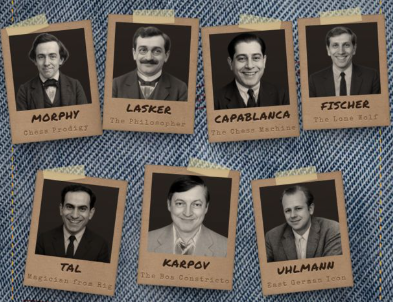
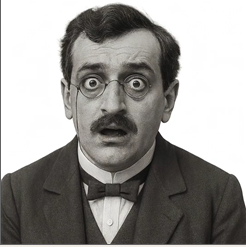
At first glance, the various VIP personalities such as Lasker, Fischer, and Tal are an appealing addition, as they react visibly to the evaluation of the position. At times, however, it is hard to tell whether the look of shock in Lasker's eyes is meant to reflect genius or sheer bewilderment.
This also highlights some of the typical shortcomings of AI-generated images. Their expressions occasionally seem out of place, and they are not entirely free of odd facial twitches. Overall, though, they are an enjoyable addition, and once you get used to their quirks, they add a fair amount of fun to the experience.
More significant, however, are the occasional inaccuracies in the live commentary feature, which provides feedback while you are playing. At times it produces rather curious mistakes. For example, Mr Lasker tried to convince me that the following position had arisen from the Queen's Indian Defence.
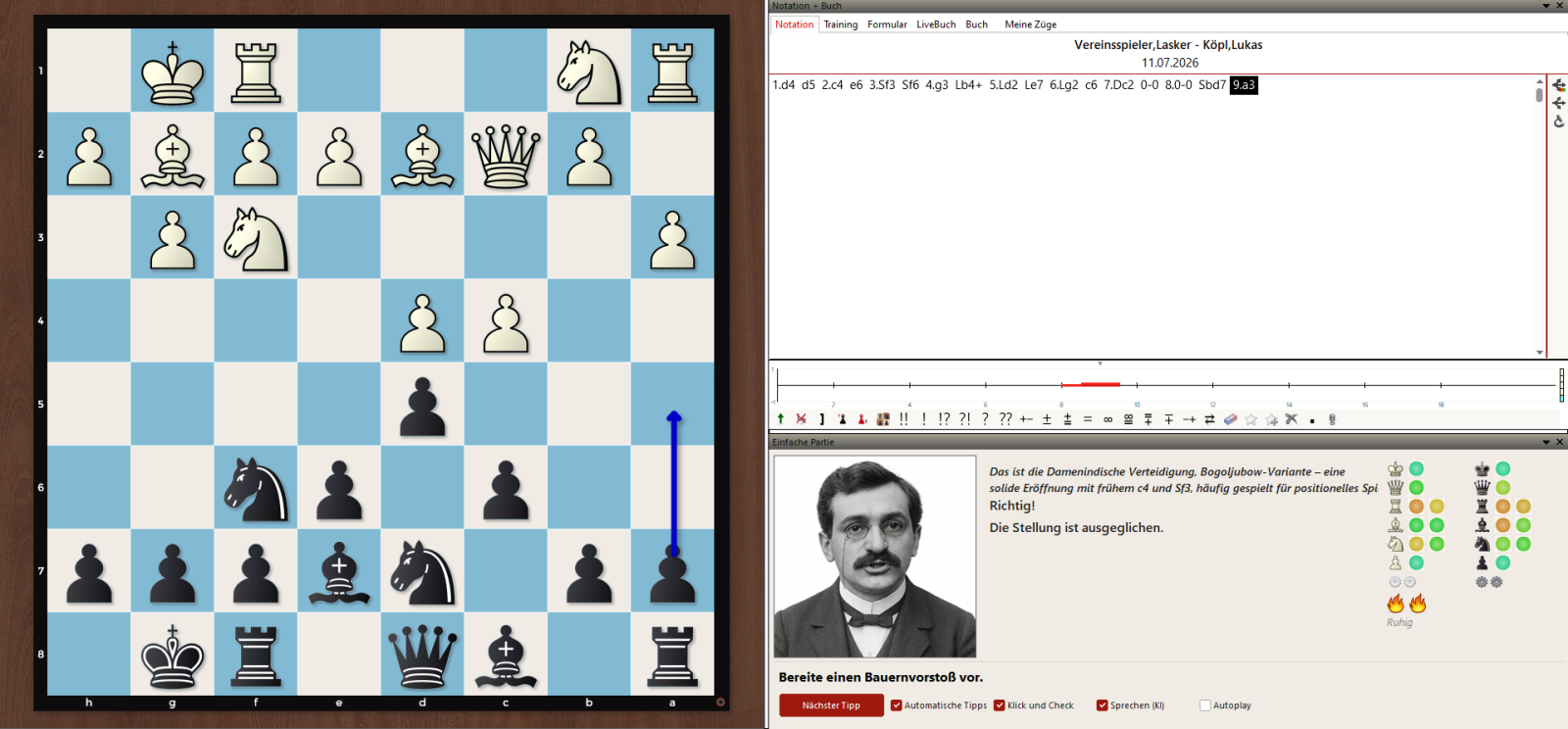
According to Lasker, this position arose from the Bogoljubow Variation of the Queen's Indian Defence.
Modernized user interface – Less clutter, better overview
One criticism of earlier Fritz versions was that the user interface had gradually become overloaded. Over the years, more and more features had been added, leaving some menus crowded and making it difficult for newcomers to find the most important tools quickly.
Fritz 21 expands the range of visual customization options, allowing users to personalize the interface even further. As recently demonstrated in ChessBase's interview series, different players have different preferences when it comes to board colours and layouts. Fritz 21 now offers even more options, making it easy to tailor your home training environment to your own visual preferences.
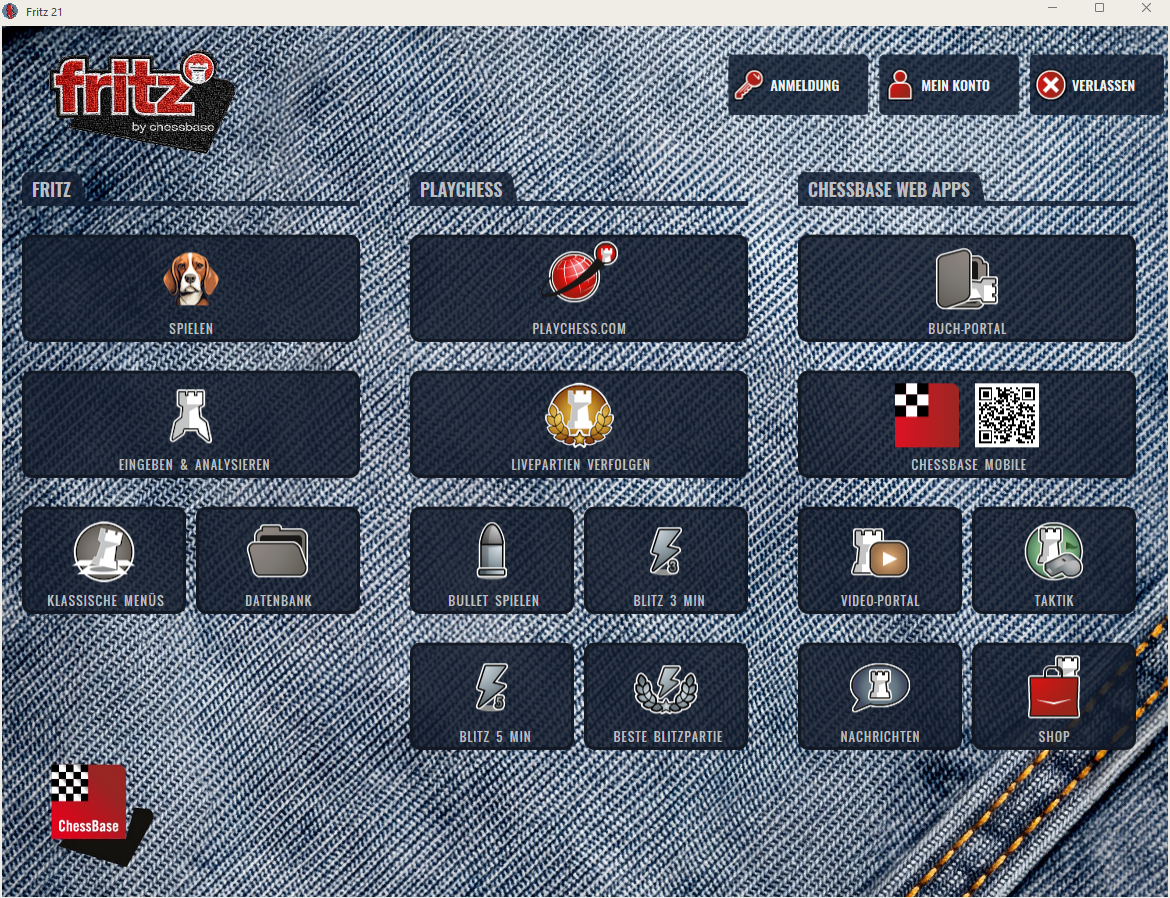
The overall look and feel is also noticeably more modern and clearly aimed at a younger audience.
New Peak Rating
With an increase of 40 Elo points, the developers have boosted the engine's playing strength once again, bringing it to an impressive 3620 Elo. For games against human opponents, this is certainly overkill, but for home analysis and engine comparisons, the extra strength can make a real difference. In any case, it is a welcome improvement.
Bullet and Blitz Training – Making Decisions Under Time Pressure
Another interesting addition is training under specific time controls. As competitive chess continues to shift towards faster formats—not least encouraged by the views of former World Champion Magnus Carlsen—targeted training for rapid decision-making has become increasingly important.
I found the Bullet training particularly interesting because, with the appropriate settings, the engine seems to play in a more human manner and is no longer completely infallible when it comes to tactical mistakes.
I am FRITZ and have been redefining the chess world for over 30 years.
The chess program for beginners who just want to have fun with chess: Play against Fritz or online, intelligent tips, cheeky sayings, easy to use, reasonable price! Note for Fritz fans: this program is not a further development of Fritz18 and is not compatible!
Improved Analysis Functions – More Efficient Rather Than More Spectacular
Fritz 21 also introduces a number of targeted improvements to game analysis. Alongside the Monte Carlo analysis, which I already discussed in my review of ChessBase 18, users can choose between a full game analysis and an analysis focused specifically on tactical mistakes. It is also possible to compare the output of different engines and to replay key positions identified during the analysis in order to improve one's understanding of similar positions in the future.
Once again, this underlines that Fritz is designed less as a database management program and more as a dedicated training tool intended to support post-game analysis.
Tactics and Visualization Training
Another feature I particularly like is the continued improvement of the training module for calculation, tactics, and visualization. Users can choose between the following training modes:
- Assisted Calculation Training
- Evaluated Calculation Training
- Tactical Calculation Training
Players who still need guidance with calculation will find helpful hints in the Assisted Calculation Training mode, which offers support on how to approach a position. As this assistance is gradually reduced, those who still want feedback can switch to Evaluated Calculation Training, which scores their calculation and provides feedback on strong moves as well as mistakes.
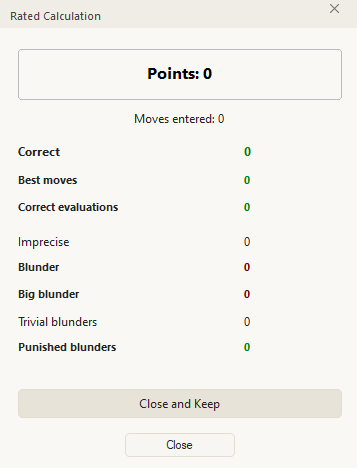
Evaluated Calculation Training – Feedback on Your Calculation Skills
Another useful feature is the option to play through a position blindfold. The pieces and pawns are hidden, allowing users to test their visualization skills. It is a feature I have spent quite a bit of time experimenting with recently, and one that I find genuinely worthwhile.
Criticism and Suggestions for Improvement
Despite its many strengths, Fritz 21 is not without its shortcomings.
- Some of the new features reveal their full potential only when used together with ChessBase's online services. Users who prefer to work entirely offline will therefore not be able to make full use of the software.
- As with any commercial chess program, the question of value for money inevitably arises. Since powerful engines are freely available, the added value has to come from convenience, training quality, and the overall user experience. Fritz 21 largely succeeds in these areas, but not every user will see sufficient reason to upgrade, especially if they already own Fritz 20 or a recent version of ChessBase.
- Finally, despite all its progress, the Style Engine remains a simulation. The different playing styles are recognizable, but they cannot replace a human training partner capable of genuine psychological decisions and creative ideas.
After taking a detailed look at the new features and testing the program in practice, one central question remains: is Fritz 21 simply another update of a long-established chess program, or does it represent a significant step forward in the evolution of digital chess training?
My answer is a nuanced one. Fritz 21 is not a revolution that fundamentally changes chess training. The market is already dominated by free top-level engines, online platforms, and AI-based training tools. At the same time, it would be unfair to dismiss the new version as nothing more than a routine feature update. ChessBase has taken the Fritz series in an important new direction: away from being merely an analysis program and towards becoming a more comprehensive training environment that is better tailored to the needs of human players.
Learn to think strategically, try out tricky mental exercises and master fun and exciting challenges – all with a generous helping of chess knowledge.
It is precisely this shift in perspective that, in my opinion, is the strongest argument in favour of Fritz 21.
That said, I do have a few suggestions for future development. One would be closer integration and better communication between different ChessBase products, such as ChessBase 18. Instead of having to work with two separate programs in parallel, I would like to see seamless interaction between them, allowing Fritz to serve as the dedicated training and analysis partner while ChessBase remains the central database management tool.
There is also one feature that I have long been missing in ChessBase 18: the ability to classify positions according to specific criteria, such as the difficulty level of exercises. Many users currently use medals for this purpose, but that is really a workaround rather than a genuine solution.
As a coach, I also see Fritz 21 as a tool for filtering games according to training themes and turning them into training exercises. A useful addition would be the possibility of assigning a value from 1 to 5 to a position or an entire game in a database—perhaps even represented by chess pieces. This would make it much easier to dissect one's own games in greater depth and identify clear training objectives.
Conclusion
Pros
✓ More personalized training through different playing styles
✓ Excellent combination of playing, analysis, and learning
✓ Modern, cleaner user interface
✓ Extensive training features
✓ Suitable for players of all skill levels
✓ Highly practical for everyday use
Cons
✗ No revolutionary technological breakthrough
✗ Some features reveal their full potential only with online services
✗ The AI assistant is prone to basic mistakes
After several weeks of intensive use, I can confidently say that Fritz 21 is a consistent evolution of one of the world's best-known chess software brands. It continues the direction established by recent versions of the program. ChessBase's greatest achievement is not the development of an even stronger engine, but the redefinition of the software's role—and to a large extent, it succeeds. The new features enrich home training by bringing together a wide range of training methods within a single program.
Fritz 21 clearly positions itself as a personal chess coach, a role it continues to grow into. Although some weaknesses remain, I very much like the direction in which the software is developing. Overall, I am looking forward to making Fritz 21 a regular part of my training from now on.




.jpeg)