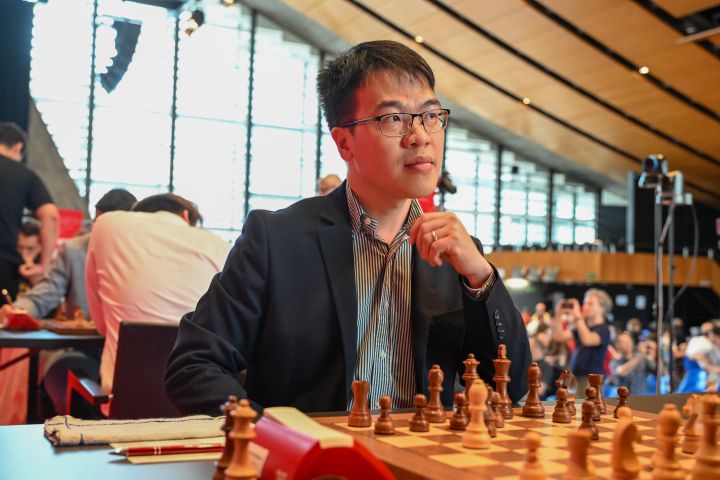
7/15/2026 – The first round of classical chess in the Masters and the Generations Challenge Triathlons at the Biel International Chess Festival was played on Tuesday. Each event produced two draws and one winner. Matthias Bluebaum (pictured) drew his game against Yagiz Kaan Erdogmus, while Le Quang Liem defeated Jose Martinez. In the Generations Challenge, Alexandra Kosteniuk beat Carissa Yip. In the Masters Open, Christian Gloeckler surprisingly dropped half a point as early as round two. | Photo: Biel Chess Festival
new: ChessBase Magazine 225
Chess Festival Prague 2025 with analyses by Aravindh, Giri, Gurel, Navara and others. ‘Special’: 27 highly entertaining miniatures. Opening videos by Werle, King and Ris. 10 opening articles with new repertoire ideas and much more. ChessBase Magazine offers first-class training material for club players and professionals! World-class players analyse their brilliant games and explain the ideas behind the moves. Opening specialists present the latest trends in opening theory and exciting ideas for your repertoire. Master trainers in tactics, strategy and endgames show you the tricks and techniques you need to be a successful tournament player! Available as a direct download (incl. booklet as pdf file) or booklet with download key by post. Included in delivery: ChessBase Magazine #225 as “ChessBase Book” for iPad, tablet, Mac etc.!
YOUR PERSONAL CHESS COACH - Whether you’re taking your first steps into the world of club chess, or already playing at a tournament level: with FRITZ, you can train more efficiently, intelligently and with a more personalised approach than ever before. FRITZ is more than just a chess engine – it’s a training revolution! Whether you’re taking your first steps into the world of club chess, or already playing at a tournament level: with FRITZ, you can train more efficiently, intelligently and with a more personalised approach than ever before.
In this video course experts examine the games of Steinitz. Let them show you which openings Steinitz chose, where his strength in middlegames were, how he outplayed his opponents in the endgame & you’ll get a glimpse of his tactical abilities!
€34.90
Le and Kosteniuk winners of the day
At the start of the classical phase, it was not only the decisive games in the Masters and the Generations Challenge that were exciting: both Yagiz Kaan Erdogmus in his game against Matthias Bluebaum and Vaishali Rameshbabu in her duel against Xiao Tong got into time trouble and had to find six precise moves under pressure. Both found good moves and drew – Vaishali even did so with the few seconds she had left to find the decisive move.
In less dramatic encounters, Le Quang Liem in the Masters and Alexandra Kosteniuk in the Generations Challenge section scored victories, both with the black pieces and made big jumps forward in the standings – not least because a win is worth 4 points and a draw only 1½ points in this section of the triathlons.
This compact course is designed specifically for practical play. Instead of overwhelming you with endless theory, it focuses on the critical lines, typical plans, and recurring tactical ideas. Looking for an opening that gets your opponents thinking on move one? Grandmaster Andy Woodward has relied on 1.b3 for years in blitz and bullet, using it to defeat strong masters and grandmasters who underestimated its hidden venom. While many players dismiss the opening as harmless, they often find themselves caught in unfamiliar positions, tactical traps, and uncomfortable middlegames. This compact course is designed specifically for practical play. Instead of overwhelming you with endless theory, it focuses on the critical lines, typical plans, and recurring tactical ideas that matter most when the clock is ticking.
Free video sample: Introduction
Free video sample: King's Indian Setup
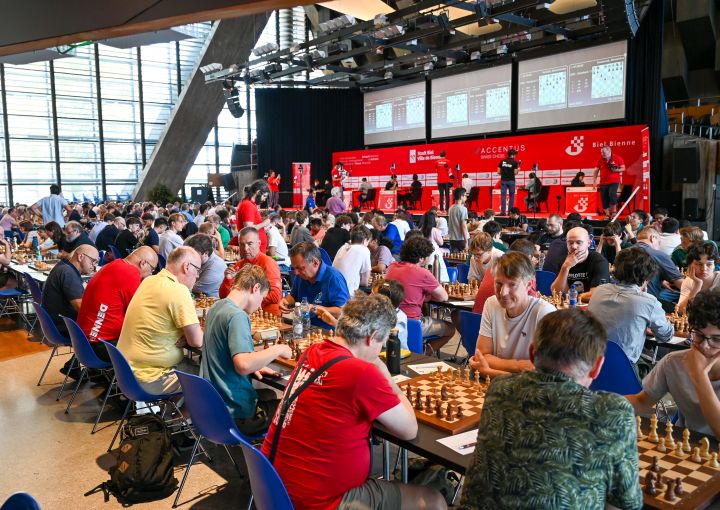
A view of the playing hall in Biel | Photo: Biel Chess Festival
Masters: Le now second behind Aronian
As the only winner of the day, the Vietnamese player naturally made a significant jump in the Masters standings, moving from penultimate place to second. Against Jose Martinez, Le, playing with black, showed excellent preparation and played his first 22 moves in under a quarter of an hour, while his opponent had already used 80 of his 120 minutes. The advantage Le had built up not only on the clock but also on the board was converted into a win after 36 moves, when his opponent resigned.
Levon Aronian remains at the top of the standings, after agreeing to a quick draw by repetition with Aydin Suleymanli in the duel between the two players who led the standings after the rapid section. Aronian thus retains the lead with 10½ points, while Suleymanli slips to third place on 7½ points. Le moved past him into second place, as he has half a point more than the Azerbaijani.
The remaining game of the day, between Matthias Bluebaum and Yagiz Kaan Erdogmus, also ended in a draw, a result that is unlikely to have been fully satisfactory for either player. Erdogmus got into serious time trouble in a position that did not particularly favour him, and had to play 17 moves in 7 minutes - the last 6 of them in under a minute. Nevertheless, he still managed to reach a winning position, but Bluebaum was able to steer the game into a threefold repetition!
Chess is a concrete game. There is no way around training your calculation skills. Improve your visualization, pattern recognition and learn calculation techniques such as reciprocal thinking with this course. Calculation is at the heart of practical chess. Every chess concept builds on proper calculation technique. Therefore, all chess players should continuosly train the fundamental techniques, concepts and patterns this course will present. The goal isn't only to teach you to calculate, but to give you the tools and insights to keep improving long after the final lesson.
Free sample video: Introduction
Le Quang Liem was the only winner at the start of the classical section of the Masters | Photo: Biel Chess Festival
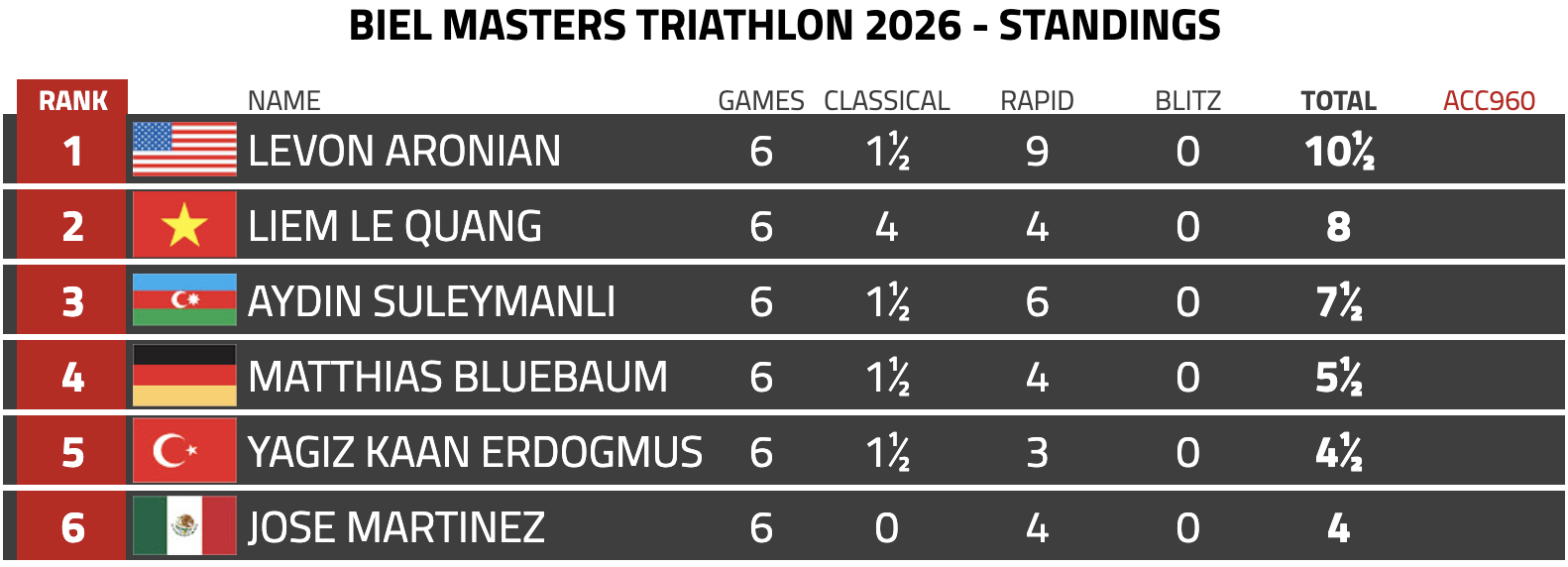
Round one results
All classical games - Masters
Addendum to the rapid tournament: Daniel King analyses Aronian v Bluebaum.
Generations Challenge: Draw at the top, Kosteniuk catches up
There was even more drama in the Generations Challenge: the two youngest players in the Challenge, Marco Materia and Vaclav Finek, agreed to a draw after several pieces had been exchanged – this after 27 moves. It was a satisfactory result for both, as it secured their top places in the standings. But the two youngsters had evidently forgotten the tournament regulations: these state that players may only agree to a draw after 40 moves at the earliest. So the two had to put the pieces back on the board and continue playing – before agreeing to a draw again after 40 moves.
Doesn’t every chess game get decided by mistakes? Absolutely. But most players never truly comprehend that they are making the same kind of mistakes over and over again.
The game between Xiao Tong and Vaishali Rameshbabu was more hectic: on move 29, Vaishali gained a bishop - but she had only 6 minutes left on the clock. The Indian player managed to make it to move 40, but she was unable to convert the position into a win.
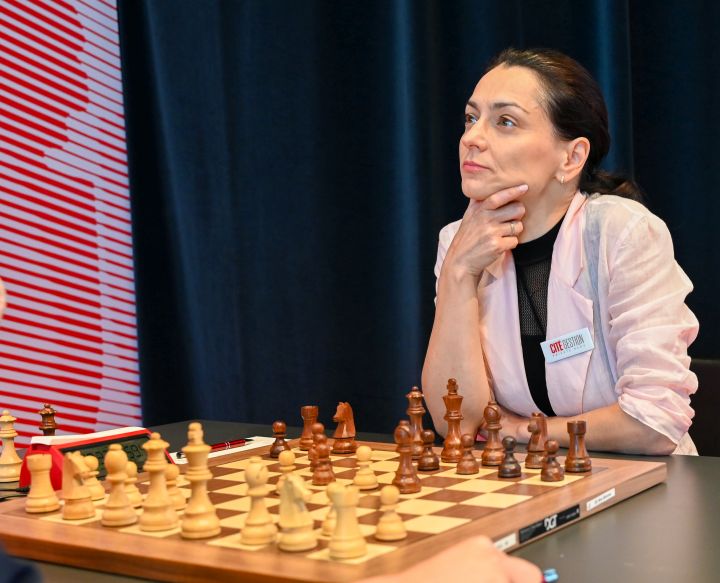
The Swiss representative scored an important win with black against Carissa Yip: Alexandra Kosteniuk collected 4 points on Tuesday | Photo: Biel Chess Festival
Alexandra Kosteniuk was able to benefit from the two drawn games. The Swiss representative gradually took control of the game against Carissa Yip in the middlegame and built up a steadily growing advantage. After 58 moves, Yip had to resign. Thanks to this win, Kosteniuk gained ground in the standings and moved closer to the leading trio.
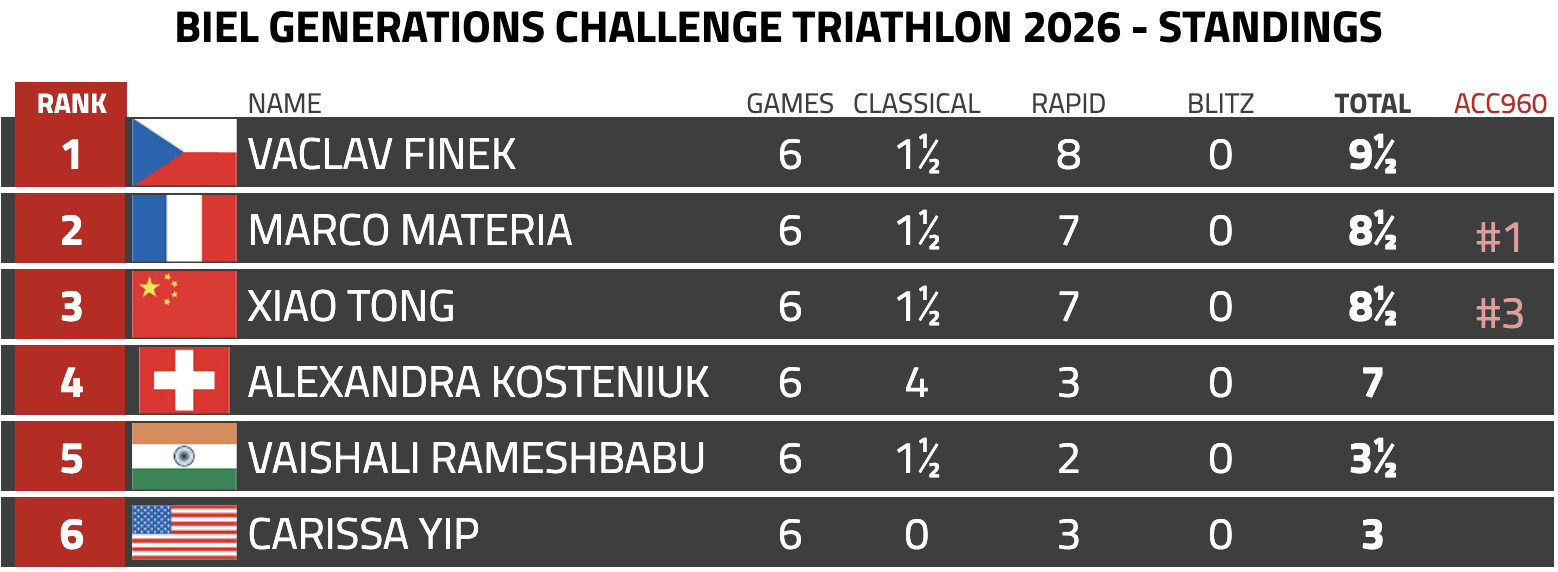
Round one results
All classical games - Generations Challenge
Still 16 players with perfect scores in the MTO
Already in the second round of the Biel Masters Open, some of the highest-rated players were strongly challenged by nominally weaker opponents: Indian GM Gopal G.N. had to settle for a draw against his compatriot WIM Ivana Maria Furtado, while German super-talent IM Christian Gloeckler also drew against CM Ling Chenxuan from the USA, who, born in 2014, is likewise a major promise for the future. Things went better for Gloeckler in his first-round game, which he analyses here for ChessBase:
This DVD focuses on several types of material imbalances, such as Rook vs 2 Pieces, Queen vs 2 Rooks, and Queen vs Pieces.
A local player produced the biggest surprise: WGM Lena Georgescu from Bern defeated grandmaster Krishnan Sasikiran, a player rated almost 300 Elo points higher than her, in 38 moves | Photo: Biel Chess Festival
Doesn’t every chess game get decided by mistakes? Absolutely. But most players never truly comprehend that they are making the same kind of mistakes over and over again.
Date
11-24 July 2026
Format
Chess triathlons with 6 participants each
System
Classical: 5 rounds (first legs) + 3 rounds (final: return games with the top four players). Rapid: 5 rounds (with colours reversed from the classical first legs). Blitz: 10 rounds
Time control
Classical: 120' for the first 40 moves, then 30' for the rest of the game, with a 30'' increment per move from move 41. Rapid: 15'+5'' per move. Blitz: 3'+2'' per move
Scoring
Classical: win 4 points; draw 1.5 points; loss 0 points. Rapid: win 2 points; draw 1 point; loss 0 points. Blitz: win 1 point; draw 0.5 points; loss 0 points.
Tiebreak
The final standings are determined by adding together the points scored in the three sections (classical+rapid+blitz). In the event of a tie, the final standings of the ACCENTUS Chess960 decide the ranking for the prizes.
Schedule
10 July
20:00
Reception of participants - toast at the Congress Centre
11 July
11:30
Opening ceremony at the Congress Centre
11 July
14:00
ACCENTUS Fischer Random rapid tournament
12 July
14:00
Rapid games of the Masters & Generations Challenge
13 July
14:00
Visit to Omega with the Masters & Generations Challenge participants
14-18 July
14:00
Classical games of the Masters & Generations Challenge
19 July
14:00
Blitz games of the Masters & Generations Challenge
20 July
Rest day
21-23 July
14:00
Final rounds of the Masters & Generations Challenge (classical games)
24 July
10:30
Closing ceremony with prize-giving and apéritif at the Congress Centre
Stefan LiebigStefan Liebig, born in 1974, is a journalist and co-owner of a marketing agency. He now lives in Barterode near Göttingen. At the age of five, strange pieces on his neighbour’s shelf aroused his curiosity. Since then, the game of chess has cast a spell over him. Flying high in the NRW youth league with his home club SV Bad Laasphe and several appearances in the second division team of Tempo Göttingen were highlights for the former youth South Westphalia champion.
7/15/2026 – The Biel International Chess Festival is taking place on 11-24 July. Following the Chess960 tournament on Saturday and the rapid chess stage on Sunday, the players in the Masters and Generations Challenge Triathlon face off in the first segment of the classical section on 14-18 July. | Follow the games live starting at 14.00 CEST (8.00 ET, 17.30 IST) | Photo: Biel Chess Festival
7/9/2026 – The 59th edition of the Biel International Chess Festival begins on the weekend of 11 July. Participating are chess greats such as Levon Aronian, Yagiz Kaan Erdogmus and Matthias Bluebaum in the Masters Triathlon, as well as Vaishali Rameshbabu and Alexandra Kosteniuk in the Generations Challenger. In both invitational events, games will be played in a triathlon system featuring blitz, rapid and classical games. | Photo: Nils Rohde / ChessBase
After 1.d4 d5 many players with White avoid the great amount of theory in the Slav, Semi-Slav, QGA and Orthodox Queen's Gambit and do not therefore play 2.c4. This is not very ambitious, but the painful experience of many chess players has been that the Colle System, the Trompowsky Attack, the Torre Attack and the London System are nevertheless extremely dangerous. Black has to be prepared for each of these openings and IM Valeri Lilov offers you some help with his six instructive videos, in which he demonstrates for each single opening a relevant plan for Black. In addition to the openings mentioned, the Bulgarian trainer also delves into the Catalan, the Blackmar-Diemer Gambit and the Richter-Veresov Opening.
YOUR PERSONAL CHESS COACH - Whether you’re taking your first steps into the world of club chess, or already playing at a tournament level: with FRITZ, you can train more efficiently, intelligently and with a more personalised approach than ever before.
The Hyper-Accelerated Dragon is fast, from the very first moves, your bishop heads to g7, seizes the long diagonal, and turns into the most feared piece on the board.
It rewards players who love initiative and clear attacking plans.
The Hyper-Accelerated Dragon is fast, from the very first moves, your bishop heads to g7, seizes the long diagonal, and turns into the most feared piece on the board.
It rewards players who love initiative and clear attacking plans.
The Hyper-Accelerated dragon is fast, from the very first moves, your bishop heads to g7, seizes the long diagonal, and turns into the most feared piece on the board.
It rewards players who love initiative and clear attacking plans.
“Mate is great!” – Tactical training with Oliver Reeh, “The 8th rank” – Andy Woodward analyses his game against Magnus Carlsen from TePe Sigeman 2026, “A modern Nimzo-Indian” – Andrei Volokitin introduces readers to "his" system and much more!
Chess is a concrete game. There is no way around training your calculation skills. Improve your visualization, pattern recognition and learn calculation techniques such as reciprocal thinking with this course.
This compact course is designed specifically for practical play. Instead of overwhelming you with endless theory, it focuses on the critical lines, typical plans, and recurring tactical ideas.
Slav and Semi-Slav Powerbase 2026 is a database and contains a total of 11 766 games from Mega 2026 or the Correspondence Database 2026, of which 1136 are annotated.
€9.90
We use cookies and comparable technologies to provide certain functions, to improve the user experience and to offer interest-oriented content. Depending on their intended use, analysis cookies and marketing cookies may be used in addition to technically required cookies. Here you can make detailed settings or revoke your consent (if necessary partially) with effect for the future. Further information can be found in our data protection declaration.
Pop-up for detailed settings
We use cookies and comparable technologies to provide certain functions, to improve the user experience and to offer interest-oriented content. Depending on their intended use, cookies may be used in addition to technically required cookies, analysis cookies and marketing cookies. You can decide which cookies to use by selecting the appropriate options below. Please note that your selection may affect the functionality of the service. Further information can be found in our privacy policy.
Technically required cookies
Technically required cookies: so that you can navigate and use the basic functions and store preferences.
Analysis Cookies
To help us determine how visitors interact with our website to improve the user experience.
Marketing-Cookies
To help us offer and evaluate relevant content and interesting and appropriate advertisement.