An underarm serve?
 In this course, Grandmaster Elisabeth Pähtz presents the London System, a structured and ambitious approach based on the immediate Bf4, leading to rich and dynamic positions.
The London System is one of the most popular openings at every level of chess but not all Londons are the same. In this course, Grandmaster Elisabeth Pähtz presents the London System, a structured and ambitious approach based on the immediate Bf4, leading to rich and dynamic positions.
Free sample video: Introduction
Free sample video: 5...cxd4 6.exd4 Qb6 sidelines
About 20 years ago, developing the bishop to f4 after 1.d4 d5, but without first playing c2-c4, was still mocked. The London System was regarded as an "old man's opening". This disparaging label referred to chess players who, without much knowledge of opening theory, wanted to play a quiet positional game with the white pieces. Many amateurs chose the opening for precisely this reason. Anyone who encountered it with Black in tournament play, however, soon realised that White's setup was not without venom. The London System is now a recognised opening and is practically part of the repertoire of most top players.
The idea of developing the bishop early can just as easily be mirrored on the other side of the board. What is meant here is the move 2...Bc4.
After 1.e4 e5 2.Nf3 Nc6, the development with 3.Bc4 has been known since the beginnings of chess theory. The Italian Game has now even overtaken the Spanish Opening as the most frequently played opening among top professionals after 1.e4 e5, and for good reason: there is neither a Marshall Gambit nor a Berlin Defence in these setups. The move 2.Bc4 has also been known for centuries as the Bishop's Opening.
The situation is quite different with the early development of the bishop to c4 after 1.e4 c5, the Sicilian Defence. This was also played fairly regularly at amateur level. Yet the verdict of opening experts was even more damning than in the case of the London System. A White setup along the lines of 1.e4 c5 2.Nf3 d6 (or other second moves for Black) and then 3.Bc4, 3.d3, 3.0-0, etc., analogous to White's setup in the Modern Variation of the Italian Game, was for a long time not even taken seriously by theoreticians. Even among stronger tournament players, developing the bishop to c4 after 1.e4 c5 2.Nf3 without first playing d2-d4 was considered unsound, almost like an "underarm serve".
But this assessment too has changed in recent years. On internet chess platforms, most games played by amateurs are played without any particular opening knowledge. Many players are content with using a simple opening setup while playing white, for example: 1.d4, 2.e3, 3.Nf3, 4.Bd3, 5.0-0, more or less regardless of what Black does. The other approach is the Italian setup, i.e. 1.e4, 2.Nf3, 3.Bc4, 4.0-0, 5.d3. Thus, one can play against many of Black's first-move replies without too much difficulty: against 1...e5, 1...d6, 1...g6, 1...Nc6, 1...b6, but also against 1...c5. Against 1...e6 and 1...c6, the Exchange Variation helps. Only against 1...Nf6 and 1...d5 does one need to be careful and come up with something. And just like that, one has a "repertoire".
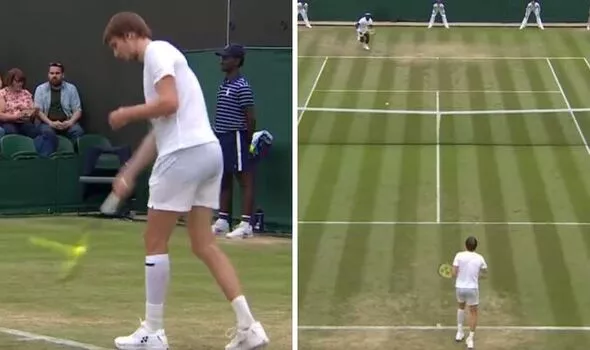
Kazakhstani tennis star Alexander Bublik has often tried underarm serves even in Grand Slams - here pictured at the 2022 edition of Wimbledon | Image: BBC
In recent years, an incredible number of games, mostly blitz games, have been played on the internet. Grandmasters participate regularly in such events. But the endless repetition of well-known theoretical variations eventually becomes boring. New paths are sought and tested. And so a proliferation of "non-theoretical" or "irregular" opening variations has emerged. The move 3.Bc4 against the Sicilian Defence is one of them.
Among the top players who regularly play 3.Bc4 against the Sicilian, at least in online blitz games, is Magnus Carlsen. If the best player in the world plays it, the move cannot be bad, can it? And if it is good enough for blitz, why not for classical tournament games?
 The Alapin Variation (1.e4 c5 2.c3) offers a simple yet highly effective solution to all major Sicilian lines, by sidestepping them with 2.c3.
Facing the Sicilian doesn’t have to be complicated. The Alapin Variation (1.e4 c5 2.c3) offers a simple yet highly effective solution to all major Sicilian lines, by sidestepping them with 2.c3. Whether your opponent plays the Najdorf, Taimanov, or Dragon, the Alapin lets you take control of the game as early as move two.
Free video sample: Introduction
Free video sample: 2...g6
So now more and more top professionals are playing the "amateur move" 3.Bc4 against the Sicilian Defence, including in classical tournament games. One of the latest examples comes from the England v. France match in round six of the Chess Olympiad in Samarkand.

Etienne Bacrot playing black against Michael Adams | Photo: Michal Walusza
Michael Adams had no interest in entering a theoretical discussion with Etienne Bacrot in long lines of the Sicilian Defence and, after 1.e4 c5 2.Nf3 d6, chose to develop his pieces with 3.Bc4. For a long time, very little happened. But when the game turned interesting, it became clear that White's setup allowed many tactically venomous possibilities.
With the win, Adams was able to offset his teammate Gawain Maroroa Jones' defeat against Marc'Andria Maurizzi. The match ended 2-2.
Links

















.jpeg)