
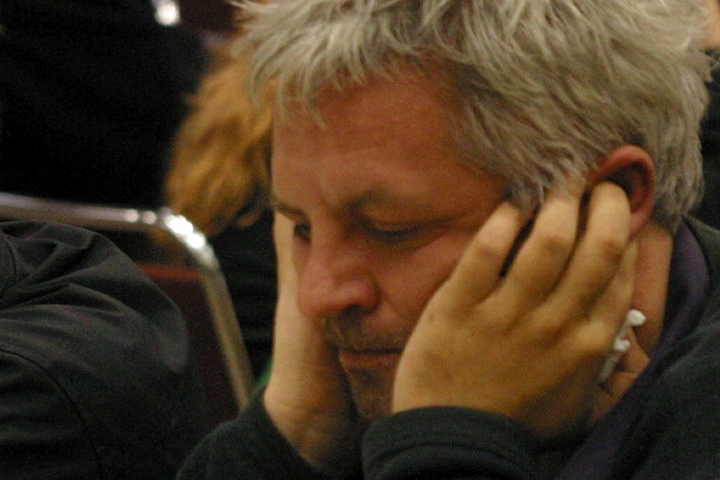

Aleksander Wojtkiewicz was born on 15 January 1963 in Riga, Latvia, which at the time was part of the Soviet Union as the Latvian Soviet Socialist Republic. He came from a family of Polish origin that had settled in Latvia. He learned chess from his father, Pawel Wojtkiewicz, a strong player in his own right who also had a passion for card games.
At the age of seven, Aleksander joined the Riga Chess Club. He also attended regular training sessions at the local Pioneer Palace, where Alfred Akmentinsh coached a group of talented youngsters that included the future grandmaster Alexander Shabalov. Leading Latvian players such as Mikhail Tal, Vladimir Bagirov, Aivars Gipslis and Alvis Vitolinsh also took part in the training of the country's most promising juniors.
Wojtkiewicz soon emerged as the strongest player in the group and represented various Latvian youth teams, usually on first board. After a strong performance in the Soviet Under-20 Championship in 1979, he came under the personal guidance of Mikhail Tal. In his obituary of Wojtkiewicz, Alexander Shabalov recalled that Tal also introduced his favourite pupil to what he considered the three most important non-chess pursuits in life: drinking, smoking and women.
In 1979, at the age of just 16, Wojtkiewicz already assisted his famous mentor as a second at the Interzonal Tournament in Riga. Two years later, at the age of 18, he won the Latvian Championship. He continued to play in tournaments throughout the Soviet Union until May 1982.
In the summer of 1982, Wojtkiewicz received his call-up papers for military service in the Soviet Army. Fearing that he would be sent as cannon fodder to the Soviet war in Afghanistan, he went into hiding and managed to evade the authorities for four years. During that time he lived in places including Leningrad and Soviet Black Sea resorts, slept on friends' floors, and earned money from card games and chess, but also worked as a pimp, according to Shabalov.
After four years, Wojtkiewicz had become so exhausted by this way of life that he gave himself up. As a draft evader, he was sentenced to two years in prison.
Behind bars he his life, at least for a while. Wojtkiewicz worked successfully as prison photographer and continued to devote himself to chess. In that time he discovered, among other things, an interesting novelty in the Dragon Variation that changed its theoretical assessment. Alexei Shirov eventually introduced the idea in his game against Adams at Biel in 1991. Wojtkiewicz had told Shabalov about the novelty, and Shabalov passed it on to Shirov.
After the moves 1.e4 c5 2.Nf3 d6 3.d4 cxd4 4.Nxd4 Nf6 5.Nc3 g6 6.Bc4 Bg7 7.0-0 0-0 8.h3 Nc6 9.Be3 Nxe4 10.Bxf7+?!, it was long believed that this bishop sacrifice gave White an advantage after 10...Rxf7. Wojtkiewicz discovered the idea 10...Kxf7. The difference is that in this line the black queen remains protected. After 11.Nxe4 Nxd4 12.Bxd4 e5 13.Be3 d5, Black has a good position. After 10...Rxf7, by contrast, White also has the possibility of 13.Bc5, exploiting the fact that the queen is undefended. Modern engines, however, show that this is not a serious problem for Black: 13...Be6 14.Qxd6 Bf5, and in the end the pawn on c2 is left hanging.
Here is the complete game with the contemporary annotations, although not all of them still stand up to modern analysis.
Wojtkiewicz was released from prison early under one of Gorbachev's amnesties. He then moved to Poland, where he had relatives, and obtained Polish citizenship. There he resumed his chess career and competed in a number of tournaments. At the end of 1988, he played his first tournament in the West, at Hastings. In early 1989, he took part in the Polish Championship for the first time and won the title at his first attempt. He repeated this success in 1995.
In 1990, Wojtkiewicz was selected for the Polish national team. He represented Poland at the European Team Championships in 1989 and 1992, and at the Chess Olympiads in 1990 and 1992.
As one of Poland's strongest players, he enjoyed generous support from the Polish Chess Federation. The relationship deteriorated, however, after Wojtkiewicz turned up drunk for an important event and, according to Shabalov, insulted the officials by calling them communists. Following further incidents of this kind, he lost the federation's support.
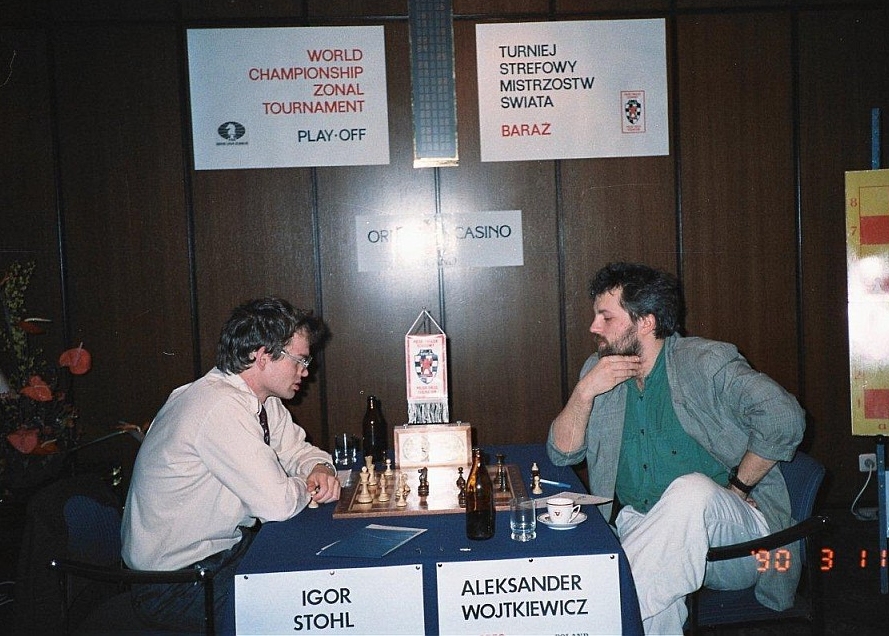
Foto: Archiv Filippowicz
In the summer of 1989, Wojtkiewicz travelled to the United States for the first time, competing with mixed success in a number of open tournaments. During the second half of the year, he toured Europe, where he also played in numerous open events. In his obituary, Stefan Löffler recalled that Wojtkiewicz turned up in Berlin in 1990, stayed at his apartment, spent most evenings in chess cafés and casinos, and usually had to sleep off his hangover the following morning.
From 1988 to 1993 and again from 1995 to 1997, Wojtkiewicz played for Polonia Warsaw in the Polish Team Championship. In 1999 and 2000, he represented Gant-Hetman Wrocław. With Polonia Warsaw, he finished runner-up in the 1997 European Club Cup.
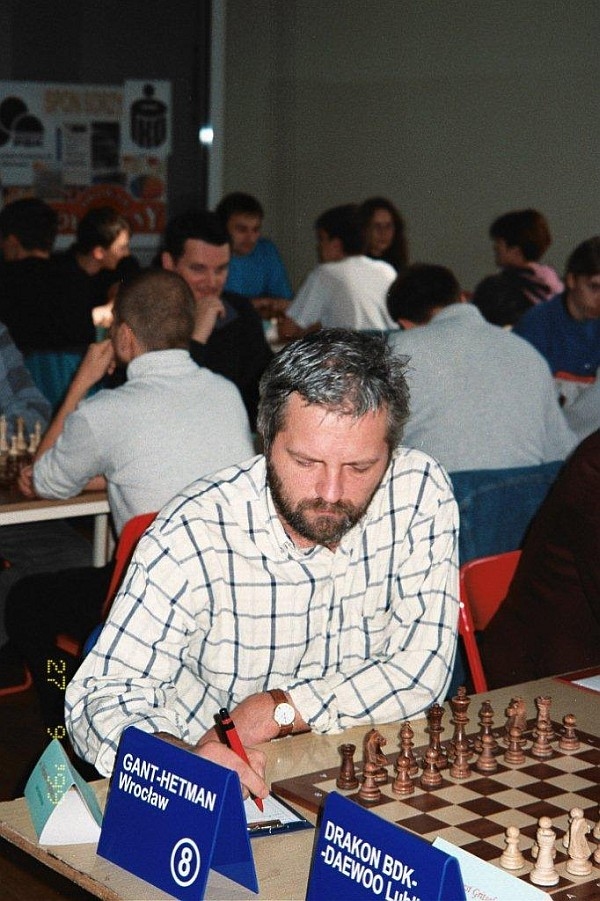
Photo: Archive Filippowicz
Over the years, Wojtkiewicz increasingly returned to the restless lifestyle of his younger days. He became a chess vagabond. Thanks to a sponsorship agreement with the Polish airline LOT, he could travel free of charge and made full use of the opportunity. He travelled around the world, played in tournaments, enjoyed life, and gave little thought to the future.
By the late 1990s, Wojtkiewicz had moved to the United States. In 1999, he assisted Alexander Khalifman, whom he had known since their youth, in his successful campaign at the FIDE Knockout World Championship in Las Vegas. On several occasions, Wojtkiewicz also won the US Chess Federation's annual $10,000 prize awarded to the player who had won the most tournaments in the United States during the year.
In 2002, at the age of almost 40, Wojtkiewicz accepted an offer to study at the University of Maryland. He received a scholarship worth $15,000 and played for the university team for a short time. However, he soon lost the scholarship because of his poor academic performance.
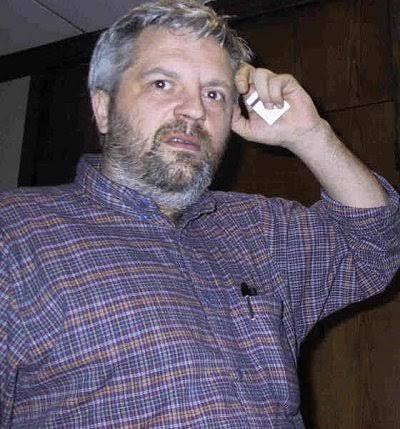
Photo: Dallas Chess Club
Wojtkiewicz now lived in Baltimore, worked as a chess coach, and continued to play regularly in weekend tournaments near his home.
In 2004, Wojtkiewicz was among the participants in the last FIDE Knockout World Championship, held in Tripoli. Shortly before his death, he shared first place at both the World Open in Philadelphia and the National Open in Las Vegas.
On the evening of 14 July 2006, Aleksander Wojtkiewicz died in Baltimore from severe internal bleeding caused by a ruptured intestine. He was only 43 years old.
Wojtkiewicz was awarded the Grandmaster title by FIDE in 1990. His highest position on the FIDE rating list was a rating of 2595, achieved in July 1998.