As one of the strongest players in the United States, Donald Byrne would certainly have deserved to become famous for his wins. Instead, his name is particularly associated with a loss - his defeat against the then 13-year-old Bobby Fischer at the Rosenwald Memorial 1956 in New York. The game entered chess history as the "Game of the Century".

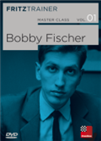 No other World Champion was more infamous both inside and outside the chess world than Bobby Fischer. On this DVD, a team of experts shows you the winning techniques and strategies employed by the 11th World Champion.
Grandmaster Dorian Rogozenco delves into Fischer’s openings, and retraces the development of his repertoire. What variations did Fischer play, and what sources did he use to arm himself against the best Soviet players? Mihail Marin explains Fischer’s particular style and his special strategic talent in annotated games against Spassky, Taimanov and other greats. Karsten Müller is not just a leading international endgame expert, but also a true Fischer connoisseur.
Even the loser of a brilliant game always plays a significant role in the creation of a masterpiece. Donald Byrne did not resign once he recognised his inevitable defeat, but instead played on until checkmate, in order to honour his young opponent, who was still completely unknown at the time. Byrne also lost most of his other games against Fischer. Nevertheless, at least one blitz game that he won has been recorded.
Donald Byrne was born on 12 June 1930 in New York and was the younger brother by two years of Robert Byrne, later a long-time chess columnist for The New York Times. While Robert Byrne became a grandmaster, Donald Byrne had to settle for the title of international master, which he was awarded in 1962.
The Byrne brothers regularly attended the Hawthorne Chess Club, founded by John W. Collins. Collins was not a particularly strong player, but he took care of young talents in New York, especially in Brooklyn. Bobby Fischer and William Lombardy were also frequent visitors at Collins' club.
Robert and Donald Byrne also regularly played tennis in Central Park and, on their way back, would pass the chess tables at the edge of the park. The fairly strong regular players there believed they would have an easy time against the white-clad teenage tennis boys, but were surprised to find themselves with no chance in games played for money.
Donald Byrne was one of these talents and, at the age of just 16, qualified for the final of the US Championship. He finished eighth, two places behind his brother.
A game against the national player and patron Jacqueline Piatigorsky:
 Why memorising endless theory might not be the best path - and how an idea-based repertoire can change your game.
In today’s fast-paced chess world, especially online, where blitz and rapid games dominate, the traditional approach of grinding through lines of opening theory can feel overwhelming, and even unnecessary. The real challenge? Striking the right balance in your opening preparation. How deep should you go? Where do you stop? This course is built on the timeless wisdom of my legendary coach, Chebanenko, who designed opening repertoires for his “lazy” students - not lazy in attitude, but smart in approach. His philosophy? Don’t memorise. Understand.
From the years 1947 to 1951, the Mega Database contains a single game by Donald Byrne, from a team match against Argentina. Evidently, during this period, Byrne focused entirely on his studies in English literature. He obtained a Bachelor of Arts from Yale University and a Master of Arts from the University of Michigan.
After a break from tournaments, he won the US Open in 1953. At that time, he had the second-highest rating in the United States, behind Samuel Reshevsky. The following year, in a USA vs USSR match, he defeated Yuri Averbakh 3–1 (three wins, one loss). Apart from him, only Larry Evans managed to win his match, against Mark Taimanov. On all other boards - the match was played on eight boards - the Soviet players prevailed. In the return match in 1955 in Moscow, Donald Byrne lost 1–3 to Efim Geller.
After completing his studies, Donald Byrne initially taught at Valparaiso University and then at Olivet College. In 1961, he became an assistant professor of English at the University of Pennsylvania and also took over the training of the university's chess team. At the University of Pennsylvania, he was widely known among students for a wide-brimmed Stetson hat that he always wore.
Donald Byrne only played a few individual tournaments thereafter.
He was part of the US team at the Chess Olympiads in 1962, 1964 and 1968. In a total of 34 games at these Olympiads, he scored 25 points. In 1962, Byrne was the second-best player on the first reserve board, and in 1968 the third-best player on the second reserve board.
 Top trainers strongly recommend regular study of well-explained classical games to improve your understanding of chess in the long term. 33 modern classics are explained in details on this video course.
At the Chess Olympiads of 1970 and 1972, Donald Byrne served as captain of the US team. From his journey to the Chess Olympiad in Varna 1962, Byrne recounted the following anecdote. The US team had landed in Central Europe (presumably West Germany) by plane and travelled onwards to Bulgaria by train. At the border, Bulgarian soldiers boarded the train to check the passengers. Among the US team, which had its own compartment, was the 19-year-old Bobby Fischer, who locked the door against the soldiers, saying: "I will not let this communist touch me". The other US players were alarmed and quickly opened the door, explaining that the young man in their group was somewhat eccentric.
Donald Byrne suffered from systemic lupus erythematosus (SLE), an autoimmune disease that attacks the organs. From 1971 onwards, he regularly underwent dialysis, although this could only slow the progression of the illness.
Donald Byrne died on 8 April 1976 at the University of Pennsylvania Hospital in Philadelphia as a result of his illness. He was only 45 years old.
Donald Byrne Memorial Chess Club...