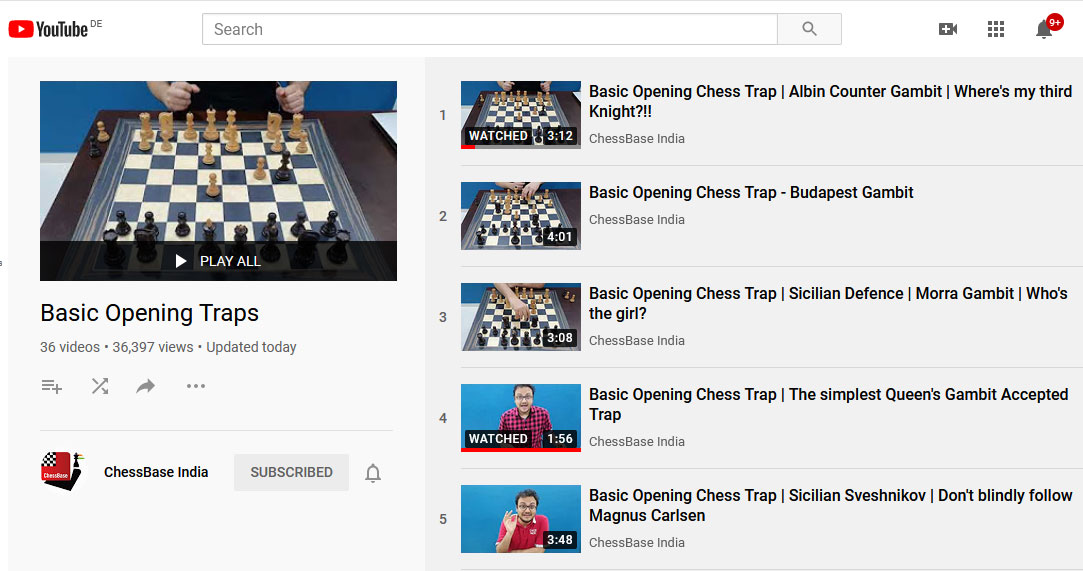
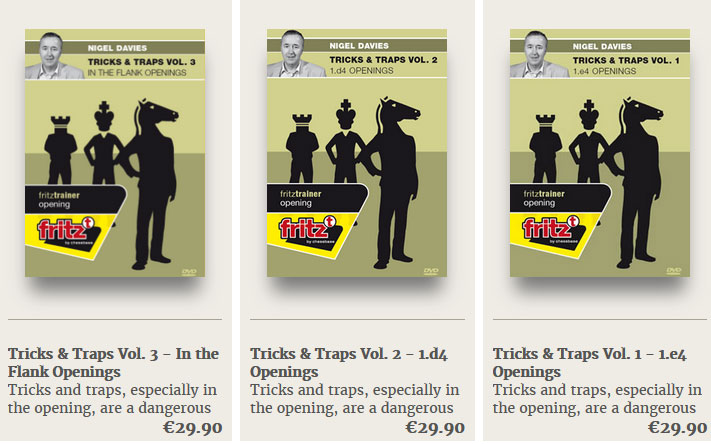
11/19/2020 – When you start playing chess, when you are still a beginner, it is useful to know a few openings tricks – move sequences that lead your opponent astray and give you a quick win. It is equally important to know such traps so that your opponent cannot use them on you. We start you on a course that is useful and at the same time quite entertaining. Take a little time to learn dozens of traps you can use in your club tournaments.
new: ChessBase Magazine 225
Chess Festival Prague 2025 with analyses by Aravindh, Giri, Gurel, Navara and others. ‘Special’: 27 highly entertaining miniatures. Opening videos by Werle, King and Ris. 10 opening articles with new repertoire ideas and much more. ChessBase Magazine offers first-class training material for club players and professionals! World-class players analyse their brilliant games and explain the ideas behind the moves. Opening specialists present the latest trends in opening theory and exciting ideas for your repertoire. Master trainers in tactics, strategy and endgames show you the tricks and techniques you need to be a successful tournament player! Available as a direct download (incl. booklet as pdf file) or booklet with download key by post. Included in delivery: ChessBase Magazine #225 as “ChessBase Book” for iPad, tablet, Mac etc.!
The new Opening Encyclopaedia offers fast access to all openings. Openings are sorted via the menu by name & ECO Code for fast and easy access to your favorite openings.
14. Which is the most interesting chess game you have ever played?
I have never reached a playing strength of 2000 Elo. For one year I played in a local club in Hamburg and won two nice games, which I can't reconstruct anymore. In my early youth I used a single opening trap paired with skilful facial expressions ("Did I just make a dreadful mistake?") to win a dozen games.
In the feedback section below the interview one reader wrote: "Was it with ...Nd4?" I have no idea who this reader was, and especially how he could have guessed correctly. My current theory is that it must have been a member of the same chess club, and he had seen me doing it live, decades ago!
So here is the trap I used, when I started playing competitive chess in my early teens:
1.e4 e5 2.Nf3 Nc6 3.Bc4. A common opening, popular at the time. My opponent wants to play "Italian." 3...Nd4?! If you are curious, this opening trap even has a name: the Blackburne Shilling Gambit.
In the above live diagram I have set a chess engine to reply to moves you enter with white. If you follow the moves I give below, and walk into the trap lines, it will execute everything flawlessly.
So here is how it works: you can't resist and play 4.Nxe5. It's a free pawn. The engine will answer 4...Qg5, attacking your knight. But wait a minute, isn't there a family check: 5.Nxf7, forking the queen and rook! The engine will reply 5...Qxg2, threatening to take the h1 rook, which naturally must move. But after 6.Rf1 there follows 6...Qxe4+. Now White can simply give up the queen (7.Qe2 Nxe2). So it is better to play 7.Be2, isn't it? No, because that gives Black a truly dramatic finish: 7...Nf3#. This is a "suffocated mate," something you rarely get to execute in a lifetime. And I managed to do it a dozen times!
My colleague Sagar Shah has very nicely described the gambit in the above video. And here's the annotated opening trap on a replay board. Note you can click on the fan button to start an engine and analyse different lines.
Actually you need some acting skills to pull this one off. As described in the annotated game above, on move three you grasp the knight carelessly and move it to b4. You do not let go, look alarmed, and then suddenly change your mind: you place the knight to d4, looking quite unhappy about it.
It is also important to play 4...Qg5 impulsively, and to stare at the knight on e5 while doing so. Your expression should say: "Now you have to retreat the knight, or I am going to take it." As soon as you let go of the queen glance at f7 and try to conceal your horror. Make your opponent feel good when he sees what you have seen: the fork. For me, in fledgling years, the gambit worked more often than not. On a few occasions I got applause.
I also tried this gambit on some strong players. Once, when travelling in a car, I challenged IM David Levy to a blindfold game. He was not really thinking and walked into the trap. But he quickly saw what I was planning and played 5.Bxf7 Kd8 6.0-0, after which I had a better position. But in the end I lost, because he was a so much better player than me. Another time, again in a car, I challenged a 16-year-old boy to a fun blindfold game. Here my acting entailed saying "Knight to ... er, wait a sec, no, okay, to d4." My opponent simply grinned and played 4.Nxd4, without any hesitation. The young IM Nigel Short knew traps! I resigned in a hopelessly lost position ten moves later.
Sagar's Opening Traps channel
The subject of my early youth escapades came up because my friend and colleague, Sagar Shah, CEO of ChessBase India and YouTube chess king, had started a new channel on opening traps:
In his series Basic Opening Traps the indefatigable Sagar has, in 40 days, recorded 38 lessons. His videos are just a couple of minutes long and have had between 50,000 and 130,000 views. So you'd better take a look – otherwise you may fall into one of the traps on your next club tournament.
Here, to start you off, are a few nice little samples. If you have found a taste for the smothered mate you will do well to start with this one:
One more smothering trap?
Here's a nice little one in the Albin Countergambit:
And here's a basic trap in the Queen's Gambit
So now you have learned five opening traps from Sagar – there are 33 left to go. My advice to you: watch the videos multiple times, so you actually remember the ideas. You can have a very pleasant few hours seriously improving your results on club evenings.
Frederic FriedelEditor-in-Chief emeritus of the ChessBase News page. Studied Philosophy and Linguistics at the University of Hamburg and Oxford, graduating with a thesis on speech act theory and moral language. He started a university career but switched to science journalism, producing documentaries for German TV. In 1986 he co-founded ChessBase.
YOUR PERSONAL CHESS COACH - Whether you’re taking your first steps into the world of club chess, or already playing at a tournament level: with FRITZ, you can train more efficiently, intelligently and with a more personalised approach than ever before.
How grandmasters win without fireworks: GM Jan Markos shows you 11 very practical tips from "How to play in a lost position" to "Be patient like Carlsen" that will improve your tournament chess.
The Nimzo-Indian has stood the test of time for over a century: Still a top choice for elite players today, from Magnus Carlsen to Praggnanandhaa, it remains one of Black's most reliable ways to fight for real chances against 1.d4 2.c4 3.Nc3.
1.c4 e5 2.Nc3 Bb4!? is an opening idea well worth considering. Black immediately threatens to double the pawns on c3 in the style of the Trompowski or Sicilian Grand Prix attack.
Italian Game Powerbase 2026 is a database and contains 8571 top class games from Mega 2026 and the Correspondence Database 2026, of which 479 are annotated.
Videos: Nico Zwirs discusses the Sicilian with 2…e6 3.d4 cxd4 4.Qxd4 Nc6 5.Qe3 Nf6 6.Nc3. Mihail Marin examines Sindarov’s 6.Ne5 in the Queen’s Pawn Defence. Plus the ‘Lucky bag’ featuring 41 analyses by Berg, Ftacnik, Gupta and many others.
€14.90
We use cookies and comparable technologies to provide certain functions, to improve the user experience and to offer interest-oriented content. Depending on their intended use, analysis cookies and marketing cookies may be used in addition to technically required cookies. Here you can make detailed settings or revoke your consent (if necessary partially) with effect for the future. Further information can be found in our data protection declaration.
Pop-up for detailed settings
We use cookies and comparable technologies to provide certain functions, to improve the user experience and to offer interest-oriented content. Depending on their intended use, cookies may be used in addition to technically required cookies, analysis cookies and marketing cookies. You can decide which cookies to use by selecting the appropriate options below. Please note that your selection may affect the functionality of the service. Further information can be found in our privacy policy.
Technically required cookies
Technically required cookies: so that you can navigate and use the basic functions and store preferences.
Analysis Cookies
To help us determine how visitors interact with our website to improve the user experience.
Marketing-Cookies
To help us offer and evaluate relevant content and interesting and appropriate advertisement.




.jpeg)