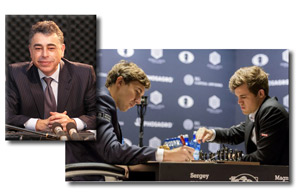

Yasser Seirawan: “A Radical Solution - Redux"

by ChessBase
12/3/2016 – During the World Chess Championship match, Yasser Seirawan's article "A Radical Solution" was causing reactions from all sides. In a second article, the grandmaster is addressing his audience for a second time and specifies his criticism - regarding the format of the match. "A Radical Solution - Redux"...

Your personal chess trainer. Your toughest opponent. Your strongest ally.
FRITZ 20 is more than just a chess engine – it is a training revolution for ambitious players and professionals. Whether you are taking your first steps into the world of serious chess training, or already playing at tournament level, FRITZ 20 will help you train more efficiently, intelligently and individually than ever before. 

Hearty congratulations to Magnus on winning the World Chess Championship match and retaining his title.  Also happy birthday.  Congratulations too to Sergey on proving himself a most worthy Challenger.  It was a gripping match.  Bravo to you both.  My criticism, and other people’s, over Game 12 will soon be forgotten because the Rapid Chess tiebreaks brought us the joyous thrills that Game 12 so severely lacked.  Long live the Champion!

I am writing this article as a follow-up to the previous one, titled “A Radical Solution.”  Most importantly because I simply want to thank the readers, you the fans, for your feedback.  Sincerely appreciated.  Truly without your interest there would be no Championships.  It is the fans that make the game.  A fact that we should always remember.

The feedback was quite positive.  Thank you to each and every one of you for contributing to the discussion.  The radical concept of an odd number of match games with draw odds for the player who has an extra game with the Black pieces was not dismissed out of hand.  Even a majority found merit in the suggestion.  Even so, a greater majority preferred a longer match of 18 games.  I do not disagree.  I too much prefer a longer match.  In fact, I find it perplexing that in the penultimate qualifying stage, the Candidates’ Tournament has 14 rounds of play, while the pinnacle event in the whole cycle, the Championship Match itself, is merely 12 games.

Other worthy suggestions included the idea that in case of a tied match “pairs of Classical Games” should be played until a winner emerged.  The problem with such a practical-sounding solution is that it is impossible in real life for the organizers to commit themselves to the possibility of an open-ended match.  For starters, leasing space in a theater would be an enormous problem.  For how long should the organizer keep the space?  I know from my own personal experience in 1987, when Seattle bid for the WC match (Seville won the bid), that it was difficult in the extreme to get a beautiful venue, the Paramount Theater, for 24 games.  Seattle is a marvelous city with many facilities as well.  For the organizer, a fixed number of games is mandatory.

Another majority position from fans that surprised me greatly was that an even number of games was fine but that in case of a tie, after preference for an 18-game match, the defending Champion scoring 9-9 should keep his crown.  The argument in favor of giving the defending Champion draw-odds seems to be that the Challenger has to beat the Champion.  Why?  Because the Champion is the best player and if the Challenger merely ties with the Champion the Challenger has not shown himself to be superior.  An interesting viewpoint to be sure, but one I find to be bogus.

Once again I stress that I’m a critic of the current system.  I don’t like it at all.  In fact, I find the current cycle to be plainly stupid.  Why?  Please, take the following grandmasterly challenge, I double-dare you:  explain the current system to a good friend who doesn’t play chess.  Explain that the Champion, presumably the best chess player in the world, sits outside of a two-year-long cycle of events, biding his time, waiting for a Challenger to emerge.  That there is a series of four “Swiss Open” tournaments with hundreds of players, called “Continental Championships”, played at a different time-control, that act as qualifier events for a big-money event called the “World Cup.”  That it, in turn, is a 128-player “Knock-out” event featuring different time-controls, as well as tie-breakers that qualify the winners for a “Candidates’ Tournament” which is a “double-round-robin” with a different, slower Classical time-control.  The Candidates’ Tournament itself features a field of eight players.  Where the runner-up of the previous WC Match is joined by the World Cup qualifiers, some of the highest rated players in the world and a wildcard player chosen by the organizers.  Be sure to emphasize such terms as “Swiss Open”, “Knockout Matches”, “Double-Round-Robin”, as well as describing the different time-controls, and toss in an “Armageddon” once or twice to be sure that your friend is listening.  Don’t forget that tiebreaks are not used in the Candidates’ tournament.  Instead, do mention, please, that tying for first by losing more games than your rival is better than going undefeated, and I guarantee you that you will have thoroughly confused your friend.  And quite possibly yourself as well.

Even worse than the above challenge of explaining the current cycle to a friend, imagine yourself as an organizer of an event in the cycle.  You would like to have a prestigious elite event played in your home city.  How exciting.  You’d like the participation of the best players in the world.  Clear.  Who is the best player in the world?  Why, the World Champion, of course.  But the World Champion, the biggest draw in chess, is out of the cycle entirely.  Again, he is waiting for a Challenger to emerge.  It is crazy.  Why create such fantastic competitions that bar the world’s best player, the champ, from competing in any of them?  That strikes me as, dare I say it, counter-productive.

Fortunately for the world of chess, we have been lucky, blessed actually, Magnus has been a wonderful, active Champion.  He has not sat on his laurels.  Not at all.  He has played in the most challenging, competitive tournaments open to him and he has acquitted himself as a true Champion.  He has earned the admiration of all chess fans.  But let us say, for the sake of argument, that Magnus was less successful than he has been or, worse still, less active.  Imagine that Magnus takes a sabbatical from the chess tour for a year.  That would be terrible for chess fans.  In the meanwhile, the Challenger faces the whole world in his quest for a single spot.  Consider the route taken by Sergey Karjakin:  he played in the World Cup 128-player Knockout, surviving some extremely difficult, pressure-packed rounds, made it to the Finals and, incredibly, won matches by winning on demand.  This bravura performance earned him the right to be in the Candidates’ Tournament.  The strongest event in the world, which he won, undefeated, and he became Challenger.  Hasn’t he proven himself to be the World’s best player?  Especially as the Champion has been forcibly absent?  Or on sabbatical.  Why would the Challenger have to give the Champion an advantage of draw-odds?  After such a harrowing journey, hasn’t he earned fair and equal playing conditions at least?  This is why in my Radical Solution article I did not suggest that the Champion be awarded draw odds; rather, I suggested that it would be the drawing of lots that determined which player received draw-odds, as well as an extra game with the Black pieces.

To his enormous credit, Magnus himself has expressed dissatisfaction with the current cycle.  He has called for the creation of a more “modern cycle”, without offering exact details of such a vision.  One thing is definite:  such a call is most assuredly not in his own best self-interest.  In a modern cycle, he may find himself having to earn a place at the final table, not enjoying the seeding of a defending Champion.

In my view, the stakeholders in the world of chess need to sit down and rethink the cycle in its entirety.  They need to analyze ruthlessly what events would be in the best interests of chess, the fans, the players, the organizers, and which offer fair, equal conditions for every competitor.  I hope that my two articles will help kick-start just such a discussion.  A discussion for which both the World Champion and the Women’s World Champion have openly called.  The chess world moves slowly.  If the cycle is not to be reconsidered in its entirety, I do hope, at least, that a radical solution for our crown jewel, the World (Classical) Chess Championship match, will no longer feature a tiebreak.

For myself, I’d consider it a massive improvement if the next World Championship Match were a 15-game contest with the player who is given the extra game with the Black pieces at the drawing of lots ceremony having draw-odds.  At every moment in such a match a player would be trailing and would have to fight for the win.  Tame draws would favor only the player in the lead.  Victory would come only in Classical Games and not through Rapid Chess, Blitz or an Armageddon game.  Lest anyone think that I would deny the chess world the thrills of Rapid Chess, I would not.  That is why there is a World Rapid Chess Championship which is called by that name.  It is coming up soon.  Be sure to tune in to that different form of chess.  But let us keep the three forms of chess, Classical, Rapid and Blitz, separate from one another.


Reports about chess: tournaments, championships, portraits, interviews, World Championships, product launches and more.

Discuss

Rules for reader comments


Not registered yet? Register

PCMorphy72 PCMorphy72 12/4/2016 06:19
I’ve found interesting the offpister comment above

( “ […] Money is driving this whole thing. Talk of a different format is like trying to discuss with Putin some improvements in Russian governmental best practices. Get real guys.” )

I would reply with “get things into perspective”.

FIDE should be seen as an organization which collects money from the national federations (which have money from people who pay to play and learn chess) and not from sponsors (which should conform to FIDE guidelines in order to get advertising and not vice-versa in order to get more money).

The problem is that FIDE (as almost every big organization) tries to maximize the profit (from sponsors, from everyone and from everything), having interest basically in lavish tournaments and events: this is what one should think when FIDE president has to be elected, forgetting capricious players and managers who ask for prize funds higher than the possible clean money the national federations can offer (let them to organize sumptuous pseudo-tournaments with the coca-cola-organization-sponsors that offpister should know).
Dukenails Dukenails 12/4/2016 06:06
Its a very valid idea however wasn't the most exciting part of the whole match the tie break day? was for me. Sergei did very well but hardly really went for it. I am sure Magnus knew he would have a huge advantage in the rapid play which he did. As such I think it was on Sergei to really go for it in game 11. Much like Germany generally win on penalties in football...... The other team needs to beat them before it gets to that! I just think the match should be longer say 18 games or even more. A short match makes play more conservative. And cut out all those rest days especially on Fridays, Saturdays and Sundays. That seemed really poorly organized. As for qualification, I think it needs those tournaments whereby everyone has a good chance. Otherwise Sergei may not have even qualified.
MikeyBoy MikeyBoy 12/4/2016 06:05
@Martas

I agree this is a possibility and even mentioned this in my original post, which is why I said I'd love someone to humor me and prototype this. I can't remember the name of the tournament but I know there was one where they experimented with the scoring system. I'd love to see them use the black-wins tiebreaker in some of these 'mini matches' they do sometimes. Maybe it will be a colossal failure, but my instincts tell me it could produce some very exciting games as black will have more incentive to win and white will be more nervous.

I also liked the idea someone else produced of having the equivalent of a penalty shoot-out sudden death where there a pair of games is played and then another and another until we end up with a winner - but I think there needs to be a cap on it - just look at Karpov-Kasparov I ... would have gone on for ages. I also don't think it would work in practicality as much as I like the idea because it would be too 'slow' for some. Honestly the current system isn't so bad - def way better than Yesser's idea.
Mawin Mawin 12/4/2016 03:46
The following openings are today drawn if black knows the theory: the Berlin, the Marshall, the Grünfeld, the Lasker, and presumably the Tartakower.

This means that any super-GM can choose to draw as black at any time. So isn't it time to realize that we have a serious problem, regardless of the format for the match? As a remedy, I suggest a minor emendation to the chess rules:

At kingside castle, the king may jump *three* squares, or two as usual. Thus, the king ends up on the corner square immediately, and the rook on its usual square. Although it weakens the f-pawn, it becomes less risky to advance it, as occurs in the King's gambit or Jaenich gambit. So it is now riskier to play 1...e5. Also, it is riskier to pin the king knight with a bishop, because the opponent may advance his flank pawns, provided that the king is already placed in the corner. I conjecture that this little rule change enhances the opening tree very much. For instance, the King's gambit becomes playable again.
http://mlwi.magix.net/bg/fidechess2.htm

Mawin
cyronix cyronix 12/4/2016 03:09
I remember Magnus stating once that he was not too fond of matches, but preferred to play a tournament with the top players instead and the winner will be crowned world champion. This also happened already in chess history when Topalov became world champion in St. Louis. So I am not so sure if is to the liking of Seirawan that Magnus "called for a creation of a more modern cycle", because then we would have no more matches.
Martas Martas 12/4/2016 02:30
MikeyBoy - When this match finished at 6-6, Karjakin had 1 win with black, Carlsen had 0. That is because Carlsen won with white.

Sorry I misunderstood your original comment. Anyway why to punish a try to win with white? With such rule you force players to be even more careful when playing white, so even more draws.
thirteen thirteen 12/4/2016 01:33
Draws are a part of our game, perhaps a BIG part of it. However, for the World Chess Championship their avoidance is required. Whilst it is perhaps understandable that both players would never wish to loose any game, not least from a professional point of view, some past and great players like Fischer, Tal, I believe, would hardly need any 'incentive' to play for wins.
As a matter of a fact it is more than possible to complicate enough to play for the win, with the white pieces or the black ones, even if draws do still occur after fighting games. It just requires the WANT of it. Therefore the actual number of games, even 12, in irrelevant.
Keep it simple and make both parties SHARE the monies and indeed SHARE the title if it is still level when done. If THAT doesn't stir the better player to produce during classical only games, then neither hardly deserves it.
Both can then reap the far lesser monies and accolades.
I believe that either of these players this time could have 'upped' their choices in any game. But if their strategies were clearly, at times, meant to just stay in the match, some 'suggestions' really do need to be implemented, unfortunately, as some means of preventing these long, boring, pointless, chess-killing events.
Cut-out the rest days!
Mike Pacasi Mike Pacasi 12/4/2016 01:14
In fact, the best way to improve Chess competitiveness is to move it to Chess960... And also, all in all, I agree with Mr. Yasser...
malambot malambot 12/4/2016 12:21
As I previously suggested. Why not make the tie break a Fischer Random Chess under classical time control? The purpose of this is to throw away the opening theory of traditional chess and let the natural talent/creativity of each player slug it out right in the opening moves of the tie break games.
Andrea Mori Andrea Mori 12/4/2016 12:14
The Champion keeping his/her title in case of a tie, with the money split 50/50, may have some disadvantages but all other methods seem to be worse. The problem seems how to avoid the deadlock of a series of draws (but note that every WC match--including Fischer-Spasskij--has included a longish series of draws at some point). You want to keep the fighting spirit high? Here's a radical solution: after each draw, no matter if a 20 moves GM draw or a 115 moves marathon, the money prize is reduced by, say, 5%. So, for instance, with 10 draws after 12 games Carlsen and Karjakin would have seen their prize cut in half. The difference could be used by FIDE to fund scholarships for young talented kids worldwide.
Denix Denix 12/4/2016 11:57
My new solution can be used on other planets. However, as it looks like necessary now, how about this one:

Solution: HKMCW Rule: In a case of a tie, the player with the highest number of King moves throughout the match wins the match.

About King Moves
1. It is a loss of time in early part of the game (A strong GM will not move his King early)
2. It is sometimes strong move in endgames (A strong GM will activate his king and use it as a weapon - think about King triangulation to give Zugzwang)
3. It will avoid players giving perpetual check - avoiding the draw horror (Only GMs with inferior position will seek perpetual check)
4. The players will tend to move their Kings first before making a draw - every King Move counts. As above, a King move can be a weakening or a strong move. (A strong GM will not make this unnecessary mistake).

Objective:
A. As you are not sure how the game will end, you have to win to avoid HKMCW rule if you are the stronger player
B. If you are the weaker player and relies on the HKMCW rule, do it at your own risk.

Strategy:
I). Stalemate the opponent King, but leave him a Knight or a Bishop to avoid the early draw. You have up to 50 Moves with your own King before the opponent can claim a Draw. (A strong GM will find this exercise very easy)
II). To avoid the HKMCW rule, the weaker player will have to resign to avoid the 50 king-move draw. (Again avoiding the draw).

It looks stupid but not more than trying to change the current system.

I will give you my number if you need more explanation

!!! Peace !!!
BarOni BarOni 12/4/2016 11:32
So how is he a champion if he didn't manage to win? The level of the comments is as the level of article.
lajosarpad lajosarpad 12/4/2016 10:32
In my opinion the least damage done in a case of a tie would be that the World Champion would keep the title:

- it would make sure that in all points of the match at least one player has a good reason to fight for
- it would make sure that no challenger with a "do not lose" approach will not be crowned unless he wins the match
- it would make sure that the challenger would be a real challenger

However, an improvement on this idea might be that the challenger would have draw odds if the Champion did not manage to win the previous match.
Petrarlsen Petrarlsen 12/4/2016 08:00
@ koko48 : You say : "Take a scientific poll among all the viewers online, including the viewers who paid for tickets (as I did)....and the viewers who paid for the app....Then come back to me and tell me I'm in the minority when I say the rapid tiebreaks (for the second WC match in a row) was the most interesting part of the match". Have you precise facts (not surmises) to support this affirmation ? Because the general positions of the commentators under Yasser Seirawan's article represents a fact, so, if what you say is a proven fact, well and good, but otherwise, this is "proven facts" against "unproven facts"...

And you are really very biased ; you say : "There's no need to cling to tradition just because "this is the way it's always been done"", but, in fact, no one used such an argument under Yasser Seirawan's articles (no one or nearly no one, I'm not completely sure, but even if there were one or two posts in this direction, compared to the enormous quantity of posts under these articles, it wouldn't seriously count). What I say is very different : that rapid (and blitz) games are quite interesting to follow live, but that, afterwards, they lose nearly all interest.

For me, it is for example obvious that the "chess content" of "classical" games by Capablanca, Alekhine, or Fischer is much stronger than the "chess content" of rapid games of modern champions.

What would then be the interest to study such "third rate games" (for this level) ?? To follow them live, yes (competitively, it is very interesting), but to study them afterwards, certainly not...

Finally, when you say : "Do you want to make chess more popular and interesting, so it can compete with other sports? There are hundreds of millions of people in the world who know how to play chess, and play at least occasionally....A huge untapped group of followers", I suppose that you mean that rapid and blitz chess could attract to competitive chess persons that aren't interested in it for the moment. But, there also, you are biased : it is completely obvious that rapid and blitz chess could perfectly well be promoted and developed whithout "killing" classical chess. But, as you strongly dislike classical chess, you naturally prefer to say that classical chess must be replaced by rapid or blitz chess.

What I would say is : "If you don't like, you don't watch" ; it isn't because you don't like classical chess that everyone must have the same opinion as you (and, in fact, it is nearly the exact opposite that is true...).
offpister offpister 12/4/2016 07:43
I think this conversation and comments ignore one telling fact. As far as I know the prize fund for this match was one of the lowest in recent years, a fact that shows that despite chess's growing popularity there is still very little interest from sponsors. To ignore this fact and all the trouble that FIDE has organizing the match (that's another story) is to ignore the crux of the problem. Of course with unlimited sponsorship and a chess crazed public the WCC would simply go on and on in classical format until one player emerged victorious or collapsed from exhaustion. I was at the match in NYC for the playoff and a number of the other games, and though I am in the purist camp that abhors the idea of the WCC decided by anthing other than classical games, there is not denying the incredible surge in media attention simply because there would be a shoot out for the match and the media knew that a winner would emerge then and there. On the other days of the match the media attention was frankly scarce and the US media attention all but non-existent. I think if you asked Magnus whether he would change the format but sacrifice 50% of the already dwindling prize fund for a "better" format I am pretty sure he (and every other top player) would say no. Principle is one thing, hard cash another. Personally, I think this discussion is entirely moot until FIDE cedes control of the WCC and a sounder organization emerges to run the WCC and the Candidates Matches that can garner support from major sponsors. Seriously, what corporation today would sponsor the WCC match when it is run by an organization whose head is banned from the US and is surrounded by constant scandal and suspicion. You have your answer: Agon. Magnus was facing a huge fine for not staying for the press conference after the game he lost. I suspect he gained a reprieve simply because by kicking the game to tie-breaks, the sponsors probably had their best day of the whole match. Money is driving this whole thing. Talk of a different format is like trying to discuss with Putin some improvements in Russian governmental best practices. Get real guys.
Petrarlsen Petrarlsen 12/4/2016 07:10
(2/2) II) My personnal (schematic) assessment of these possibilities :


In my opinion, the worst drawbacks, in order of decreasing importance are :

1) The fact that a solution would be potentially too expensive for sponsors - if "money" cannnot follow, the solution will never be implemented (solution 8 - unlimited pairs of classical games : this would be a good solution, but would, in my opinion, be potentially quite too expensive for the taste of potential sponsors).

2) The fact that the "tiebreak solution" doesn't give equal chances for both players (solution 2 - 13 games with drawing of lots ; solution 6 - first player to win a game).

3) A serious weakening (in my opinion...) of the value of the World Champion title (solution 9 - No tiebreaks at all).

4) Using "non-classical" games (rapid and blitz) as a tie break (I would add, personnally, that I'm quite opposed to Armaggedon games, because I find these type of games too artificial - even in the context of a rapid and blitz playoff, I would find much better to suppress them in favor of another tiebreak solution) (solution 1 - rapid and blitz tiebreaks).

In my view, all the drawbacks of the other solutions aren't too important, and all these solutions would represent a significant improvement over the present system.


So, for me, the best solutions are (without any particular order) :

- Champion keeps title (solution 3).

- Challenger having to win with White in 13th (or 15th, etc.) game (solution 4).

- Champion plays Candidates as a future tiebreaker for the World Championship Match (solution 5).

- "First to win (globally), in the match, a pair of games" (with alternating colors) (solution 7).


Any other opinions on these points ?!?
Petrarlsen Petrarlsen 12/4/2016 07:08
(1/2) To choose a good solution for the "tiebreaks problem", I think it is necessary to take into account as the first criterion the drawbacks of each possible solution (each possible solution having some drawbacks), the goal being to chose the solution with the least possible drawbacks.

I tried to take all the different solutions proposed in and under Yasser Seirawan's articles (hoping not having forgot too many of them), and to find the main drawback, for each of them, and then, to make a schematic assessment of these possibilities.


I) The possible solutions and their drawbacks :


1) Rapid and blitz tiebreaks (drawback : all the games of the Match aren't played in classical games)

2) 13 games (or 15, etc.) with drawing of lots for the 13th game (drawback : doesn't give equal chances to both players - the drawing of lots can influence significantly the final result)

3) Champion keeps title (drawback : uses as a tiebreaker the result of the previous World Championship Match, the problem being that, in this case, a result taken of the previous cycle is used as a tiebreaker - it could seem more coherent not too "mix" two cycles to obtain the result of the World Championship)

4) 13 games (or 15, etc.) with Challenger having to win with White in the 13th game (drawback : cf. "Champion keeps title" - it is a variant with a smaller advantage for the Champion).

5) Champion must play Candidates (renamed) and the winner of the "Candidates" (Champion or Challenger) will have the tiebreak advantage for the World Championship Match (drawback : gives two important and completely distinct objectives to the same competition : 1) to determine the Challenger ; 2) to serve as tiebreak for the future World Championship Match - as a consequence, the global "meaning" of the tournament is less clear).

6) Using as a tiebreak the fact, for one player, to be the first to win a game (drawback : favor the player who begins the match with White, and doesn't break the tie if all the games are drawn, so another solution must nonetheless be chosen for this last hypothesis).

7) Using as a tiebreak the fact, for one player, to be the first to win (globally) a pair of games of the match (with alternating colors) - for example, if the first game of the match is a draw, and the second a victory for the Challenger, then the Challenger will be the "tiebreak winner" if the match ends in a tie (drawback : doesn't break every tie - must be combined with another solution to break the tie, in the cases where this tiebreak wouldn't be conclusive ; for that, it could obviously be combined with nearly all other methods, including, for example, "Champion keeps title", or "Rapid and blitz tiebreaks").

8) Unlimited classical games tiebreak by pairs of games (drawback : practically too potentially expensive for sponsors).

9) No tiebreaks at all - in case of a tie, there are two Champions (drawback : this weakens the meaning of the Title, for each champion - there would be two "half-champions" rather than a Champion "with a capital C").
MickRiding MickRiding 12/4/2016 07:08
Actually - the MikeyBoy breaker of B;ack wins is a good starter too
koko48 koko48 12/4/2016 07:06
@Petrarlsen Just because most of the other posters here are traditionalists and want to keep the World Championship classical only, does not mean I'm in the minority when I say that rapid tiebreaks are the best and most interesting tiebreak

Take a scientific poll among all the viewers online, including the viewers who paid for tickets (as I did)....and the viewers who paid for the app....Then come back to me and tell me I'm in the minority when I say the rapid tiebreaks (for the second WC match in a row) was the most interesting part of the match

There's no need to cling to tradition just because "this is the way it's always been done"....There should be a better reason than that....Especially when the old methods have never done much to popularize chess in the first place

Do you want to make chess more popular and interesting, so it can compete with other sports? There are hundreds of millions of people in the world who know how to play chess, and play at least occasionally....A huge untapped group of followers

And when you say you spend more time analyzing the classical games of this match than the rapid games, I'm assuming you mean the 50% of the classical games that were real games?

MickRiding MickRiding 12/4/2016 07:06
Ok save one point. Its not enough just to write off an option as 'bogus' e.g. the champion retains title in event of a tie - "An interesting viewpoint to be sure, but one I find to be bogus". What does that mean? So justify why you don't like it please. It has as much merit as the 'white must win' option but favours the champion, which is not wholly unreasonable.
geraldsky geraldsky 12/4/2016 06:46
The best WCC system is --1) No More TIE-BREAK , 2) Play 12-16 Classical games, 3) In case of tie, the world champion retains his title, but the prize is 50-50. Simple, ideal and clear.
SmartShark SmartShark 12/4/2016 04:56
What is the point of the World Chess Championship anyway? If it is to determine who the best classical chess player in the world is, then why isn't chess rating sufficient for that purpose? I think before Carlsen vs Karjakin 2016, most people in the chess world knew that Carlsen is absolutely the best chess player in the world. Even if Carlsen had lost the match, I doubt those same people would conclude that Karjakin was the best. They'd probably say that Carlsen is still the best, but he just had a bad tournament.

Since chess ratings have been a reasonably good indicator of the playing strength of a player, if a player manages to be active and maintain the highest chess rating for a long period of time (like Carlsen has) then there is no doubt that he is absolutely the best player in the world.

Knowing that, the "World Chess Championship" is rather redundant if its purpose is to find the best chess player. What the chess world should instead have is the equivalent of a Wimbledon in chess, a most prestigious tournament where all of the world's best players play. So even if you are the undisputed world number 1 chess player, you compete in this Wimbledon on the same terms as the other participants. You're not automatically guaranteed a place in the final.

This "Wimbledon" should be a knockout tournament where players are seeded as per their chess rating. So, if there are 8 players, the 1st player plays the 8th, the 2nd plays the 7th and so on. The format of these matches could be the 13 game "draw odds" match that Yasser proposes.
Peter B Peter B 12/4/2016 04:45
If this is to be adopted, the last game must only be used in case of a 7-7 tie. If one player leads 7.5/6.5, the neither play has a chance at a last game to win the match. In effect, an Armageddon game at classical time limits. Which raises one good point: why must the Armageddon game be at a blitz time limit?

Unfortunately, the Anand-Gelfand and Carlsen-Karjakin matches have shown that winning with white is much harder than drawing with black. An Armageddon classical game is not a fair contest.

But why the aversion to rapid? The standard of the rapids has been good in each WC match which has used it. And other sports do similar things. Soccer has a penalty kickoff. Golf has (in effect) single hole matches. Tennis has tie breaks. Many sports play extra time.

So how about up to 6 rapids (3 pairs of 2), followed by a *rapid* Armageddon game? It reduces the chance of an Armageddon game (unlike Sierawan's proposal). There could even be 2 tie break days, enabling up to 12 rapid games before finally resorting to Armageddon rapid. A rapid playoff isn't too bad. I agree a blitz playoff for the WC should be avoided, when there is a perfectly reasonable alternative, i.e. rapid.
The ArabReaper The ArabReaper 12/4/2016 04:29
@rgorn @XChess1971, Agree with both of you. Seirawan's second seems even worse than his first one. Has it to do perhaps with US fast food culture? that we need a world champion now at any price and that It must work in a standardized fashion like an SAT test? The clownish passage of YS's letter where he makes it seem as if all those no-WCC events are just too much to bear is a great effort of sophistry. Actually I'd like to remind Yasser, that chess has the only particularity among practically all board games that it has a world championship which stretches back for more than a 100 years. This tradition is truly what constitutes the link between the past and the future of this game, and the link has always been maintained by WCC long and classical chess matches. Long before there any of those frequent tournaments, the worldchampion was simply the guy who beat the previous world champion through a long tough match. This one can easily "explain to a friend", much more easily than Seirawan's ideas. I can't understand why people just want to mess with beautiful and precious things. It must be that the world is becoming more stupid, in general.
GROK GROK 12/4/2016 04:21
These are my preferred options (in random order):
- 16 games match, with pairs of classical games as tiebreaks (you will always find an organizer)
- 16 games match, the champion have draw odds, but in that case the challenger earns a rematch next year, if the rematch is also drawn, the champion retains the title.
- 18 games match, with draw odds for the higher rated player (so in case of a tie, the better player at the moment holds the title), if that player didn't play a certain number of games during the year before the match, he loses the draw odds in favor of his opponent.
peterfrost peterfrost 12/4/2016 04:16
Yasser's final paragraph nails it. No system is perfect, but Yasser's proposal is at the very least a significant improvement on the current clearly flawed model. I do not understand Kevin C's comments at all. Firstly, they are personally disrespectful to a highly esteemed chess player. Secondly, it is not the '1200ers" who are standing with Yasser on this. Every serious player I have discussed this with HATES the idea of the world championship being decided by rapid (or even blitz!) games. It seems to me that it is weaker players who are comfortable with the world championship being decided by quick games. I am reminded of when the World Cup football was held in the USA. All the football connoisseurs were horrified at so many games being decided by penalty shootouts. However, the Americans, who lacked a full understanding of the game, hoped for each game to be decided by a shootout, believing them to be "the best bits".
aquaplane aquaplane 12/4/2016 03:37
Although Yasser's arguments are quite reasonable and his ultimate goals (i.e. aim to make the World Championship fairer and more exciting) certainly worthwhile, the solution is anything but fair, unless you happen to believe that a tied match more-or-less settled by drawing lots fair.

Mathematically, something ~70% of World Championship games are drawn (e.g. Anand-Carlsen 7/10, Carlsen-Anand 7/11 and Carlsen-Karjakin 10/12; in fact these stats are biased in favour of decisive games, since the first two matches were concluded with decisive games). Now assuming that 20% of games are won by White and 10% of games by Black, for two players of equal strength, it's not difficult to see there's a problem! From the first and last games , the person with the White pieces can expect .55 + .2 = .75 from the two games, while his opponent can expect .45 + .8 = 1.25

Simply put, in the event of a tied match that coin-toss was worth .25 points! What's more, with White only expecting .2 from the final game (perhaps notch it up to .3 with more aggressive play), this is not all that different from giving the Black player draw odds for the match - which, as Yasser agrees, is quite unfair.
zenpawn zenpawn 12/4/2016 03:20
@MikeyBoy Kramnik won two games in that 2000 match.
johnmk johnmk 12/4/2016 03:03
I would question the need for a match between the alleged best player in the world and the alleged 2nd best player. Why do that at all? Instead just have a championship tournament, like a Candidates tournament featuring the top eight players in the world and including the current world champ. The winner becomes the new world champion. How to find the top eight? By rating obviously. I think that such a tournament is more interesting than having the #1 compete against the presumed #2 (in this cycle, Karjakin was not #2 in the world by rating).
BalaPala BalaPala 12/4/2016 03:02
You want a truly radical solution, here is one...get used to the idea of co-champions or joint-winners !
Before you go 'what the'...hear me out.

Even number classical games is the fairest way to determine the true champion, considering how critical playing white is in Chess especially in a world championship. At the same time, awarding the championship to the Champion in case of a tie is so unfair as explained by Yasser. Breaking the tie using Rapid and Blitz games is obviously a mockery of classical championship.

So what do we do? Announce the champion and the challenger as joint winners which seems to be the fairest assessment of the concluded match. Well, you may say this will be anti-climactic and question the meaning of having two champions. Here is my rationale...
1. There is no cardinal rule that there needs to be only one champion. After all, a drawn chess game does not produce a clear winner.
2. This ensures a level playing field. If the Champion thinks that he can retain the title if he can keep drawing, then he does not have the motivation to take risks. On the other hand if the Challenger thinks that his strength lies in Rapid and Blitz, he may try to steer the match to tie and go for the kill in Rapid and Blitz games.
3. Finally, if you remove the incentive to tie the classical match, you send a message to the Champion and the Challenger that you will have to share the glory if you tie the match. I think this will be a tremendous driving factor for both the players that they will in fact try harder to produce more results in regular games.

The probability of an yawning result of joint winners will be actually very small if it is made known that it will actually be a probable result !!

I applauded Scripps Spelling Bee for producing joint winners the third consecutive time this summer. If there is more than one spelling champion why not co-world chess champions ? ( Hey, keep the trophy for six months apiece !)
BarOni BarOni 12/4/2016 02:24
I agree. Yassar is presenting to us one of the dumbest chains of articles I have ever seen in my life. Besides the many logically flawed arguments and dobious reasoning in this article, his idea is just plain stupid . The way he writes it so enthusiastically makes u think the guy is a beginner . The bs in his suggestion that he fails to acknowledge is: that this suggestion was chosen already as an Armageddon game but only in blitz where white gets one extra minute. ONLY then it makes it kinda equal and fair. Applying this nonsensical idea in classical will just make it absurdly unfair when black has much better chances of wining. This is a joke. And a bad one. And Yassar really seems to be happy when clueless patzers are endorsing 'his' 'ideas'.
Now don't get me wrong, the current arrangement of the wcc is also stupid. Involving any other format of chess in determining the best classical player makes NO SENSE whatsoever. But this seems to be made as a necessity, and if you want to replace it then try to come up with a more useful logical approach than the existing one, instead of writing useless essays , and making a doctorate degree made of trash laced by patzerish and self congratulatory comments. Garnering 700elo level rave reviews.
The_Jeh The_Jeh 12/4/2016 02:15
I'm going to start with the premise that the only acceptable solution to break any tie, no matter whether the match length is 12 games or 24, is to play pairs of classical games until the tie is broken. This means the only issue is the organizational problem of having an undetermined match length, and the added expense that brings. So how about the following ideas:

1. For each pair of tiebreak games that must be played, the players' prize fund gets reduced by some amount to help pay for any associated costs.
2. FIDE could construct a dedicated venue at its headquarters in Athens, Greece specifically for hosting the WCC and other events, which could accommodate the match no matter its duration. The only downside to this is that the match would then not rotate through various countries, although you could invite various federations to construct their own central venues and then hold the match.

You could also consider reducing the time control in the tiebreak stage to G/90+30, playing two games a day.
williebob williebob 12/4/2016 02:14
Yasser hits the critical points here, regardless of whether one likes his suggestions.
Rapid games inherently feature more mistakes, which is why if we keep rapid tie-breaks, we will see more drawn matches; GMs seem to like their chances better in the rapids and will steer that way given the opportunity.
I like very much the idea that we don't need a "king" sitting around waiting for a challenger. It really makes no sense, and actually made the World Championship seem rather depressing (at least in retrospect) back when Botvinnik could spend all of his time studying for his next opponent.
Agreed that the Champion should emerge out of the cycle itself. This will magnify the excitement by a big margin, I think. If we chess fans enjoy the current cycle to determine a Challenger, would it be any less exciting to know that the new Champion is among the climbers?!
No idea how the matches and/or tournaments should be organized, but these points strike me as critical for a better appreciation of the game itself.
Petrarlsen Petrarlsen 12/4/2016 01:51
@ koko48 : Everywhere, you say the same thing, that classical chess is completely outdated, that it isn't the "modern game", etc.

I sometime wonder if you read the other posts : a crushing majority is in favor of classical chess, and not of rapid chess (I think that among all the persons commenting under the different articles on the World Championship, there were only two, including you, that prefer rapid games).

So, quite obviously, it is not that classical chess is "outadated", but only that your personnal preference goes in favor of rapid chess. And I don't see, in this case, why it would be necessary to suppress classical chess in favor of rapid chess, when you take into account that there is only a very small minority of persons that share this analysis.

And, furthermore, I don't share at all either your opinion on the content of the games of this match : the rapid games were interesting to follow live, but aren't very interesting to study afterward ; it is quite obvious, in my opinion, when you see these games, that there are not at all of the same quality level than the classical games of the match. I will study the classical games of the match in detail, but not the rapid games ; I followed them live, but for me, they aren't really worth further analysis.
Exclam Exclam 12/4/2016 01:42
The only thing I noticed hear is that KevinC is unbelievably arrogant and high on himself without any likely justification
romualdo romualdo 12/4/2016 01:33
Hi, my only suggestion is: 15 games and the champion keeps the title in case of draw. This situation demands more efforts from the challenger to overcome the champion and in case it happens in some moment before the final games demands more efforts from the current champion to win and keep the title. Of course the end check mate net in the last rapid game was beatiful, but the WCC is for classical games and we as chess fans expect more fight and desire for a win from both players and not several boring games when we have one book playing against other book. It is a shame that a WCC for classical games is decided in rapid or blitz games.
XSammaelx XSammaelx 12/4/2016 12:16
Perhaps an even more radical solution would be to just admit that if a match of a dozen games is not sufficient to decide who is the superior classical chess player, we're not going to then suddenly figure it out by using the 'best' or 'right' tiebreaks format. Therefore, we should drop the pretense and just use a random decider, such as a coin flip. This way by eliminating the day allocated to tiebreaks and also a few of the overly plentiful rest days, we could probably get the match to a more reasonable 16 games in the same overall twenty days and at least have a sample size with a little extra statistical significance.
ChessTalk ChessTalk 12/4/2016 12:11
Dear Yasser, why would you want to give draw odds with the toss of a coin or arbitrarily? It's much better to let the fight begin with some tiebreaker rapids/blitz. The winner gets choice between White in first game and last game and tiebreak advantage. To minimize the effects of tiebreaks, just add the first blood rule that winning in Classical Chess first wins back or secures the tiebreak...It's very possible that the winner of the tiebreaks will chose the first and last White instead of the Pyrrhic tiebreak option...which would only be useful if all games were drawn.
XChess1971 XChess1971 12/3/2016 11:06
Mr. Seirawan already forgot the different chess tournaments in which he played, and that were played years ago? Why to give any kind of advantage in the final to any player in a 12, 16, 18 or 24 game match?. If you can beat the WC Champion then you do not deserve to be World Champion. Why damage it by trying to look for something different. Let's put it this way Mr Seirawan claims that it has to be won on a classical game. Ok, no problem but win it by BEATING the World Champion in a classical game. The excuses that the organizers, the location, and so on.... is nothing new. It has been like that since forever. And still, years ago they had the Zonals, Interzonals, Candidate Tournaments, Candidate Matches, and so on.

The FINAL of the World Chess Championship is the FINAL. To Mr. Seirawan's proposal in the FINAL we better toss a coin. Don't you think?

Also to Mr. Seirawan didn't Carlsen played in the Leuwen, Sinquifield Cup and many, many other tournaments where different organizers had the World Chess Champion? So why try to distort the WCC?

I remember many years ago there was a match played between Timman and Tal. After six games it ended 3-3. By certain formula one of them qualified. I do not remember who. But you have to realize that it is not the final of a WCC, and that everything was Classical games.

Mr. Seirawan's excuse that if Carlsen doesn't play, or doesn't show that he is a truly world champion, then he should play at least in the final of the Candidate Tournament? Are you serious Mr. Seirawan? Fischer didn't play between 1972 to 1975. He still was the World Champion. Carlsen has shown a lot for modern times I guess. But honestly I do not think that whoever is the World Champion has to show anything at all. Didn't Botvinnik, Smyslov, Tahl, Petrosian, Spassky, Karpov, Fischer, Karpov, Kasparov, Kramnik, Anand, Carlsen showed even before becoming World Champions that they were the best in the world?
The Final of the WCC is a unique event. And it has always been like that since forever. Why Mr. Seirawan is trying to distort it?
I would be much more worried about the qualification systems. Especially those knock out jokes created by Mr. Ilyumzhinov.
XChess1971 XChess1971 12/3/2016 10:56
tom fox didn't Carlsen risk much more than Karjakin? Wasn't karjakin supposed to risk much more to beat Carlsen? I wonder if you watched the games due to your opinions?