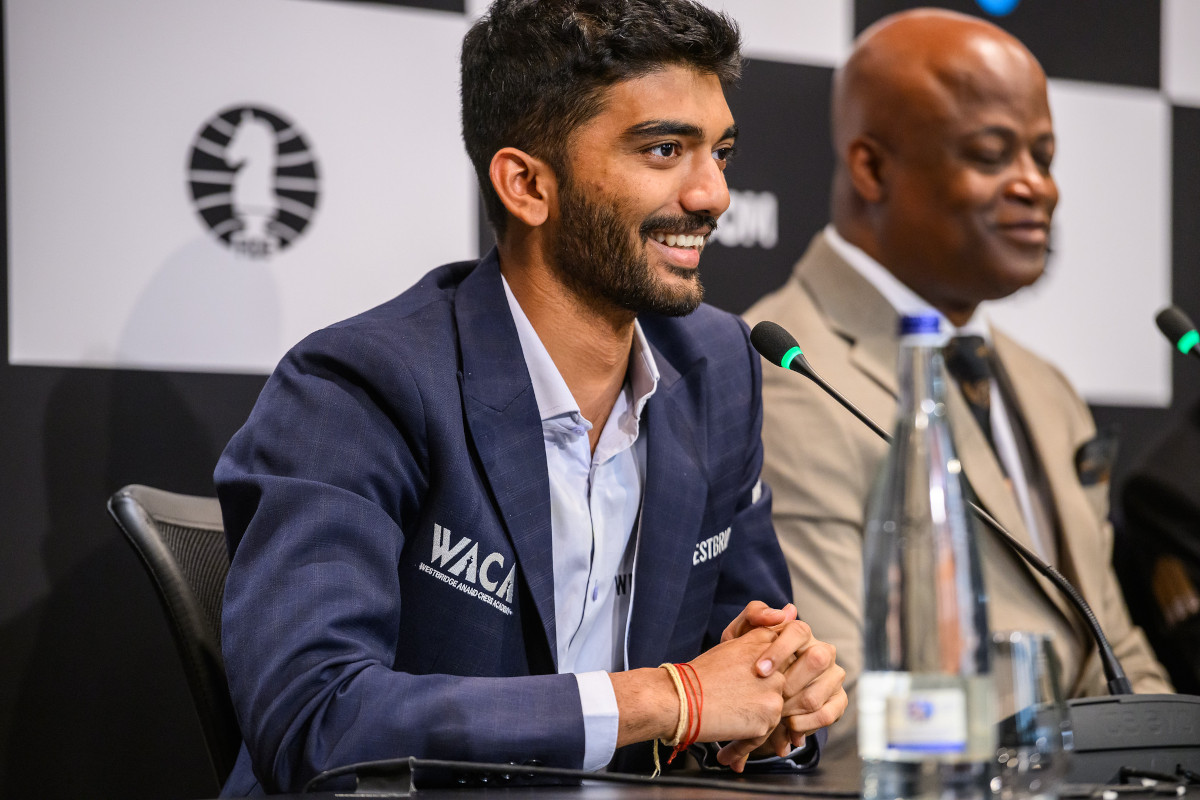
A costly queen trade
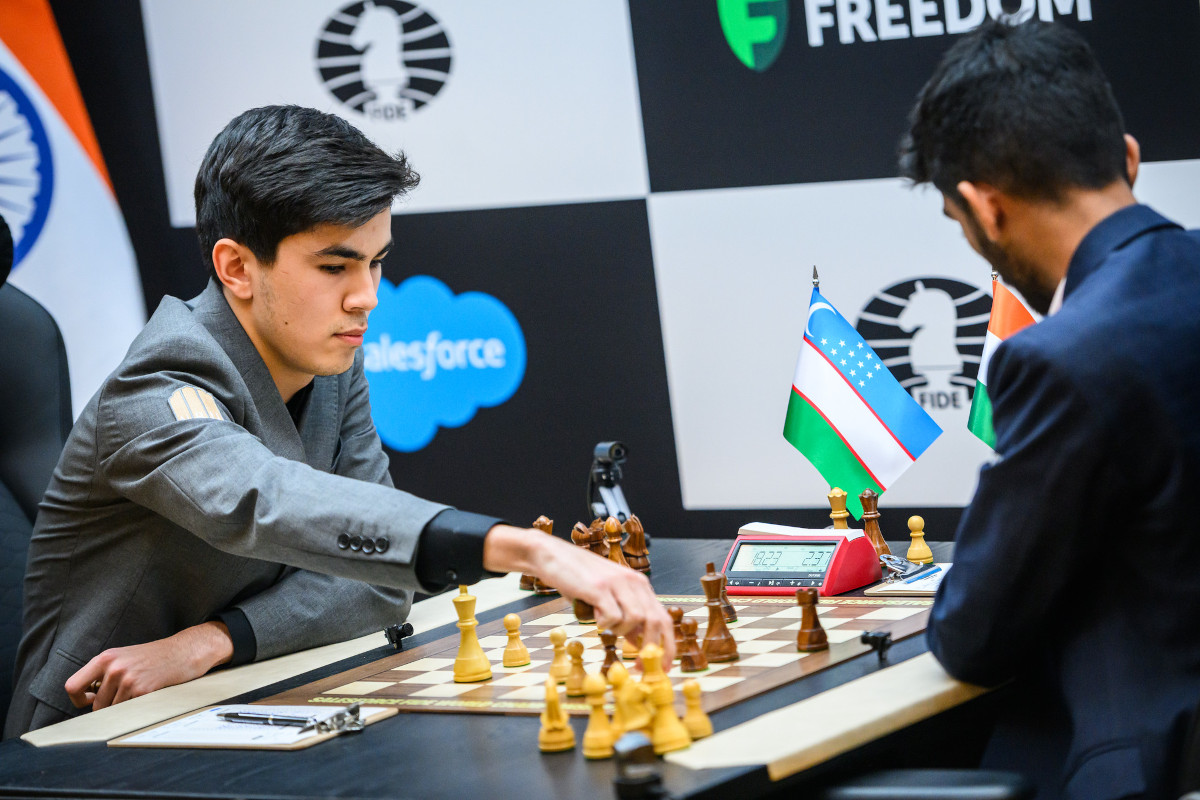
After four consecutive draws, the deadlock was broken on Sunday at the World Chess Championship match in Geneva. Javokhir Sindarov took the lead by scoring a 47-move victory with the white pieces, after defending champion Gukesh Dommaraju made a costly misjudgement on move 31, offering a queen trade that led to a losing rook endgame.
 He was a child prodigy and he is surrounded by legends. In his best times he was considered to be unbeatable and by many he was reckoned to be the greatest chess talent of all time: Jose Raul Capablanca, born 1888 in Havana.
Interestingly, there have been four previous instances in the history of the classical World Chess Championship in which the first four games ended in draws and the first decisive result came in game five. On all four occasions, it was the challenger who drew first blood.
| Year |
Match |
Venue |
Game 5 winner |
Final result |
| 1910 |
Lasker v. Schlechter |
Vienna / Berlin |
Schlechter (White) |
5–5 |
| 1921 |
Lasker v. Capablanca |
Havana |
Capablanca (White) |
9–5 to Capablanca |
| 1951 |
Botvinnik v. Bronstein |
Moscow |
Bronstein (Black) |
12–12 |
| 2013 |
Anand v. Carlsen |
Chennai |
Carlsen (White) |
6½–3½ to Carlsen |
Two of the challengers, José Raúl Capablanca and Magnus Carlsen, went on to claim the world title, while the other two, Carl Schlechter and David Bronstein, drew their respective matches, allowing the defending champions to retain their crowns (in modern times, a rapid and blitz tiebreaker is played in case of a draw in the classical section).
Sindarov's victory in Geneva marks the fifth such instance, with the challenger once again the first to get a win on the scoreboard.

Both José Raúl Capablanca and Magnus Carlsen obtained the world title for the first time after drawing their first four games and winning the fifth (in 1921 and 2013) - will Javokhir Sindarov be the third in line to claim the title after such a start? | Photo:
Sindarov opened with 1.Nf3, deviating from the 1.e4 he had employed in his first two outings with the white pieces. The contenders entered a King's Indian Attack, and it was the challenger who first gained an advantage on the clock, as Gukesh spent 25 minutes before opting for 10...Rd8, with 10...e5 the more popular continuation.
It seems likely that the defending champion was still familiar with the setup but was weighing up which lines might be more dangerous against a well-prepared opponent. Such psychological considerations are an important part of lengthy one-on-one battles, especially when the stakes are as high as they are in Geneva.
Sindarov subsequently spent 25 minutes of his own before replying with 11.Nc4, a move that had been played before, although no previous encounters between elite players had followed this exact path. Two moves later, the Uzbek grandmaster introduced a novelty with 13.e5
Also playable was 13.Ne3, allowing Black to grab the pawn on e4. There might have followed 13...Nxe4 14.Rfd1 Be6 15.Qc2 f5, leading to a double-edged position. White has better piece coordination and Black's queenside pawns might become vulnerable, but Black is a pawn up, after all.
In the game, Gukesh spent just over half an hour before continuing with 13...Nd5, and a critical position arose following 14.Ne3 Be6
The engines favour 15.h4 here, a more ambitious continuation than Sindarov's 15.Rfd1, which was nonetheless perfectly sound. While the engines initially give White a sizeable advantage following the pawn push, their assessments become more restrained at greater depths, suggesting that Black should be able to hold with accurate play.
 The King‘s Indian Attack is a universal opening: easy to learn, flexible, and rich in both tactical and positional opportunities.
The practical difficulties for Black, however, are considerable, as Sindarov himself acknowledged at the post-game press conference:
If I play h2-h4, the position is super hard to play for Black, I just realised it later.

Javokhir Sindarov considering how to proceed on move 15 | Photo: Michal Walusza
Following 15.Rfd1, it was still Sindarov who was asking the more difficult questions, while maintaining his advantage on the clock. The challenger pushed his kingside pawns deep into enemy territory, eventually establishing a strong bind with pawns on e5, g6 and h6. Gukesh, however, continued to find the moves needed to maintain the objective balance.
By the time Sindarov played 25.h6, all the minor pieces had left the board, and the contenders found themselves in a position featuring only heavy pieces and seven pawns apiece.
As many club players can attest, considerable care is needed when navigating such positions.
The manoeuvring continued, and a fifth consecutive draw seemed likely, with both contenders once again displaying patience and precision. That all changed, however, when Gukesh made the first major mistake of the match: 31...Qd2??
By offering a queen trade, the defending champion allowed his opponent to enter a winning rook endgame. The mistake was quite possibly related to the clock situation. Gukesh had around ten minutes to make his final ten moves before the time control - with no increments before move 40 - while Sindarov still had 21 minutes at his disposal.
After four games in which both players had dealt admirably with pressure, it was the defending champion who slipped first. Notably, it was Gukesh who had been putting pressure on his opponent in Saturday's fourth game, having emerged on top in the battle of opening preparation, i.e. Sindarov first dealt successfully with the pressure and now emerged on top while on the better side of the opening-preparation battle.
 Grandmaster Dr. Karsten Müller, one of the world’s leading endgame experts, guides you step by step through everything you need to know in this second volume.
Picture this: you’ve outplayed your opponent move by move, you’re clearly better – and then the endgame slips into a draw, simply because you lacked the crucial theoretical knowledge. That is exactly where this course comes in. Without solid endgame skills, there’s no way forward. Rook endgames are most essential: they occur more often than any other type of endgame, and often make the difference between victory and half a point. If you master them, you’ll confidently convert your advantages into wins!
Free video sample: Introduction
Free video sample: Bodycheck
Sindarov needed less than two minutes to decide to trade the queens, later declaring at the press conference:
I was a hundred percent sure it's winning because I calculated everything there.

"I calculated everything there" | Photo: Michal Walusza
The challenger duly converted his advantage, prompting Gukesh's resignation on move 47. Endgame expert GM Karsten Müller has analysed the instructive rook ending that followed the queen trade below.
Gukesh, the more experienced of the two 20-year-olds when it comes to matches of this nature, was quick to put the defeat into perspective:
Nine games are still there, so it's not an emergency.
Sindarov 1-0 Gukesh
Annotations by GM Karsten Müller
 Your opponents are improving. Are you?
ChessBase is a personal, stand-alone chess database that has become the standard throughout the world. Everyone uses ChessBase, from the World Champion to the amateur next door. It is the program of choice for anyone who loves the game and wants to know more about it. Start your personal success story with ChessBase and enjoy your chess even more.

Gukesh Dommaraju at the post-game press conference | Photo: Y.E. Nisenbaum

A great time to get a selfie - soon after Javokhir Sindarov scored his first-ever victory in a World Championship game | Photo: Y.E. Nisenbaum

Never a bad time to read Stefan Zweig's Schachnovelle (published in English as Chess or The Royal Game) - here in its Danish translation, Skaknovelle | Photo: Michal Walusza
All games
Schedule
 How grandmasters win without fireworks: GM Jan Markos shows you 11 very practical tips from "How to play in a lost position" to "Be patient like Carlsen" that will improve your tournament chess.
Most chess books teach you what to think about. This series teaches you what to actually do when the clock is running and the result is on the line. Compiled from GM Jan Markos's acclaimed "Practical Tips for the Tournament Player" column in ChessBase Magazine, Volume 1 covers the decisions every tournament player faces before the position ever gets complicated: how you use your time, how you handle pressure, and how you think when the stakes are real.
Free Video Sample: How to use your time effectively
| Date |
Day |
Event |
| 22 November |
Sunday |
Opening ceremony |
| 24 November |
Tuesday |
Game 1 |
| 25 November |
Wednesday |
Game 2 |
| 26 November |
Thursday |
Game 3 |
| 27 November |
Friday |
Rest day |
| 28 November |
Saturday |
Game 4 |
| 29 November |
Sunday |
Game 5 |
| 30 November |
Monday |
Game 6 |
| 1 December |
Tuesday |
Rest day |
| 2 December |
Wednesday |
Game 7 |
| 3 December |
Thursday |
Game 8 |
| 4 December |
Friday |
Game 9 |
| 5 December |
Saturday |
Rest day |
| 6 December |
Sunday |
Game 10 |
| 7 December |
Monday |
Game 11 |
| 8 December |
Tuesday |
Game 12 |
| 9 December |
Wednesday |
Rest day |
| 10 December |
Thursday |
Game 13 |
| 11 December |
Friday |
Game 14 |
| 12 December |
Saturday |
Tiebreaks (if needed) and closing ceremony |
Links















.jpeg)