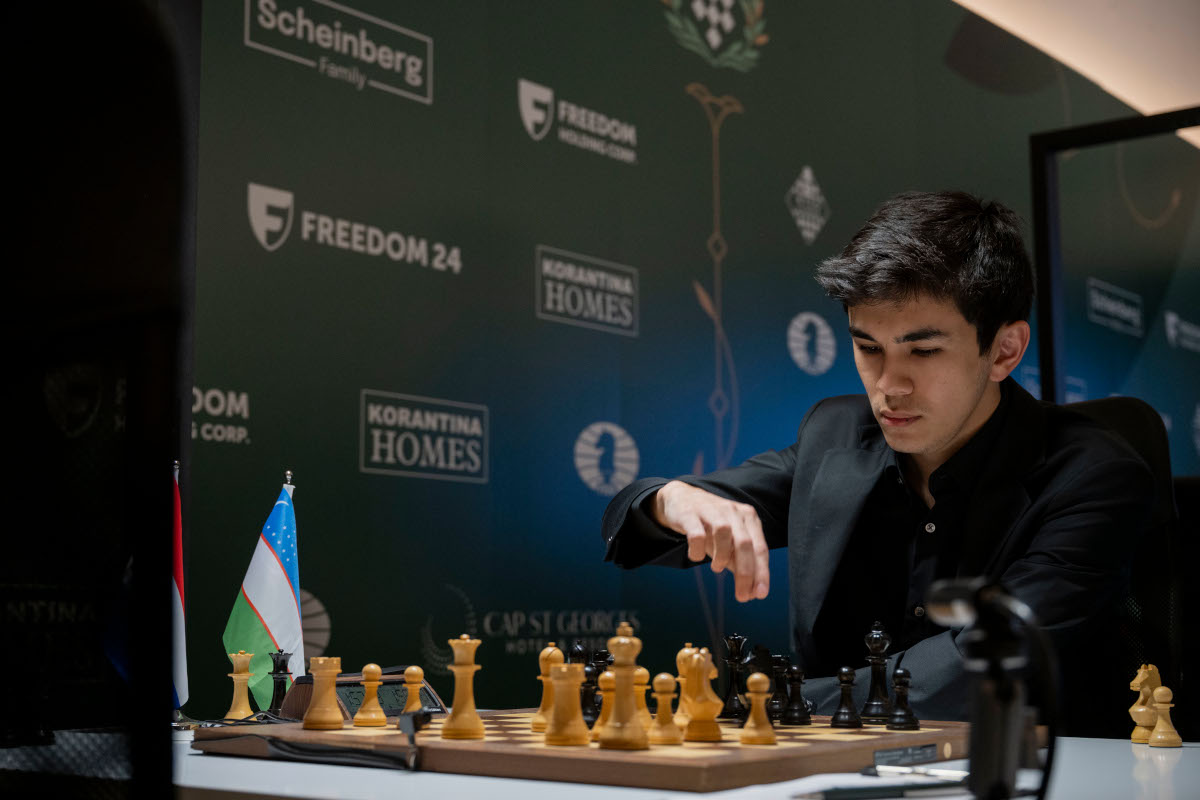
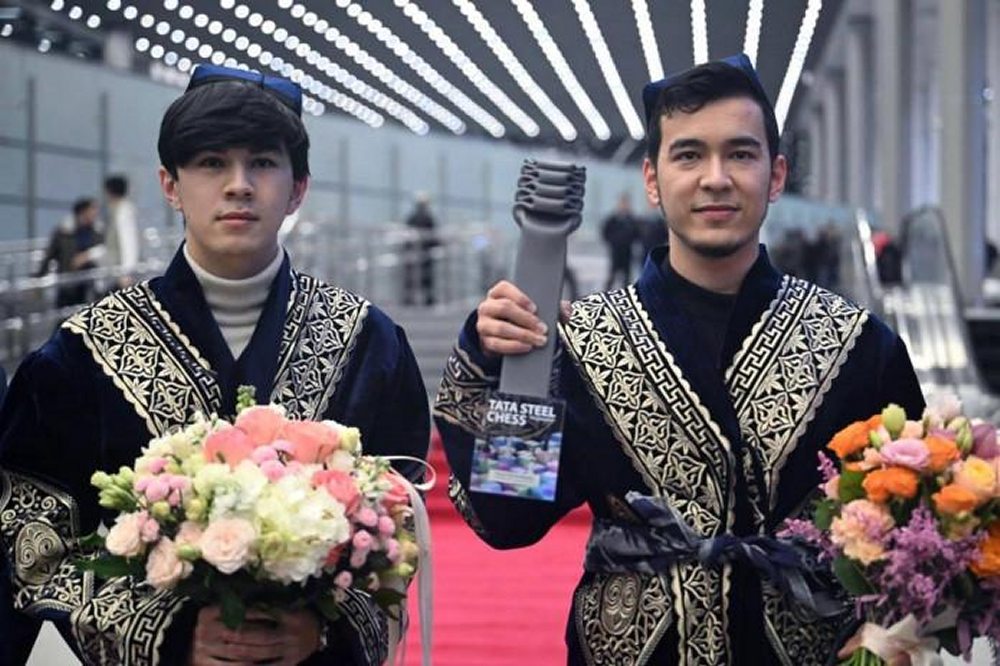
Sindarov was born on 8 December 2005 in Tashkent. His father is a businessman and his mother a teacher. He learned to play chess at the age of four and a half from his grandfather Komil Sindarov, a crime writer and vice-president of the Uzbek Chess Federation.
At six, Sindarov won the Asian U7 School Chess Championship. In 2014, he took gold in rapid and blitz at the World School Chess Championship in Brazil. He became an International Master in 2017, and in October 2018, at the age of twelve years, ten months and eight days, he completed his final grandmaster norm, becoming the second-youngest grandmaster in history at the time. He had beaten the record set by Praggnanandhaa just four months earlier by five days.

The young grandmaster | Photo: Amruta Mokal
Among his first coaches were FM Sirojiddin Zaynidinov, a two-time World Deaf Chess Champion, and later grandmaster Marat Dzhumaev.
But while players such as Gukesh, Praggnanandhaa, Abdusattorov and Firouzja quickly climbed into the world's elite, Sindarov progressed more slowly after his early successes. It was not until late 2021, three years after earning his GM title, that he crossed the 2600 Elo mark. Another two years passed before he reached 2700 for the first time.
Perhaps he lacked the ambition and dedication to training of his contemporaries, or perhaps he was too easily distracted by the attractions of other games. He is said to have secretly played video games at night even as a six-year-old.
But during the Covid pandemic, his attitude changed. "Quarantine changed my life," Sindarov later explained in an interview with FIDE. With the usual distractions gone, he began training more intensively. He earned a place in Uzbekistan's young national team, which surprised everyone by winning gold at the 2022 Chess Olympiad in Chennai. But his real breakthrough came three years later.
From the 2026 Candidates Tournament, featuring a video review by Dorian Rogozenco, to Jan Werle’s opening video on the French Tarrasch Defence, and Oliver Reeh’s tactical column ‘Top Grandmasters at Work’. Analyses by Giri, So, Wei Yi and many others.
ChessBase Magazine offers top-class training material for club players and professionals! World-class players analyse their finest games and explain the ideas behind the moves. Opening specialists present the latest trends in opening theory and exciting ideas for your repertoire. Master trainers in tactics, strategy and endgames show you exactly the tricks and techniques you need to become a successful tournament player! Available as a download (including the magazine as a PDF file) or as a printed magazine with a download key sent by post.
Included: CBM #231 as a “ChessBase Book” for iPad, tablet, Mac etc.! At books.chessbase.com
In January 2025, Sindarov met Ukrainian International Master Roman Vidonyak, who has lived and worked as a coach in Munich for many years. Vidonyak recognised his potential and developed a systematic training programme. In an interview with Sagar Shah, Vidonyak described how he structured their training and put together thousands of exercises. During training camps, they often worked eight hours a day, mostly without engines, spending much of their time calculating variations at the board. According to Vidonyak, he and Sindarov spent between 140 and 160 days together at training camps.

Sindarov at the 2025 Weissenhaus Freestyle tournament | Photo: Lennart Ootes
"I used to work a lot too, but sometimes it was boring. Then I would distract myself with computer games or other things," Sindarov explained in the FIDE interview. "But with Roman, training is always interesting. We solve problems and exercises, and time passes so quickly that sometimes we work for eight hours without even noticing."

Roman Vidonyak | Photo: Amruta Mokal
In November 2025, Sindarov won the World Cup in Goa. He became the youngest World Cup winner in history and qualified for the 2026 Candidates Tournament in Cyprus, where he started as the sixth seed. But after four rounds, he had already taken the lead with 3½/4, having beaten Caruana, one of the main favourites, in round four. In round five, he defeated Nakamura, another favourite, and in round six he beat Wei Yi. After drawing with Anish Giri in round seven, Sindarov reached the halfway point with 6/7, a point and a half ahead of Caruana.
He also showed good nerves in the second half of the tournament, defending his lead all the way to the finish. Particularly important was his draw against Caruana in round eleven. Sindarov was on the defensive for much of the game, but defended stubbornly and managed to save it. He later described the game enthusiastically in an interview with Sagar Shah as "perhaps one of the best defensive performances in history". His coach Vidonyak also rated this draw more highly than the six wins Sindarov scored at the Candidates Tournament.
In the end, Sindarov won the Candidates Tournament with 10/14 (+6, =8, −0) and a performance rating of over 2900, securing first place with a round to spare. No player has ever achieved a better result since the introduction of the current Candidates format with eight players and fourteen rounds.
"Somehow, in this tournament, I felt I could see the best moves for both sides," Sindarov explained afterwards in an interview with Chess.com. "I don't know why, but that's how it was in this tournament."
Although computer games distract him less these days, he still enjoys playing Counter-Strike. During the Candidates Tournament, he said, he spent an hour and a half at his computer almost every evening.
Sindarov is a versatile player. He is well prepared, calculates quickly, spots hidden tactical opportunities and defends difficult positions tenaciously. Vidonyak used to call his almost invariably cheerful and relaxed pupil "Sunny Boy". Now he calls him "TNT", after the explosive, as he revealed in his interview with Sagar Shah.

In good spirits: Sindarov at a press conference during the 2026 Candidates Tournament | Photo: Nils Rohde
Sindarov showed his feel for dynamics and tactics at the Clutch Chess tournament in Saint Louis in late October. He won the event with a strong finish, ahead of Praggnanandhaa, Caruana and Nakamura, and played a brilliant game with Black against Nakamura along the way.
"One of the best King's Indian games I've ever played," he said afterwards in an interview with Maurice Ashley.
GM Blohberger presents a complete two-part repertoire for Black: practical, clear, and flexible – instead of endless theory, you’ll get straightforward concepts and strategies that are easy to learn and apply.
The King’s Indian Defence has been one of the most dynamic and popular responses to 1.d4 for decades. Legends such as Garry Kasparov, Bobby Fischer, and Hikaru Nakamura have employed it at the highest level – and it continues to fascinate today, as it offers Black not only solidity but also rich attacking and counterattacking opportunities. Its special advantage: the King’s Indian is a universal system, equally effective against 1.d4, 1.c4, and 1.Nf3. Grandmaster Felix Blohberger, multiple Austrian Champion and experienced second, presents a complete two-part repertoire for Black. His approach: practical, clear, and flexible – instead of endless theory, you’ll get straightforward concepts and strategies that are easy to learn and apply.
Free video sample: Introduction
Free video sample: London System
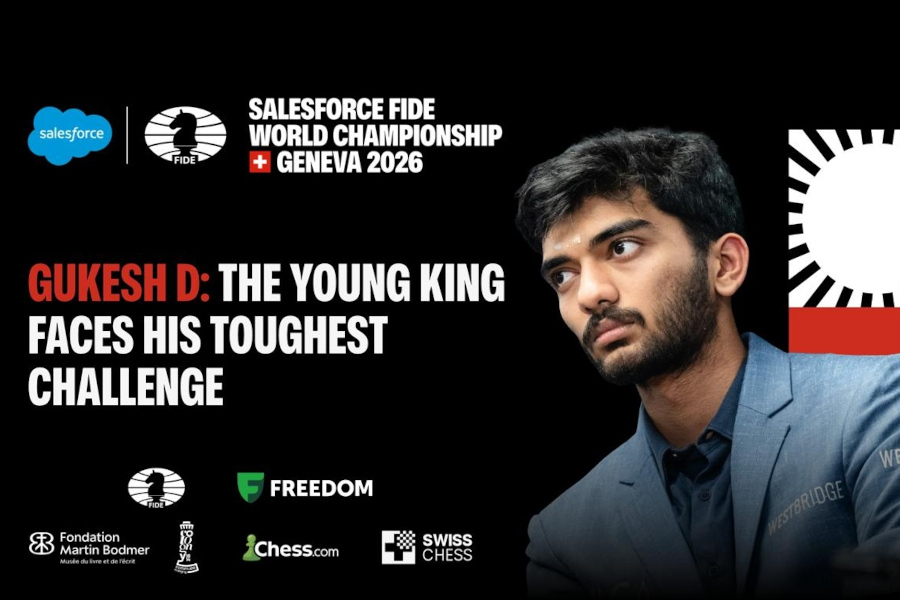
The World Championship match against Gukesh begins with the opening ceremony on 22 November. The first game will be played two days later, on 24 November, at 15.00 CET. Sindarov and Gukesh are almost the same age (Sindarov was born six months before Gukesh), but surprisingly, they have played very few classical games against each other. Sindarov has the better record in those encounters: two wins and one draw.
But Sindarov is not underestimating Gukesh. In an interview with the Indian Express, he said: "When he is at his best, he is one of the best players in the world. I am preparing for the best version of Gukesh."
Nevertheless, Sindarov goes into the match as favourite. While Sindarov has enjoyed one success after another since the World Cup, things have not gone well for Gukesh since his World Championship victory over Ding Liren. Yet Sindarov does not seem to be getting carried away. Speaking to the New Indian Express, he said: "This will be the toughest match of my life. I don't know if I'll get a second chance."
Javokhir Sindarov – Player profile
- Born: 8 December 2005
- Place of birth: Tashkent, Uzbekistan
- GM 2018, IM 2017
- Winner of the 2025 World Cup
- Winner of the 2026 Candidates Tournament
- Challenger in the 2026 World Chess Championship
- Second-youngest grandmaster in chess history at the time he completed his GM norms
Further information about the 2026 World Chess Championship
- Format: 14 classical games
- Starting time: Daily at 15.00 CET
- Playing dates: 24 Nov, 25 Nov, 26 Nov, 28 Nov, 29 Nov, 30 Nov, 2 Dec, 3 Dec, 4 Dec, 6 Dec, 7 Dec, 8 Dec, 10 Dec, 11 Dec. Tiebreaks/award ceremony: 12 Dec
- Rest days: 27 Nov, 1 Dec, 5 Dec, 9 Dec
- Official opening: 22 Nov
- Venue: Fondation Martin Bodmer, Route Martin-Bodmer 19, 1223 Cologny
- Tickets: Information and booking
- Early conclusion: If one player takes an unassailable lead, the remaining games will not be played. This happens when a player reaches 7½ points
- Time control: 120 minutes for the first 40 moves, followed by 30 minutes for the rest of the game, with a 30-second increment per move from move 41
- Draw rule: No draw offers before Black's 40th move. Exceptions apply in cases of threefold repetition and stalemate
- Tiebreak: First, four rapid games (15 minutes plus 10 seconds per move), followed by two games at 10+5 and then two blitz games at 3+2. If the score is still tied, further blitz games at 3+2 will be played until a winner emerges. Colours will be drawn before each new tiebreak stage. A 10-minute break is scheduled between games
- Prize fund: US$2.5 million. In principle, each player receives $200,000 for every point scored through a game victory. The remaining amount is split. Special rules apply to certain final scores involving a particularly high number of decisive games and to a victory in the tiebreaks
- Media regulations: Both players are required, among other things, to attend daily press conferences after their games and take part in at least two promotional events
Source: FIDE: Regulations for the FIDE World Championship Match 2026
Live commentary

Peter Leko and Peter Svidler are the official commentators for the 2026 FIDE World Championship match between Gukesh Dommaraju and Javokhir Sindarov in Geneva.
Watch the live coverage on FIDE's YouTube channel
Your opponents are improving. Are you?
ChessBase is a personal, stand-alone chess database that has become the standard throughout the world. Everyone uses ChessBase, from the World Champion to the amateur next door. It is the program of choice for anyone who loves the game and wants to know more about it. Start your personal success story with ChessBase and enjoy your chess even more.