Shifts in momentum
A third draw in as many games was seen in Geneva on Thursday, but the encounter that preceded the first rest day of the World Championship match was both the longest and the one that featured the most shifts in momentum. For the first time in the match, it was Gukesh Dommaraju who clearly had the upper hand in the opening preparation, while Javokhir Sindarov demonstrated his ability to deal with a difficult practical situation.
Sindarov, playing white for the second time in the match, again opened with 1.e4, and Gukesh once again opted for the Berlin Defence with 1...e5 2.Nf3 Nc6 3.Bb5 Nf6. The defending champion deviated from game one, however, by following 4.0-0 Nxe4 5.d4 with 5...Be7, i.e. the Rio de Janeiro Variation (as Anish Giri pointed out, the World Championship contenders have already "visited" Berlin, London and Rio!).
The difference in the quality - or depth - of the players' preparation became particularly apparent after Gukesh's rather unusual 8...Nf5, with 8...Nb7 accounting for close to 90% of the games played from the position.
Sindarov spent six and nine minutes on his next two moves, respectively, while Gukesh continued to play quickly.
Interestingly, the contenders were following in the footsteps of two chess legends. All the moves up to and including 13...Qb8 had been seen in an encounter between Ljubomir Ljubojevic and Boris Spassky at the 1988 World Cup in Belfort, France. That game ended in a draw, although Spassky needed to show his defensive skills to hold the position with black.
 In this Fritztrainer: “Attack like a Super GM” with Gukesh we touch upon all aspects of his play, with special emphasis on how you can become a better attacking player.
Sindarov introduced a novelty with 14.a3, by which point he was already 40 minutes behind on the clock and clearly finding his moves over the board. Gukesh blitzed out two more moves, making it clear that he had studied the position in considerable depth.
The queens left the board by move 17, but the resulting position was rich in possibilities, with notable imbalances in pawn structure and piece activity.

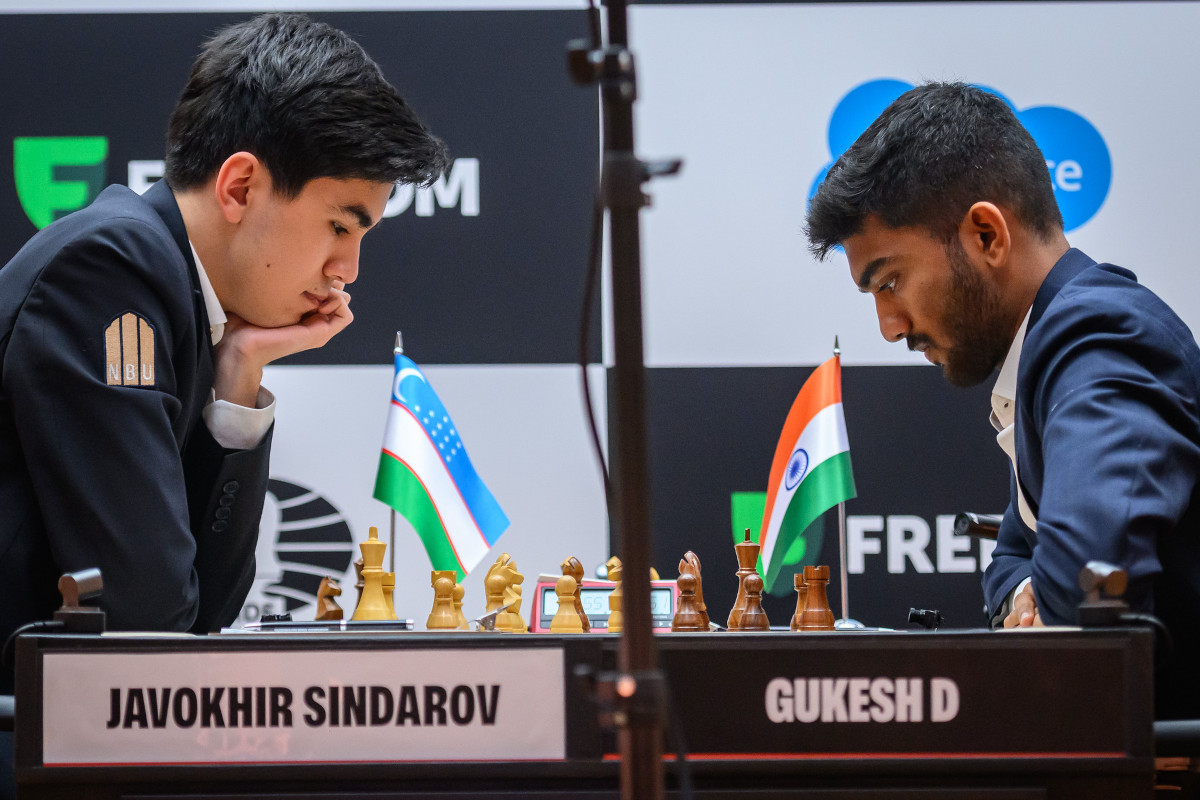
Game three unfolding at the Fondation Martin Bodmer | Photo: Y.E. Nisenbaum
What followed was a fine illustration of the strengths of the two young grandmasters. Gukesh kept looking for ways to increase the pressure, gaining space on the kingside and finding a number of subtle manoeuvres, while Sindarov had to deal with an uncomfortable position and a sizeable deficit on the clock, having been outprepared for the first time in the match.
A crucial moment came when Sindarov played 29.f4, breaking on the kingside. While the Uzbek grandmaster was rather critical of his decision at the post-game press conference, Gukesh explained that he had overlooked this particular break, despite expecting his opponent to seek counterplay on that flank.
The Indian spent over 15 minutes on his response - his longest think of the game. Although the engines continued to assess the position as equal, Black had seemingly lost some of the momentum, as active plans were now harder to come by. If anything, it was Sindarov who had the slightly more promising position.
At that point, was also plenty of tension surrounding the clock situation, with Sindarov having to play at a pace of roughly one minute per move. Remarkably, the precision of play hardly suffered, even as the challenger made his 40th move with just six seconds to spare.
By the time the players reached the time control, an endgame with rooks and bishops of opposite colours had arisen.
There was still work to be done to maintain the balance, and the contenders continued playing until move 60, when they agreed to a draw.
The match thus remains level at 1½–1½ going into Friday's rest day. While neither player has yet managed to secure a win, Thursday's game offered a glimpse of the sort of prolonged, strategically complex battles we might see as the match progresses.
Sindarov ½-½ Gukesh
Annotations by Johannes Fischer
 This video course provides a comprehensive and practical White repertoire in the Ruy Lopez! Through instructive model games and in-depth theoretical explanations, you will learn how to confidently handle both main lines and sidelines.
Free video sample: Introduction
Free video sample: Overview
Free video sample: Chigorin: 9...Na5 10.Bc2 c5 11.d4 Nd7/cxd4

Dealing with a tricky position | Photo: Y.E. Nisenbaum

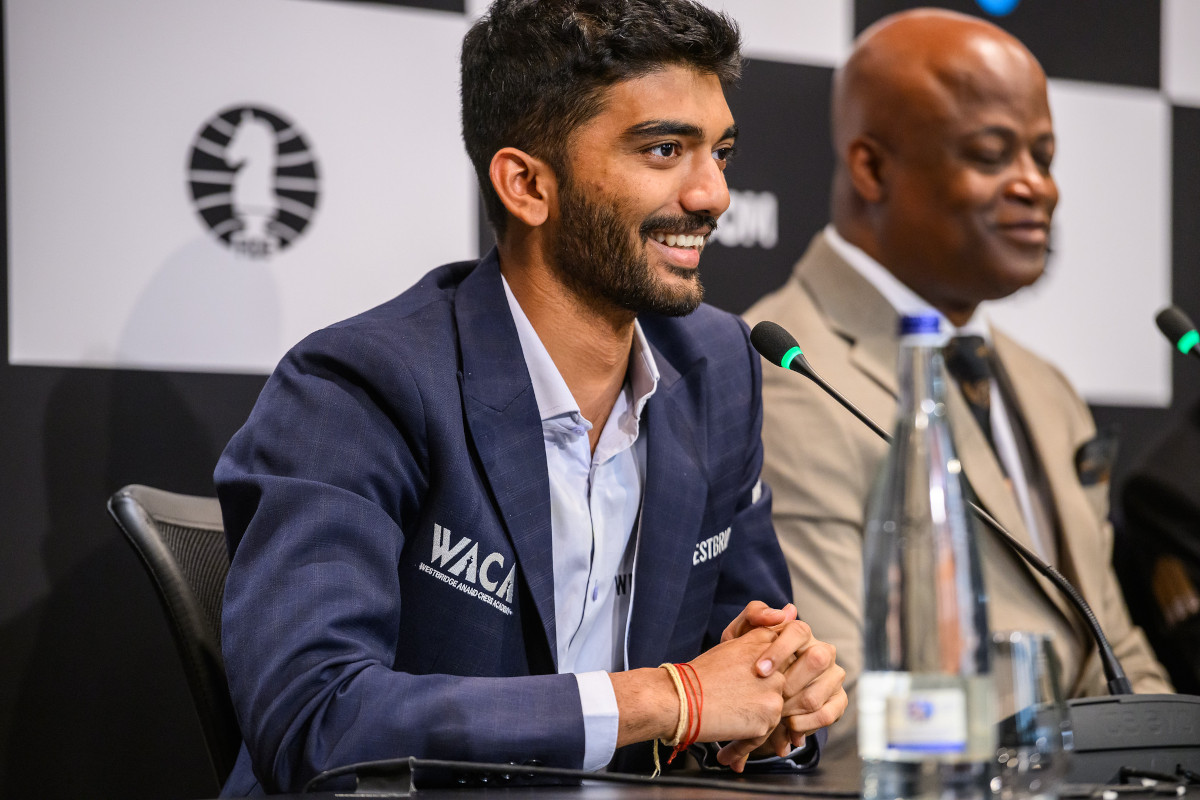
Gukesh Dommaraju reflected: "There's a lot of thinking, a lot of trying to outsmart the other" | Photo: Michal Walusza

Javokhir Sindarov confessed at the press conference: "I'm happy that I defended very well" | Photo: Michal Walusza
All games
Schedule
 Most players don’t lack the urge to attack, they just strike at the wrong moment, and GM Sipke Ernst shows you which signals tell you to go for the king and which tell you to choose another plan.
Most players know how to attack. What separates strong players from the rest is knowing when. In this course, GM Sipke Ernst, a grandmaster from the Netherlands and experienced coach, addresses the mistake he sees most often in his own students: attacking with the right idea, at the wrong moment.
Free video sample: Introduction
Free video sample: Example Game: Ernst - Mediema
| Date |
Day |
Event |
| 22 November |
Sunday |
Opening ceremony |
| 24 November |
Tuesday |
Game 1 |
| 25 November |
Wednesday |
Game 2 |
| 26 November |
Thursday |
Game 3 |
| 27 November |
Friday |
Rest day |
| 28 November |
Saturday |
Game 4 |
| 29 November |
Sunday |
Game 5 |
| 30 November |
Monday |
Game 6 |
| 1 December |
Tuesday |
Rest day |
| 2 December |
Wednesday |
Game 7 |
| 3 December |
Thursday |
Game 8 |
| 4 December |
Friday |
Game 9 |
| 5 December |
Saturday |
Rest day |
| 6 December |
Sunday |
Game 10 |
| 7 December |
Monday |
Game 11 |
| 8 December |
Tuesday |
Game 12 |
| 9 December |
Wednesday |
Rest day |
| 10 December |
Thursday |
Game 13 |
| 11 December |
Friday |
Game 14 |
| 12 December |
Saturday |
Tiebreaks (if needed) and closing ceremony |
Links
















.jpeg)