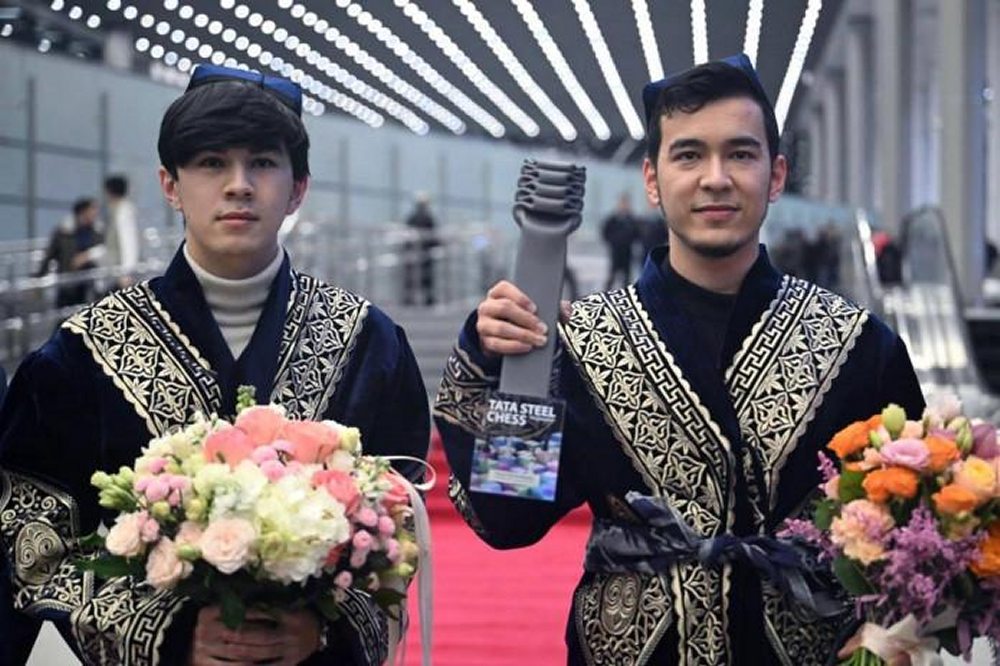
Gukesh under pressure
What remains the most popular event in the chess calendar, particularly among mainstream audiences, got under way on Tuesday at the Fondation Martin Bodmer in Cologny, near Geneva. The elegant setting is particularly fitting for an event with such a rich history, especially at a time when efforts to popularise the royal game increasingly revolve around fast-paced competitions, often played online or on computers in front of a live audience.
It has been 140 years since Wilhelm Steinitz became the first officially recognised world chess champion, in 1886, and the tradition lives on. Eighteen players have held the undisputed world title, with Gukesh Dommaraju, the defending champion in Geneva, the latest addition to the list. Coincidentally, Gukesh was 18 years old when he defeated Ding Liren to become the youngest undisputed world chess champion in history.
 In this Fritztrainer: “Attack like a Super GM” with Gukesh we touch upon all aspects of his play, with special emphasis on how you can become a better attacking player.
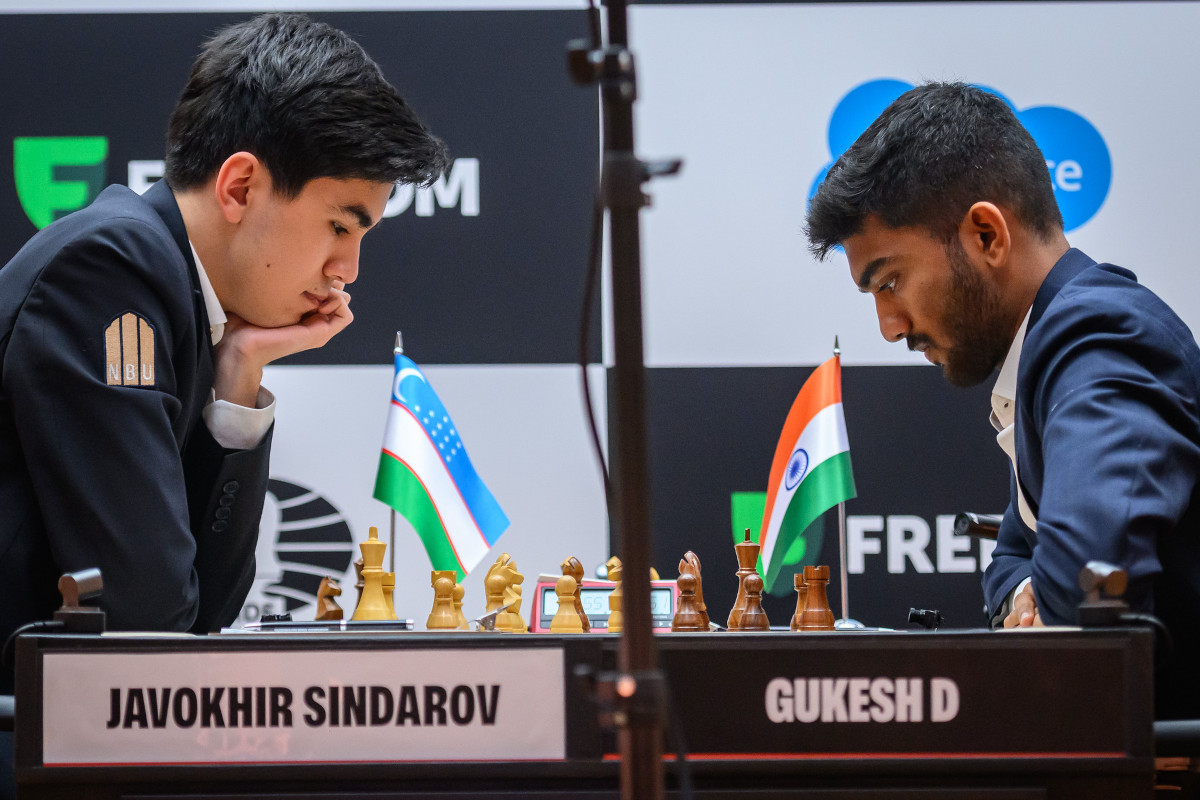
Gukesh now faces Javokhir Sindarov in what is, by average age, the youngest World Championship match in history, with both contenders aged 20. Sindarov will celebrate his 21st birthday on 8 December, the day on which game 12 is scheduled to take place. Theoretically, the Uzbek grandmaster could claim the world title on his birthday, much as Magnus Carlsen did in 2016. The Norwegian secured his third victory in a match for the crown by defeating Sergey Karjakin in rapid tiebreaks on 30 November, the day he turned 26.

The first game of the match is under way at the Fondation Martin Bodmer in Cologny | Photo: Michal Walusza

Three chess legends commentating on the game - Peter Svidler, Vishy Anand and Peter Leko | Photo: Michal Walusza
As determined by the drawing of colours at Sunday's opening ceremony, Sindarov had the white pieces in the first game of the match. Following 1.e4 e5 2.Nf3 Nc6 3.Bb5, Gukesh opted for the Berlin Defence with 3...Nf6, and Sindarov agreed to allow the much-explored Berlin Endgame by playing 4.0-0 instead of opting for the Anti-Berlin with 4.d3. Gukesh followed the main line, and the theoretical battle began.
The Berlin has a notable history in World Championship matches. Vladimir Kramnik famously employed the system to neutralise Garry Kasparov's formidable opening preparation in their 2000 match in London. Fourteen years later, in Sochi, Magnus Carlsen secured his second world title with a victory over Vishy Anand in game 11 of their match out of a Berlin. The Indian legend incorrectly sacrificed an exchange to obtain a passed pawn on the queenside.
In Geneva, Sindarov blitzed out his preparation up to and including 13.Ne4, a novelty. Gukesh had already been playing at a more measured pace, and after spending over 15 minutes on his response to the new move, found himself 25 minutes behind on the clock.
A tense battle ensued, with Sindarov looking for ways to increase the pressure and Gukesh carefully dealing with the threats to maintain the balance. By the time Sindarov played 21.g4, a move that was not the engines' first choice, the Uzbek had a 30-minute advantage on the clock. Gukesh had just 16 minutes to make 20 more moves, with no increments until after the first time control.
The tension continued to build, as tactical complications were becoming increasingly difficult to avoid. Sindarov soon sacrificed a pawn temporarily, and precise play was required from Gukesh to keep the position under control.
 How grandmasters win without fireworks: GM Jan Markos shows you 11 very practical tips from "How to play in a lost position" to "Be patient like Carlsen" that will improve your tournament chess.
Most chess books teach you what to think about. This series teaches you what to actually do when the clock is running and the result is on the line. Compiled from GM Jan Markos's acclaimed "Practical Tips for the Tournament Player" column in ChessBase Magazine, Volume 1 covers the decisions every tournament player faces before the position ever gets complicated: how you use your time, how you handle pressure, and how you think when the stakes are real.
Free Video Sample: How to use your time effectively
It was at this point that the Indian star demonstrated that the time he had invested earlier in the game had been well spent. Gukesh began to play quickly and confidently, clearly having worked out the critical lines in advance. Despite the considerable disparity on the clock, the defending champion gave his opponent little opportunity to make progress.
Sindarov eventually saw no benefit in playing on, and the game ended in a draw by threefold repetition on move 38.

Javokhir Sindarov incorrectly claimed a draw and was penalised by the arbiters (he lost two minutes on the clock) - but that was just a formality | Photo: Michal Walusza
At the post-game press conference, Gukesh explained that he felt he had things under control throughout the encounter and did not "really need to be worried". Sindarov, for his part, acknowledged that his opponent had "defended very well".
World number seven Praggnanandhaa Rameshbabu, who is rooting for his compatriot, summed up the encounter on X:
Incredible first game of World Championship match! High quality game from both! Gukesh found great moves under pressure!
 Most players don’t lack the urge to attack, they just strike at the wrong moment, and GM Sipke Ernst shows you which signals tell you to go for the king and which tell you to choose another plan.
Most players know how to attack. What separates strong players from the rest is knowing when. In this course, GM Sipke Ernst, a grandmaster from the Netherlands and experienced coach, addresses the mistake he sees most often in his own students: attacking with the right idea, at the wrong moment.
Free video sample: Introduction
Free video sample: Example Game: Ernst - Mediema

The challenger | Photo: Michal Walusza

The defending champion | Photo: Michal Walusza
Schedule
 Your opponents are improving. Are you?
ChessBase is a personal, stand-alone chess database that has become the standard throughout the world. Everyone uses ChessBase, from the World Champion to the amateur next door. It is the program of choice for anyone who loves the game and wants to know more about it. Start your personal success story with ChessBase and enjoy your chess even more.
| Date |
Day |
Event |
| 22 November |
Sunday |
Opening ceremony |
| 24 November |
Tuesday |
Game 1 |
| 25 November |
Wednesday |
Game 2 |
| 26 November |
Thursday |
Game 3 |
| 27 November |
Friday |
Rest day |
| 28 November |
Saturday |
Game 4 |
| 29 November |
Sunday |
Game 5 |
| 30 November |
Monday |
Game 6 |
| 1 December |
Tuesday |
Rest day |
| 2 December |
Wednesday |
Game 7 |
| 3 December |
Thursday |
Game 8 |
| 4 December |
Friday |
Game 9 |
| 5 December |
Saturday |
Rest day |
| 6 December |
Sunday |
Game 10 |
| 7 December |
Monday |
Game 11 |
| 8 December |
Tuesday |
Game 12 |
| 9 December |
Wednesday |
Rest day |
| 10 December |
Thursday |
Game 13 |
| 11 December |
Friday |
Game 14 |
| 12 December |
Saturday |
Tiebreaks (if needed) and closing ceremony |
Links















.jpeg)