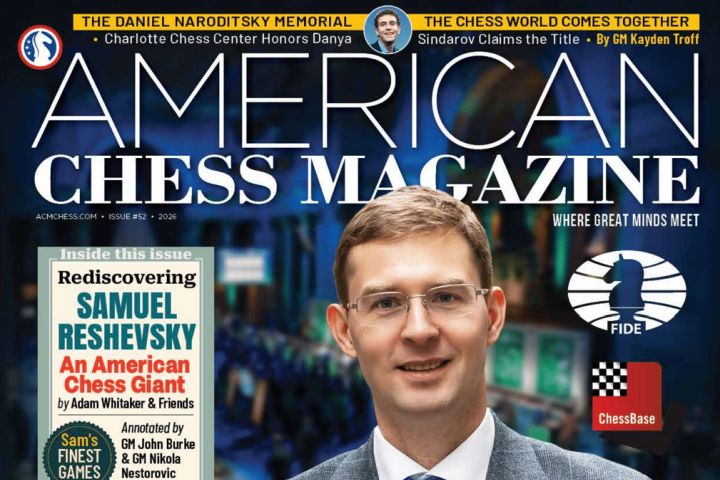
Before Timur Turlov’s election to FIDE President his role in FIDE was growing. His company, Freedom Holding Corp., had already become FIDE’s principal sponsor; his Kazakhstan Chess Federation had staged the 2023 World Championship match in Astana and put the World Rapid and Blitz on Wall Street.
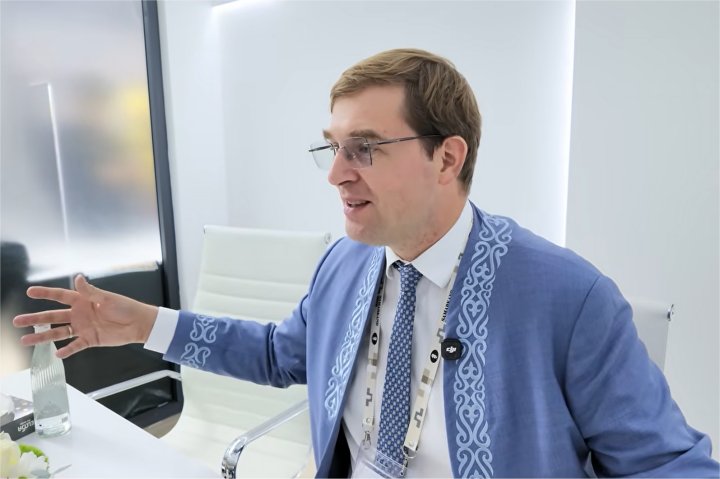
He is aware of how his rapid rise within FIDE may look, and has decided it works in his favor. “I’m still not the most familiar person for the chess community,” he said in an interview conducted by video link in early August. “I hope we will use every opportunity to meet each other and talk to each other before this election happens. And I hope that I still will be able to surprise many delegates... Don’t just try to think in stereotypes. Sometimes it’s better to talk than not to talk.”
Lobnya to Wall Street
 While tactics decide the game in concrete moments, strategy guides the entire battle. Understanding how to improve your pieces, create weaknesses, execute maneuvers, and steer the game toward favorable structures is what defines strong players.
After exploring the fundamentals of calculation in his first ChessBase course, International Master Kostya Kavutskiy now turns to the other half of chess mastery: positional play.
This course offers a structured and practical introduction to the core elements of positional chess.
Free video sample: Introduction
Free video sample: Strategic Classic: Bondarevsky - Smyslov
Turlov was born in 1987 in Lobnya, a town outside Moscow near Sheremetyevo airport. His early years were shaped by the dramatic changes that followed the collapse of the Soviet Union. He grew up in a rapidly changing Russia, at a time when the country was finding its way into a new era.
What he wanted was the world he saw in American movies. “No one had a home like that in Moscow,” he has said of the suburban house in Home Alone. Wall Street films left a different mark: wealthy people in them, he noticed, “did something with the stock market.”
He opened his first brokerage account at about fourteen with roughly $800 inherited from his grandfather, and lost most of it. At sixteen he was interning at an American firm in Moscow, attending school in the mornings and trading until midnight while New York was open — “high-frequency trading before it became algo-based,” as he describes it. He joined Uniastrum Bank’s brokerage arm in 2005 and was out of a job at twenty-one when the bank collapsed in 2008, despite his own desk remaining profitable to the last day.
He and six colleagues pooled their severance — roughly $100,000 — and started again. That company became Freedom Holding.
He moved the business to Kazakhstan in 2011, on a friend’s recommendation, and discovered a family connection: his father had been born in Shymkent. He has lived in Almaty for over a decade with his wife and six children. Freedom listed on Nasdaq in October 2019, the first financial company from Russia or Central Asia to list there, and Turlov rang the bell himself. He became a Kazakh citizen in June 2022, after the invasion of Ukraine, and ceased to hold Russian citizenship. The company sold its Russian subsidiaries the following February.
Freedom Holding reported revenue of $2.19 billion for the fiscal year ended March 2026, and Forbes ranks Turlov among Kazakhstan’s wealthiest individuals. Its consumer “super app” — banking, brokerage, insurance, travel, ticketing, groceries, film streaming — serves more than 11mn customers across more than twenty countries. That product, more than the balance sheet, shapes how he thinks about running a federation.
How He Came to Chess
Turlov plays. So do all six of his children, including a daughter who could push the pieces at three. “I play with them at dinner time or on weekends or when travelling,” he said in an earlier interview in Almaty. “They sometimes have decent results in local competitions, but they don’t take it seriously — it’s just a hobby.” He added: “For now.”
“Chess is massively undervalued”
Turlov wants to turn its global reach
into a bigger opportunity for sponsors.
He took over the Kazakhstan Chess Federation in 2023, and the results since have been hard to argue with. Kazakh players won 162 international medals in 2025, 64 of them gold. The women’s team took silver at the Budapest Olympiad. Bibisara Assaubayeva has three world blitz titles. Edgar Mamedov became the country’s youngest-ever grandmaster at fourteen and is the reigning U16 world champion. Danis Kuandykuly, the U12 world champion, drew with Magnus Carlsen at Grenke.
Underneath the elite results sits a schools program in more than 1,500 Kazakh schools reaching over 60,000 children, plus a donation of about KZT 20mn to bring chess into fifty orphanages. Turlov is also president of the International School Chess Federation, a body he proposed and the FIDE General Assembly approved.
Companies associated with him have put more than $75mn into the game, at a rate he has described as $10mn to $20mn per year. Asked in Almaty why he had gotten into chess, he put the business case second.
“First and foremost it is my passion and charity — why I came to chess,” he said. “The marketing and the relationships we develop through chess — I think that is just a side effect. Because chess opened a lot of doors in the banking world. It is a very nice, high-quality club of people.”
He is candid that the club is also the pitch. “Chess is massively undervalued. A lot of chess fans are intellectual people. It’s bankers, politicians, business leaders, different artists,” he said this summer. Businesses are “missing a great opportunity for sponsorship. With relatively small budgets, you can get global influence.”
What He Would Actually Do
His central claim is that FIDE governs the professional game competently but captures almost none of the value from the game’s migration online — and that federations will never be financially secure until they do. “Funding for federations will never be secure or sustainable unless we have a much stronger presence online,” he said.
In practice that means CRM systems so each federation can count its players; a chess ID, modeled on the KazChess ID already being completed in Kazakhstan, so a federation knows who in its country plays; voluntary accreditation of clubs, so a parent can tell a beginners’ club from a professionals’ one; calendar alignment tools; arbiter registries with allocation; performance tracking. A single platform, in other words, sitting underneath 200 federations of widely varying capacity.
Then he goes further than any other candidate has. He wants “a very strong link between online gaming platforms and national federations,” he said — “starting with biometric identification of chess players to maintain the integrity of ratings.”
 In this insightful video course, Grandmaster David Navara shares practical advice on when to calculate deeply in a position — and just as importantly, when not to.
In this insightful video course, Grandmaster David Navara shares practical advice on when to calculate deeply in a position — and just as importantly, when not to.
Free sample video: Introduction
Free sample video: Invisible moves
For a readership that has spent five years arguing about online fair play, that is the most consequential statement in the interview. It is also the least developed. He did not specify what would be captured, by whom, under what privacy regime, or whether the major platforms have agreed to anything. No other candidate is proposing it.
The second surprise is the Olympics, which appear nowhere in the five pillars his campaign published on August 1.
“We need to become an Olympic sport, and I think we have a very good chance to become an Olympic sport,” he said. “It’s not fast, but at least I want to come as close as possible to this moment in the next four years.” The route runs through continental recognition: “We need recognition from international competitions such as the Asian Games, European Games and African Games.”
The barrier, as he sees it, is not participation. “Hundreds of millions of people play chess in the world and it’s enough for the Olympics for sure,” he said. It is that chess is close to unwatchable for people who do not play it.
“Sometimes to really understand all beauty you need to be at least a master to understand the beauty of grandmasters,” he said. “With the help of AI, we can make broadcasts more attractive to the general public” — including, he suggested, “at least some beautiful animation of different lines.” A research group has been set up to work on it.
Third, and perhaps the most immediately practical, money with a longer horizon. He wants to underwrite FIDE’s calendar so events can be scheduled two years out.
“My key is to provide some financial backstop to FIDE, to make sure that we will be able to plan a longer calendar,” he said. The problem, in his diagnosis, is not staffing: “That happens not just because of a lack of professionals. That happens because of lack of predictability.”
He also wants federations to be able to embed chess in other businesses without building the technology themselves — essentially, a software development kit, so a national federation can strike a deal with a bank or a telecom. Asked whether people might one day solve puzzles to pay for things, he did not hesitate. “Yes, why not? You can give some gigabytes for solving puzzles, some extra internet, some extra engagement.”
His warning to federations that ignore all this is blunt: “They will lose authority over this game.”
ChessBase, and the Freedom Ecosystem
In April, Freedom acquired ChessBase — the Hamburg company whose databases have been the working infrastructure of professional chess for four decades — with about €5mn of committed investment. The headquarters stay in Hamburg, the management team stays, no job cuts are planned, and the group expects to add staff. The plan is to upgrade the platform with AI and connect it to the super app. ChessBase managing director Rainer Woisin called the deal “a secure new stage of development.”
The acquisition is the clearest expression of how Turlov thinks. His argument for the super app is also his argument for FIDE.
“Each big organization is kind of similar sometimes even to a small country,” he said. “So if you want to manage your country properly, you need to take care of multiple disciplines.” Ecosystems beat standalone products because the pieces reinforce each other: shared identity, shared payment rails, shared data. Applied to chess, that means the whole pyramid — schools at the base, then clubs, then tournaments, then the professional game — with one digital spine running through it and federations taught to raise money and explain themselves to governments and sponsors.
Whether the model exports is the open question. It rests in Kazakhstan on infrastructure most FIDE members do not have: a national digital ID system Turlov rates among the world’s best, and a country where 85% of payments are already cashless. He did not address how it would work in federations without any of that.
Chess and Decision-Making
Turlov has no interest in political office. “I truly believe that now I will be much more useful for any society and for any country as a businessman,” he said. “And frankly, I will be much more free in my decisions.”
What he offers instead is a promise to deliver. “If we’re promising something, we are from business, we are not from politics. We know how important it is to deliver what was promised.”
He is also clear, at least rhetorically, about the limits of the office. “We will never change the chessboard without deep involvement of the National Federation,” he said. “Any single person with any resource will not change. The community will do this.”
On the schools programs he is unromantic about outcomes. “Chess in school programs is not just to make grandmasters. Sometimes it’s just to let people study better,” he said. “Maybe they will never become even a master... Even they will become a doctor and will play chess with their kids. It’s also okay.”
A year ago, asked what the game had taught him, he talked about tiredness and consequences: do not decide when exhausted, and consider the opponent’s reply rather than only your own move. Asked the same question this summer, the answer had moved.
“In management, especially for organizations like FIDE, your mistakes are usually in your relationships with different people,” he said. “A lot of chess players actually don’t care so much about relationships. They’re more focused on results of their game... But in federation, you need to be focused on relationships. That’s all we do.”
“Mistakes could not be just factual,” he added. “Mistakes also could be in your relationships. And also if you’re tired and sick, so don’t clash with your people, with your friends, with your colleagues, with your community.”
The above interview was conducted by Leon Aris, a foreign correspondent and reporter for American Chess Magazine and BNE IntelliNews, as well as a longtime chess enthusiast.
Editor’s Note
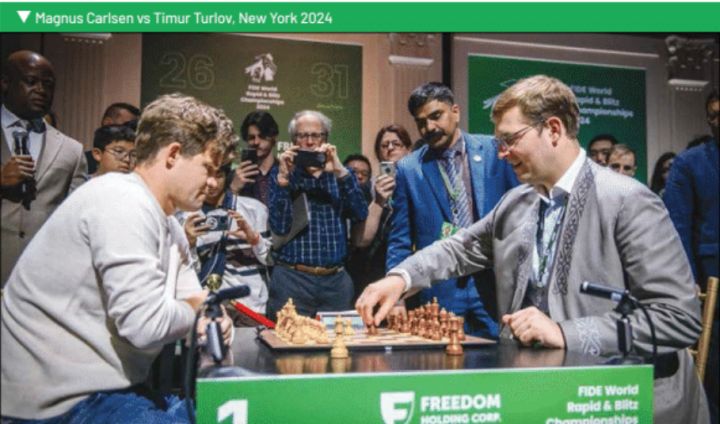 American Chess Magazine first came into contact with Turlov in New York in late 2024, when Freedom Holding was the main sponsor and driving force behind the World Rapid and Blitz Championships. We wrote about it in ACM #43, the issue with the famous Carlsen’s jeans cover. I was more than impressed by what I saw, so much so that I temporarily put aside my general reservations about FIDE.
 In this video course, kings will play a role of strong and active pieces. We will explore how Kings can be helpful in defence and prophylaxis, or even in attack!
As I grew up in former Yugoslavia and saw plenty of state-funded tournaments at the highest level, what was created by Turlov on Wall Street was, quite simply, a dream chess event.
Western media have often portrayed Turlov either as the Elon Musk of Central Asia or through the lens of his Russian connections. But what I saw during my visit to Kazakhstan in April 2026 made me feel that this misses an important part of the picture. His role in the region, and increasingly in Asia more broadly, goes far beyond brokerage. Freedom Holding is deeply involved in the region’s economic and digital development. What also struck me was Kazakhstan itself, a vast country where I was impressed by the energy and enthusiasm for progress I saw among ordinary people.
A billionaire himself, Turlov looks more like a visionary than a CEO. He told me that he is not as strong on execution, but that his strength lies in strategy and in building teams of people who are better than him at everything else. It seems to me that chess has more to gain from his involvement than he has to gain from chess. I hope his potential victory in the FIDE elections could mark a genuine turning point for our game.
FM Josip Asik, Editor-in-Chief, American Chess Magazine
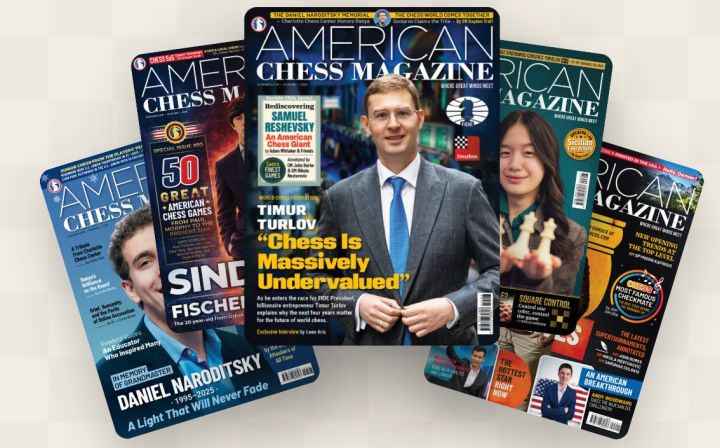
American Chess Magazine is a print-only chess publication celebrating its 10th anniversary this November (52 issues published). Its founder and editor-in-chief, Josip Asik, was recently named the 2026 Chess Journalist of the Year by the Chess Journalists of America (CJA). You can subscribe to the magazine at acmchess.com. Subscription is $124.95 per year, with free U.S. shipping with every subscription.
Here is a video interview conducted with Timur Turlov at the Olympiad
In this video course experts examine the games of Bent Larsen. Let them show you which openings Larsen chose, where his strength in middlegames were, how he outplayed his opponents in the endgame & you’ll get a glimpse of his tactical abilities!
Bent Larsen (1935–2010) was the greatest chess player in Danish history, and for a time, the second-strongest player in the Western world behind Bobby Fischer. Between 1954 and 1971, he won the Danish Championship six times, and achieved numerous international tournament victories throughout his career.
Free video sample: Introduction to Bent Larsen by Peter Heine Nielsen
Free video sample: Introduction to the Opening Section