
8/29/2019 – The 2019 Sinquefield Cup playoff ended up with Ding Liren beating world champion Magnus Carlsen to win the title and take home $82.500. After two draws in the rapid games, the Chinese star beat Carlsen in both blitz encounters. The commentators and the world champion deservedly praised Ding's performance. Express report. | Photo: Lennart Ootes / Grand Chess Tour
new: ChessBase Magazine 225
Chess Festival Prague 2025 with analyses by Aravindh, Giri, Gurel, Navara and others. ‘Special’: 27 highly entertaining miniatures. Opening videos by Werle, King and Ris. 10 opening articles with new repertoire ideas and much more. ChessBase Magazine offers first-class training material for club players and professionals! World-class players analyse their brilliant games and explain the ideas behind the moves. Opening specialists present the latest trends in opening theory and exciting ideas for your repertoire. Master trainers in tactics, strategy and endgames show you the tricks and techniques you need to be a successful tournament player! Available as a direct download (incl. booklet as pdf file) or booklet with download key by post. Included in delivery: ChessBase Magazine #225 as “ChessBase Book” for iPad, tablet, Mac etc.!
Let endgame expert Dr Karsten Müller show and explain the finesses of the world champions. Although they had different styles each and every one of them played the endgame exceptionally well, so take the opportunity to enjoy and learn from some of the best endgames in the history of chess.
In this video course, Grandmaster Ivan Sokolov explores the fascinating world of Dutch and Grünfelkd structures with colours reversed.
€39.90
Carlsen suffers in rapid and blitz
After defending his World Championship title against Fabiano Caruana on tiebreaks last year, Magnus Carlsen confirmed once again he is not only the best classical player on the planet, but also the strongest in accelerated time controls. In fact, the Norwegian is known for claiming title after title when first place is decided in rapid and blitz.
Carlsen's dominance continued during the first semester of 2019, until the August events in Saint Louis kicked off...His performance at the GCT Rapid & Blitz tournament in the 'capital of American chess' was disappointing, and it did not seem like he would be returning to his winning ways at the Sinquefield Cup. But two back to back victories in the final rounds propelled him to shared first place, which meant the title would be decided on a rapid and blitz playoff against Ding Liren.
The Chinese ace had impressed the chess world with his positional wins over Anish Giri and Fabiano Caruana in the classical event. However, facing the world champion in a direct match-up in faster time controls probably reminded him of the 2017 Champions Showdown tournament, when Carlsen defeated him more than convincingly by a 67:25 score.
But Ding was up to the task! He defeated Carlsen in the two blitz games that followed the pair of draws in the rapid phase of the tiebreaks. With these results, the Chinese grandmaster climbed to sixth and third places in the live rapid and blitz ratings list, respectively. Without a doubt, a remarkable feat!
Closing Ceremony
The closing will be held at the World Chess Hall of Fame at 23:00 UTC (1:00 CEST, 19:00 EDT).
Ultimate moves
A tradition after the Sinquefield Cup is an exhibition match at the Saint Louis Chess Club pitting founder Rex Sinquefield against his son Randy, each joined by a team of grandmasters. Rex and Randy make the first five moves, then the players swap out for a GM from their "bench", who rotate every five moves. Six games in all are played with each side having 5 minutes plus 5 seconds per move.
At the airport, in the hotel or at home on your couch: with the new ChessBase you always have access to the whole ChessBase world: the new ChessBase video library, tactics server, opening training App, the live database with eight million games, Let’s Check and web access to playchess.com
WGM Jennifer Shahade and GMs Yasser Seirawan and Maurice Ashley
Tiebreak results
Final standings
Results of Rounds 1-11
Round 11 Round-up show
IM Lawrence Trent reviews the games of the round
Round 11 games annotated by V. Saravanan
Here are the tour standings prior to the Sinquefield Cup:
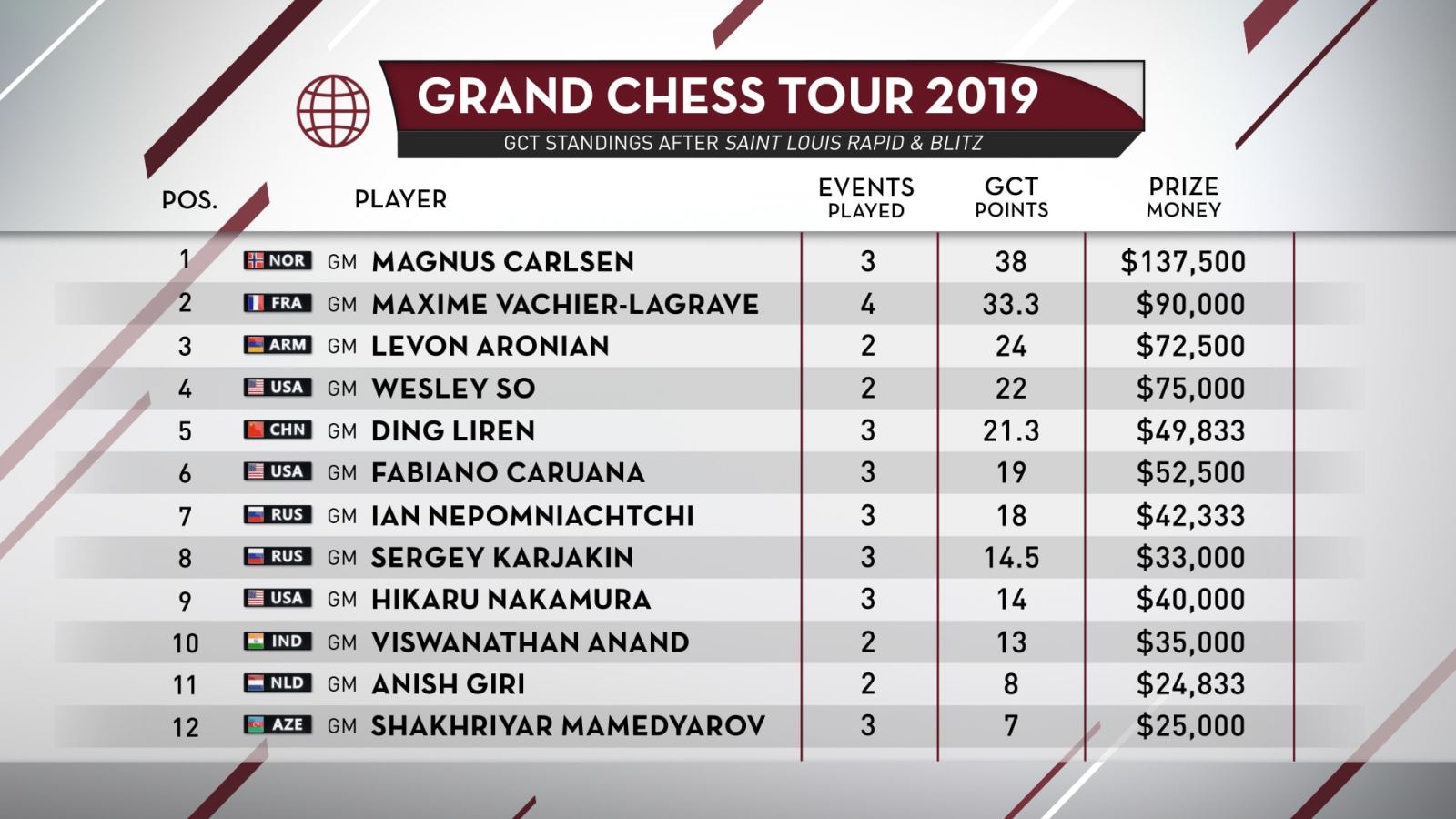
Magnus Carlsen leads despite a lacklustre St. Louis Rapid and Blitz | Graphic: Grand Chess Tour
Kasparov to play Caruana in Fischer Random
The Sinquefield Cup will run through August 27th, but the jam-packed chess session in Saint Louis will continue a week later. On Monday, September 2nd, another edition of the Champions Showdown will kick off. Using the same format as in 2018, four Chess 960 matches will take place. The event, dubbed Chess 9LX (Roman numerals are in use), will include the presence of none other than living legend Garry Kasparov.
The 13th world champion will have a tough task, as he will be facing world number two Fabiano Caruana. Last year, Kasparov lost his match against Veselin Topalov 14½:11½. The fact that he has already played under this format might help him overcome the lack of practice, as Caruana was not part of the line-up at the 2018 edition.
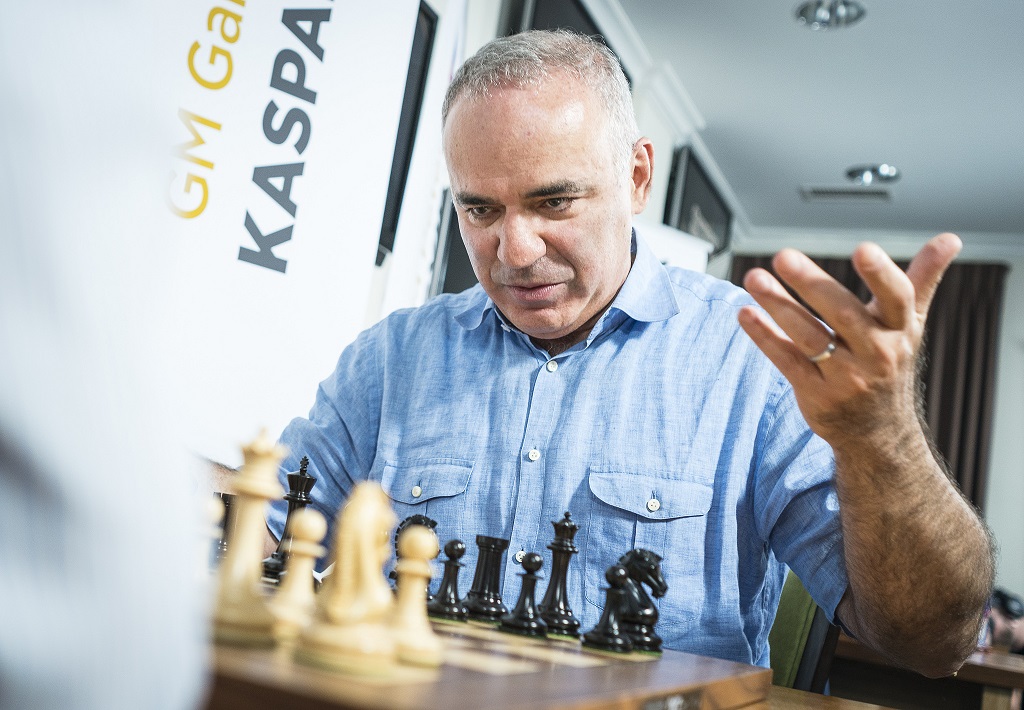
Garry Kasparov during the 2018 Champions Showdown | Photo: Lennart Ootes
The regulations are the same as last year. Six rapid games at G/30 with a 10-second delay and fourteen blitz games at G/5 with a 5-second delay will decide the winners. Each rapid game is worth two points and each blitz encounter is worth a single point. Days one, two and three will see the players facing each other twice in Rapid and twice in Blitz; while eight blitz games will be played on day four.
Each round will begin with the same starting position on all boards, and new positions will be drawn after every fourth game. The players will be able to prepare for their games, but they are not allowed to use electronic devices. As the regulations stipulate:
Positions will be drawn in the playing hall. Once drawn, players will have time to prepare, but must remain in the playing hall. Players may have a second to assist, but may not use electronic devices such as computers or phones. The Chess Club’s video production team will have the right to record players during their preparation and may use that content on the show.
Besides Kasparov vs Caruana, the other three match-ups are Wesley So vs Veselin Topalov, Leinier Dominguez vs Peter Svidler and Hikaru Nakamura vs Levon Aronian. Notice that Caruana and Aronian are set to participate in three consecutive events in Saint Louis — the GCT Rapid & Blitz, the Sinquefield Cup and the Champions Showdown.
Regarding not seeing the same players at the top, take a look at the final 9 in the fischer random world championship: Carlsen, Caruana, So, Fedoseev, Svidler, Gujrathi, Nepo, Firoujza, and Nakamura. 4 of them are not Grand Chess Tour invitees. But the difference isn't in who was invited, it was the fact that these 4 qualified in an open competition.
fgkdjlkag 9/1/2019 03:09
Interesting that Kasparov made the same 2 points I already made below: 1. the absolute best playing over and over is not a problem. 2. draws are not a problem.
Can someone tell me why last year (in 2018) the Sinquefield Cup had a three winners? Why did Fabiano/Magnus/Levon not have a threeway playoff???
Peter B 8/30/2019 04:46
The score of the first blitz game is incomplete. It went a while longer and Carlsen lost on time.
chessgod0 8/30/2019 12:28
Congrats to Ding! His confidence is growing--it's clear he does not fear Carlsen. The future could get very interesting for the champ...
jonkm 8/29/2019 11:30
A Ding shocker! You could have made lotta money in Vegas betting on that outcome!
satman 8/29/2019 08:22
Here's an idea to liven things up.
At the moment the players have 90 minutes the first 40 moves and then just 30 minutes to finish off the game.
It's well known that this leads to badly played endings, and we might ask the question: if they're so booked up with the computer lines why do they need so much time for the early part of the game?
So my suggestion is to switch things around: 30 minutes for the first 20 moves, 90 minutes for the rest of the game.
With this maybe players would be more willing to spring surprises and take risks in the opening, knowing that their opponent hasn't got so much time to find a punishing refutation.
Also very often the critical positions occur between moves 30 and 40, leading many games to be spoiled by time-trouble blunders - this system would give the players more time to ponder in that critical period.
And - in principle - there's more time allocated to the endgame, although maybe not in practice!
calcomar 8/29/2019 04:58
@conillet: Three blitz match-ups will take place before the arbiter's decision determines how to go on. Which makes more sense, of course :)
conillet 8/29/2019 04:28
It strikes me as odd that tiebreak rules are unclear (left to the arbiter's discretion) after only 4 games.
Ajeeb007 8/29/2019 01:21
The top players play each other way too much. Organizers only want to invite the top 10 or 15. These players know each other's game so well that after 100s of meetings it becomes difficult to find anything new. They don't want to take chances for fear they'll lose a few rating points and then start not getting invited by these organizers. Professional chess has become too elitist. If a slightly wider range of players were invited to these tournaments you would see more exciting and decisive games, as well as major upsets. Open tournaments like Gibraltar and IOM are much more interesting to follow than those like the Sinquefield Cup where one boring draw after another is seen.
Keith Homeyard 8/29/2019 09:45
KungFuChess: I didn't mean Fischer Random but randomize who you play each day! If you don't know who you are playing (or colour) until just before start of play the prep is much harder
KungFuChess 8/29/2019 06:07
We're seeing top level, classical chess. Fischer Random is a different game. Blitz, Bullet and Rapid tournaments bring out everyone from the woodwork complaining about the 'less than optimal skill' involved. The 'Goldilocks' is already upon us and has been for well over a century it's called classical chess! The best players still tend to win the tournaments and the championships because, wait for it.... they're the best. Hate draws so much that it has become unbearable? Go do something else with your time. The fans of chess are still growing. Some fans leave, some stay, new ones are made. That's life. Weird, eh? Not really. And now let's get ready for what we can hope is a really entertaining tiebreak to this tournament filled with such tremendous talent! Yeah, baby!!!
Keith Homeyard 8/29/2019 12:14
In an all-play-all tournament, if you randomize order of play and colours (allowing for equal number of each colour) and only announce the draw in the morning then home prep would be very difficult - the player wouldn't necessarily even know whether he/she needs to push for a win!
fgkdjlkag 8/28/2019 11:46
klklkl is absolutely right and its strange to always see a plethora of comments that cannot acknowledge it. klklkl also correctly points out the problem is memorised opening theory, and not frequency of draws. "Rather the problem is that novel moves occur too late in elite chess games, often after the true "opening phase" is over and the "middle game" has begun" BECAUSE OF memorised theory. How can this be seen as an independent problem? And 1 position per year means that all memorised theory is useless the following year. What a colossal waste of time. To memorise for a decade and then throw it all out is also silly. As klklkl pointed out, the problem IS memorised theory, so why should any solution involve memorising theory? Any solution that deals with opening theory would also reduce the draw rate, and open up many other possibilities. Eg, incentivising wins does not work with chess now, but would work with fischer random. Not that I advocate fischer random, but it is one of the possible solutions.
genem 8/28/2019 09:48
@klklkl : Goldilocks. It is not quite right to simply say that - "Memorised theory is the problem". Rather the problem is that novel moves occur too late in elite chess games, often after the true "opening phase" is over and the "middle game" has begun.
Chess960-FRC takes the other extreme, of no at-home preparation for the starting setup.
What chess needs is a "Goldilocks" solution: Decide on one chess960 start setup per year (or per decade), and reuse during the whole year. Watch opening theory grow from nothing to a little, then to a little more, over the months. In today's age, with electronic communications and powerful chess computers, we could all watch this growth occur in something like real time. Authors who annotate recent chess games would have a lot more to say as opinions would differ about the positional strengths and weaknesses of highly novel lines the games branch into around move-pair 5, in a world where consensus has not yet had time to calcify. Goldilocks.
Masquer 8/27/2019 10:38
Ivanchuk is only 100 Elo below the average top 10 player. Statistically he shouldn't get smashed, and his experience and talent are still there, or he would not have a rating near 2700. I have to think such creative players (renowned veterans with enough left in the tank) and somewhat lower rated 'up and coming' youngsters with lots of talent and energy would spice up the elite tournaments.
That is exactly how the famous tournaments of old used to be - a mixture of young, old, and very strong. Just the right mix.
JanneKejo 8/27/2019 04:18
One way to try to increase the amount of decisive games could be that some amount (for example half) of the total prize money in a tournament would be distributed to the players who won games (x dollars per win; the smaller the amount of decisive games in the tournament, the more money for a won game) and the other half of the prize money would be distributed according to the final standings in the tournament table as usual.
anthonyy 8/27/2019 09:19
Reduce the time given to the players ? It is already the case,
with the result that the endgames are played very poorly now.
Do you think that So would have lost agains Nepo if he had had
50 minutes every 20 moves ? What is the interest to have
a decisive result with plenty of mistakes ?
Mix stronger and weaker players ? I love Ivantchuk or Jobava, but they
would be smashed into pieces, what would be the interest ?
There are already tournaments with different level players, such as
the Olympiads.
In the old days, the spectators were motivated, good players
who understood chess (specially in the Eastern countries)
and did not mind a well played draw.
Now people rated 1500 complain about the draws and say that
Caruana is a patzer because their computer tells them
that he played only the second best move ! As soon as they see
a red move, they yell Blunder in the comments.
If I had money, I would organize a tournament with 2h30 for 40 moves
then 1h every 16 moves, with adjourned games (computers forbidden),
and more rest days.
Masquer 8/27/2019 09:16
I think top players are playing not to lose first and foremost when facing roughly equal or better opposition. Not always the case, but mostly true. There is not enough of an incentive for risk taking, unfortunately. Notice that brilliancy prizes have gone the way of the dodo? Playing to win has to be better rewarded and more risks will be taken.
Of course, it's better when some beatable players are present, too. These guys are biting on granite, with no one to overpower, and the organizers have to think of a better format and make-up of participants.
JanneKejo 8/26/2019 10:59
A draw or many draws is no problem as long as the game is exciting. But top players getting won positions and not being able to convert -- time after time? I wasn't bored by the draws Karpov and Kasparov played in their matches against each other, or the draws Tigran Petrosian played in his time. But somehow I lost interest for top chess after the Caruana - Carlsen match. Not just because of the 12 draws but because both failed to win when they had the chance.
Could it be that the top players have lost their confidence and courage because of the computers? Could it be that they no longer dare to take any risks because they fear there might exist some refutation even though they can't see it?
Masquer 8/26/2019 08:02
One solution could be to also invite both a) talented and exciting up-and-comers, like Artemiev, Duda, Rapport, Firouzja, Wei Yi, and b) former stars now past their prime, such as Shirov, Kamsky, Ivanchuk, Morozevich etc. besides the current elite. A far lower draw rate would be guaranteed. These classical time control tournaments are too exclusive right now and result in draw death.
Masquer 8/26/2019 07:52
If you look at the great tournaments of the past, up to the the late eighties or so, there were plenty of elite contestants, but lower tier titled players also joined them. The tournaments were somewhat longer, of course, but there was an abundance of decisive results and instructive games to always look forward to. These days, the elite players cancel each other out, and there is no lower tier opposition to beat up on. Hence, the built-in problem of elite-only competitions.
klklkl 8/26/2019 02:56
Some profoundly naive remarks and ideas below.
The football-scoring notion is bogus. Players already have a much more compelling incentive in huge prizes at the Sinquefield Cup, but it's changed nothing.
Meanwhile, the idea of inviting weaker players to disturb the regularity is specious: weakening participant calibre might well lead to more excitement, but the event could no longer be called elite, even with massive prizes.
And finally the idea that so long as these games fascinate the connoisseur, the rabble can GFT, is the worst sort of insular elitism. I really don't believe anyone other than a tiny minority want the chessboard to be a dusty theoretical temple. Ordinary viewers will switch off, and sponsorship will eventually either run or demand alternative formats. But the fact we have this same discussion seemingly with almost every elite event shows just how diseased & rotten the professional game is. Many of those at its heart might not see it - but casual viewers & players (the majority) do.
Memorised theory is the problem. Chess is the only sport I can name where players can play half or three-quarters - sometimes even an entire game - before they even arive at the board, with many of the decisions directed by a computer engine or other people. In football, if two teams arrived and for the first 75 mins played out a pre-choreographed, the outcry would be huge. In chess, we accept it as normal - even applauding the player whose prearrangement runs deepest. And our cognitive dissonance is bizarre: it's cheating to hand off decisions to engines during the game, but fine if we do it beforehand.
Short of other ideas appearing, the solutions are limited to:
- Fischer Random - to hamper theory
- Shorter controls - to fluster memory
- Other formats with penalties for players relying on memory (as with Norway's)
AidanMonaghan 8/25/2019 10:36
Time to experiment with shorter time controls to find a balance between sufficient quality of play and more decisive results.
Sponsors and the public may tire of continued elite play of this kind.
Aighearach 8/25/2019 01:07
I'm just a patzer, but I was playing a rapid game a couple months ago and I was down the exchange and a pawn, and then I had to give up the other exchange to prevent mate, except whoopsie, accepting the second exchange was a blunder for my op because now the position was dead drawn. It looked super-scary, but it had turned into a mirage with no targets for the rooks.
Aighearach 8/25/2019 01:03
I doubt Anand is "fuming" over being the one creating the most chances, he's playing against the best in the world and it is hard to deliver checkmate. In my observation, the morale of top players has more to do with how well they feel like they're playing, rather than the results they achieved in specific games. Maybe Ivanchuk was an exception when he was at the top.
Nakamura talked about that in NY a while back, at the top level there are just so many defensive resources. Computers have changed the number of positions worth trying to defend, and having a "winning" advantage isn't as straightforwards as it sounds.
sceptic101 8/24/2019 06:03
Fans of every generation presume they are seeing chess at the highest level. They need a time range to have a comparison and perspective. The tournaments in which Kasparov and Karpov played together competing against rivals like Nunn, Timman and Speelman are some of the best of all time. Ivanchuk in form could put every one in his place from Kasparov to Carlsen. Those who don’t believe can look at his wins over both. Is he past his prime now? Invite him for a big event and see. He is a highly unpredictable player. People have this attitude of ruling out a player once he has a relatively bad period. Anand and Aronian had their bad spells and they are back. Every one thought Magnus is invincible with his form and rating this year. He collapsed in St, Louis, losing many games. Now he is back, but still struggling with form. About these young players: Rapport and Duda, not to mention Artemiev court danger and are not afraid of losing. In formative years their results would have ups and downs. That’s how great players like Larsen evolved. So let us give them a chance. We can't have the same set of players running rings around one another all the time.
VVI 8/24/2019 03:43
Anand missing out 2 clear wins - Wesley So and Anish Giri. He must be fuming inside.
Hope he maintains his composure and finishes well.
Serse 8/24/2019 11:21
Ivanchuk used to be a top player many years ago. And he is still a strong gun. But let's be serious: he wouldn't have a chance against the current top 12. And yet I admire him a lot.
For Duda, it's different. He is still too inconsistent but his playing is energetic and often exciting.
Lilloso 8/24/2019 08:13
@sceptic101 You are entitled to think that there are numerous talents in chess. But Ivanchuk and Rapport would'nt have any chance in this type of tournament. The players of the Sinquefield are simply on a level of their own.
sceptic101 8/23/2019 03:42
At the end of the day all players are performers. They have a duty to chess public. If they experiment, take risks and play fascinating chess, it’s genuine entertainment. Players of the old school like Bronstein and Tal understood this very well. The idea that the players at Sinquefield alone can play the greatest and best chess is absurd. Ratings alone cannot be the determining factor. Could some one suggest veterans like Ivanchuk and young players like Rapport and Duda are inferior to the lot playing in Sinquefield? We don’t grudge the privileges elite players enjoy, appearance fee, free air travel transport and five star accommodation + prizes to be won. Meanwhile let us spare a thought for other talents, struggling to come up or trying to eke out a living. They don’t need charity, only opportunities to showcase their creative skills.
emerlion 8/22/2019 02:09
Hilarious on the Carlsen - Karjakin game. 45... a4! It's the only legal move and it gets a !
Jayarama Iyer 8/21/2019 09:35
These elite tournaments are played at the highest level and majority of draws is a natural consequence. They are playing to win the tournament (not just the game) and are not paid gladiators playing to entertain the crowds only like clowns. They are professionals at the highest level whose livelihood depends on doing well and winning the tournament. As Venkatachalam Saravanan's analysis show, these drawn games involve lot of internal strategic drama.
I think if you want results for entertainment, they should play Fischer Random 360 for show.
As an old school chess fan, I enjoy these games whatever the result. Of course, win/loss result are great, but it is not going to happen at this level that frequently.
Michael51 8/21/2019 03:06
These "elite " tournaments have become boring and predictable .....same conservative openings rolled out tournament after tournament with little innovation.... 2 wins in 24 games pretty much says it all.
fgkdjlkag 8/21/2019 03:00
The Sinquefield cup is the strongest event in the United States, maybe one of the strongest in the world? To not invite the absolute top players is silly, and dramatically reduces interest in it. Everyone is always interested in seeing the best fight. Inviting weaker players is a not so tacit admission that the game of chess is fundamentally flawed.
Peter B 8/21/2019 01:26
@Dojisan "Len" is short for "length of game", in terms of the number of moves that have been played.
DojiSan 8/20/2019 11:05
on the pairing what does "Len" stand for?
eltollo 8/20/2019 10:55
I agree that the schedule for elite players is very tightly packed.
However, they can choose to not accept all invitations, can't they?
peterfrost 8/20/2019 10:34
This ALWAYS happens when organisers stupidly invite only elite players. Much more interesting tournaments result with a mix of the truly elite and a batch of 2500-2650ers (especially when they are up and coming juniors, romantic attackers, or veteran elites). Classical chess should be just fine, but organisers are going to kill it with their unimaginative approach to invitations. The Grand Chess Tour concept is flawed for this reason. I would much rather watch original contests of the type described above than yet another Vishy-Ding draw. When one goes through the games of GM's at "second tier" events, one sees that classical chess is alive and well with a good balance of results and draws. There's only a problem with these repetitive "elite" events where the players who would make it more interesting are shut out.
In this course, you will learn the foundations and key ideas of the Vienna Game and discover a variety of systems that make you extremely difficult to prepare for.
Tata Steel 2026 with analyses by Bluebaum, Giri, L'Ami, Woodward and many more. Opening videos by Kasimdzhanov, Marin and Zwirs. 10 exciting opening articles with new repertoire ideas and much more.
In this course, Dutch Grandmaster Jan Werle presents a modern and practical repertoire in the French Advance Variation, focusing on the critical line 1.e4 e6 2.d4 d5 3.e5 c5 4.c3 Nc6 5.Nf3.
One of the major battlegrounds of the Queen’s Gambit Declined is the Catalan, and against it Zwirs chose an ambitious strategy: accept the pawn and hold onto it with …c6 and …b5, aiming for an unbalanced fight from the very start.
In almost every chess game there comes a moment when you just can’t go on without tactics. You must strike to not giving away the advantage you have worked for the whole game.
€39.90
We use cookies and comparable technologies to provide certain functions, to improve the user experience and to offer interest-oriented content. Depending on their intended use, analysis cookies and marketing cookies may be used in addition to technically required cookies. Here you can make detailed settings or revoke your consent (if necessary partially) with effect for the future. Further information can be found in our data protection declaration.
Pop-up for detailed settings
We use cookies and comparable technologies to provide certain functions, to improve the user experience and to offer interest-oriented content. Depending on their intended use, cookies may be used in addition to technically required cookies, analysis cookies and marketing cookies. You can decide which cookies to use by selecting the appropriate options below. Please note that your selection may affect the functionality of the service. Further information can be found in our privacy policy.
Technically required cookies
Technically required cookies: so that you can navigate and use the basic functions and store preferences.
Analysis Cookies
To help us determine how visitors interact with our website to improve the user experience.
Marketing-Cookies
To help us offer and evaluate relevant content and interesting and appropriate advertisement.