Part III • Strategic and Positional Play
Strategy is an important part of the development of chess players who have already learned the basics. At first, however, it can seem overwhelming, as players have to deal with concepts and individual aspects of pawn play and piece play that make up a chess position. Terms such as weak square, bad piece, space advantage or prophylaxis are quickly explained, but knowing their definitions is still a long way from being able to apply them in practice.
In every game of chess, there comes a moment when one is confronted with the question: what should I do now?
It is not enough simply to rely on rules of thumb. Instead, players need to develop sound mental images and an understanding of how individual strategic features can influence one another and affect the position as a whole.
Robert Ris addresses this problem by consistently linking positional features, plans and their concrete execution. His earlier course Strategy Training: How to Make a Plan and the three-part series Mastering Chess Strategy together form a course of instruction that ranges from basic strategic vocabulary to developing plans that take the opponent's intentions into account.
In doing so, Ris avoids two common extremes. He neither reduces strategy to rules of thumb nor dissolves it entirely into engine variations. Instead, he shows that a plan is derived from the features of a position. Which pawn can create a lever? Which tension should be maintained or resolved? Which piece is limiting the coordination of your forces? What target can be created? What does the opponent intend to do next? These questions lead from describing a position to making decisions.
Strategy Training: How to Make a Plan (2019)
 How to Make a Plan aims to teach the methods by which a plan can be formulated for a given position. The idea is not to develop an all-encompassing master plan, but rather to provide guidance on how to formulate a plan, or a mini-plan, in any position, regardless of its complexity.
Ris reduces his method to five key aspects that players should make use of:
- 1. The influence of pawn play
- 2. Dealing with tension
- 3. Improving the worst-placed piece
- 4. Creating and exploiting weaknesses
- 5. Prophylactic thinking
These are certainly familiar questions that can also be found in the relevant literature on the subject. One could argue that a universal method of finding plans might require an even finer subdivision, but that perhaps depends more on the chess "school" in which one was brought up.
These five key ideas are discussed through illustrative games, which sometimes make it particularly clear how closely the five aspects are intertwined.
The game examples, however, are not merely presented as lectures. Rather, they provide the basis for the test positions that follow. There are plenty of these, allowing players to practise each of the five techniques extensively.
Basics of Chess Strategy Vol. 1 – Concepts of Pawn Play
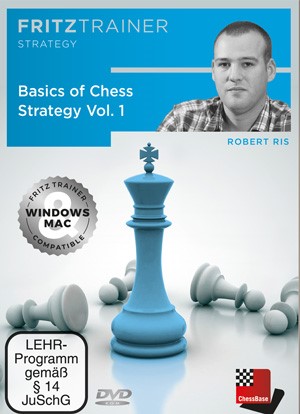 Some time after this broad outline of how to find a plan, Ris followed up with a three-part series devoted to the study of strategic play, incorporating aspects from the course Chess Training – How to Make Plan. The individual elements that make up a position are examined in greater detail.
Basics of Chess Strategy Vol. 1 begins with the functions of pawns: king protection, support for the pieces, restriction of the opponent's mobility, weak pawns, weak squares and typical pawn structures. Open files and the seventh rank as the natural domain of the rooks are also covered. This breaks down the common distinction between "strategic" and "attacking" play. A rook on the seventh rank is positionally justified and at the same time poses tactical threats; a weak square is only relevant if a piece can occupy it and exert an influence from there.
The strength of the first volume lies in its concrete approach. Ris does not treat pawns as an isolated feature, but shows how they interact with the other aspects of piece play. An isolated or backward pawn is not automatically a weakness – what matters is whether it can be attacked, the activity of the pieces and the possibilities for dynamic counterplay.
For beginners, this is an important lesson in avoiding rigid rules and losing their sense of dynamics. For stronger players, the volume serves as a systematic review, especially if they make a serious effort to solve the numerous exercises. From a trainer's perspective, I can say that this took a great deal of time, but it also provided me with a useful collection of material to supplement my existing exercises on the individual topics.
In this video course you are making your first steps in mastering strategic concepts. Focus will be on Pawns and Rooks in this first volume.
Mastering Chess Strategy Vol. 2: Concepts of Piece Play
 Mastering Chess Strategy Vol. 2, published in 2025, shifts the focus to the handling of pieces. Which piece is well placed, which is badly placed, and what can be done to improve the situation? The central topics are improving the worst-placed piece, finding suitable squares, decisions about exchanges and coordination.
These topics are fundamental, but the way they interact is complex. A piece may be badly placed in principle and still perform an important defensive function. An exchange may create space but leave the opponent with a strong square. It is precisely this interaction that makes the series so appealing to me, because, compared with other approaches, it does not neglect dynamics and the resulting interplay of different factors.
Pieces are assessed according to the tasks they perform, the pawn levers they support and whether improving them makes a concrete plan possible. The course is particularly suitable for players who can describe positions correctly but then struggle to find a sequence of moves.
Become a master of chess strategy – get Robert Ris’s complete bundle now at a special price!
Become a master of chess strategy – get Robert Ris’s complete bundle now at a special price!
Mastering Chess Strategy Vol. 3:
Identifying, Prioritising and Attacking Weaknesses
 Mastering Chess Strategy Vol. 3 concludes the trilogy by examining how to exploit the opponent's weaknesses. Weak pawns, a vulnerable king and poor piece coordination are not merely identified – the player must determine the most important target, prioritise the attack and develop a plan that can be carried out. This represents a decisive step beyond static positional evaluation. Many club players identify several weaknesses but attack the wrong one or switch targets before their pieces are ready.
As already mentioned in connection with the series, Ris's approach deserves particular emphasis here: strategy is not enough without tactical awareness. A weakness often becomes exploitable only through a concrete threat. Conversely, attacking a target may give the opponent a tactical resource. Volume 3 thus leads back to the series on calculation, creating a valuable connection between the two.
It is precisely this relationship between the different areas that makes the complete work stronger: understand the position, choose a plan, calculate the variations. This brings everything together into a well-structured course of instruction on the middlegame.
Conclusion
For players rated below 1600, Volume 1 is the natural starting point, followed by selected chapters from How to Make a Plan. Between 1600 and 2000, the complete trilogy is recommended, with each unit supplemented by examples from the player's own games. Above 2000, the value lies less in learning new concepts than in systematising existing knowledge and working through the exercises. At this level, How to Make a Plan is often the more compact standalone course. For trainers, the package is particularly attractive because it offers a clear progression from positional features through piece play to the selection of targets.
***
Special attention will be paid to Intermediate Moves, Quiet Moves, Sacrifices on Empty Squares, Mating Patterns, Ignoring Opponents Threat, Calculation in Defence and Method of Comparison. Plus 50 interactive examples to test your knowledge.
About the author:
 International Master Robert Ris (born in 1988) has successfully represented his home country, the Netherlands, at numerous youth championships. Today, he is primarily active as a chess trainer in schools and chess clubs and coaches students from various countries online at playchess.com. He has also worked as a live commentator for the Dutch Championship and the traditional tournament in Wijk aan Zee.
More products by the author are available in the ChessBase Shop
--> MORE REVIEWS <--
Part 1 of this series
Part 2 of this series
The attention will be paid to the castled king and in particular on ways of exploiting the weakened kingside. Several well-known themes, pawnformations and other attacking weapons are covered in 8 chapters.




.jpeg)













.jpeg)