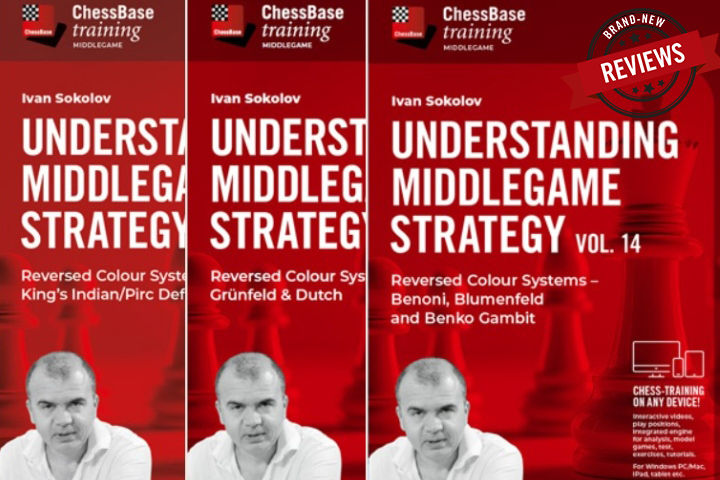
The 14-part video series Understanding Middlegame Strategies by Dutch grandmaster and author Ivan Sokolov explores a wide range of middlegame themes. The early instalments focus on opening-independent topics such as dynamic pawns and practical middlegame play. The later volumes examine positions arising from popular opening systems. Rather than covering opening theory, the emphasis is on understanding the resulting middlegame positions and the strategic ideas they contain.

In the first part of this series, I reviewed the more general courses.
Part two focused on courses dealing with typical middlegame structures arising from the Sicilian Defence, the French Defence and the King's Indian Defence.
In this final instalment, I take a look at the three courses devoted to positions arising from reversed-colour openings:
In this video course, Grandmaster Ivan Sokolov explores the fascinating world of King’s Indian and Pirc structures with colours reversed, often arising from the French or Sicilian.
The King’s Indian Defence is one of the most dynamic openings in chess - and Pirc structures share much of the same DNA. With colours reversed (the King’s Indian Attack), these setups can be just as powerful. What may look modest at first often transforms into highly complex middlegames, where timing, precision, and a deep feel for dynamics make all the difference.
Free video sample: Introduction
Free video sample: Misplaced Pieces
In this video course, Grandmaster Ivan Sokolov explores the fascinating world of Dutch and Grünfelkd structures with colours reversed.
In this video course, Grandmaster Ivan Sokolov explores one of the most intriguing and under-examined areas of modern chess: reversed opening systems, focusing on the Reversed Grünfeld and the Reversed Dutch. At first glance, these two systems seem unrelated. However, they share a common strategic challenge: the value of tempi, structure, and psychology when familiar openings are played with colours reversed. Drawing on his long professional experience, Sokolov explains why these positions are far more subtle than they appear and why traditional engine evaluations often fail to capture their true complexity.
Free sample video: Introduction
Free sample video: Larsen’s b4 Plan vs Reversed Stonewall Setups: Larsen - Spassky
You will learn how Black's dynamic piece activity and structural counterplay more than compensate for White's extra tempo in the colour-reversed setups.
The Benoni family of openings has toppled world champions, decided match games under the highest pressure, and rewarded those brave enough to play them with some of the most electrifying chess imaginable. In this Fritztrainer, Grandmaster Ivan Sokolov - continuing his successful series "Understanding Middlegame Structures" - takes you deep inside the complexities of the Colour-Reversed Benoni, the Colour-Reversed Benko Gambit, and the Colour-Reversed Blumenfeld Gambit.
Free sample video: Introduction
Free sample video: Colour Reversed Banoni - Game 1
Note:
Do not confuse these courses with opening Fritztrainers. While they do include theoretical variations, they are not designed to provide a complete opening repertoire for either White or Black. To build a solid theoretical foundation in these openings, they are best complemented by dedicated opening courses, such as the following:
These video courses feature a black repertoire against 1.d4, 1.Nf3 and 1.c4. The recommended variations are easy to learn and not difficult to remember, but also pose White serious challenges.
The King‘s Indian Attack is a universal opening: easy to learn, flexible, and rich in both tactical and positional opportunities.
Understanding Middlegame Strategy 12-14:
Reversed Colour Systems
Sokolov not only explains the strategic characteristics of reversed-colour openings and, where appropriate, the differences compared to the corresponding defences, but also discusses the psychological aspects. In many cases, the extra tempo of the first move does not make a major objective difference, but it changes the players' expectations. A player choosing the Grünfeld Defence with Black is usually happy to concede space and allow White a broad centre in return for dynamic counterplay. With White, however, a "Grünfeld with an extra tempo" is generally expected to yield an opening advantage. Whether this expectation is objectively justified is another matter. Sometimes the aim is simply to steer the opponent into a type of position with which they are less familiar.
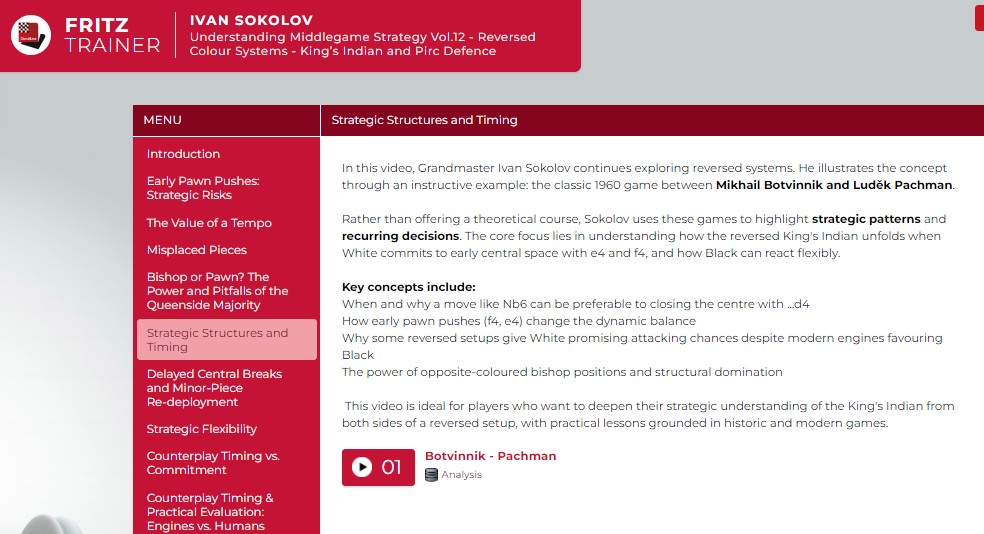
Volume 12 is devoted to the King's Indian Attack (KIA), although some of Black's setups without an early ...c5 are closer to a reversed-colour Pirc Defence. Sokolov presents a series of key themes, each illustrated by a deeply annotated model game.
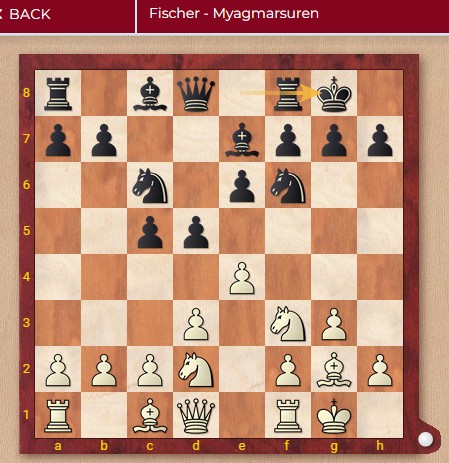
One of the structures discussed in detail is the following position, which can arise not only after 1.Nf3 or 1.g3, but also via 1.e4 in the Sicilian or the French Defence.
Volume 13 is devoted to the Grünfeld Defence and the Dutch Defence with colours reversed. The two main chapters present several annotated games illustrating different strategic themes.

I was particularly interested in Sokolov's discussion of 1.f4 (the Bird Opening), as I have not had much success against it with Black. Somewhat to my surprise, he also examines—and recommends—the From Gambit, beginning with 1...e5!
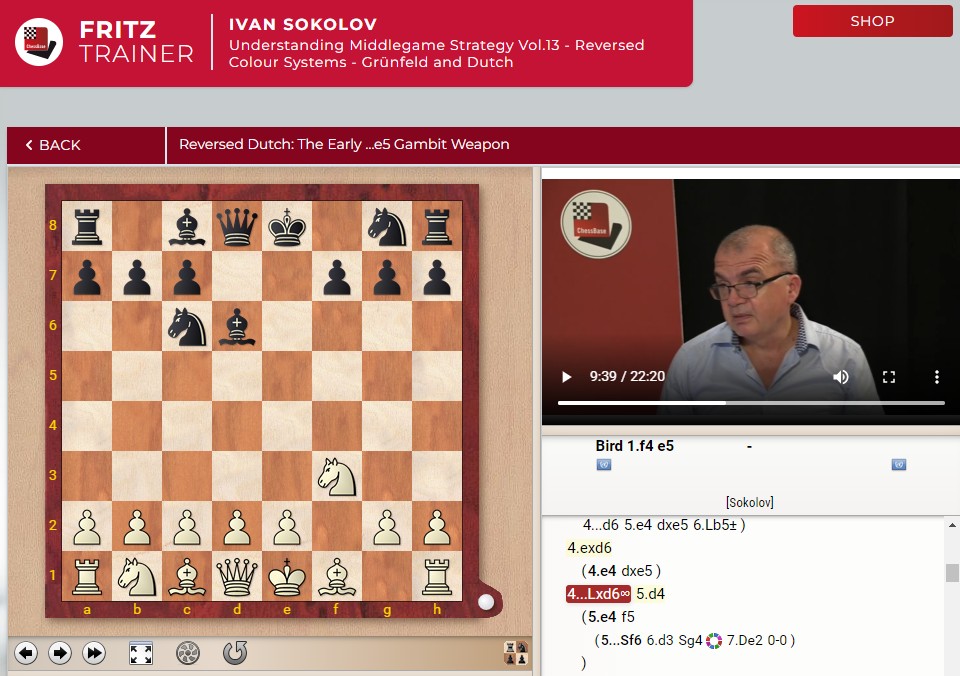
Here, too, Sokolov emphasizes the psychological aspect. Why allow your opponent to reach the Dutch Defence they were hoping for—with an extra tempo? By playing 1...e5, you force them into a completely different type of position, regardless of whether they accept the gambit with 2.fxe5 or transpose into the King's Gambit with 2.e4.
Players who prefer a more solid positional approach and have no interest in gambits will also find alternative systems discussed and illustrated.

In the second chapter, devoted to the Grünfeld Defence with White, Sokolov examines in detail whether the extra tempo really provides a significant advantage compared to the corresponding lines with Black:
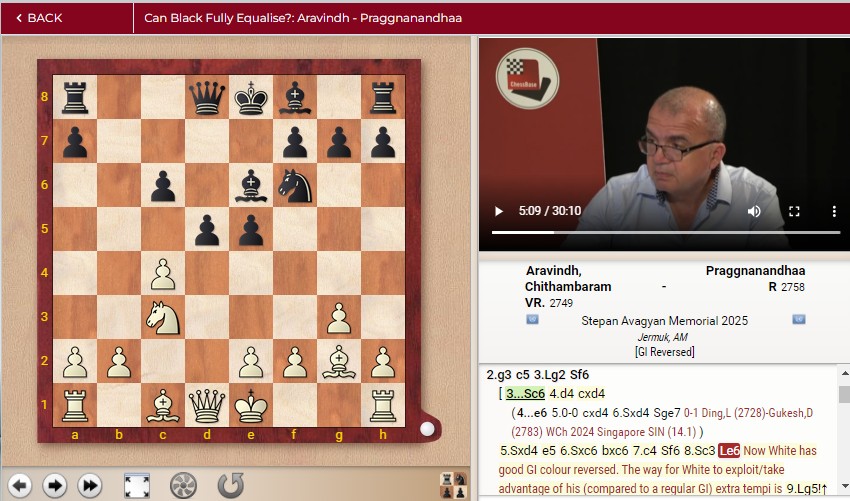
In Sokolov's view, it certainly does. That reinforces my own preference for meeting these reversed-colour systems with my regular repertoire against 1.d4, for example the Tarrasch Defence or King's Indian setups.
Positions with the character of the Modern Benoni, the Blumenfeld Gambit or the Benko Gambit with colours reversed usually arise from the Réti Opening (1.Nf3) or the English Opening (1.c4).
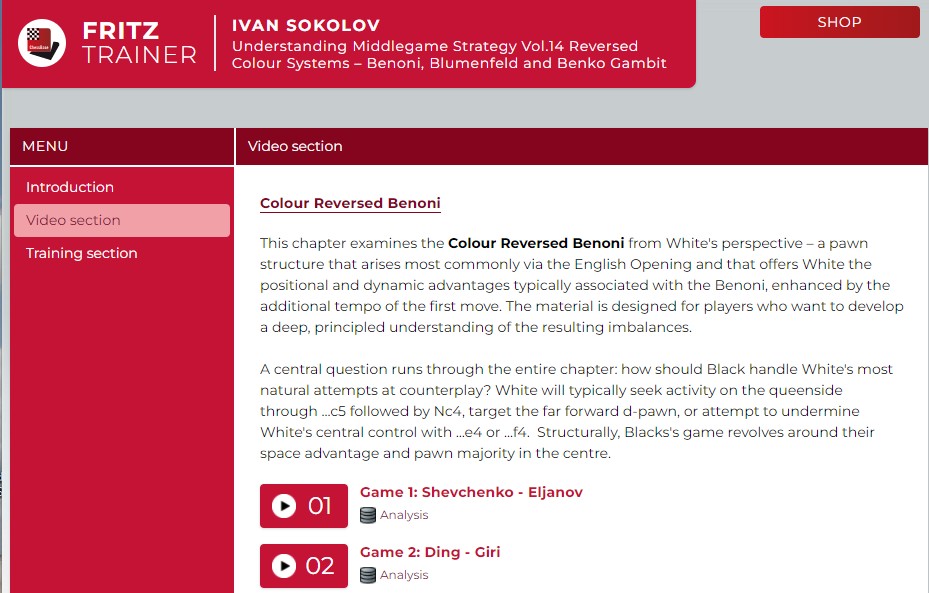
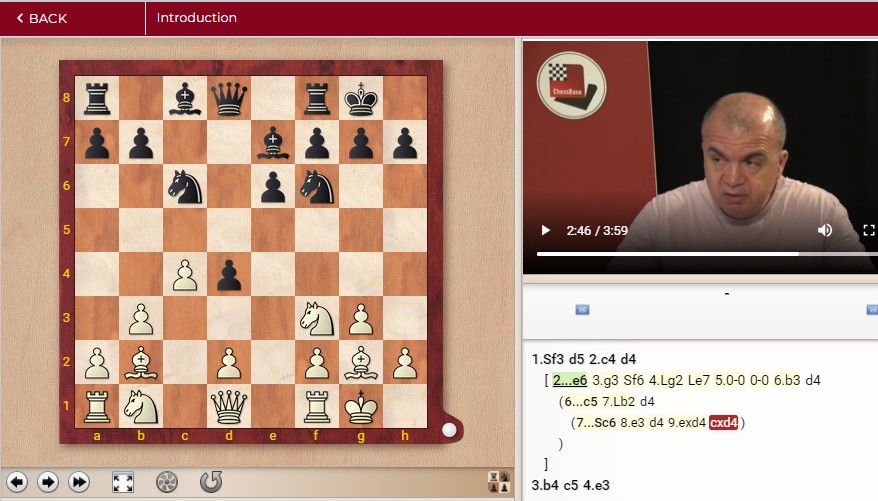
As Sokolov explains, it is a mistake simply to copy variations from these openings. White's extra tempo, along with other positional factors, changes the character of the position considerably. These structures need to be treated on their own merits—and this is precisely where Sokolov's analysis begins, as in the following Benoni-type position:
Conclusion
These three video courses are valuable from both perspectives: for players who enjoy using reversed-colour systems with White and for those who need to face them with Black.
In these courses, too, Sokolov remains true to his own distinctive style. Both the choice of topics and the way he presents them are delightfully unstructured. Personally, I like that approach, because nothing would be more boring than a systematic catalogue of every possible position or variation. A Sokolov course is always a bit like a surprise egg—you never quite know what you are going to get until you have worked your way through it.
About the author:
 Ivan Sokolov is a Dutch grandmaster and the author of several acclaimed chess books. He won the Yugoslav Championship in 1988 and the Dutch Championship in both 1995 and 1998. For more than two decades, he has been one of the world's leading grandmasters and has scored victories against many of the strongest players of his generation.
More products by Ivan Sokolov...