
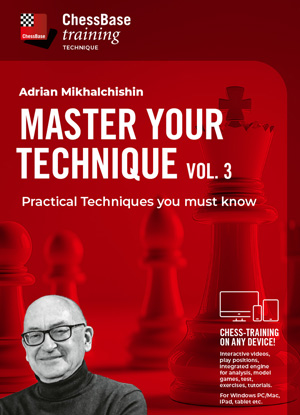
Review: Master Your Technique Volume 3 – Practical Techniques you must know von Adrian Mikhalchishin

by Lukas Köpl
8/22/2026 – While it has become easier nowadays to find information on openings, main lines and sidelines, converting advantageous positions effectively remains a fine art. As is well known, winning a won position is no easy task. In the third volume of his “Master Your Technique” series, Grandmaster Adrian Mikhalchishin examines techniques that occur particularly frequently in practical play. Lukas Köpl has taken a look at the course and summarised his impressions.

YOUR PERSONAL CHESS COACH - Whether you’re taking your first steps into the world of club chess, or already playing at a tournament level: with FRITZ, you can train more efficiently, intelligently and with a more personalised approach than ever before.
FRITZ is more than just a chess engine – it’s a training revolution! Whether you’re taking your first steps into the world of club chess, or already playing at a tournament level: with FRITZ, you can train more efficiently, intelligently and with a more personalised approach than ever before.

GM Adrian Mikhalchishin is a well-known figure in coaching circles, with many years of experience as the author of numerous ChessBase publications and as a coach and second to famous players. In his ChessBase series "Master Your Technique", he focuses on various aspects of converting positions through sound technique.

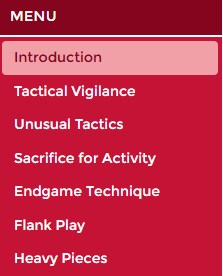
In the third volume, he covers the following topics:
In this volume, we dive into core aspects of chess technique. Smyslov taught the principle of tactical hierarchy, “checks, double attacks, and unprotected pieces”, and Mikhalchishin demonstrates how this method of calculation is vital.
After mastering positional play in Volume 1 and learning how to convert small advantages in Volume 2 of the Master Your Technique series, GM Mikhalchishin now presents Essential Techniques, covering topics from playing on the flank versus the center to maintaining tactical vigilance. In this volume, we dive into core aspects of chess technique. Smyslov taught the principle of tactical hierarchy, “checks, double attacks, and unprotected pieces”, and Mikhalchishin demonstrates how this method of calculation is vital. He shows how top players apply it, but also how even grandmasters sometimes miss critical resources, highlighting the necessity of developing a strong “tactical sense.” This approach encompasses tactical vigilance and scanning for sacrifices, but is also highly relevant to the second part of the course, which focuses on more strategic elements such as the use of heavy pieces and endgame technique.
Free Video Sample: Simple Tactics
Free Video Sample: Mating Net: Ne7+ Qxh7 Rh5+

While the tactical section covers motifs such as cross-pins and backward moves, the chapters on endgame technique and sacrificing for activity deal with situations in which things become concrete and there is no turning back. When a position requires dynamic play in order to convert an advantage, or precise knowledge of theoretical endgames to assess whether a winning idea will work, these chapters are exactly the right place to look.

For this review, however, I would like to focus on the chapter on heavy pieces.
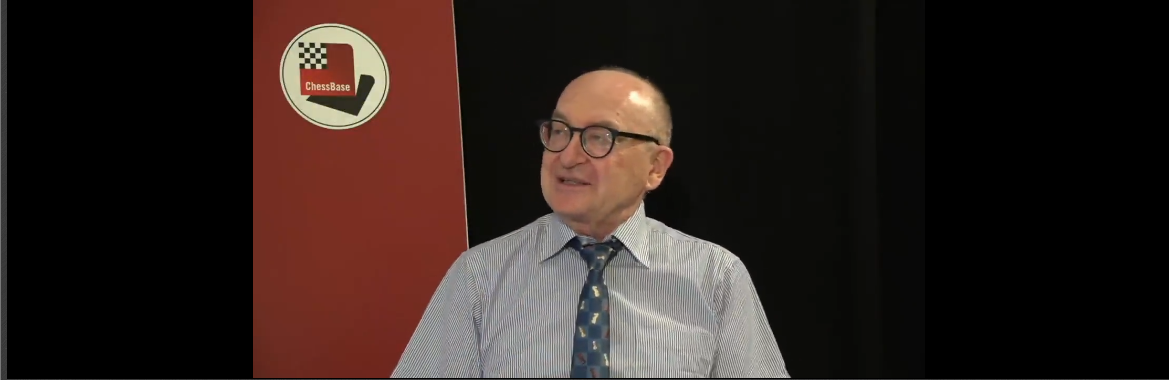
The master at work

Free video sample: Simple Tactics

Master your Technique Vol. 2 is a must-have for ambitious players who want to confidently convert “better” positions, or turn equal ones into wins.
After laying the groundwork of positional excellence in Volume 1, Volume 2 dives even deeper into the technical core of practical play. This new training course focuses on converting advantages, handling typical endgame imbalances, and mastering essential attacking and defensive techniques. Whether you‘re up a pawn, or striving for activity in a simplified position, the right technique makes all the difference.
Free video sample: Precise Endgame Technique
Free video sample: The Power of Double Attack

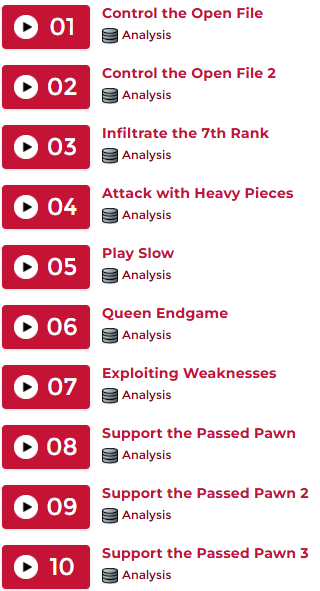
As Mikhalchishin notes in his introductory text, rooks and queens are powerful pieces – but only when they work together. This section of the course therefore focuses on coordinating the major pieces in order to exploit their strategic potential and to assess and plan how an advantage can be converted.

The concepts Mikhalchishin uses for this purpose are "Control the Open File", "Infiltrate the 7th Rank", "Attack with Heavy Pieces", "Play Slow", "Queen Endgame", "Exploiting Weaknesses" and "Support the Passed Pawn".
After 1.e4 c5 2.Nf3 d6 3.d4 cxd4 4.Qxd4 Nc6 5.Bb5 Bd7 6.Qd3, White sidesteps mainline theory and steers the game into less explored, strategically rich positions.
Tired of heavy Najdorf theory? This surprise weapon offers a fresh and practical alternative.
After 1.e4 c5 2.Nf3 d6 3.d4 cxd4 4.Qxd4 Nc6 5.Bb5 Bd7 6.Qd3, White sidesteps mainline theory and steers the game into less explored, strategically rich positions.
Instead of memorising endless variations, you’ll learn how to:
• Disrupt Black’s preparation early
• Reach solid, flexible structures
• Apply clear plans with long-term pressure
A perfect choice for ambitious players who want to take opponents out of their comfort zone and play for the initiative without drowning in theory.
Free video sample: 6...Nf6 7.Bg5 Ng4 - Grischuk vs Gelfand

The chapter about the heavy pieces

In keeping with Markos’ article in ChessBase Magazine #231 on evaluating open files according to their "length" (see review), I particularly like the choice of games here and the motifs involved in the fight for the open file. To illustrate this, I would like to present the game Shirov–Hou Yifan from the 2013 FIDE World Cup in Tromsø, supplemented by textual annotations:

Every player must develop the necessary classical knowledge of technical manoeuvres. With this video course I give you the essential knowledge for your own practice.

As can be seen, some of the analyses are quite extensive. This is one of the strengths of the course. You are presented with a wealth of ideas that you can incorporate into your own studies. One minor drawback, however, is that some of the analyses contain errors and either have not been checked or have been taken from outdated sources without critical review.

Conclusion

Overall, I like the course. As in the previous volumes, it presents and explores a wide range of ideas. Although the way the course is presented – particularly the explanations and pacing – could still be improved to appeal to a broader audience, the many game examples nevertheless offer plenty of instructive material for training and studying various aspects of practical technique.

Overall Rating: ★★★★ 4/5

Highly recommended!

Fischer liked to play aggressive but basically sound lines against the Sicilian and many of his variations are still very much alive and a good choice for players of all levels.

About the author:

Adrian Mikhalchishin was born in Lviv in 1954 and has held the Grandmaster title since 1978. He is currently regarded as one of the world’s leading coaches and is Chairman of the FIDE Trainers’ Commission. The Ukrainian coached the national teams of the Soviet Union, Slovenia, Poland and the Netherlands in the 1980s. Mikhalchishin was also Anatoly Karpov’s coach from 1980 to 1986 and has worked with Zsuzsa Polgar, Alexander Beliavsky, Maja Chiburdanidze, Arkadij Naiditsch and Vassyl Ivanchuk.

Adrian Mikhalchishin in the ChessBase Shop

--> MORE REVIEWS <--


Lukas Köpl, born in 1989, is a passionate club and tournament player who has been successfully working as a chess coach for over 15 years with an active coaching and referee licence. His wider field of expertise includes journalistic work for chess magazines and publishers, as well as active club and youth work. As a chess player, he has represented several clubs in various leagues over the years.
Discussion and Feedback Submit your feedback to the editors