ChessBase Magazine
ChessBase Magazine (CBM), the bimonthly magazine published by ChessBase, has a long tradition. It combines coverage of the latest tournaments, current opening trends and endgames from contemporary tournament practice with dedicated sections on tactics and middlegame training, offering readers a broad and comprehensive training resource.
Jan Markos: The Eighth Rank (in: Practical Tips)

In my previous review, I already explained the overall structure of ChessBase Magazine. This time, however, I would like to take a different approach. Rather than examining the entire contents of CBM #232, I have chosen to focus on GM Jan Markos' article "The 8th Rank", published in the section "Practical Tips".
To put the article into context, it is worth taking a step back. In CBM #231, Jan Markos began a series on the strategic concept of open files. Compared to semi-open files, open files generally offer deeper penetration squares, as there is no longer a pawn on the seventh (or second) rank. This has a significant impact on both the evaluation of open files and their practical value.
In this video course we will explore in depth some familiar concepts regarding the bishops. For example, everyone knows that a bishop-pair should grant him a positional edge.
Jan Markos' series is based on the assumption that one side already has good prospects of occupying, controlling or dominating an open file. According to established theory (see also Adrian Mikhalchishin's Master Your Technique – Vol. 3: Practical Techniques You Must Know), open files should be evaluated not only for their ability to cut off key enemy pieces, such as the king, but also by the entry squares they provide. These are weak or strong squares, typically located in the opponent's half of the board.
In my own club training, I like to compare an open file to a motorway and an entry square to its exit. The value of such an exit – or entry square – depends, as Markos explains in his series, on the "length of the rank" and on the presence of weaknesses along that rank. In middlegame theory, the seventh rank enjoys an almost sacred status, and with good reason: statistically, it is where most of the opponent's pawns remain for a long time, while the enemy king is often already cut off, creating ideal conditions for heavy-piece activity and, eventually, a direct attack on the king.
_REPLACE_BY_ADV_5
In CBM #232, however, Jan Markos shifts his attention to entering on the eighth rank, a theme that is often overshadowed by the more familiar seventh rank. As he demonstrates, the eighth rank has several important characteristics that players should understand in order to recognise such opportunities in their own games and, whenever possible, make use of them.
From his article, I identified two key factors that can be important when evaluating the eighth rank:
- Back-rank weakness
- Infiltration
Let us learn together how to find the best spot for the queen in the early middle�game, how to navigate this piece around the board, how to time the queen attack, how to decide whether to exchange it or not, and much more!
When discussing back-rank weakness, two forms are generally distinguished. The first is the natural back-rank weakness, where all the pawns remain on the seventh (or second) rank, leaving the king without a "luft" or escape square. The second is the artificial back-rank weakness (also known as pseudo back-rank weakness), in which an existing escape square is blocked by a piece or rendered unusable by the influence of an opposing piece or pawn. As a result, the back-rank weakness reappears.
The following examples illustrate these two concepts. The solutions can be found in the video below each exercise and in the PGN at the end of the article.
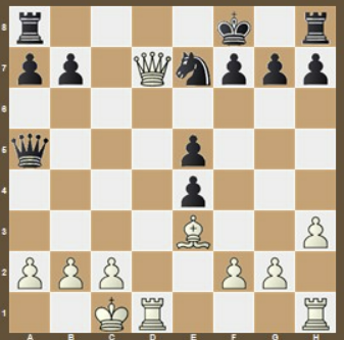
Bruzon - Jobava, Capablanca Memorial 2005
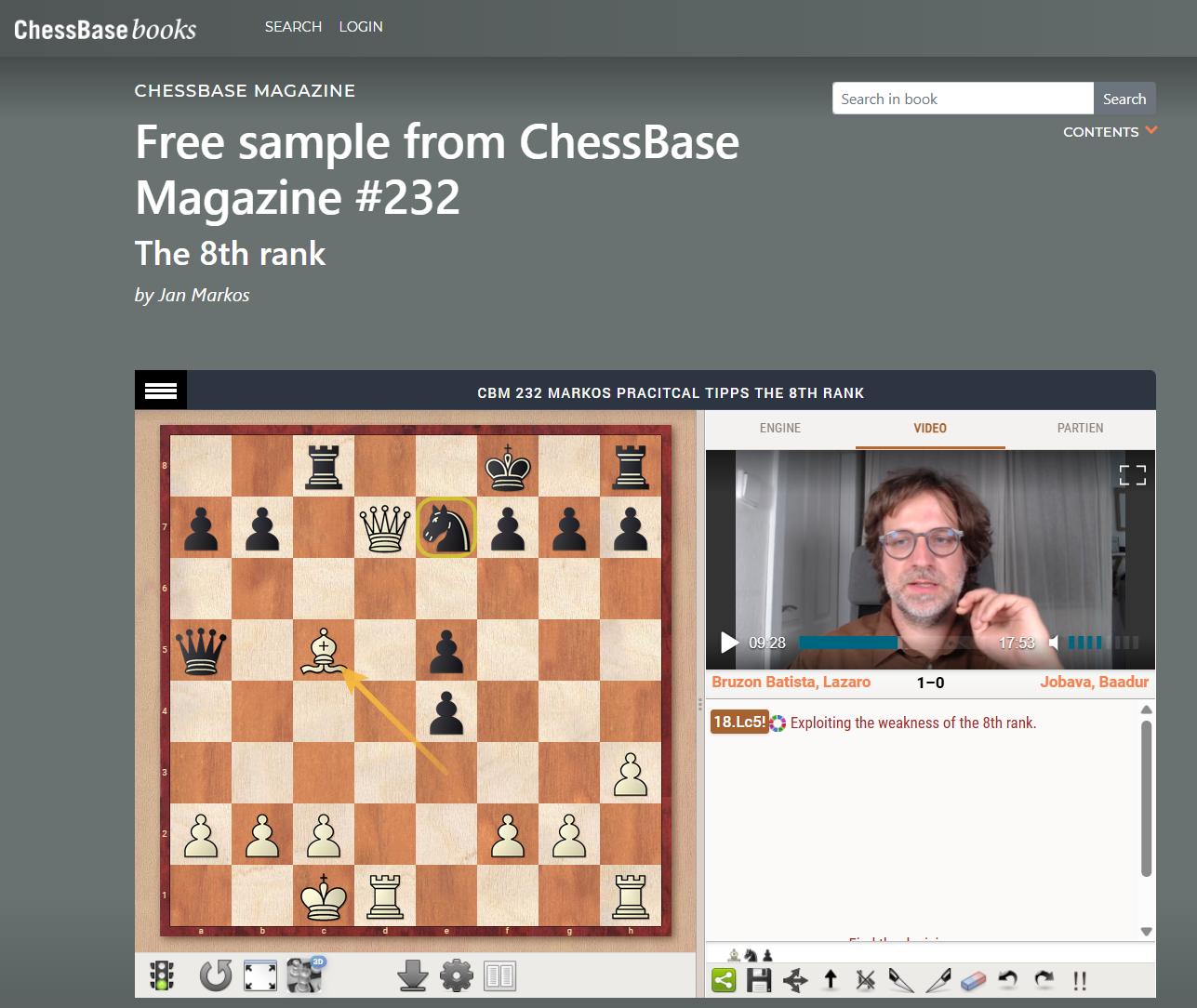
Here, Jobava made the decisive mistake with 17...Rc8?. How would you punish this with White? (The solutions can be found at the end of the article.)
The second motif is the indirect route. This refers to a rook entering the eighth rank and then swinging across the opponent's back rank to attack weaknesses from behind. To illustrate this idea, Markos uses a position from a game between Giri and Tari.
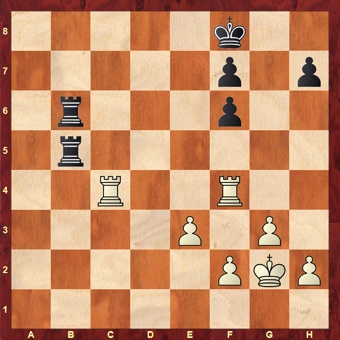
Giri vs Tari, Stavanger 2023
Black's last move was 32...R8b6?. How can White punish this immediately?
Knights add irrational content to any position. However, in this video tutorial you will learn how to tame them.
Additional material
In this video course, kings will play a role of strong and active pieces. We will explore how Kings can be helpful in defence and prophylaxis, or even in attack!
In addition to the video explanation, the article is followed by five exercises provided by GM Jan Markos to help readers consolidate what they have learned. For a short training session, and thus for the scope of the article, this is entirely sufficient. The annotations are mostly taken from the original sources and have not been adapted to the lesson, which at times would have been desirable.
The only difficulty is finding the games used in the video explanation. Under “All games from this issue”, they cannot be identified via the filters, at least not directly. This makes incorporating them into one’s own databases somewhat cumbersome, as one has to wait until the relevant game fragment appears in the video before it can be saved.
Conclusion
A highly instructive article on an important topic. Admittedly, this motif is not among the most common ones encountered in practice when fighting for open files. Nevertheless, its value should not be underestimated, since one must exploit the dynamics of the opponent’s disrupted coordination in order to gain an advantage. Markos illustrates this very well in his article and highlights several aspects that need to be taken into account when handling this motif.
Overall rating: ★★★★ 4/5
-----------------
Solutions: