



.jpeg)

Why does the following study require no instruction or stipulation such as, for example, "White to move and win"?
Karl Fabel und Werner Keym, Basler Nachrichten, 1967
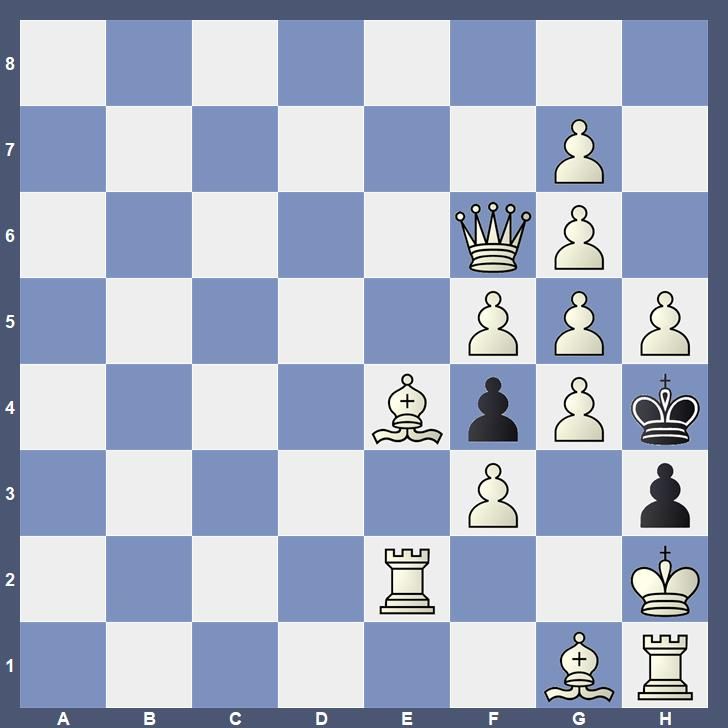
The reason is that, on closer analysis, the position permits only one single move. This may seem surprising, since White, with a queen, rooks and bishops alone, should apparently have a great many moves available. But appearances are deceptive.
To understand this, it is necessary to think backwards in chess. Like an archaeologist, one must dig into the position and visualize what must have happened in the past for the diagrammed position to have arisen in the present. Let us now do this step by step, using purely logical arguments, each building upon the previous one.
Our first observations are these: Black has lost 13 pieces. White has 7 pawns on the board. These 7 pawns, all of them on the right half of the board, are the ones that originally stood on the seven squares from b2, c2, … h2. The white pawn on a2 cannot have reached any of the squares the 7 white pawns are now placed on. For example, the pawn now positioned on g7 is the original b2- pawn and has taken the path via c3, d4, e5, f6 to g7. Hence, it has to have made 5 captures along the way. Other pawn paths are from c2 via d3, e4, f5 to g6 with 4 captures, from d2 via e3, f4 to g5 with 3 captures. And the e2 pawn must have gotten to the f-file with one capture. In total there are 13 captures. And there cannot have been any more or less, no matter what you try. Therefore, the white pawns originally on a2 and h2 have not made any captures and remained on their file, the a2-pawn before something happened to him because it is no longer on the board.
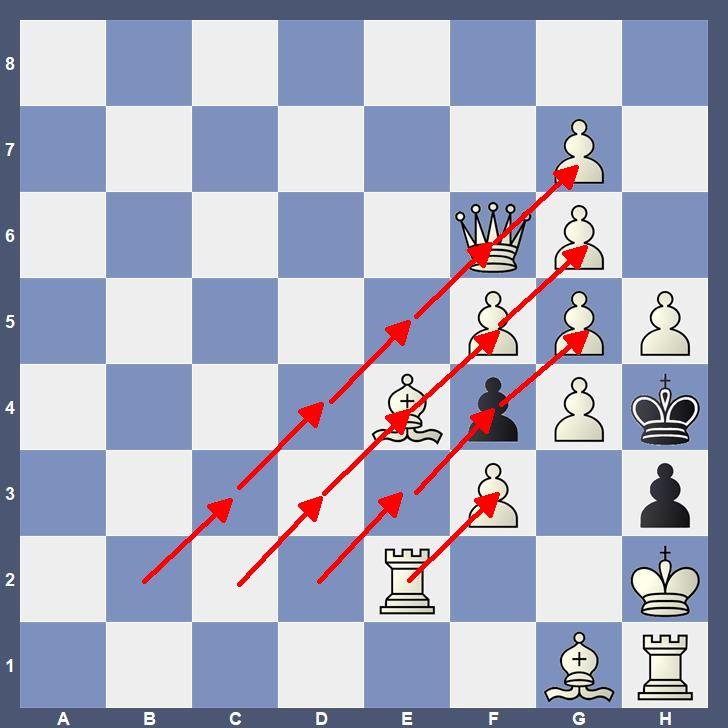
This is our current state of thinking, but a little later we will see that the white e2-pawn does not capture on f3.
To continue: White is missing 3 pieces, the 2 knights and a white pawn. Since the white pawn on h5 has not left the h-file to get there, the black pawn originally on h7 must have captured a white knight to get to the g-file and then this pawn or some other pawn on the g-file later on must have captured the other white knight on the h-file to get to h3, where it rests now. This accounts for two black captures so far. The third one was made by a black piece capturing the white a-pawn, so that the black a-pawn can proceed to a1, promote to a black officer which later moves in such a way to become the victim of one of the 13 white capturing moves. The black b7-pawn, in order to get captured, also had to become a victim of one of the 13 capturing moves by the white pawns, since White has no additional captures by officers left.
Hence, the b7 pawn had to promote first on b1. Therefore, in this line of thinking the black pawns on a7 and b7 promoted on a1 and b1, respectively. But that is only one possibility. The second possibility is that the black a-pawn captured a piece on the b-file and went on to promote on b1. The white a-pawn went from a2 to promotion on a8.
These considerations all require exactly three captures by Black. There have been no other captures by Black. In particular, Black cannot have made its last move with a pawn from e5 to f4. The black pawn on f4 must have reached that square peacefully, without capturing. It must therefore have travelled there from f7 to f4. This pawn must have completed its journey before the white pawn now standing on f5 blocked its route on the f-file by making a capture. So the white pawn must have moved from e2 to e4 and captured on f5.
This, therefore, is our revised white pawn capture diagram:
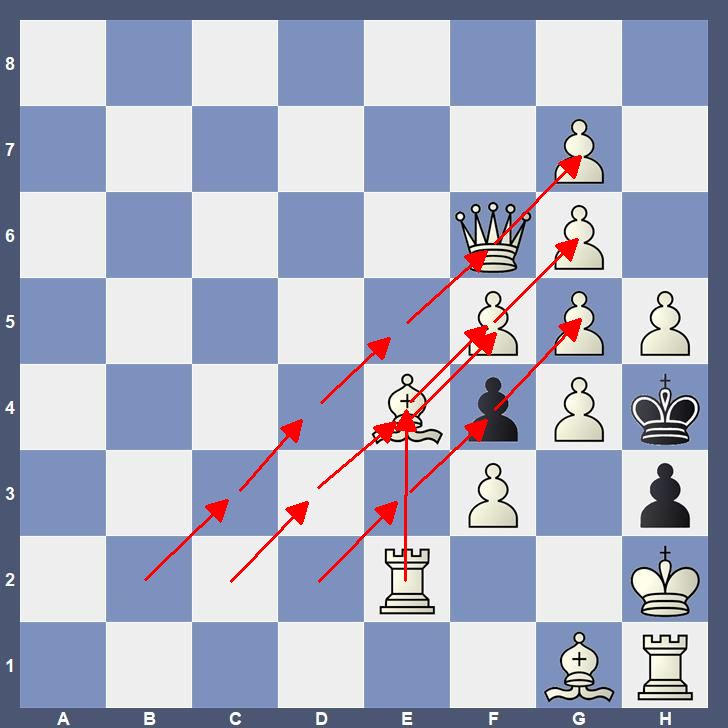
Taking all this into account, there is no possible move in the present position that Black could have made last. It follows inevitably that White made the last move—the move that led to the diagrammed position.
So far, so good. But the main achievement has not yet been accomplished. We must determine what that move was. Was it even possible?
Yes!!
This possibility, which so far has merely been asserted, sounds even more surprising than all the previous statements about the position.
So let us examine White’s possible moves: White cannot have made the last move with the king, queen, rook or bishop, because then Black could not have made a move immediately before it. But, thinking backwards, in order to permit an immediately preceding black move, White’s last move must have been g2-g4.
Stepping one move further back into the past of the position, the black king must have been standing on g4 and then moved sideways to h4. Having arrived at this point, it becomes obvious what must have happened before: the final few moves leading to the diagram position were, one after another: the black king moved from h4 to g4, the white pawn moved from f2 to f3 with check, the black king moved from g4 to h4, followed by the double-step of the white g-pawn from g2 to g4.
Thus we have proved—not merely with a probability approaching certainty, but in fact beyond any doubt—that it is now Black to move and that Black has only one single move: the en passant capture 4...fxg3 e.p., which checkmates the white king.
In view of all these considerations, the position presented by Karl Fabel and Werner Keym is self-explanatory, and it is indeed unnecessary to add any words whatsoever as a problem stipulation. Implicitly, the diagram position contains its own stipulation. It is a problem without words, one that does full justice to the figuratively "speechless" diagram position. What is silently expressed by the supposedly inarticulate diagram already says, without words, everything that could not possibly be surpassed by even the most elaborate verbal explanation. That is Zen of the highest order.


| Advertising |











.jpeg)