On the Superfluity of Words
By Christian Hesse and Helmut Pfleger
Part one by Christian Hesse
Sometimes these two areas of creativity are closely linked. For example, there are ways of solving mathematical problems using chess accessories – that is, a chessboard and pieces. By this I do not mean problems whose statements relate to the specific features of the chessboard and the pieces. Rather, I mean the possibility of proving purely mathematical statements through the use of chess-related methods. Similarly, one can sometimes solve chess problems using logical methods.
To clarify what we mean, let us begin with an introductory example involving odd numbers – that is, the numbers 1, 3, 5, 7, and so on. There are an infinite number of these. Let us add the first two, then the first three, and then the first four odd numbers:
1 + 3 = 4
1 + 3 + 5 = 9
1+3+5+7 = 16
Do you notice something?
Exactly! On the right-hand side of the equation, there is a square number in each case. When the first two odd numbers are added together, the result is the square of 2, which is 4. The sum of the first three odd numbers is the square of 3, which is 9. Next comes 16, which is the square of 4. It seems to continue in this way. At any rate, that is what one might assume. Let’s test this assumption with a more extensive example. Let’s calculate the sum of the first 8 odd numbers:
1 + 3 + 5 + 7 + 9 + 11 + 13 + 15
If our conjecture is correct, we expect the result to be the square of 8, i.e. 64. Of course, this can easily be checked by simply calculating the sum. But that would not be a creative exercise.
We therefore want to take a different approach and provide a proof that also establishes a connection to chess. More specifically, we want to demonstrate the statement using a chessboard.
To do this, let’s imagine a perfectly ordinary 8×8 chessboard with the usual black and white pattern of 64 squares. Now, let’s mentally make a simple change to the 32 black and 32 white squares: in the bottom left-hand corner, we leave the black square that is also present on a normal chessboard. We change all three neighbouring squares – a2, b2 and b1 – white. The next five adjacent squares – a3, b3, c3, c2 and c1 – are coloured black. And this continues, right up to the corner block, which consists of the eighth row and the h-file of the chessboard. It comprises 15 squares, all of which are coloured white.
The result is the diagram below. It is still an 8×8 board, but one would no longer call it a chessboard. The pattern now consists of alternately coloured L-shapes, each of which, as can easily be seen, comprises an odd number of squares. The 8x8 board consists of 8 L-shapes, ranging from the innermost one at the bottom left, which consists of just 1 square, to the outermost one, which consists of 15 squares. The sum of all the squares in the L-shapes is clearly the sum of the first 8 odd numbers. It therefore corresponds to the number of squares on a standard 8x8 chessboard, namely 64. Here is the corresponding illustration:
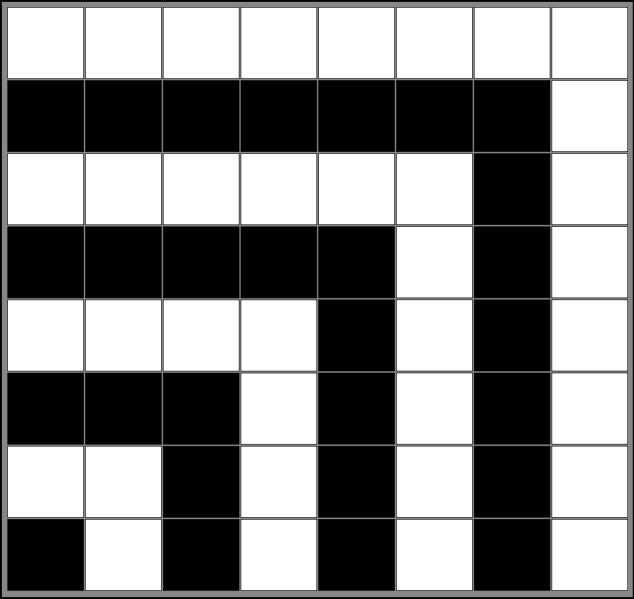
This way of tackling the problem is a highly creative and, for all its simplicity, an ingenious approach. For it allows for a far-reaching generalisation of the original problem: without needing to say much, one can see immediately from the diagram that any number of further angle brackets can be added on the outside. Each of these angle brackets consists of the next largest odd number of squares. And each additional L-shape increases the side length of the resulting square by the length of one square. One therefore simply needs to mentally add further L-shapes until reaching the nth L-shape, consisting of individual squares which together form an n×n board with n×n squares. The mathematical relationship between the odd numbers and the perfect squares, generalised in this way, is thus:
1 + 3 + 5 + 7 + ... + (2n – 1) = n2
There you go, that’s the proof. A proof which, in principle, needs no words – you just need to examine the square board pattern above and give it a bit of thought.
Incidentally, the equation holds for all natural numbers n = 1, 2, 3, … ad infinitum. The special case in chess arises for n = 8. The diagram on its own is, in that respect, a magnificent proof without words.
The next item on the agenda, following this mathematical-chess example, is a gem of chess composition. We will provide it in part two of our three-part series.
















.jpeg)