
The upstart in question is, of course, Robert James ‘Bobby’ Fischer, and the sheer brilliance of his victory over the highly-experienced Donald Byrne, at the third Lessing J. Rosenwald Trophy, led to the game being billed by Hans Kmoch as the “Game of the Century” in the December 1956 issue of Chess Review and the title stuck. (Though in a misprint, it appeared alongside a front-cover picture of a young Fischer, but when you went, as instructed, to page 370 the game in question turned out to be the equally impressive Smyslov-Pachman from the 1956 Moscow Olympiad.)
It was indeed a breathtaking game that proved to be Fischer’s calling card as a potential world champion-in-the-making. And such was its impact, the game even featured prominently in leading Soviet chess magazines of the day, as the Russians started to compile a ‘Fischer file’. Before this game, Fischer was untitled and little-known outside of New York, let alone the US. However, after the game, everyone knew who he was, because just a little more than two years later, he was playing in the Candidates, the world’s youngest grandmaster, and seriously talked up as being a future world title contender.
So this game was the first blow of his trumpet. Donald Byrne (the younger and more affable of the famous Byrne playing brothers; the eldest, Robert, going on to become a grandmaster and also a world title Candidate), was a very strong amateur and a professor at Penn State University, who gained the IM title and had won the 1953 US Open – but even he never saw the true depth of Fischer’s stunning sacrificial assault, believing right up to the very moment of truth with 17...Be6!! that he stood better.
Surprisingly, in 1969, Fischer didn’t include this historic game in his must-read all-time classic anthology, My 60 Memorable Games, but this was so typically systematic of Fischer. His rationale was that he’d already published it with light annotations in his earlier 1959 book, Bobby Fischer’s Games of Chess, which contained 34 of his early games up to 1958, and despite how commercially popular his Byrne brilliancy would be with deeper notes, he didn’t see the appeal, nor the need, to reproduce it again.
From my own personal perspective, my first time seeing this game came not long after learning to play, caught up in the media swirl of the Fischer-Spassky world championship match, so circa late October 1972, following yet another trip to my local William Patrick Memorial Library in Kirkintilloch. There I found to my delight on the Reykjavik-inspired bulging chess section shelf, a copy of the 1970 tome from publishers George Bell & Sons, The King-Hunt by W H Cozens (with its distinctive light-blue dust jacket), where it appears as game 38 in the author’s 45-game anthology devoted to the pursuit and tracking down of the king.
If we step back in time to 70 years ago, things were beginning to click at the chessboard for the young Bobby Fischer. He’d emerged from his much-vaunted 11-year-old “I just got good” days of 1954, and with each tournament and game throughout 1956, he was rapidly improving. Curiously, he started the year as something of a gifted amateur, but by the end of it, he was a solid master firmly on a trajectory to stardom. In an email exchange, chess author, historian and Fischer maven IM John Donaldson (whose latest book on his chess hero is the very readable Inside the Mind of Bobby Fischer) attributes this, in part, to his total immersion in the game when he enrolled in Jack Collins’ self-styled “crucible of chess genius”, the Hawthorne Chess Club, in the June of 1956.
The results thereafter were impressive. Fischer appeared for the first time on the cover of a chess magazine, as the 13-year-old won his first US title by dominating the 11th US Junior Championship held at the Franklin Chess Club in Philadelphia. Chess Life, the magazine of the United States Chess Federation, celebrated his achievement with a cover story in its 20th July 1956 issue. Little were they to know that this was just the start of a roller-coaster ride that would usher in the Fischer era.
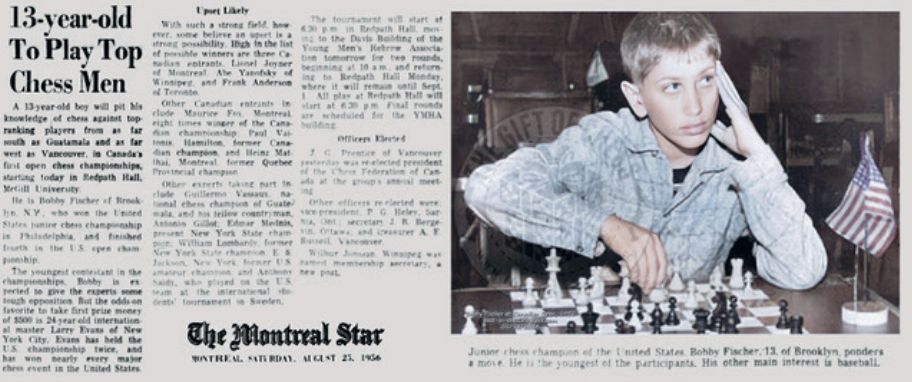
The Montreal Star was quick to spot Fischer’s potential when the 13 year old arrived in their city to take part in the Canadian Open, where he was far from disgraced finishing joint eighth.
Fischer’s junior triumph was followed by a heightened summer of chess activity with barely a break, starting first with the US Open Championship in Oklahoma City from 17th to 28th July. There, without a loss, he scored 8½-3½ to finish tied for fourth to eighth places. At the conclusion of the tournament, Tony Saidy’s family hosted Bobby on Martha’s Vineyard for a short break and it was while there that he received a personal invitation to play in his very first ‘overseas’ tournament, the Canadian Open, in Montreal, 25th August to 2nd September, where he stayed with William Hornung, the tournament director. Interviewed by The Montreal Star about his young house guest’s non-stop passion for chess, morning, noon and night, Hornung commented: “That boy! He even plays expert chess while he’s sleeping.”
In the Canadian Open, Fischer finished in eighth to twelfth places, only one point behind joint winners and top seeds Larry Evans and William Lombardy. After the event, Bobby then got a ride back to NYC from Evans, who later wrote that during the six-hour drive home he talked non-stop about chess, and nothing but chess, even to the extent of ignoring Evans’ wife.
After the Canadian Open, the next stop was the tournament that made Fischer’s name. In the autumn of 1956 (7th-24th October), he was allowed time off school to play in the annual Rosenwald Trophy Memorial – an invitational tournament held at the famous Marshall Chess Club and for this edition, expanded to twelve top players from the USA to allow the Brooklyn schoolboy, as the newly-crowned US Junior Champion, to compete. Fischer’s final result of 4½/11 (eighth-to-tenth place) was not exactly spectacular, but what was truly spectacular was his round 8 game against Donald Byrne, the ‘Game of the Century’. And from that very moment, the face of American chess was to dramatically change, as the game shot across the world.
This was the game 70 years ago that subsequently appeared in every newspaper chess column and chess magazine. How did our own Chess Magazine cover Fischer’s 1956 brilliancy? Well…we didn’t! For some inexplicable reason, it didn’t appear. To our horror, all we could find in our archives was a one paragraph snippet of news under the headline “New York’s New Chess Prodigy” that appeared in the November 9, 1956 issue (Nos. 279-80, p.35) of Chess. It reported that Sammy Reshevsky had won the 3rd Rosenwald tournament, a prestigious event which was marked by a controversial double default and a remarkable game: “Donald Byrne was beaten by a thirteen-year old boy named Fischer (who totalled 4½ points) in a game of great depth and brilliancy, which we shall publish later.”
Despite an exhaustive search (from our editorial team, John Saunders, and even Canadian-based chess author, collector, and historian Alan McGowan), we couldn’t find the game appearing in any of the magazine indexes from 1956 through to the end of 1959. Just in case, we even searched through all of Leonard Barden’s wonderfully instructive and entertaining ‘How Good Is Your Chess?’ columns during this period, lest it had been slipped in there. A good try – but, alas, still no joy.
We can only assume this rather strange omission was down to some really bad timing for Baruch H. Wood, the magazine’s legendary founding editor. The appearance of Fischer’s “Game of the Century” would have hit the chess scene during a very busy period for the magazine: BH was frantically finishing off his mega report with many games from the 1956 Moscow Olympiad, after which came the Christmas edition of the magazine (always a headache), followed by the extremely popular Hastings report, which, back then, was one of the world’s top elite events. That particular edition was jointly won by Svetozar Gligoric and a young Bent Larsen, in what was the Dane’s debut appearance, and would have appeared in the late January/February 1957 (and probably even stretching through to March) editions of the magazine. We’re sure the game did eventually appear in the magazine at some later date during the 1960s/70s – but it certainly didn’t appear, as promised, in the final few years of the 1950s. So, as an atonement of sorts, we bring you the game in this, its 70th anniversary month. And no matter how many times I’ve seen this game, it never fails to enthrall me – and hopefully it will similarly enlighten and captivate a generation of younger players who are new to the game and perhaps not aware of this amazing Fischer brilliancy.
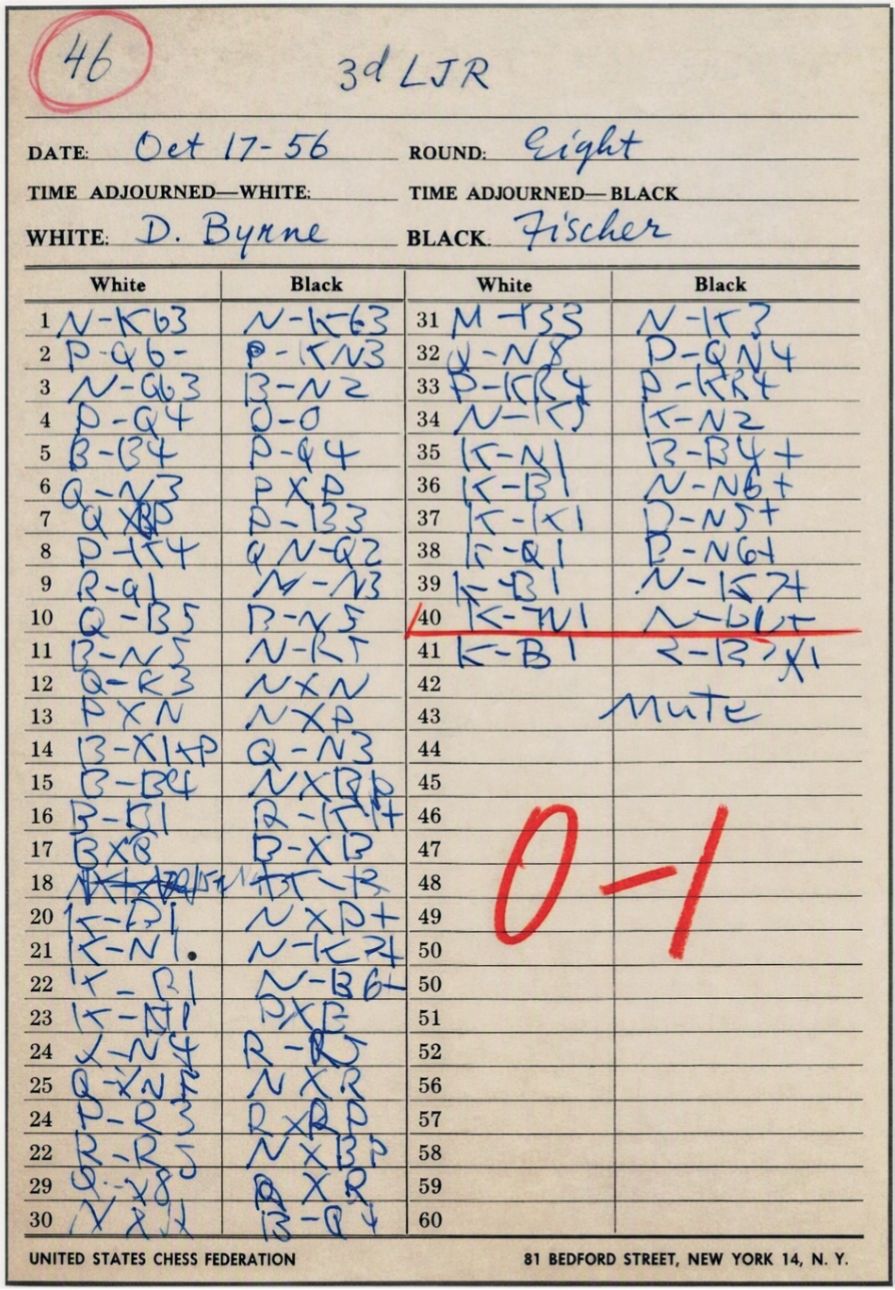 And it comes with a big bonus for our readers, with many thanks to American collector and historian David DeLucia, who has built an incredible library of chess books, manuscripts, documents and ephemera that’s unlike any other collection in the world, either publicly or privately.
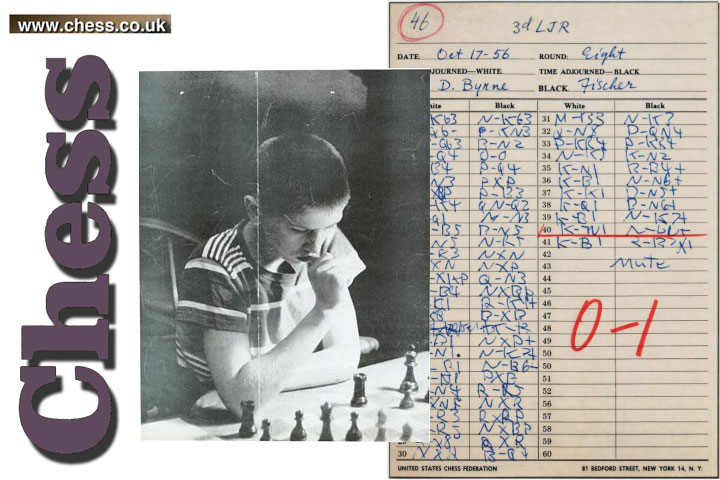
David is also a passionate collector of all odd sorts of Bobby Fischer memorabilia. It includes Fischer rarities such as his bible, his wristwatch and his wallet, a children’s book, an inscribed copy of his work, I was tortured in the Pasadena Jailhouse!, and five pocket chess sets. He also owns the publisher’s galley proofs of Fischer’s My 60 Memorable Games, along with the manuscript that originally only contained 52 games. Also in his collection is over a hundred Fischer scoresheets, among which is Bobby’s original game score, in his very distinctive hand, of the Game of the Century against Donald Byrne!
 About the author
John B. Henderson is a Scottish chess journalist, writer, and former daily chess columnist for The Scotsman, where he writes a long-running, near-daily chess column covering tournament news, historical anecdotes, and games. He is a long-time contributor to both Chess and New in Chess Magazines.
Though originally from Scotland (Glasgow), John has also lived and worked in Seattle, Washington. He holds a FIDE active rating (around 2132).
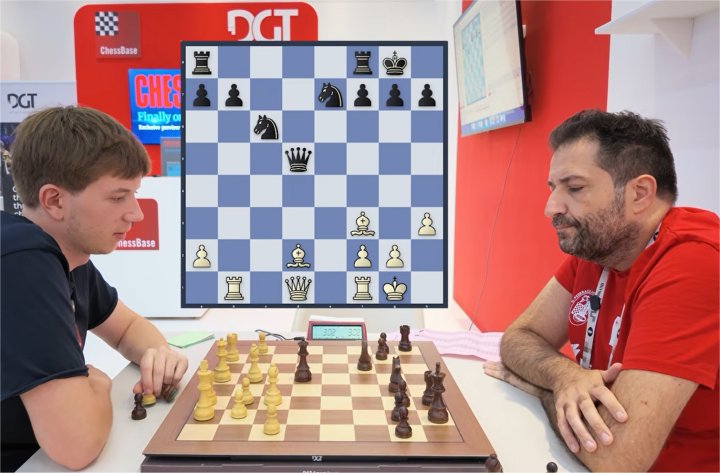
Here's the Game of the Century, extensively annotated by John Henderson
About CHESS Magazine

The above feature is reproduced from Chess Magazine October 2026, with kind permission.
CHESS Magazine was established in 1935 by B.H. Wood who ran it for over fifty years. It is published each month by The Chess Shop, London and is edited by IM Richard Palliser and Matt Read.
The Executive Editor is Malcolm Pein, who organises the London Chess Classic.
CHESS is mailed to subscribers in over 50 countries. You can subscribe here, with specially discounteds rate for first timers.

















.jpeg)