
Let's Check: the elite are better than you know

by Albert Silver
10/17/2022 – There are several ways to check a player's performance using an engine. One is to simply ask an engine to analyze every move and highlight every disagreement however small. Another is to use the tool in ChessBase and Fritz known as Let's Check. Here are the results from the recent Sinquefield Cup including a 100% match and the curiously high results by...

"Evolving Genius": learn to attack and play brilliancies. Fritz offers you everything you will need as a dedicated chess enthusiast.

There are three main ways today to evaluate a player using an engine. This is not to be confused with annotating a game.

The most sophisticated one is used by analysts such as Dr. Ken Regan, who compile the average error rates of players per level. For example, I might lose an average 0.15 pawns per move compared to the engine's best, while a top GM might lose only 0.02. His system will go deeper than this, but that is still the foundation on which it lies and it will be better at catching 'smart cheaters' than a more basic system such as below.

The simplest is just to analyze a game with an engine and ask it to highlight every move it disagrees with, however small the difference. Obviously the risk is that in some positions, there might be three roughly equal moves that three engines play slightly differently.
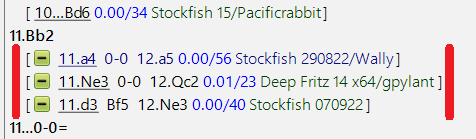
Imagine you are analyzing with only Stockfish, and it says that five moves out of ten are not a match. This might overlook that two of the moves that don't match its choices, are chosen by another top engine such as Komodo Dragon 3. In other words, only five match Stockfish, but seven in all match top engine choices. That is the underlying point of Let's Check. When you analyze a game with it, it will not only tell you what a variety of engines thought of each move, it will give you a summary called Engine Correlation at the top, showing the percentage of times a player's moves matched the top choice of an engine.

However, unlike a plain engine comparison, it won't compare with just one top engine move, it will compare with several, and if the move matches any of those engines, then it is a match for Engine Correlation. 

The new Komodo Dragon 3 engine has gained 100 Elo points in playing strength over its predecessor when using a processor core in blitz. That's a huge improvement for a program that already reached at an Elo level of over 3500!

Sinquefield Cup

Recently there were several claims about high Engine Correlation matches between Hans Niemann's games and the Let's Check choices, so out of curiosity I ran a complete Let's Check on all the games in the recent Sinquefield Cup and I must say the results were unexpected.

The first result to come out was that one player did actually obtain a 100% match. This was not the result of some ultra-short draw, since Let's Check will ignore theory moves, and games with too few moves played. I.e. a game that was 28 moves long but had 20 moves of theory will not be eligible for an Engine Correlation result. Who is this engine matching wonder? Wesley So.
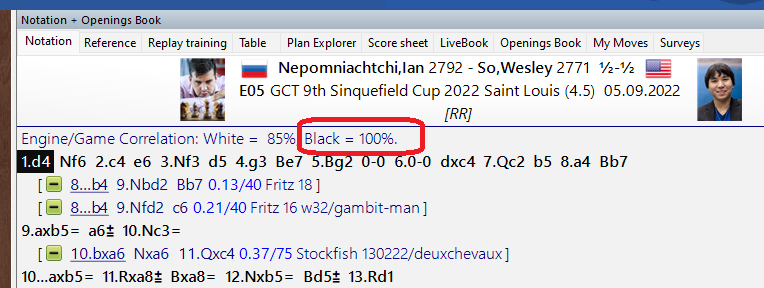
In his game against Ian Nepomniachtchi, the American player achieved a 100% Engine Correlation score. However, he was not the star performer overall in terms of such measurements, since it was his only game over 80%. No, one player managed to score three times in excess of 90% engine correlation. Aha! I hear you cry out. We have him! So who is this chess engine-like god?
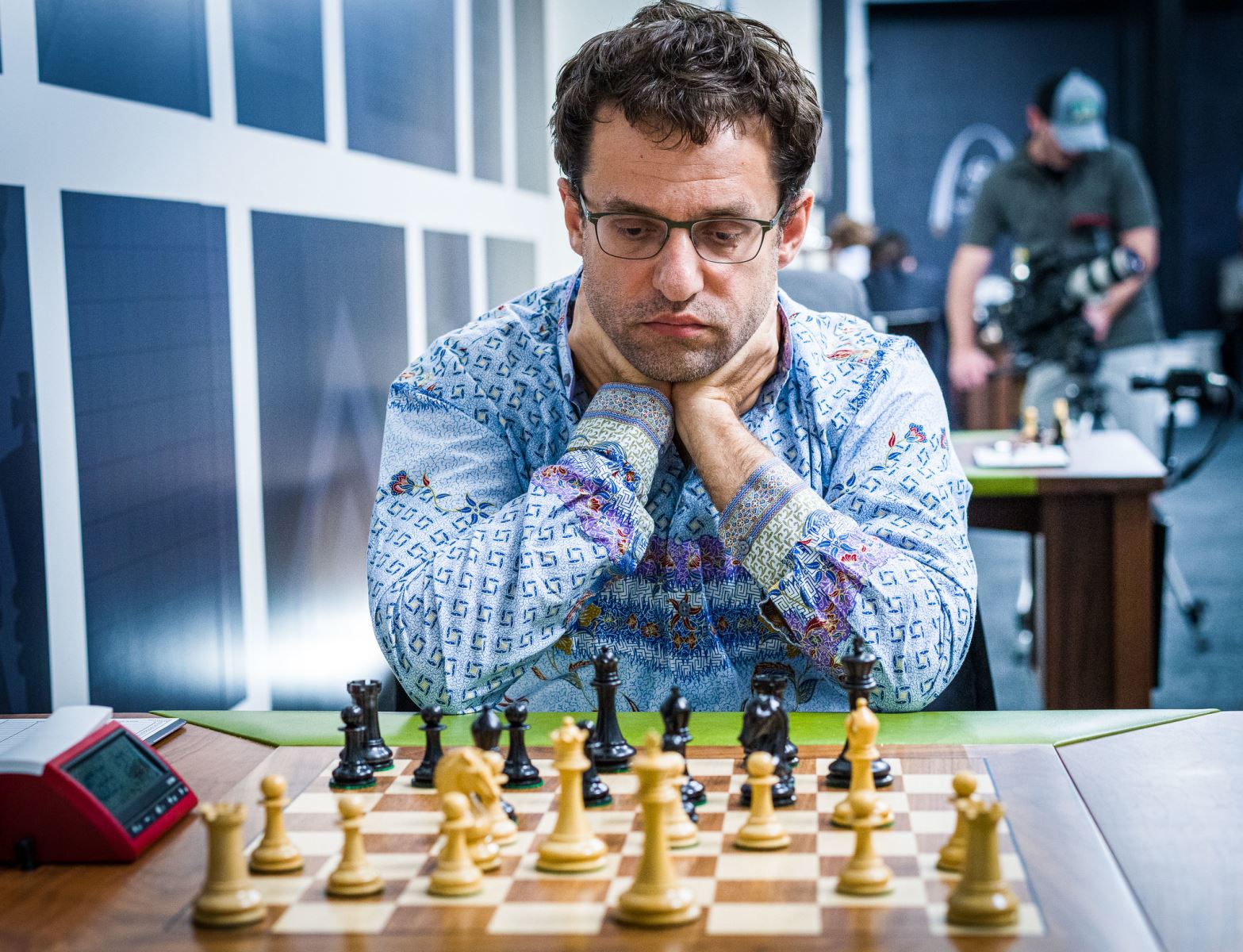
Levon Aronian had several of the highest quality games according to Let's Check

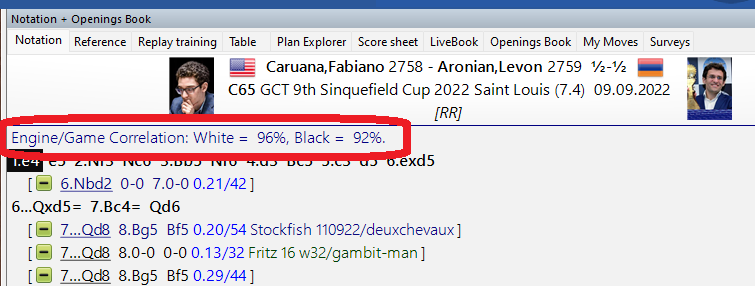
Meet Levon Aronian, late-bloomer extraordinaire, who had an engine correlation of 92% against Caruana (who himself has a 96% correlation in that same game) over 45 moves, 91% against Wesley So in 43 moves, and 91% against Magnus Carlsen in 36 moves. Plus two more games with over 80%.
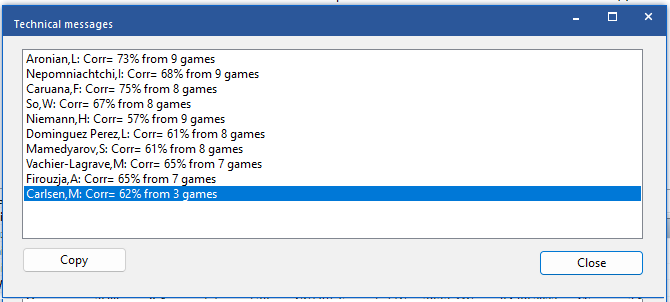
He was not quite alone though, and none other than Ian Nepomniachtchi had two as well, plus several over 80%, showing the quality of play that led him to win the Candidates this year. Note that he had an average 78% engine correlation for the entire Candidates, 11% more than second-best Caruana.

The burning question on your mind, dear reader, is what about Hans? In terms of engine correlation, Hans was the worst. His best game, with an 88% match over 55 moves, was in round seven against Maxime Vachier-Lagrave. In his game against Carlsen it was a modest 68%, but of course Magnus was playing dreadful that day, and had only 37%. 
The mythical 100%

So how rare is 100% after all? It is rare but not as rare as you might think. I ran some random checks through games in 1999-2000 as I was curious about Kasparov and Kramnik. All in all I had some 150 eligible games, maybe less, yet it turned up a higher-than-expected number of perfect matches.

For example, the rapid games Amber tournament had several 100% perfect games, including Jeroen Piket in one, and Kramnik in another. And against Topalov no less... Memories of Toiletgate. There were also two(!) by Kasparov in Bosnia in 1999, another in Bosnia in 2000, one more by Kramnik in the World Knockout event against Korchnoi over 41 moves and later one by Michael Adams against Vlad in that same event.

However, there is a caveat that must be mentioned when using such tools. It is eminently possible to game the system to show a 100% match where it normally might not. You see, when doing a Let's Check analysis within Fritz, you have the option of providing your own engine, and then telling it to only use it for moves that did not match engine choices. In other words, you are trying to find an engine it will match. And if it does.... the engine correlation will improve.


Originally, this game was only a 90% match, with no engine choosing Garry Kasparov's 16.cxd5 for example. After trying several, I found an engine that chose it, and entered it as another Let's Check choice. Now the tally reads:
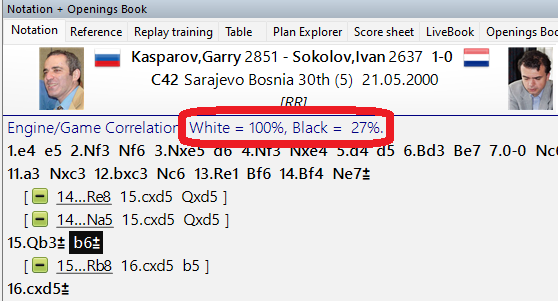
So yes, the results can absolutely be manipulated by the unscrupulous. A telltale sign might be in the engines listed. If a new game shows Stockfish 14+, Komodo 12+ and so on, it should be fine, but if you see some very old engines or odd names for that same new game, be on your guard, as they may have been used only to get an extra match. 

The ChessBase Mega Database 2022 is the premiere chess database with over 9.2 million games from 1560 to 2021 in high quality.

Regardless, here is the signature win by Kasparov with notes from Mega Database:


Conclusion

Does this in any way invalidate the use of a tool such as Let's Check? Of course not, but as all such tools, they must be used with good sense and judgement. The fact that modern elite players can rattle off multiple games with such extraordinarily high engine matches is a testament to the increasing overall quality of the chess players, since the engines they are matching today, are also hundreds of Elo stronger than engines of a decade ago. These players are also studying and learning from the engines, and that increase in pure ability is a consequence of it.


Born in the US, he grew up in Paris, France, and after college moved to Rio de Janeiro, Brazil. He had a peak rating of 2240 FIDE, and was a key designer of Chess Assistant 6. In 2010 he joined the ChessBase family as an editor and writer at ChessBase News. He is also a passionate photographer with work appearing in numerous publications, and the content creator of the YouTube channel, Chess & Tech as well as the author of Typing Tomes, a powerful typing program.

Discuss

Rules for reader comments


Not registered yet? Register

tauno tauno 10/19/2022 06:04
@Pemoe6. If Magnus would refuse to play against Hans in their prestigious tournament it could cause great damage, I agree. And it would certainly unsettle the other participants under the given circumstances, I understand it too.

But the ethical, moral and legal aspects of the ban raise some questions.

The fact is that Hans has done nothing wrong. It was Magnus who behaved badly and unsportingly and caused the scandal. It was Magnus who left the tournament in the middle of it. It was he who demonstratively abandoned a game in the next tournament and made the scandal even bigger. And it was Magnus who made groundless accusations that Hans had cheated in their game.

So if there's anyone who should be banned from their prestigious tournament, it should be Magnus, right? But how the hell could Chess.com ban their new business partner? It is impossible to even think about it.
Science22 Science22 10/19/2022 05:43
@with_cheats_you_lose : At the moment I suspected false play it suddenly became logical what lajosarpad and arzi writes. First they assume something false is true, and then they ask agressive questions that must be answered as if the false statement was true.

They create this type of spam all the time, and talk to each other in long comments so sane comments disappear for the reader. Try to read a little bit of Pravda in English on the internet. Then you can see how identical the style is.

Example of style : "Statistics can never solve the question if Hans Niemann has cheated. Now that we have this fact I would like to ask the question : " Wrong assumptions. Good statistics is exavtly what will solve this question. It is like DNA on a crime scene. FIDE will nail this con man through good statistic. They know who to ask and what to ask for. Wait and see.

Also notice how often lajosarpad fish for personal information. He wants personal scientifc papers ( which of course has a name) , and he constantly attack I use a nickname.
Science22 Science22 10/19/2022 04:52
@with_cheats_you_lose : " arzi and lajosarpad are definitely internet trolls, have no doubt about it. They bring no value to the discussion, they spam the comments and try to confuse everyone with their walls of text. They mock and ridicule anyone that goes against their narrative. Chessbase should really consider restricting these two from the comments. Until these two go away, please do not feed the trolls. "

I completely agree with you, and will follow your advice from now on. I believe they belong to the same service organisation that is here to disrupt. Arzi claims he is from Finland in an older comments and not a sociopath from FSB. Ok, let it be. But his comments are FSB stuff like lajosarpad. Disrupt the West on every social platform. Exhaust all sanity. Create hate. It beats me why chessbase.com cant see it and remove them.
Science22 Science22 10/19/2022 04:47
@arzi : I cannot understand that you see Niemann as a complete idiot.

You normally praise him. Only a complete idiot would sit down an win every round in the US Open with terrific flawless play and amazing combinations.

If you took the trouble to study Niemann's training videos online, you will see that he very carefully explains how to cheat the opponent in different ways. He is a very intelligent con man.

After a terrific start where he wouldn't give any interview after the game, the report about his fraud came out on chess.com. After that, he wisely chose to play more draws and lose on minor misjudgments, which should prove that he was a human being who played. But now he is back and I predicted that he would win the last three rounds in computer style. Only one is missing now, lets see tonight.

Niemann deviates early after the opening with more tactical approach which are incredibly exhausting to rely on all the time. Sooner or later a human will make mistakes in the endgame and then his computer is ready with the correct counter-answer. Of course Niemann never blunder in the horrible complications. Never. Only humans blunder.

He will also win tonight in the same style. After all, he need a win to gain some ELO and get above 2700. You can read him like an open book.
Science22 Science22 10/19/2022 04:31
@lajosarpad continued : Can you have a program that talks to someone like Stockfish, and continuously passes on variants? Yes, of course you can. A little fun here: If the variants are passed on by a Russian-speaking person in broken English, then perhaps there is an explanation for Niemann speaking with a Russian accent! For two years, day in and day out, he maybe have had English with a Russian accent directly in the ear during the games !

In conclusion, there does not need to be another person involved at any time. But given the profile of Hans Niemann as a 19-year-old with no training in relevant subjects, he obviously cannot set up such a system by himself in the first place. He must have professional help with the initial set-up.

All the above does not exclude that he use a completely different system. You have no idea about how smart the systems are to day. We do not hear with the ear. We hear with the brain and any signal that can activate the same respons as the ear can do in the brain through electric signals will do. You can hear with a vibrating food. I think Beethoven did just that !
Science22 Science22 10/19/2022 04:27
@lajosarpad : "If the conspiracy theory presented here is correct, then somehow the moves need to be communicated from the audience to the person sending the signal (or someone from the audience would send the signal)."

As usual, you are making false assumptions. First you assume something false is true, and then you ask a question that must be answered as if the false statement was true. In Denmark it is called manipulations, I dont know the name in Romania.

When a move on the board is transmitted to the internet, a switched-on computer with the right programs can analyze the position and activate an electronic device that sends the infrared signal vwith variations directly to Niemann's ears. The entire system can be in a car, an apartment or, for that matter, in the pocket of a person outside the arcade. It doesn't take much more today.

To stop the signal, you must stop all heat radiation (infrared radiation) in the room. Of course you can't, as we all emit heat radiation. But then you can do something more cunning, namely disrupt the heat radiation at certain wavelengths that can be emitted from a laser. Not all rays can do this, only certain wavelengths.

They don't check for that in the US open. That is another false assumption you use. I have asked myself. They don't have such advanced equipment. They check for radio waves in the range of several hundred meters to 0.3 meters. Infrared radiation has an extremely much smaller wavelength of 1900 nanometers.
Pemoe6 Pemoe6 10/19/2022 04:01
@tauno: "I can not either. That's why I wrote "maybe" and added a question mark. Maybe you have another theory as to why Hans was suspended after that game?"

Perhaps they simply wrote the truth in their report, namely that they wanted to prevent possible damage from their prestigious tournament and did not want to unsettle the other participants under the given circumstances.
I know that here in the forum it is generally assumed that such a thing is not possible, but still ...
arzi arzi 10/19/2022 12:53
To with_cheats_you_lose, I`m glad that you, user of many names, are NOT a troll. Bless you nice soul!
with_cheats_you_lose with_cheats_you_lose 10/19/2022 12:39
arzi and lajosarpad are definitely internet trolls, have no doubt about it. They bring no value to the discussion, they spam the comments and try to confuse everyone with their walls of text. They mock and ridicule anyone that goes against their narrative. Chessbase should really consider restricting these two from the comments.

Until these two go away, please do not feed the trolls.
arzi arzi 10/19/2022 11:54
to lajosarpad, doesn't such a system require anyway some sort of fancy technology, which a 19-year-old may not be able to finance with his own income? A conspiracy theory? Now I understand him better. Maybe the earth and the universe were created 6000 years ago, the dinosaurs drowned and didn't get on Noah's ark and evolution is a lie?
lajosarpad lajosarpad 10/19/2022 11:25
@arzi

"What do you think, Science22, you can also give me your great insights, as a scientist. Jacob woge and science22, If Niemann is cheating again in US Chess Championship 2022, maybe you can also give me the moves on those four games of Niemann where the cheatings have happened and the means of cheatings? This should be easy for you two scientists to show me. I´m no scientist so try to use simple words. "

My understanding is that Science22 has a conspiracy theory according to which a signal from outside the venue is being sent to Niemann, who has no electrical device on him. I did not have time so far to read the links, so I may be wrong about this theory, but, if Niemann has no device on him, but has water in his ears, then signal can be transmitted to his ears that he will perceive as sound. If I'm not missing something (it's possible that I'm missing something, given the fact that I did not read the linked articles yet), then any other person in the venue may hear that sound, as long as he steps into the way of the laser. Not to mentioning the fact that it's not simple at all to point a laser through a wall into the exact place Niemann will sit at. It's quite the logistical challenge to do that. And the arbiter or a player taking a walk could easily step in the way, especially if the sender does not see the live transmission.
lajosarpad lajosarpad 10/19/2022 11:25
@Jacob Woge

Let's say that a sequence of n-1 tosses is possible to achieve an all-heads result, while a sequence of n tosses is impossible to achieve an all-heads result (I do not believe in this, but let's assume your position to be correct for a second in order to disprove it). Now, the sequence of n-1 all-heads result is possible, so, let's consider the scenario when that happens and we wait for the result of the infamouth n'th toss. Now, since the n-1 previous tosses already happened, they cannot possibly influence the result of the n'th toss. Since it will either be a heads or a tail, if the coin is not loaded, then there is an 1/2 chance that it will be a head. Our premise, inspired from your reasoning assumes that n-1 all-heads is possible, while n all-heads is impossible. That means that there is no chance that the next toss will be a head. So, it means that 1/2 = 0. So, an all-heads result of a sequence of n tosses is impossible if and only if 1/2 = 0. Since 1/2 <> 0, a sequence of n tosses may result in a result of all-heads, independently of how great natural number is chosen for n.

As we can see, your position is biased against a specific case while you accept a similarly unlikely unspecial case as normal.
lajosarpad lajosarpad 10/19/2022 11:24
@Jacob Woge "Does delayed broadcast inhibit the scheme? (I thought delay was implemented at the USCH, but since we’re discussing I guess I am mistaken.) "

"The broadcast of the games was delayed half an hour, no spectators were allowed, and instead of just a metal detector the players were checked for any silicon devices or radio signals. Memes were inevitable." https://chess24.com/en/read/news/us-chess-champs-1-hans-niemann-defies-his-critics

It should be emphasized that chess24 published this article, an entity that is in conflict with Niemann.

If the conspiracy theory presented here is correct, then somehow the moves need to be communicated from the audience to the person sending the signal (or someone from the audience would send the signal).

"Enough heads in a row, the coin is loaded, the next one isn’t 50-50 but heads as well."

Is it impossible to achieve an all-heads result without a loaded coin? It has the same probability as any other sequence of the same length. Why do you exclude this from happening if it matches your special result, while you accept that the same unlikelihood happens in reality when any other exact sequence is resulting the experiment?

Or, let's put it into different perspective.

Is a sequence of a single toss impossible to achieve an all-heads result? Is the 1/2 chance impossible?

Is a sequence of two tosses impossible to achieve an all-heads result? Is the 1/4 chance impossible?

So, what is the exact (!) length of the sequence where this is already impossible from your point of view?
lajosarpad lajosarpad 10/19/2022 11:24
@Science22

"Will it macth my own conclusions that Niemann can not possible play like this without a computerprogram ?"

I think that any investigation that relies only on the statistical output of matching his moves against the engine cannot reach to your conclusion. A statistical-only research can only say that his cheating is likely or unlikely. It cannot say that he was cheating or he was not cheating. For such factual claims we need proof.

You mentioned that you have worked with laser technology. Can you list a few scientific papers you have contributed to that are relevant to the topic?

Also, I wonder how the sender receives the moves in time, as there is a half-an-hour delay.

"I only mentioned this model because everybody said that Niemann was clean for sure"

"Everybody" is a set I am part of. I did not say "he must be clean for sure", so your statement is incorrect. My position is that proof must be found of the cheating. If Niemann does not have a device, then someone else, sending the signals has a device even in your conspiracy theory.

"Delay of the transmission is not so important if a person can talk to you all the time and give variations in critical positions. If the opponent do this or that, then play this or that. You are prepared for different options."

So now, apparently the sender does not have to see the game in time :)

How is your conspiracy theory falsifiable? Can you describe an imaginary, example scenario, which, if happening would make you say "okay, I was wrong, the theory was disproved". Is such a scenario, which would change your mind possible?
lajosarpad lajosarpad 10/19/2022 11:24
@Science22

Since the two probabilities are of the same infinetessimal magnitude, we need to accept that correlating to an engine is perfectly possible and, if such a pattern occurs, that by itself is not enough to assume cheating. Since interest is involved in achieving such a pattern, I grant you that this can be suspicious and investigation may be needed, but this, by itself is not enough to prove that someone has cheated.

Also, let's add to that that in the case of super GMs, flawless or close o flawless games are much more likely than in the case of the majority of players, including yours truly.

"It is therefore very unlikely that a human without knowledge of the computer's choices will choose an identical sequence of moves as the computer."

That's true. Yet, this "very unlikely" is the result of predicting an exact game in general. You tend to assume the "very unlikely" of a correlation to the engine to be impossible, while you accept the "very unlikely" of an exact game being played if it does not end up to correlate to the engine. This is an inconsistency in your thinking.

"These examples of more in-depth questions makes it possible to create the players statistical DNA and determine the probability of computer use with high accuracy."

Taking 01), 02) and 03) into account one can make a strong case that XY is suspicious and he needs to be watched, so, if he is cheating, then the chess world's interest is to catch him. But, such an analysis is not proving his guilt. So, the difference between the two of us is that we agree that Niemann needs to be watched given the suspicion towards him, but, the point where we disagree is that you already treat him as a cheater, while, according to me this is premature.
lajosarpad lajosarpad 10/19/2022 11:23
@Science22

"If you toss a coin randomly n times the probability of a certain sequence is of course . (0.5) raised to the power of n. . All sequences will be equally probable. But that is irrelevant here. What we need is statistical correlation. Does Niemann choose a sequence of moves that is identical to a sequence chosen by a computer? "

It is very much relevant to point out that playing an exact sequence of n moves, then the likelihood of predicting exactly all moves a player will play is largely equally unlikely whatever the player will end up playing, independently of whether those exact n moves correlate to the engine or not. So, we have a p -> 0 probability that an exact game is played. You and likeminded people accept the fact that this p -> 0 is constantly happening, whenever a game is being played, predicting its moves is almost impossible. Yet, if a game correlates to the engine, then the same p -> 0 is suddenly considered impossible and cheating is assumed as a result.

Note that if we take m games and a total of N moves cumulatively in those games, then we still have a sequence of moves, even though, their number is greater than a single game and they are broken up into several games. So the phenomenology is very similar if we look at a single game or a collection of games (there are differences, like the time period being longer, the player rests in the period several times, etc., but these differences are not of great importance in my opinion). My point is that if we take the games of a player that do not correlate to the engine and accept that they happened, we also need to accept that the chance they would happen exactly as they ended up to happening was equally unlikely as the chance that they would correlate to the engine.
arzi arzi 10/19/2022 06:37
To Jacob woge, US Chess Championship 2022, one game left. I have to repeat my question to you because I didn't get an answer to my previous query.

Jeffrey Xiong (2690) 6,5 points, 1 win, 11 draws (2697).
Hans Niemann (2699) 6,5 points, 4 wins, 3 lost games, 5 draws (2703).

Does it mean that Niemann has cheated in four games and not-cheated in 8 games? What about Jeffrey Xiong? Does his current game result relate to his playing style? What about Niemann's result? Is it just because he is cheating?

What do you think, Science22, you can also give me your great insights, as a scientist. Jacob woge and science22, If Niemann is cheating again in US Chess Championship 2022, maybe you can also give me the moves on those four games of Niemann where the cheatings have happened and the means of cheatings? This should be easy for you two scientists to show me. I´m no scientist so try to use simple words.
Science22 Science22 10/19/2022 04:35
@Jacob Woge : Good morning. Or should I say late good evening...

In the original experiment heat radiation ( infrared radiation at 1907 nanometer) was absorbed by water vapor hanging in the air in the vicinity of the persons ear. The water molecules absorbed the radiation , vibrate and create normal sound, even a piece of music.

The clever part is that the wavelength depends on the material. This means infrared radiation can be designed in wavelength to a specific elastic material og gel in the ear. So the vibration only occur in this material, and no stranger by accident gets the signal.

I only mentioned this model because everybody said that Niemann was clean for sure , because he never had any electronic device on him when checked before a match. So he could not possible receive help from outside.

Yes he can, but it has to be a very sophisticated form of signal.

Delay of the transmission is not so important if a person can talk to you all the time and give variations in critical positions. If the opponent do this or that, then play this or that. You are prepared for different options.
Science22 Science22 10/19/2022 04:33
@Jacob Woge : About your bridge example :

"Both players denied at first, but eventually one player (Schapiro) cracked: “That evil man made me do it”. Reese then postulated it was all part of an experiment, with the aim of demonstrating how easy it is to cheat at bridge - Material for an upcoming book. "

Try to study the emails from Niemann to Chess.com in the Niemann rapport. History repeats itself. When caught cheating Niemann wrote to Chess.com that he was not really cheating. He was just testing if the security worked !
Jacob woge Jacob woge 10/19/2022 02:54
If I understand this correctly, there is supposed to be a transmitter at a distance of less than 300 meters, i.e. a block or two away, and no receiving device in the playing hall, except for the recipient’s ear(s).

How do you ensure that the signal gets to the right person? Can anyone pick up, do you need to direct precisely.

Do you need one accomplice, or several?

Does delayed broadcast inhibit the scheme? (I thought delay was implemented at the USCH, but since we’re discussing I guess I am mistaken.)

I am trying to imagine the physical setting in place. To draw a sketch, something.


As for the coin, I brought it up to illustrate predictability. While any sequence of coin toss is equally probable, only a very few sequences will make you doubt that the next toss, like the rest, has fifty-fifty odds. Enough heads in a row, the coin is loaded, the next one isn’t 50-50 but heads as well.

As for Niemann, will he gain or lose rating in an OtB tournament? Even odds? No - Easy to predict - all you need to know is whether the event was broadcast live or not. That’s what the data says.
Science22 Science22 10/19/2022 12:56
@Jacob Woge : Exactly as I predicted, Hans Niemann is winning the last three games in US Open with flying colors. This is what he need to improve ELO and look human with losses first.

He never makes a blunder and there is an excellent exploitation of the opponent's inaccuracies in the endgame. He do not chose computers first choice every time, but the chosen path is good enough. The opponent never escape the strangulation.

Super-skilled opponents look like children learning to play chess, because no human can avoid inaccuracies. They drift into lost positions without understanding how Niemann can possible calculate that far.

Well, he cant. Wait and see.
Science22 Science22 10/19/2022 12:49
@Pemoe6 : I have worked with laser technology and statistical correlations. The MIT experiment 2016- 2019 created a breakthrough sending clear acoustic signals to the ear via electromagnetic radiation.

Today the technology can be used handheld with several types of wavelengths in the infrared area and a range of 300 meter. Many articles have been classified now, you can guess why.

If Niemann use this method he has good connections. It is not for everyone to operate. The only think I know for sure is that it can only be stopped if you disturb signal transmission during the game. So try that and see what happens....
Science22 Science22 10/19/2022 12:09
If you toss a coin randomly n times the probability of a certain sequence is of course . (0.5) raised to the power of n. . All sequences will be equally probable. But that is irrelevant here. What we need is statistical correlation. Does Niemann choose a sequence of moves that is identical to a sequence chosen by a computer?

In most positions after the opening, the evaluation of the best move and the second best move are very close to each other. The small deviation is based on variants which are typically 30 half moves or 15 full moves long for a supercomputer. Which is far beyond the human horizon. We simply cannot calculate that far and make a confident assessment of a difference between the best and second best move.

It is therefore very unlikely that a human without knowledge of the computer's choices will choose an identical sequence of moves as the computer. It applies to all players that there will be deviations from the best choice.

Even better is to ask detailed questions. Here are som examples : Take all the games played over the board the last 3 years .

01) How many blunders are there in these games? Moves that within a human horizon lead to a catastrophic change in the games outcome at best play? All humans have these blunders, even Carlsen.

02) In those situations where the opponent makes a significant inaccuracy, how many times does the player see this inaccuracy and play the correct rebuttal?

03) Is there a significant difference in performance when games are broadcast live and when they are not broadcast?

These examples of more in-depth questions makes it possible to create the players statistical DNA and determine the probability of computer use with high accuracy. FIDE is naturally doing exactly these detailed studies right now, and I look forward to the result. Will it macth my own conclusions that Niemann can not possible play like this without a computerprogram ?
Jacob woge Jacob woge 10/18/2022 11:35
To be true, I may have noticed the mentioning of some technology, triggering a John McEnroe reaction somewhere in hippocampus: “You cannot be serious!” .

There has been some debate on climate crisis, and how to “solve” it. Then someone came up with the solution: We solve the climate crisis, - using technology!

That was easy. General relief in the situation room, and promotions for everybody.

Forgetting that the actual proceedings remain totally in the dark...
Jacob woge Jacob woge 10/18/2022 11:01
@Pemeo6

Sorry, I haven’t noticed, I do quite a bit of scrolling. So no, not everyone, I can disprove that.

Not being a tech wiz, I don’t know the first thing but guess a signal is electromagnetic. Receiver, no clue.

But I am curious about two things. One is the radius of action. Someone else must be working a gadget somewhere, how far away to look? Building, next block, nearby city, Russia? Second is how information flows out of the venue, with no spectators and a half hour time lag in transmission. We are not suspecting arbiters I hope (even though that would be in line with Carlsen’s initial Mourinho tweet, which could be interpreted as going after the ref. But that has been solidly dispelled since.).

So, could you be specific? Referring to a technology doesn’t quitecut it, in my opinion. How many people involved, for instance. That kind of thing.

Sebastien Feller, it was three.
tauno tauno 10/18/2022 10:13
@Pemoe6. I can not either. That's why I wrote "maybe" and added a question mark. Maybe you have another theory as to why Hans was suspended after that game?
Pemoe6 Pemoe6 10/18/2022 09:57
@ Jacob woge: By now, everyone who posts here about Niemann should know it. Science22 has already given the link to the technique of infrared transmission without own device (developed by MIT) about five times. This technical article did not read like an April Fool's joke from MIT to me and it is not even new.
In the meantime, such giant apparatuses as shown there in the laboratory may no longer be needed and the infrared transmitter can really be used inconspicuously from a side room.
Since the demand for facts instead of polemics was rightly made here, it would be desirable to fathom the technical possibilities that this technology offers nowadays.
Pemoe6 Pemoe6 10/18/2022 09:38
@tauno: I can't really understand the alleged links between chess.com and Carlsen as a reason for such an "eager concession". Carlsen is not the owner of "Play Magnus". The whole Carlsen family holds less than 10% of the shares. Okay, he's the name giver and the driving force, but still...
Jacob woge Jacob woge 10/18/2022 09:34
“You have to measure DURING the game, not before because he does not use electronic device. You have to measure for other types of wavelenght ( like infrared). Dont worry, it will come.”

I have absolutely no idea what could be referred to. Totally in the dark, it sounds like we are not in Kansas anymore, rather James Bond territory. Or William Gibson.

I am being serious, is this where this is headed for a theory?
lajosarpad lajosarpad 10/18/2022 08:57
@Jacob Woge

Let me provide an example. Do you think that

HTTHTHHHTHTH

has any difference in probability than

HHHHHHHHHHHH

? It's eash to know that the two cases are of equal probability, as at each "move" there is a 1/2 chance that we have a Head as the chance that we will have a Tail. We might consider a pattern in the universe "special", but the universe does not know, nor does it care for what's special for us.
lajosarpad lajosarpad 10/18/2022 08:53
@Jacob Woge

The thought experiment was the repetitive coin toss or the repetitive moves. So, in both cases we speak about a sequence. And that sequence is the outcome.

If I have a sequence of coin flips as follows

F = f1, ..., fn

then the outcome is F and the sequence is f1, ..., fn, which is the very same and one can use the term "sequence" or "outcome" interchangeably.

We have a pre-experimental state before we flip the coins or move the pieces and by a sequence of coin flips / moves we reach to a specific outcome. The specific outcome we arrive to is equally unlikely if it's "special" (all heads / correlation with the engine's suggestion) with the case when it's "not special" (a speficic exact outcome of the tosses / a specific game).

If we view the likelihood of the "special" game prior to the game, then its probability is infinetessimal in comparison to the likelihood of that not happening (the cumulative probability of a "not special" result). But, if I view an "unspecial" game and try to guess what its moves are, without knowing the moves, it is equally unlikely to guess it.

So, the normal game is roughly equally unlikely (not exactly, but I can explain you the reasons if you want) as the "special" game and it is inconsistent thinking to accept the fact that the "unspecial" game occurred, yet, the similarly unlikely event of the "special" game occurring is something one excludes.

In short: the sequence of flips/moves is the outcome. What else would be the outcome?
Jacob woge Jacob woge 10/18/2022 07:45
“why would I believe that ending up with all heads (probability = (1/2)^n) is impossible, while any other exact sequence (probability = (1/2)^n) is somehow normal? ”

Because, if you load a coin, it is towards one specific outcome. Not towards one specific sequence of outcomes.

And your bet was?
lajosarpad lajosarpad 10/18/2022 07:25
In chess, we also have sequences of moves and an exact sequence of moves is roughly equally unlikely (it's less straightforward in chess due to variational bottlenecks, but roughly it's the same). So, why do we accept that a sequence of moves happens if it does not correlate to the engine and why would we evaluate the probability of correlating to the engine as being different?

Since there is earning both in money and prestige in an all-precise game, there is a reason of being suspicious if someone is too precise, but that is not enough to accuse the person. An investigation, without insinuations and outright accusations is welcome, but condemning the player without actually finding out whether he committed the offence is a bad approach.

Humans are often biased against the odds of special cases "too nice to be true", but it IS possible and it IS just as likely as playing the exact moves of an imprecise game. By the way, if we take into account the strength of super GMs, they are much more likely to correlate to engines than to play very imprecisely. So, beforehand the game Niemann's precision was far more likely than Carlsen's imprecision. Niemann did not need an engine to beat Carlsen that day. With Carlsen's imprecision that day he would have probably lost to other players of the Sinquefield Cup as well

@tauno that's precisely one of my main concerns about chess.com's report. Even they admit that they did not have a valid reason to ban Niemann, Carlsen did not claim to have seen anything except his feelings and that was enough for chess.com.
lajosarpad lajosarpad 10/18/2022 07:25
@Jacob Woge

Let's take your coin example. If we toss a coin, we have a chance of 1/2 that the coin will be heads and 1/2 that it will be tails. If we repeat it n times, then, whatever exact sequence we end up with, its chance is of (1/2)^n.

So, if the exact sequence I end up with is more varied, I get sometimes heads, sometimes tails and the distribution is approximately 1/2, then everyone accepts it and nobody believes it is something special.

The chance of reaching that result is (1/2)^n

Now, what if all my n tosses result in heads? People tend to view it as if it was something fantastic. But, what is the chance to end up with that result? (1/2)^n

So, why would I believe that ending up with all heads (probability = (1/2)^n) is impossible, while any other exact sequence (probability = (1/2)^n) is somehow normal?

Of course the thinking is flawed here is I'm inconsistent about assessing the likelihood of two equally likely event as different.
Jacob woge Jacob woge 10/18/2022 07:21
“Do you have a time machine of your own? Can you calculate or use a pocket calculator? Does it mean that on next year, 2023, Niemann is 40?”

Calling out typos is the second-to-lowest form of debate.

Calling out calling out of typos is the lowest.
Jacob woge Jacob woge 10/18/2022 07:07
Ps. The number 18 was not chosen at random.
tauno tauno 10/18/2022 07:05
According to Chess.com, there is no evidence of Niemann cheating after August 2020 - neither online nor OTB. So the question is on what grounds did they ban Niemann right after the infamous Carlsen game. And the simple answer is that he was banned only because of the implied wish of Carlsen and some other top players.

Maybe Danny got a little starstruck by his mighty new business partner and wanted to give him a little gift to make a good first impression and avoid future conflicts?

Money speaks for itself.
Jacob woge Jacob woge 10/18/2022 07:05
Recall an infamous high-level bridge cheating incident involving the British then top pair, Terence Reese - Boris Schapiro, 1965. Some might know of it:

Someone kibitzing noticed peculiar hand positions being employed by the pair. In bridge, each player holds 13 cards fanned out in one hand. A statistical correlation between finger position and some feature of cards dealt was sought for, and after a while eventually found: the code related to number of hearts held.

Once discovered, there was no doubt. Because, hold your breath: the statistical evidence was overwhelming. By looking at fingers one player always knew how many hearts his partner held. This is a considerable advantage.

Illicit information was being transferred, and that is an absolute no-go in bridge. Every care must be taken not to pass unauthorized information to your partner.

Both players denied at first, but eventually one player (Schapiro) cracked: “That evil man made me do it”. Reese then postulated it was all part of an experiment, with the aim of demonstrating how easy it is to cheat at bridge - Material for an upcoming book. He had nothing to back up that claim.

In bridge, you get banned for life as a pair. Never to play together again, and I believe not even on same team. You get time-limited ban as a person, but the subsequent carreer of both players was short.

What nailed them? A statistical abberation.

Even 100% predictive skill of a statistical model is not a mathematical certainty. There is always the possibility it happens by chance. But the more times in a row you flip a coin, ending up “heads” every time - the higher the chance the coin is loaded, the lower the chance of coincidence.

In practice, how many identical coin flips before getting suspicious? 18? 19th flip, what is your bet?
siciliov siciliov 10/18/2022 05:29
Wow, elbow-drop on all "kid detectives" opinions about recent chickened out ex-WC, a.k.a Magnus Carlsen who only had 37% accuracy on that memorable losing-day... There is only one way to prove the claims :"Show me the device, mr. Complainant".
lajosarpad lajosarpad 10/18/2022 05:16
So, this is how the debate often looks alike sadly:

Accuser: "Niemann has played too precisely, there is no chance of doing that"
Skeptic: "There is actually a chance, it can happen, especially if we view the number of chess players and games"
Accuser: "Honest play is less probable than the nonexistence of Higg's bozon given the accuracy"
Skeptic: "Okay, but 29... Nc4 was a mistake"
Accuser: "A smart cheater"
Skeptic: "He has lost a game"
Accuser: "To hide his cheating"

And so on and on and on. https://en.wikipedia.org/wiki/Moving_the_goalposts

In reality it's quite possible that he has cheated. It's also possible that he has not cheated. The accuser side needs to provide proof in order to establish his cheating as a fact. Carlsen acted prematurely by treating him as a cheater before a fair trial reached to that conclusion.

@with_cheats_you_lose the unclarity in the report is the number of forced moves (an aggregate) and the individual forced moves that were ignored.