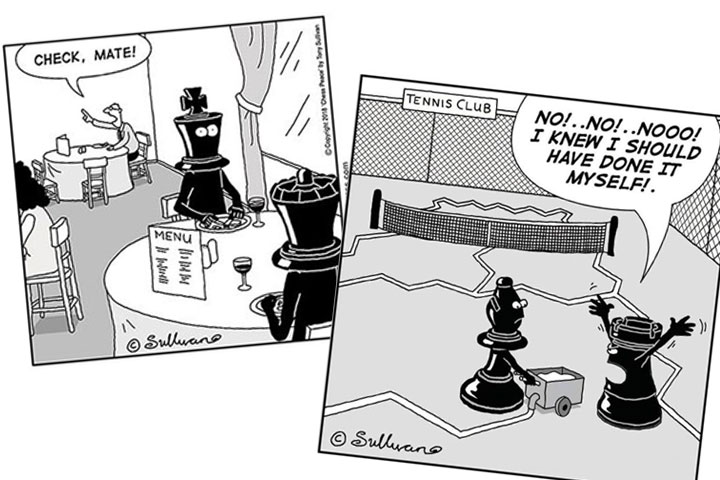
Let us start with the following joke. "What do you think of this cartoon?" I asked.
 On this DVD Grandmaster Daniel King offers you a repertoire for Black against the Catalan, based around maintaining the rock of a pawn on d5. Keeping central control ultimately gives Black good chances to launch an attack against the enemy king.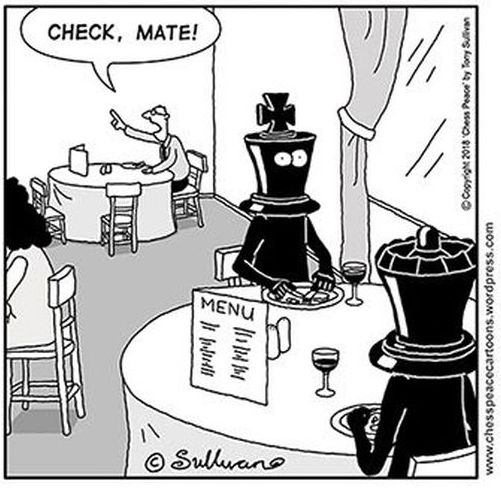
This was the initial reply:
"I think the phrase 'CHECK, MATE!' is doing double duty: in chess, 'checkmate' is the familiar word meaning the king has been trapped and the game is over. In a restaurant, 'check' means the bill. So 'Check, mate!' can naturally mean, 'The bill, my friend'. The comma is what makes the interpretation possible."
"What do you think of the expression on the king?" I asked. The reply:
"The king's expression is actually the best part of the cartoon. He looks completely startled and alarmed—his eyes are wide, and he has the expression of someone who has suddenly realized that something might be seriously wrong. And that makes the joke work on another level.
Not at all bad. ChatGPT seems to have caught the joke comprehensively.
So I tried a slightly more complex chess cartoon. What did it think about this:
Its initial reaction:
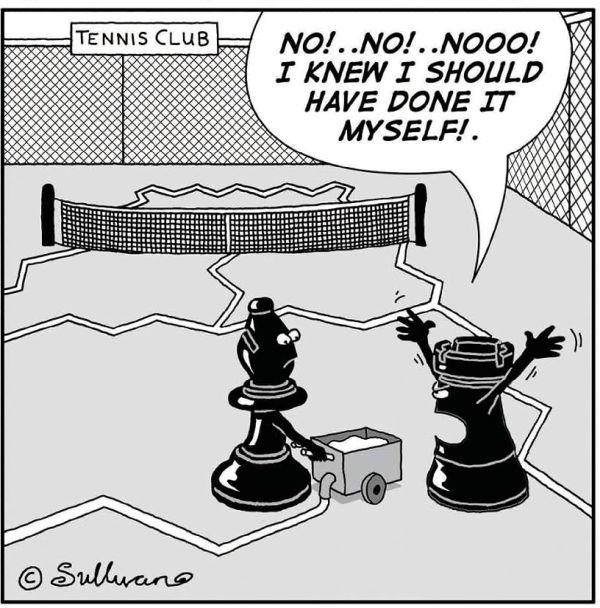
"The gag is that chess pieces have invaded a tennis court. The court has been catastrophically cracked and damaged, while the pieces appear to be trying to deal with the aftermath. The piece on the right is apparently blaming himself. The joke is about the chess pieces behaving like people doing a job, while their chess identities remain relevant."
 Checkmate. That's the aim of the game. There are numerous ways to checkmate the enemy king, but there are common patterns that recur over and over again, and having these at our mental fingertips is essential for when we want to finish the game.
It didn't get the joke. So I asked it to "think of how bishops and rooks move." It's reply:
"Ah, yes. The movement of the chess pieces is the entire joke. I was missing the key clue. The two pieces are a bishop and a rook, and they're apparently trying to move the little box across the tennis court. The court has been cracked along the paths they've taken. The result is the bizarrely shattered tennis court we see in the picture."
"Actually they are drawing the lines of the tennis court" I prompted. Reaction:
That's exactly it! And that makes the cartoon much more elegant.
The bishop and rook are workers painting the lines of a tennis court. The little cart contains the paint, and the pieces are it to perform their work.
But they can only move according to the rules of chess: the bishop moves diagonally, so he has painted the diagonal lines, the rook moves horizontally or vertically, so he can paint the straight lines.
The poor bishop is therefore wrong for the job, and has painted a line in a direction that is useless for a tennis court.
So the fundamental joke is about what happens when you hire chess pieces to paint a tennis court. A rook is perfectly suited to the job; a bishop isn't.
I have lightly edited the above exchanges, which were longer and more convoluted.
My initial conclusions from the experiments:
- LLMs can look at and interpret cartoons. But they don’t catch many things that we immediately see.
- They have an idea of what humans find funny, and search for elements that could fulfil the criteria.
- When you discuss the cartoons with them, as with a ten-year-old, they pick up the point of the cartoon very nicely.
- It is unclear whether they find them funny, or merely reconstruct why humans do.
In any case, discussing cartoons with AI is a lot of fun, and at the same time quite instructive. These systems, I believe, easily pass the Turing Test in this area of discussion.
Also read: Does AI understand humour?
Korchnoi and Zak described 3 Nc3 as ‘A risky move leading to great complications in which a single inaccurate move by either side can have fatal consequences.’ If that’s the kind of chess you like playing, you are in the right place.
You thought the usual King’s Gambit was crazy? Try this variation. On the third move, after 1 e4 e5 2 f4 exf4, White plays 3 Nc3 – discouraging …d5, but allowing 3…Qh4+ pushing the king up the board: 4 Ke2. But there is method in this madness – White is going to play the knight to f3 to gain time against the queen. Korchnoi and Zak described 3 Nc3 as ‘A risky move leading to great complications in which a single inaccurate move by either side can have fatal consequences.’ If that’s the kind of chess you like playing, you are in the right place.