Like to get an impression of ChessBase 27 and what it can do to help you?

Click the above image to start a short video which will show you some of the main features that have been implemented in the latest version of our program.
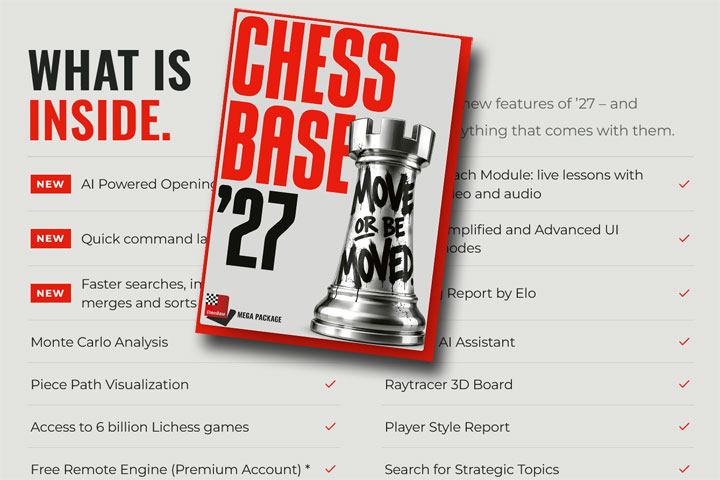
And here is a summary of all the new functions ChessBase 27 and what they actually do:
The most important new features
1. The Opening Catalog
A new interactive opening encyclopedia built directly into the board window.
- Around 2,000 opening entries, based on the ECO system.
- Graphical profiles showing characteristics such as sharpness, draw tendency, central structure, branching complexity and endgame probability.
- Opening articles explaining the history, ideas and current theoretical status of a variation.
- Annotated repertoire recommendations for White and Black.
- Audio narration, tactical puzzles and quizzes.
The catalog follows the position on the board. You can click a variation in an article to play it directly in the notation.
Why it matters: This is a major step towards integrating opening instruction, repertoire building and theoretical research into one interface.
2. Consult AI
Probably the most ambitious new feature. ChessBase connects to Claude or ChatGPT through the user's own Anthropic or OpenAI API key. The AI can use ChessBase's chess-specific tools directly, rather than merely discussing chess in a conventional chat window.
Examples include:
- Creating a complete opening repertoire for a club player.
- Analysing a game and producing annotations.
- Preparing against a specific opponent.
- Building a database of important endgame positions.
- Setting up a specific position on the board.
Suggested moves can be replayed on the board, and explanations can be presented as a visual walkthrough. Conversations can be saved locally and exported as PDFs with diagrams.
Why it matters: This is a new way of interacting with a chess database. You can ask for a complete chess research task instead of manually navigating through databases, engines and notations.
3. The Coach System
A complete environment for live chess lessons. The coach starts a session and shares a link or QR code. Students can join using a free web application on a computer, tablet or phone.
Features include:
- Demonstrating games and positions.
- Seeing moves entered by individual students.
- Switching between private, live and locked modes.
- Allowing students to analyse independently.
- Setting exercises and discussing them individually.
- Audio and video communication.
Why it matters: ChessBase becomes a teaching platform, not just a database used by a chess coach.
4. Plans Explorer
A new tool for discovering typical strategic plans from a reference database.
It identifies recurring plans for both sides in the current position, lists the games in which they occurred and displays the relevant piece manoeuvres graphically on the board.
You can click on a plan to examine the games in which it was used.
Why it matters: It helps answer a question that ordinary opening statistics cannot: what are players actually tring to achieve in this position?
5. Lichess Tree
A new opening-tree pane based on more than eight billion Lichess games. It displays:
- Moves played from the current position.
- Frequencies and results.
- Games reaching the position.
- Filters for different time controls.
- Separate trees for variants such as Chess960 and Atomic.
Why it matters: It gives access to a huge online playing database, with a different player population and playing environment from traditional tournament databases. We identify this as a Premium feature.
6. New analysis and training functions
Full Chess960 support. This is supported throughout the program, including opening books, tactical analysis, Buddy engine and Monte Carlo analysis.
Play against Fritz. ChessBase 27 lets you play out a position against Fritz, using its human-play algorithm. Useful for honing positions in your repertoire.
Repertoire Training. A dedicated function for practicing your opening repertoire.
Analysis Board. This provides a second, independent board for exploring variations without changing the game being analysed.
Quick Annotation. You can incorporate deep analysis from archived live broadcasts into game annotations.
Practical Engine Moves. This is a particularly interesting addition. The engine pane can now distinguish between:
- The objectively best move.
- Moves that are almost equally strong but create more practical problems.
- Moves that leave the opponent with only one satisfactory reply.
The program marks the most practically attractive moves, and also provides a verbal assessment of how difficult a continuation is to find. This is useful when preparing against a particular opponent. The best practical move is not always the move with the highest engine evaluation.
7. Other new functions
Interesting Games. ChessBase 27 uses machine learning to assign an interest score to games. The system learns from features of annotated games in Mega Database and applies this knowledge to other games. The score appears in the game list and can be used for sorting.
CQL Search. The program supports Chess Query Language, allowing searches for specific chess patterns, tactical themes and endgame configurations. Examples:
- Smothered mates.
- Knight underpromotions.
- Model mates.
- Particular endgame configurations.
- Games ending in stalemate between highly rated players.
This is a particularly powerful tool for chess historians, researchers and authors.
Raytracer board: This can be used to create photo realistic images of a chess position. In CB27 the stability, performance and look has been significantly improved. You immediately get a nice looking rendering of the position. Also it works well together with the new analysis board.


The launch of ChessBase 27 is on Tuesday, November 17!

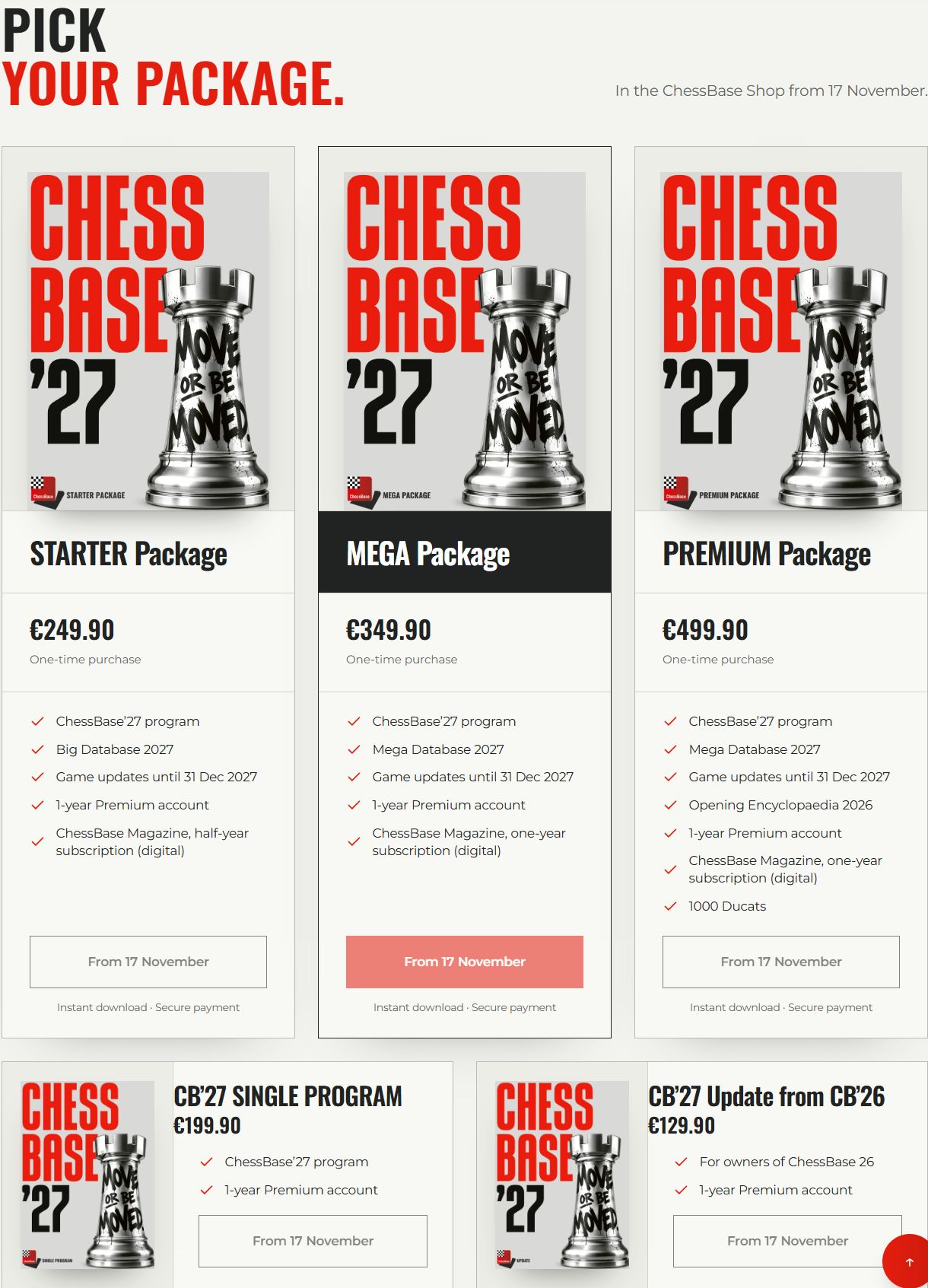
Pick your package
Important Information on Usage
ChessBase Account and Installation: The software can be installed on up to three devices. The program can only be used with one ChessBase account.
Premium Membership: A valid Premium Membership is required to use the ChessBase’27 online features. A 12-month Premium Membership is included in the package.
Coach Feature: Usage is limited to one coach with up to 5 students and a total of 25 teaching hours per month.
Ask ChessBase (AI Assistant): Usage is charged in Ducats. During the introductory period until December 31, 2026, usage worth up to 100 Ducats per week is free of charge. Once this free allowance has been used up, users must spend their own Ducats, which can be purchased if needed. From January 1, 2027, usage will be charged from the start.


















.jpeg)