
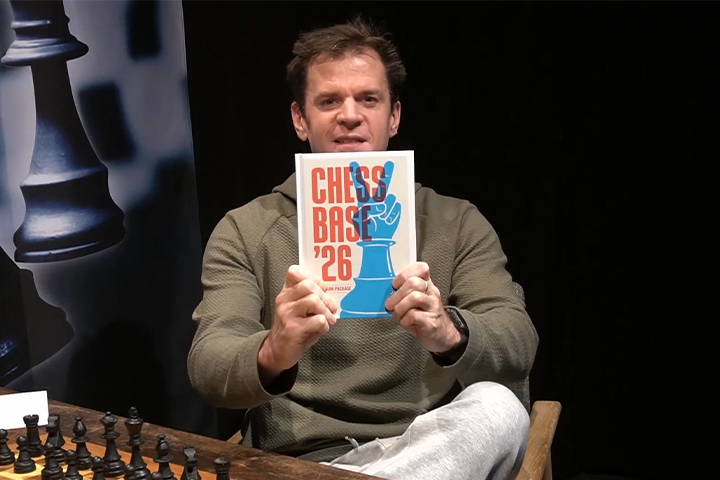

11/11/2025 – This interview with Matthias Wüllenweber, Head of Development at ChessBase, was recorded last week, just before the official release of ChessBase 26. In it, he presents the major innovations of the new version, including the redesigned Opening Report, the Fashion Index, and the powerful Monte Carlo Analysis. If you missed it then, now’s the perfect time to discover how ChessBase 26 has evolved into a smarter, more intuitive tool for your chess training.
new: ChessBase Magazine 225
Chess Festival Prague 2025 with analyses by Aravindh, Giri, Gurel, Navara and others. ‘Special’: 27 highly entertaining miniatures. Opening videos by Werle, King and Ris. 10 opening articles with new repertoire ideas and much more. ChessBase Magazine offers first-class training material for club players and professionals! World-class players analyse their brilliant games and explain the ideas behind the moves. Opening specialists present the latest trends in opening theory and exciting ideas for your repertoire. Master trainers in tactics, strategy and endgames show you the tricks and techniques you need to be a successful tournament player! Available as a direct download (incl. booklet as pdf file) or booklet with download key by post. Included in delivery: ChessBase Magazine #225 as “ChessBase Book” for iPad, tablet, Mac etc.!
EXPAND YOUR CHESS HORIZONS Data, plans, practice – the new Opening Report In ChessBase there are always attempts to show the typical plans of an opening variation. In the age of engines, chess is much more concrete than previously thought. But amateurs in particular love openings with clear plans, see the London System. In ChessBase ’26, three functions deal with the display of plans. The new opening report examines which piece moves or pawn advances are significant for each important variation. In the reference search you can now see on the board where the pieces usually go. If you start the new Monte Carlo analysis, the board also shows the most common figure paths.
In this video course, Grandmaster Ivan Sokolov explores the fascinating world of Dutch and Grünfelkd structures with colours reversed.
€39.90
ChessBase 26
Matthias Wuellenweber reveals features
At the core of ChessBase 26 lies the completely reimagined Opening Report. A tool that turns your repertoire work into a guided journey through ideas. It now highlights the most instructive games, extracts typical plans and manoeuvres, and identifies recurring tactical motifs directly from millions of games in the Mega Database. This allows you to understand openings rather than memorize them, training your intuition with real examples from top-level play.
One of the most exciting insights from this new system is that openings can’t be judged universally.
What fails at grandmaster level can still score brilliantly for club players!
ChessBase 26 lets you explore these rating-specific truths, giving practical players the confidence to rediscover classic or unconventional systems such as the Stonewall, the Scandinavian, or even old gambits that have proven success in their own rating range.
The Fashion Index adds another fascinating layer, showing which openings are currently trending, how long they stay popular, and why certain lines fade away. It even identifies the pioneers who first played and developed them - whether it’s the Evans gambit or Botvinnik’s system in the Slav - offering a historical storytelling element that connects modern play with chess tradition.
Equally innovative is the new Monte Carlo Analysis, a feature that brings a fresh scientific dimension to chess evaluation. By running thousands of ultra-fast games in parallel on all CPU cores, ChessBase 26 reveals winning probabilities, draw ratios, and typical piece manoeuvres, offering a much richer picture of a position than a single 0.00 engine score ever could.
Behind all these innovations stands Matthias Wüllenweber’s long-standing vision: to combine powerful technology with real chess understanding. ChessBase 26 makes full use of today’s multicore processors, ensuring even complex analyses and data searches run faster than ever.
Whether you are a grandmaster refining your repertoire, a club player discovering new attacking ideas, or a coach building lessons for your students, ChessBase 26 offers a vibrant, modern, and intelligent way to study chess - one that reflects Wuellenweber’s philosophy:
Preparation should not just be about numbers, but about learning to think like a chess player.
EXPAND YOUR CHESS HORIZONS Data, plans, practice – the new Opening Report In ChessBase there are always attempts to show the typical plans of an opening variation. In the age of engines, chess is much more concrete than previously thought. But amateurs in particular love openings with clear plans, see the London System. In ChessBase ’26, three functions deal with the display of plans. The new opening report examines which piece moves or pawn advances are significant for each important variation. In the reference search you can now see on the board where the pieces usually go. If you start the new Monte Carlo analysis, the board also shows the most common figure paths.
You will learn how Black's dynamic piece activity and structural counterplay more than compensate for White's extra tempo in the colour-reversed setups.
In this course, you’ll learn how to take the initiative against the London and prevent White from comfortably playing their usual system by playing 1.d4 Nf6 2.Bf4 Nh5.
London System Powerbase 2026 is a database and contains in all 11 285 games from Mega 2026 and the Correspondence Database 2026, of which 282 are annotated.
The London System Powerbook 2026 is based on more than 410 000 games or game fragments from different opening moves and ECO codes; what they all have in common is that White plays d4 and Bf4 but does not play c4.
In this course, Grandmaster Elisabeth Pähtz presents the London System, a structured and ambitious approach based on the immediate Bf4, leading to rich and dynamic positions.
Opening videos: Open Spanish (Sipke Ernst) and Classical Sicilian (Nico Zwirs). Endgame Special by Igor Stohl: ‘Short or long side’ – where should the defending king be placed in rook endgames? ‘Lucky bag’ with 35 master analyses.
YOUR EASY ACCESS TO OPENING THEORY: Whether you want to build up a reliable and powerful opening repertoire or find new opening ideas for your existing repertoire, the Opening Encyclopaedia covers the entire opening theory on one product.
€169.90
We use cookies and comparable technologies to provide certain functions, to improve the user experience and to offer interest-oriented content. Depending on their intended use, analysis cookies and marketing cookies may be used in addition to technically required cookies. Here you can make detailed settings or revoke your consent (if necessary partially) with effect for the future. Further information can be found in our data protection declaration.
Pop-up for detailed settings
We use cookies and comparable technologies to provide certain functions, to improve the user experience and to offer interest-oriented content. Depending on their intended use, cookies may be used in addition to technically required cookies, analysis cookies and marketing cookies. You can decide which cookies to use by selecting the appropriate options below. Please note that your selection may affect the functionality of the service. Further information can be found in our privacy policy.
Technically required cookies
Technically required cookies: so that you can navigate and use the basic functions and store preferences.
Analysis Cookies
To help us determine how visitors interact with our website to improve the user experience.
Marketing-Cookies
To help us offer and evaluate relevant content and interesting and appropriate advertisement.