

Openings and analysis are closely connected, but analysis goes far beyond the first few moves. It’s about evaluating middlegames and endgames, identifying critical moments, and uncovering possible improvements. ChessBase provides several tools to make this process both rigorous and insightful.
One of ChessBase´26’s most exciting additions is Monte Carlo Analysis. When you activate this option, the engine splits its core and begins playing against itself hundreds of times per minute. With each self-play game, it learns and refines its understanding, gradually improving the accuracy of its evaluations.
The output is simple yet powerful: win and draw percentages for both sides, along with the highest-scoring move based on the simulations. The longer you let it run, the more reliable the results become.
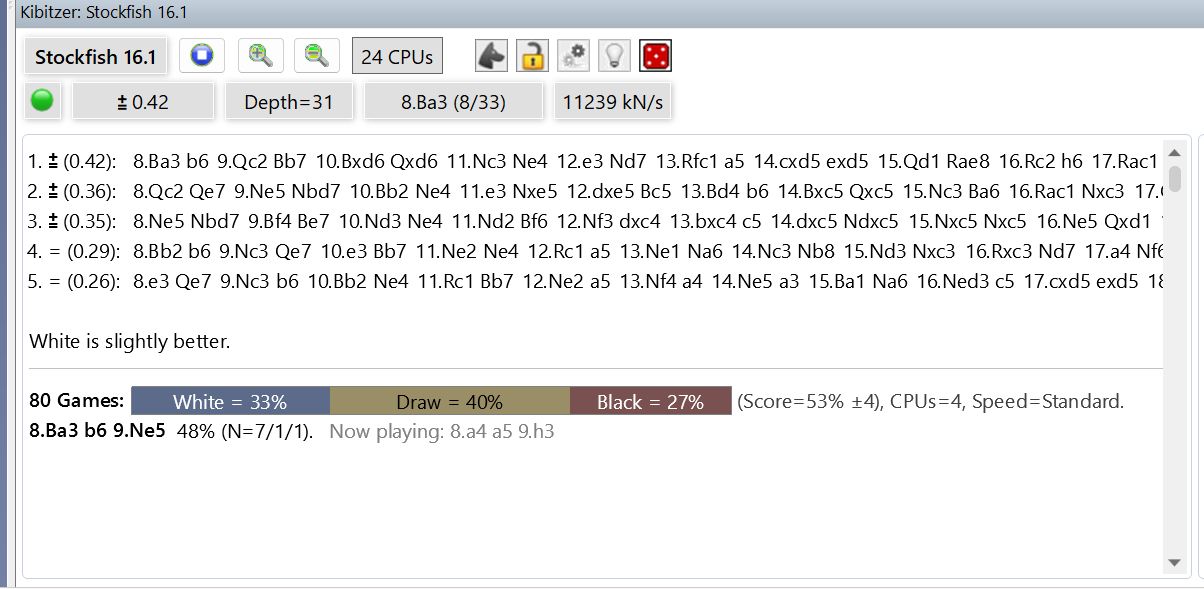
This approach mirrors how neural network engines like AlphaZero were trained, but here it’s personalized—applied to the exact position you’re studying. It’s like having your own miniature AlphaZero experiment running in the background, tailored to your preparation needs.
To access: Board -> Choose Engine -> Black dice like button.
Let the engine play as many self-games as possible, the more iterations, the sharper the accuracy.
Use Monte Carlo Analysis to evaluate how a position holds up when both sides play at a consistently high standard.
We’ve already explored AI Consult in the context of openings, but I was curious whether it could extend its usefulness into other phases of the game. After all, openings benefit from reference games and established theory—so the AI has a base to work from. But what happens in positions of true novelty, where no games exist and no database offers guidance?
Surprisingly, AI Consult still performs impressively. It dissects the position piece by piece, then stitches the insights together into clear, human-like explanations. Starting with the key factors influencing the position, it highlights what to focus on, then builds toward potential plans, candidate moves, and concrete evaluations. The order may vary depending on the position, but the result is always the same: a coherent explanation that makes complex positions accessible.
This feature shines when you’re staring at a position and don’t know where to begin. It’s like having a coach whispering in your ear pointing out plans, clarifying structures, and guiding you through the fog. The potential here is enormous. If perfected, AI Consult could evolve into a personalized coach capable of explaining the subtleties of openings, the secrets of middlegames, and the techniques of endgames.
In today’s chess world, cloud engines are everywhere—but trusting unknown vendors with your analysis can feel risky. ChessBase solves this with its own Remote Engine service, ensuring both reliability and privacy since the engines come directly from ChessBase itself.
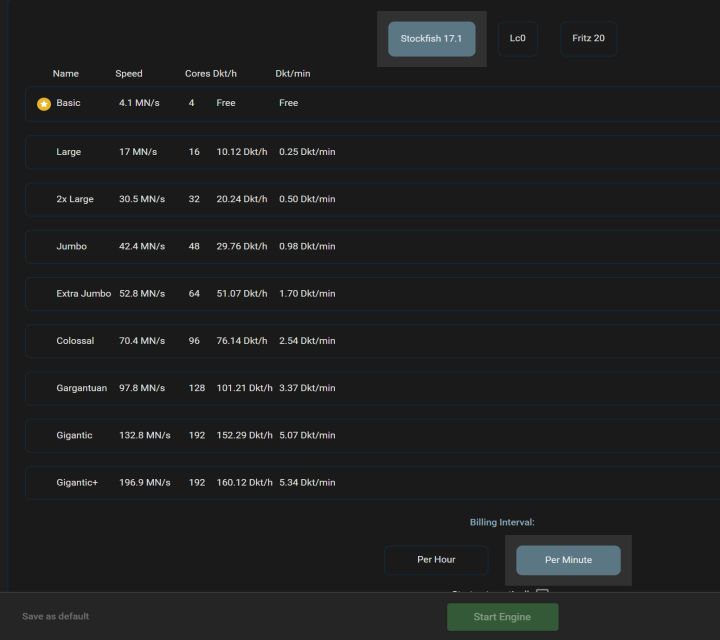
You can choose from different speeds and core configurations. A 4 MN/s engine is available for free—roughly equivalent to the performance of a standard laptop. From there, speeds scale all the way up to 192 MN/s, purchasable with Ducats (ChessBase’s official currency). This flexibility lets you tailor the service to your needs, whether you’re running quick checks or diving into marathon analysis sessions.
The engines offered include Stockfish, LC0, and Fritz, giving you access to the most respected names in computer chess.
Remote Engine is especially valuable for:
Players with less powerful computers, who can benefit from the free tier.
Serious analysts who want high-speed, in-depth evaluations without relying on unverified cloud providers.
In short, it’s like renting a supercomputer from ChessBase itself safe, fast, and customizable.
To access: Board -> Add Kibitzer -> Remote Engine -> Choose engine of choice.
Novelty Annotation is one of ChessBase’s most brilliant time-savers. With a single click, it analyzes the selected game—or even multiple games and highlights key points in the opening: names, novelties, predecessor games, and evaluations.
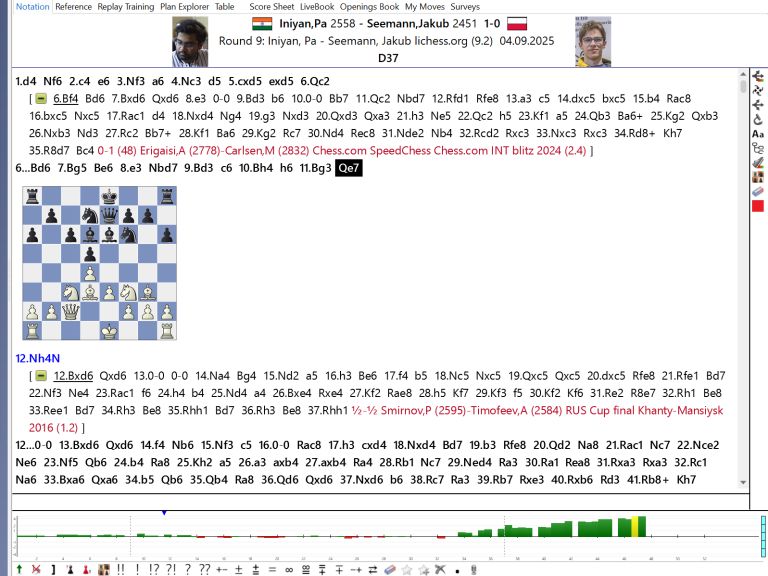
Novelty Annotation pointing out the novelty, predecessor, etc
Preparing from a major tournament? Or reviewing your own recent games? This feature allows you to mass-analyze openings instantly, saving enormous amounts of time and energy. Instead of manually hunting for novelties, ChessBase does the detective work for you.
To access:
While Novelty Annotation focuses on openings, Tactical Analysis shifts the spotlight to middlegames and endgames. It scans one or multiple games, pinpointing mistakes, blunders, and tactical opportunities. The output is a concise report that highlights critical moments and suggests improvements.
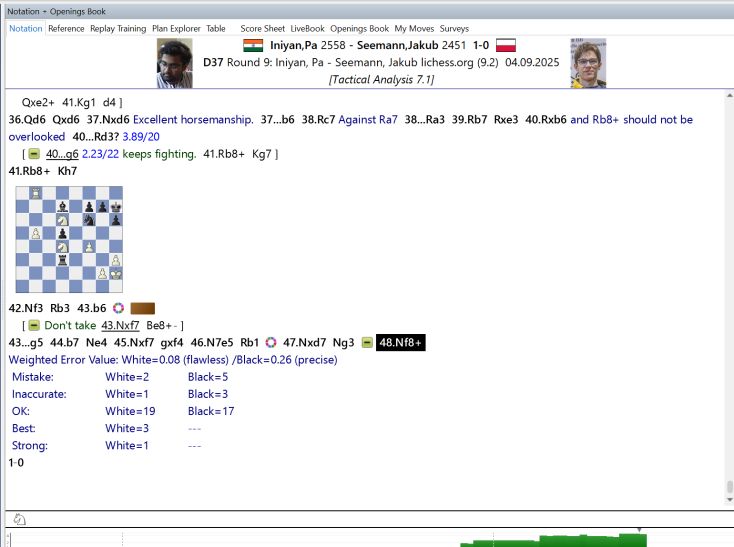
This is especially useful when you want to review a large batch of games quickly. It’s like having a coach who circles the key positions and says, “Here’s where you slipped—and here’s how you could have struck back.”
To access:
Chess evaluations are measured in pawns, with +1 meaning White is roughly a pawn ahead and -1 meaning Black holds the equivalent advantage. But humans, unlike engines, are far from perfect—we make mistakes, sometimes small, sometimes glaring.
Centipawn Analysis quantifies this imperfection. It compares your moves against the engine’s top choices across the entire game, then averages the difference. For example, if a 40-move game has a total deviation of 4 pawns, your average error is 0.10 centipawns per move.
A score between 0 and 0.15 indicates an exceptionally precise game.
A score between 0.15 to 0.40 indicates a decently well played game.
A score of 1 or more suggests there’s serious room for improvement.
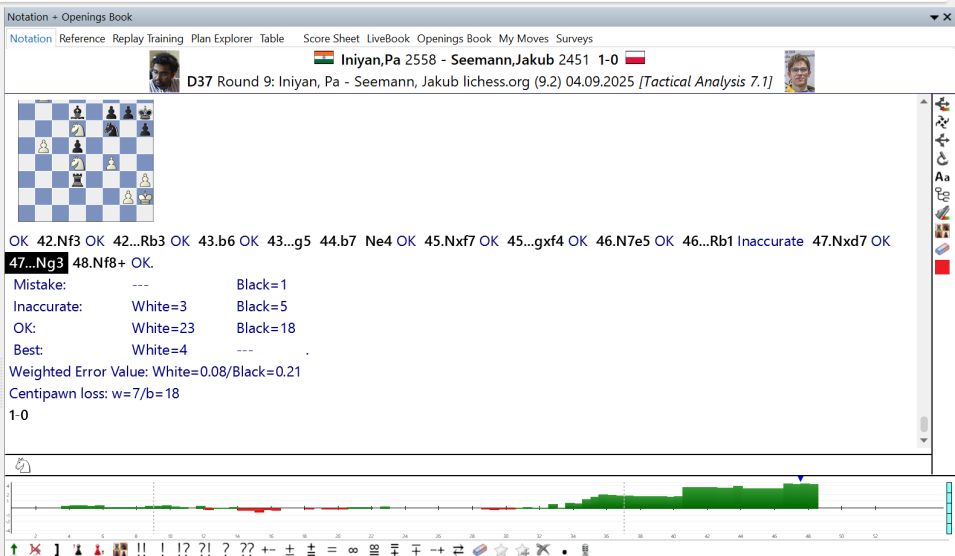
Most players fall somewhere in between, with stronger play reflected in lower centipawn averages.
Beyond the numbers, Centipawn Analysis also categorizes your moves—good, great, dubious, or outright bad—providing a clear picture of your accuracy compared to your opponent. It’s a humbling but highly instructive way to measure progress.
To access:
Combine analysis of Centipawn, Tactical Analysis and Novelty Annotation to have a complete analysis of large amount of games in negligible times.