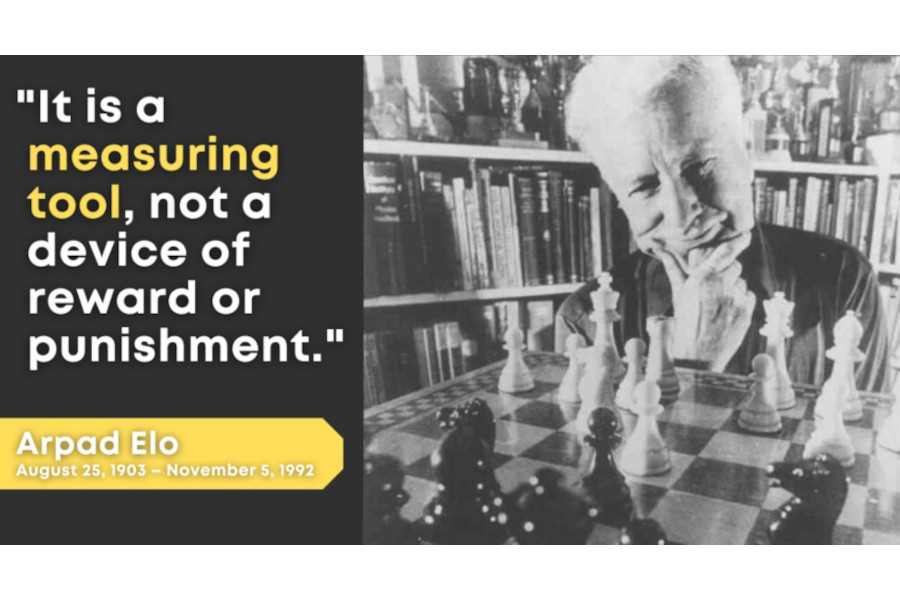
Press release by FIDE
122 years ago, Arpad Emmerich Elo - a physicist, chess master and pioneer of the rating system - was born. A native of the Kingdom of Hungary, he moved with his parents to the United States in 1913, later earning his BSc (1925) and MSc (1928) degrees from the University of Chicago. From 1926 until his retirement in 1969, Elo taught physics at Marquette University in Milwaukee.
 The course is designed to provide a deep yet practical repertoire for Black, balancing solid foundations with aggressive counterplay.
The Classical Sicilian has stood the test of time as one of the most principled and fighting defences against 1.e4. With its rich history spanning world championship matches and modern elite tournaments, this opening remains a favourite among players who seek a dynamic, counterattacking approach without venturing into extreme theoretical battles like the Najdorf or Sveshnikov.
Free video sample: Introduction
Free video sample: 6.h3
By the 1930s, he was the city's strongest chess player, at a time when Milwaukee was one of the nation's leading chess hubs. He won the Wisconsin State Championship eight times and was the 11th person inducted into the World Chess Hall of Fame.
A system for a new era
The dawn of the 1970s brought a wave of technological breakthroughs. The debut of the commercial microprocessor marked a new era, and the invention of the pocket calculator in 1970 proved particularly significant for chess.
It greatly simplified the work of the FIDE Qualification Commission, which had to handle a rapidly growing number of rating calculations. That same year, FIDE officially adopted Elo's system for calculating chess ratings.
Elo pioneered this rating system, which the US Chess Federation first implemented in 1960. A player's Elo rating is a numerical measure of past performance, adjusted based on the game's result, aligning with expected outcomes.
For example, if you are rated 200 points higher than your opponent, you are expected to score about 75% of the points in head-to-head games. Meeting that expectation keeps your rating stable; exceeding it raises your rating; underperforming lowers it.
Originally designed for chess, the Elo system has since been used in football, baseball, basketball, and other sports.
Legacy and evolution
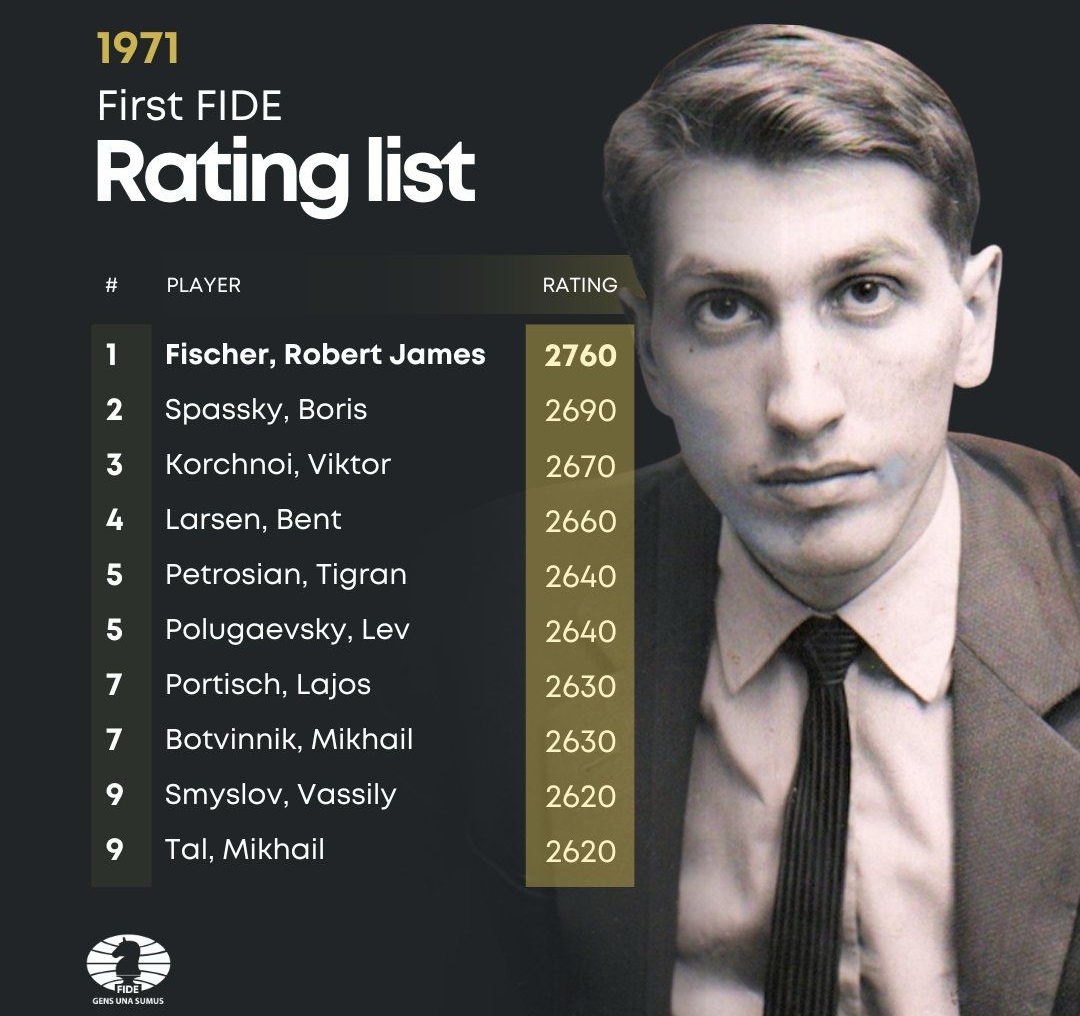
In 1971, FIDE published its first rating list. Bobby Fischer topped it with 2760 - the only player above 2700 - followed by reigning World Champion Boris Spassky at 2690. Thirteen other grandmasters were above the 2600 mark.
The publication frequency of the FIDE rating list has changed over time. From 1971 to 1980, only one list was issued per year. This has gradually increased to the current standard of monthly updates.
Ratings have generated fascinating statistics. The highest rating ever achieved belongs to 16th World Champion Magnus Carlsen, who reached incredible heights of 2882. Only 14 other players in history have crossed the 2800 threshold. To qualify for the grandmaster title, a player must reach a rating of 2500.
Today's FIDE rating system continues to evolve, considering numerous factors to adapt to the modern game. A major 2024 update, for instance, addresses rating inflation associated with a rapidly growing base of new players, particularly children and beginners.
No other World Champion was more infamous both inside and outside the chess world than Bobby Fischer. On this DVD, a team of experts shows you the winning techniques and strategies employed by the 11th World Champion.
Grandmaster Dorian Rogozenco delves into Fischer’s openings, and retraces the development of his repertoire. What variations did Fischer play, and what sources did he use to arm himself against the best Soviet players? Mihail Marin explains Fischer’s particular style and his special strategic talent in annotated games against Spassky, Taimanov and other greats. Karsten Müller is not just a leading international endgame expert, but also a true Fischer connoisseur.
Links