Fifty years of the Hannover Chess Club
Chess enthusiasts in Hannover suspected that the energetic Hermann Zwanzig may have been the person who suggested founding a chess club in the city. As a businessman, Zwanzig travelled widely throughout Germany in the second half of the 19th century and visited chess enthusiasts in many cities. He was also one of the driving forces behind the foundation of the German Chess Federation in 1877 and served as the organisation's General Secretary until his death in 1894. In fact, the Hannover Chess Club had already been founded a year before the German Chess Federation, in 1876.
The leading figure at the founding meeting, held at what was then the Hotel Union and later became the Hotel Ernst August, was the physician Dr Jung. The names of other founding members have also been preserved: wine merchant Karl Schultz, businessman Meyerhof, government official Goering, director Wille, timber merchant Levi, banker Louis Rothschild, piano teacher Bierwirt and commissioner Evers. They were all members of Hannover's upper social circles. Even so, their names would probably no longer be known today had they not shared a common hobby and had a careful chronicler not recorded their names as the founders of a chess club.
Early activities
 Daniel King presents 50 puzzle positions in video format, all arising from the King's Gambit. They feature typical tactics from the opening, so this is a great way of becoming familiar with the tricks and traps that you can set your opponent.
A few more years passed before a highly significant tournament was held in Hannover in 1902: the 13th DSB Congress, which included a strong international masters tournament.
Dawid Janowsky won it by a margin of 1½ points over Nelson Henry Pillsbury. Eighteen players took part in the masters tournament, including many other well-known and strong players of the time from around the world. The Hauptturnier was also strong and featured several prominent names.
During the congress, Pillsbury gave one of his legendary blindfold simultaneous exhibitions, facing 21 (!) players, including several very strong masters. Pillsbury lost the overall contest against such formidable opposition, but nevertheless won three games and drew eleven.
In 1906, to mark its 30th anniversary, the Hannover Chess Club organised another congress of the Lower Elbe Chess Federation. The NESB was based in Hamburg and brought together chess clubs from northern Germany. Alongside organising regional congresses, the NESB was particularly active in chess composition. It was dissolved in 1934 as part of the Nazi policy of Gleichschaltung. No games from the 1906 congress have survived. The Hannover Chess Club had already left the NESB in 1923 and joined the newly founded Lower Saxony Chess Federation.
From time to time, the Hannover Chess Club was visited by strong masters, who were often invited to give simultaneous exhibitions.
The 50th anniversary tournament
In 1926, the Hannover Chess Club celebrated its 50th anniversary with a major chess event. It hosted the second congress of the newly founded Lower Saxony Chess Federation and also organised an international masters tournament, which was opened with a festive banquet on the evening of 8 August 1926. Among the guests, alongside dignitaries from the city of Hannover and the tournament participants, was Walter Robinow, President of the German Chess Federation.
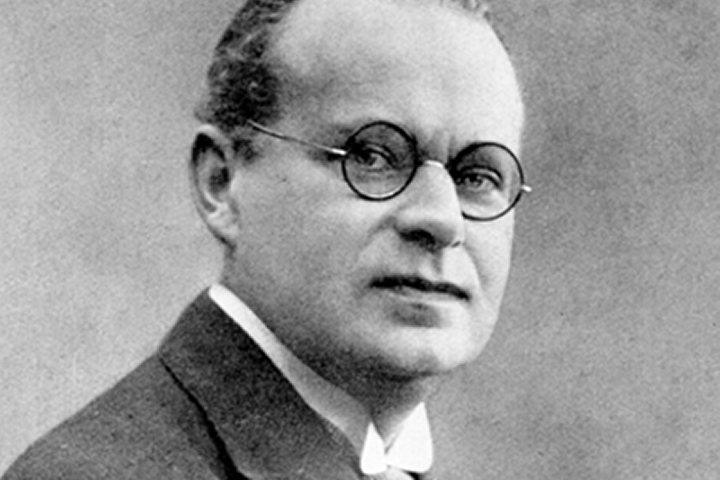
For the anniversary tournament, two world-class players had been invited: Aron Nimzowitsch and Akiba Rubinstein. In 1926, Nimzowitsch was among the players being discussed as possible challengers to world champion Capablanca. Rubinstein, who was living in Berlin at the time, had already passed his peak. Friedrich Saemisch and Jacques Mieses represented Germany's leading masters, as did the considerably older Hermann von Gottschall, born in 1862. Walter Freiherr von Holzhausen, a retired major and an internationally renowned authority on chess composition, played a special role. The physician Oskar Antze from Bremen and Hans Duhm from Göttingen were strong club players from Lower Saxony.
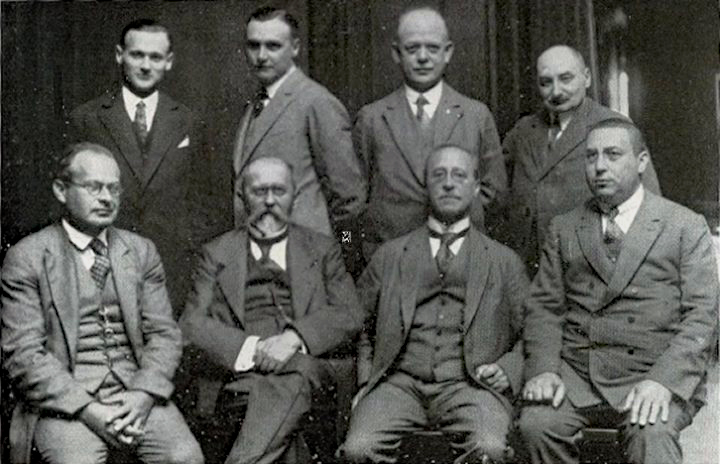
Back row: Friedrich Sämisch, Oskar Hans Antze, Hans Duhm, Walther von Holzhausen
Front row: Aaron Nimzowitsch, Hermann von Gottschall, Jacques Mieses, Akiba Rubinstein
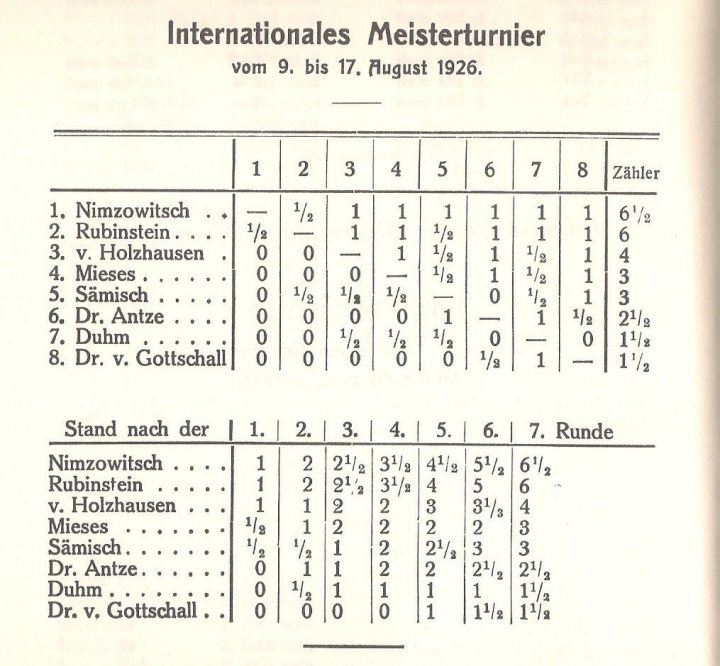
The first round of the masters tournament was played on Monday, 9 August 1926. The favourites Nimzowitsch and Rubinstein established themselves atop the standings from the opening rounds and subsequently fought a two-man battle for tournament victory. The game between the two leading players ended in a draw.
Otherwise, the two leading players defeated all their opponents - almost all of them. Friedrich Saemisch ultimately played the role of kingmaker: although he lost to Nimzowitsch, he held Rubinstein to a draw.
Nimzowitsch therefore won the tournament with an impressive 6½ points from 7 rounds, while Rubinstein, with one additional draw, took second prize.
 Checkmate. That's the aim of the game. There are numerous ways to checkmate the enemy king, but there are common patterns that recur over and over again, and having these at our mental fingertips is essential for when we want to finish the game.
The "best of the rest" was chess composer Walter Freiherr von Holzhausen, who achieved one of the best tournament results of his career. He had no chance against the two frontrunners, but against the remaining opponents he scored three wins and two draws.
On the rest day, the players visited Marienburg Castle near Nordstemmen, south of Hannover, and were also guests of the Hildesheim Chess Club.
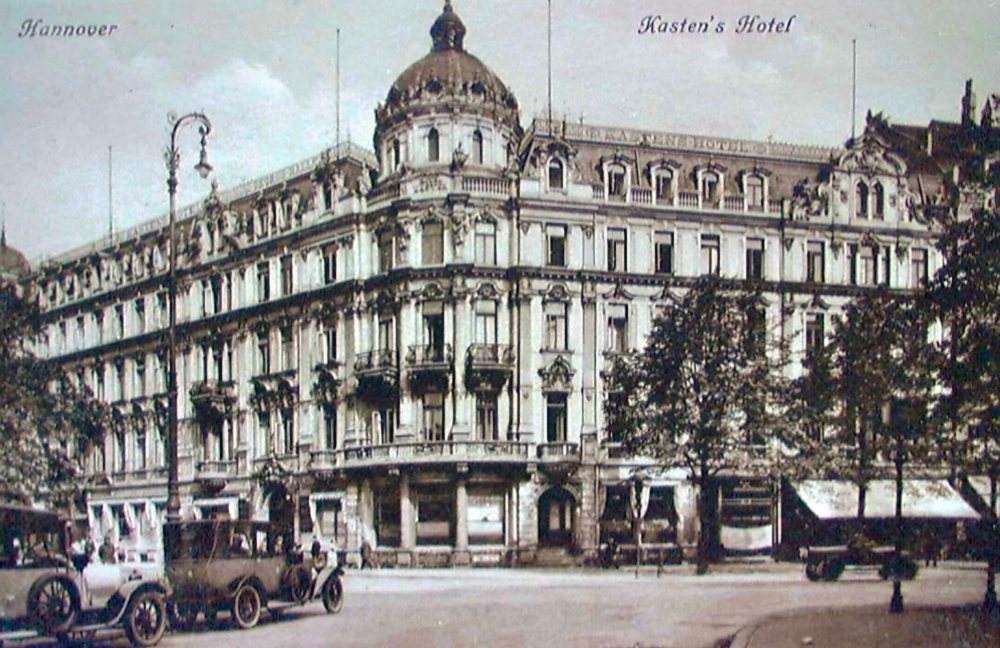
The closing ceremony took place on 17 August at the traditional Hotel Luisenhof – Hannover's only five-star hotel.
The brilliancy prize was shared, being awarded to Mieses for his game against Von Gottschall and to Nimzowitsch for his game against Mieses.
The anniversary chess events also included an international chess composition tournament featuring problems in two or no more than three moves. Walter Freiherr von Holzhausen was one of the two judges who decided the prizes.
Smyslov cultivated a clear positional style and even in sharp tactical positions often relied more on his intuition than on concrete calculation of variations. Let our authors introduce you into the world of Vasily Smyslov.