From Europe to Sharjah to Dubai
Vandan's chess education commenced at age seven in Delhi academies before he began individual training under FM Gurpreet Pal Singh. Over the subsequent five years, he crossed the 1900 Elo threshold - the traditional benchmark for Indian juniors transitioning to competitive circuits abroad.
HatsuzukiMeiso 1 - 0 MagnusCarlsen
Annotations by Vandan Alankar Sawai
In his own words: Highs, lows and hard truths
 YOUR PERSONAL CHESS COACH - Whether you’re taking your first steps into the world of club chess, or already playing at a tournament level: with FRITZ, you can train more efficiently, intelligently and with a more personalised approach than ever before.
FRITZ is more than just a chess engine – it’s a training revolution! Whether you’re taking your first steps into the world of club chess, or already playing at a tournament level: with FRITZ, you can train more efficiently, intelligently and with a more personalised approach than ever before.
* COMPETE AGAINST LEGENDS
* FRITZ is fun! BETTER CALCULATIONS – EVEN UNDER TIME PRESSURE!
* STYLE SIMULATION AT THE HIGHEST LEVEL
* EVEN STRONGER. EVEN MORE BEAUTIFUL. EVEN MORE DIRECT.
My chess journey started when I was seven years old. It began with a couple of chess academies in Delhi, and from there I moved to an individual coach, Mr. Gurpreet Pal Singh. Within the next five years, with many ups and downs, I finally reached the level of 1900 the rating where many Indians start playing tournaments abroad.
I decided to follow suit and try my hand at several tourneys in Europe, as well as some in the United Arab Emirates. During these tournaments spread over late 2024 and the beginning of 2025, I increased no less than 300 rating points and achieved the CM title.
Unfortunately, I was not playing chess at the level of my then-peak rating of 2243, and I would end up dropping no less than the entire 300 points.
The Sharjah slump and the Dubai turnaround
The reality of competitive chess is ruthless, and Vandan's rapid drop was a wake-up call.
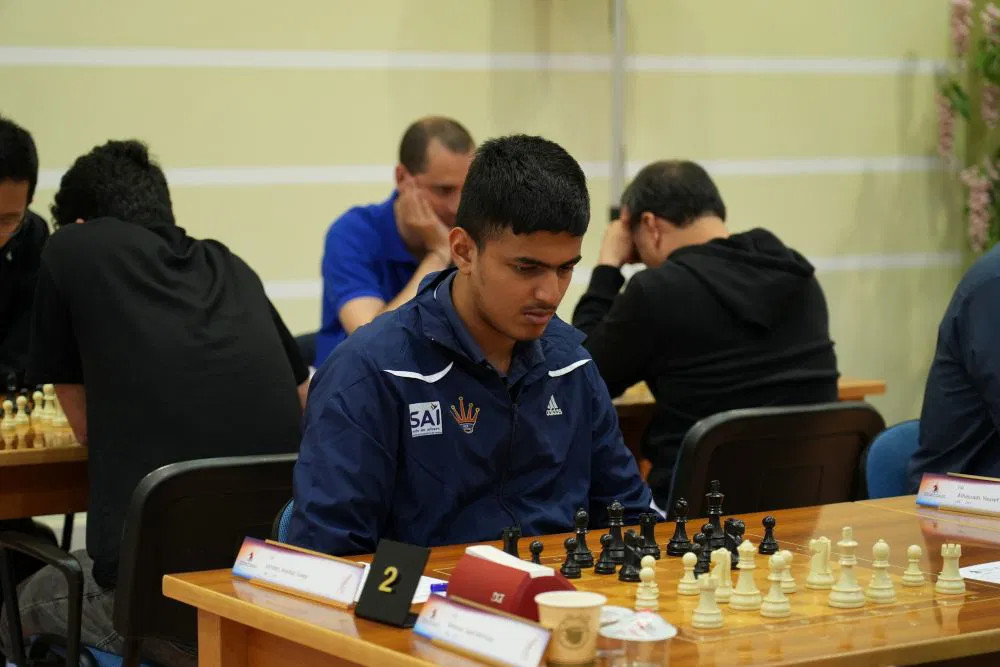
I continued practicing, and then I played a tournament in Sharjah followed by one in Dubai. The first one was a fiasco, to put it mildly - I dropped 120 points and lost the most unlosable games.
However, the second tournament was a turnaround. I finished third in the 25th Dubai Open 2025. I hardly expected anything good, especially as I was fairly high up in the starting list. Regardless, it was still disappointing to lose the last round; with a draw I'd be second, and with a win I'd be the champion. But my opponent never turned down the pressure and played well, so I was not too unhappy with the third prize.
It was only these reoccurring howlers in the first half of 2025 which convinced me that I could hardly hope to regain my rating unless I seriously improved my chess. By the end of July, I was down to 2086.
Learning to calculate: The breakthrough
To rebuild his game from the foundation up, Vandan sought out structured guidance alongside training sessions with GMs Ruslan Shcherbakov and Sahaj Grover.
I came across GM Oleksander Goloshchapov's chess school. I took part in two of his courses, which were immensely helpful in understanding aspects of chess I had hardly grasped before. I worked on diversifying my openings and sharpening my endgame technique.
 This is a full repertoire after 1.e4 e5 2.Nf3 focussing on the Evans Gambit as the main weapon.
Few openings teach the art of attack as directly as the Evans Gambit. After 1.e4 e5 2.Nf3 Nc6 3.Bc4 Bc5 4.b4, White gives up a pawn to rip open the position, build a powerful center and head straight for the black king. The best part is that the tactics aren't forced or memorized. They arise naturally from the position, which makes the Evans the ideal opening for club players and ambitious juniors who want sharper, more confident results. But a great gambit is only half a repertoire. Across these two volumes, IM Andrew Martin gives you the complete picture after 1.e4 e5 2.Nf3, with a clear, ready-to-play answer to everything Black can throw at you.
In early 2026, I began working with IM Kushager Krishnater, who pointed out - much like Goloshchapov - that my main issue was a lack of will to calculate, and calculate properly at that.
Soon enough, I was training my calculation in a structured manner, and the results followed. At the National U-17 Championship 2025-26 in Ahmedabad, I calculated ten moves ahead, sacrificing a full piece along the way to secure two connected passed pawns. While there was no forced win against best defence, the complications induced an opponent blunder, allowing a queen and eventually a mate-in-one in severe time trouble.
Only then I realised that learning to calculate is maybe not such a bad idea after all!
Vandan added:
Now I had another chance to go abroad, in July-August 2026. I played some good games and did my fair share of blunders, which should not have happened. After all was said and done, I had played four tournaments and increased almost 230 points, for which I should have a published rating of 2338 by the end of August.
In this course, we will learn how to identify passively placed pieces in any given situation and how to improve their health by bringing them into active squares.
















.jpeg)