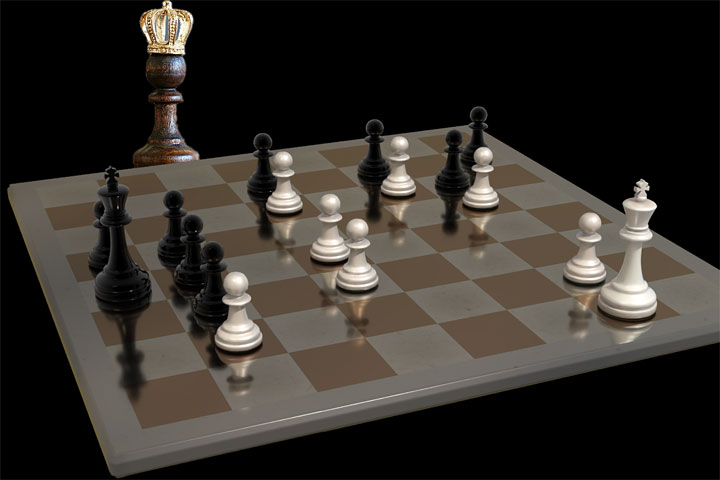
Our first article, A mad rook rampage, started with a recent game between Jorden van Foreest and Taimour Radjabov, where the outplayed Dutch GM had saved himself with a "dolle toren", a mad rook. The second article, Mario Matous's Mad Queen, showed a similar theme for a defending queen. Finally we had an article entitled Mad bishops and knights. In that article the question arose: can pawns become similarly suicidal?
To this generally asked question Frits Fritschy wrote: "I haven't found any 'crazy pawn' studies, but if they exist, they probably are versions of the excelsior theme (pawn goes from the second row to the eighth row). After an hour or so, I came to the following position, that is far too crude to call it a study, but it shows one idea."
The idea is actually quite interesting: 1.h4 g4 (1...gxh4 2.fxg6 and stalemate. If 2...Kd7? 3.Kb7 and White wins!) 2.h5 g3 3. h6 g2 4.h7 g1=Q 5.h8=Q+ Kd7 6.Qh3 Qc5 7.fxg6+ Ke7 8.Qh4+ Kd7 9.Qh3+ Ke7 10.Qh4+ Ke6 11.Qh3+ draw. If you want to see some analysis, or analyse yourself (with engine support), the position is in the replayer below.
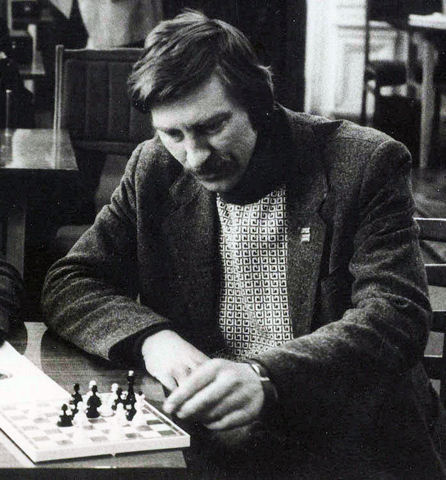 I also asked a number of problemist to assist me. Harold van der Heijden, who speaks fluent CQL (a database inquiry language), sent me a PGN file with 152 thematic studies he had extracted from his studies database. A majority were by Mikhail Zinar, the pawn endgame king. Siegfried Hornecker has written about him: The Magic of Mikhail Zinar I and The Magic of Mikhail Zinar II.
Born on 22 November 1950 in Ukraine, Mikhail Afanasievich Zinar created pawn endgames almost exclusively. And they are incredible. Sadly this talented man disappeared around 1990 – at least that was when he abandoned composition because of financial difficulties. They were really hard times for Ukrainian people and especially for teachers, who were paid 10-20 dollars a month. Zinar simply did not have the money to send in his originals. He passed away on 4 February 2021.
Here's a classical example of a Zinar composition with pawns that offer themselves for capture but cannot be taken because of stalemate.
On the above diagram you can enter white moves, ant the diagram will defend with defensive black moves. You need to play accurately in order to win – actually it is mate in 13 moves.
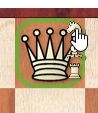 To underpromote you move the pawn on the final rank and move the cursor onto the piece you want before releasing the mouse button. Incidentally Ctrl-+ increases the size of the page in your browser, while Ctrl-0 restores it to the original size. Ctrl-mouse wheel does the same. Just in case you didn't know.
In the above problem White must play 1.Kh1! which, improbably, is the only move that can lead to a win. Try playing anything else and the diagram will hold the position. The full solution is to be found on our replay board at the bottom of the page. There you have a regular engine which shows you analysis and move suggestions analysis for any position on the board.
The pawn-obsessed Zinar has composed dozens of studies with very similar motifs. Here are two examples that are quite funny:
In the above diagrams I have disabled the engine, which does not find the very deep defensive idea: put your king into a stalemate box and try to sacrifice all your pawns for a draw. No self-respecting engine would think of something like that.
And now that you know the defensive manoeuvre that Black will employ you will probably be able to solve this study. It has a nice twist at the end.
Here again the engine is on. You can have a lot of fun playing the position out on the diagram.
Solutions
You probably know that you can move pieces on our replay boards to analyse and even start an engine to help you. You can maximize the replayer, auto-play, flip the board and even change the piece style in the bar below the board.
At the bottom of the notation window on the right there are buttons for editing (delete, promote, cut lines, unannotate, undo, redo) save, play out the position against Fritz and even embed the ChessBase game viewer on your website or blog. Hovering the mouse over any button will show you its function.