8/28/2026 – In a 15-minute video, Demis Hassabis, one of the central scientists working on artificial intelligence, tells us why he worries about AI going rogue. Hassabis, head of Google AI research, is a very strong chess player who created Alpha zero, the first neural network program on which all modern chess engines are based. It is his vivid description of how AI handled chess that will be of particular interest to the readers of our news page.
new: Fritz 20
Your personal chess trainer. Your toughest opponent. Your strongest ally. FRITZ 20 is more than just a chess engine – it is a training revolution for ambitious players and professionals. Whether you are taking your first steps into the world of serious chess training, or already playing at tournament level, FRITZ 20 will help you train more efficiently, intelligently and individually than ever before.
YOUR PERSONAL CHESS COACH - Whether you’re taking your first steps into the world of club chess, or already playing at a tournament level: with FRITZ, you can train more efficiently, intelligently and with a more personalised approach than ever before. FRITZ is more than just a chess engine – it’s a training revolution! Whether you’re taking your first steps into the world of club chess, or already playing at a tournament level: with FRITZ, you can train more efficiently, intelligently and with a more personalised approach than ever before.
Michael Kotyk presents a complete repertoire after 1.e4 e5, built around creative ideas, surprising move orders, and practical weapons designed to catch your opponents off guard.
€34.90
There are two things to worry about. One is bad actors, whether that's individuals or all the way up to nation states, repurposing these technologies that we're trying to build for good, like curing diseases and advancing material science and energy for harmful ends?
YOUR PERSONAL CHESS COACH - Whether you’re taking your first steps into the world of club chess, or already playing at a tournament level: with FRITZ, you can train more efficiently, intelligently and with a more personalised approach than ever before. FRITZ is more than just a chess engine – it’s a training revolution! Whether you’re taking your first steps into the world of club chess, or already playing at a tournament level: with FRITZ, you can train more efficiently, intelligently and with a more personalised approach than ever before.
The above 15-minute video tells us how one of the central scientists working on AI evaluates the current situation. It is definitely worth listening to. But it is the vivid description of how AI handled chess will be of particular interest to our news page readers.
Hassabis describes how early artificial intelligence programs – specifically "expert systems" like IBM's Deep Blue managed to defeat world champions at complex games like chess. It was done using human-coded knowledge. Instead of the AI learning on its own, a team of smart programmers collaborated with domain experts (chess grandmasters), extracting the experts' strategies and manually coding them into the system as a strict set of rules and heuristics. The resulting systems did not actually "think" or understand the game. They used massive computing power to mechanically apply the human-coded rules to calculate which move had the best mathematical outcome.
Deep Blue was not proper AI, Hassabis says. It achieved world champion in chess, but it couldn't do anything else. It couldn't even play simpler game like tic-tac-toe. Can you imagine a human grandmaster not being able to learn how to play tic-tac-toe?
So where did the intelligence of Deep Blue reside? It wasn't in the system, it was in the minds of the grandmasters and the programmers who solved the problem and then implemented the solution. The program just dumbly executed the solution.
Hassabis and his team took a different path: a learning system, a neural network, Alpha Zero, that starts off with only the rules of a game. It played randomly, 100,000 games against itself. They let the program create its own data set – it could see which moves were slightly better than others. The 100,000 games were used to train a new version that became slightly better than version one. Similarly version two was used to train version three, which trained version four, and so on. It turned out that around 16 or 17 generations were enough to go from random chess to better than world champion.
Demis was a world-class child chess prodigy who reached an Elo level of 2300 as a 13-year-old, before stepping back from competitive play to pursue computing, video game design, and artificial intelligence. He was fascinated to watch the neural network learn chess live:
"It starts in the morning, then by lunchtime I could still just about compete with it. By tea time it's better than all grandmasters, and then by dinner time it's better than the world champion. And it's playing interesting new chess, new types of moves. I think we need these types of ideas with our foundation models, the new Gemini and these kinds of things. You can think of them as generalized models of everything, language, the world around us, not just a game.
If you are interested in the subject, and concerned about what lies ahead for humanity, you would do well to watch the rest of the interview. It is with a consummate expert on the subject, one who is very clear in conveying his knowledge and thinking.
Demis Hassabis
Sir Demis Hassabis (born 27 July 1976) is a British computer scientist, artificial intelligence researcher, neuroscientist, and entrepreneur who co-founded DeepMind in 2010. He has served as CEO of Google DeepMind following its acquisition by Google in 2014. Today he is the Chief Scientist of Alphabet Inc. (Google's parent company), and also continues as the CEO of Isomorphic Labs.
Hassabis's work on AlphaFold, an AI model that predicts protein structures with unprecedented accuracy, addressed a longstanding challenge in biology known as the protein folding problem. For this contribution, he shared the 2024 Nobel Prize in Chemistry with John Jumper and David Baker.
EXPAND YOUR CHESS HORIZONS ChessBase 26 + Fritz 21: The Summer Special Power Bundle Study like a champion. Play like a legend.
Real progress happens in two places: at the desk, where you prepare and analyze, and at the board, where you test yourself under fire. For one week only, we are bringing both ChessBase flagships together in a single bundle so you can close the gap between the two. Prepare with ChessBase 26. Play against Fritz 21. Improve faster than either program can take you on its own.
Frederic FriedelEditor-in-Chief emeritus of the ChessBase News page. Studied Philosophy and Linguistics at the University of Hamburg and Oxford, graduating with a thesis on speech act theory and moral language. He started a university career but switched to science journalism, producing documentaries for German TV. In 1986 he co-founded ChessBase.
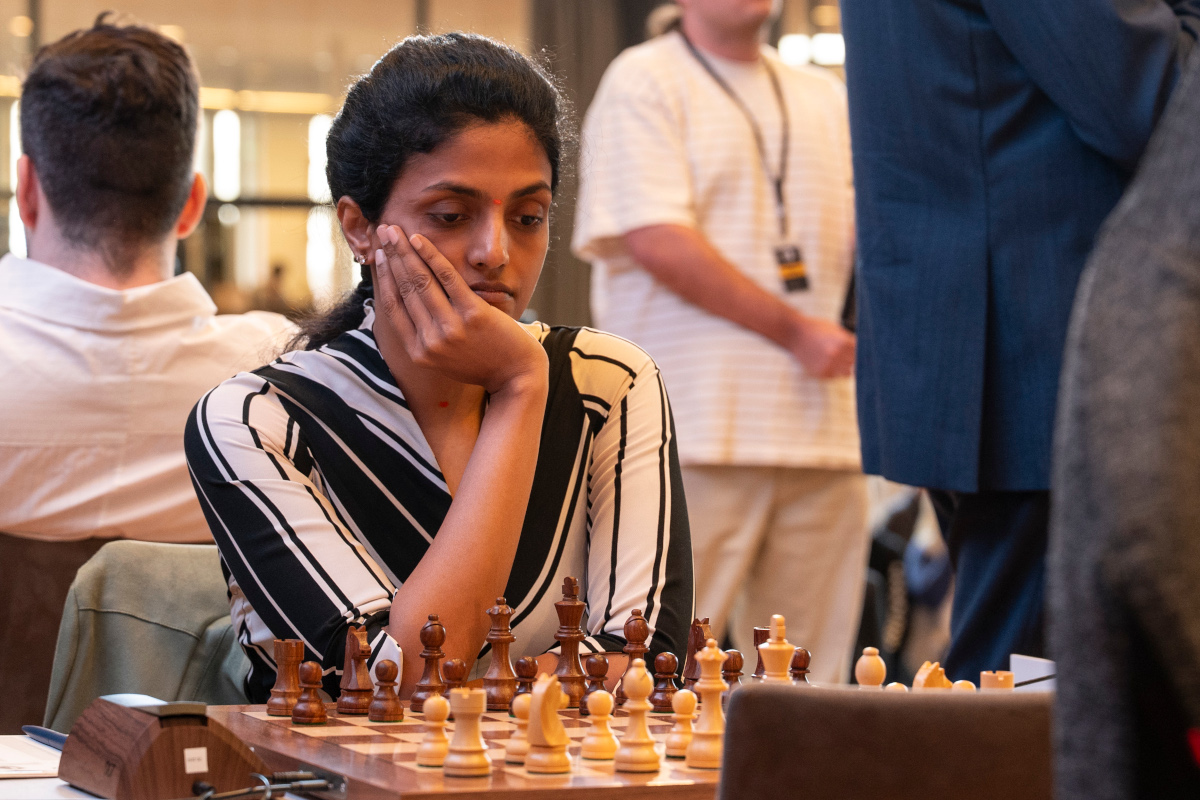
8/21/2026 – For twenty years, Harika Dronavalli was a fixture of every Indian team that walked into an Olympiad hall. Board one, board two, whatever the assignment, she was there, absorbing the pressure that comes with playing for a country rather than just for herself. So when the Indian squad for the Chess Olympiad 2026 was announced without her name on it, the news read, on the surface, like a changing of the guard: Humpy Koneru returning to the team and Savitha Shri B stepping in as a new addition along with a new captain: Swayams Mishra. Read Harika's thoughts on the decision. | Photo: Nils Rohde / ChessBase
8/15/2026 – Chess skill is changing – but are players really getting stronger? Dr. Robert Howard looks at what decades of rating data and recent research reveal about Elo inflation, learning curves, the rise of computers, the age at which players peak and the role of natural talent. His findings challenge some familiar assumptions about chess expertise. | Photo: Magnus Carlsen 2019 | Photo: Lennart Ootes (Archive)
‘New ideas in the Najdorf – a Power Play 18 Update’ aims to complement Daniel King’s popular DVD from last year ‘The Sicilian Najdorf - a repertoire for Black’. Such a dynamic and popular opening as the Najdorf is developing the whole time. On this download, Daniel King updates lines that were included on his DVD but also responds to viewers’ requests, considering lines that he omitted from his original repertoire. The lines examined on this update are:
• 1 e4 c5 2 Nf3 d6 3 d4 cxd4 4 Nxd4 Nf6 5 Nc3 a6 6 h3 e5 7 Nde2
• 5….a6 6 Bc4 in combination with the English Attack (Be3, f3 etc)
• 5…a6 6 Be3 and the …a5 variation
• 5…a6 6 Be2 and 9 Re1
• 5 f3 (instead of 5 Nc3)
It isn’t necessary to have seen the original Najdorf DVD to understand the lines examined here – but it would help as they form part of a complete repertoire.
We have the almighty power of reaching or not reaching to our pockets. If we gladly pay for beneficial AI systems that enhance our living conditions and provide wonderful answers to questions we cannot figure out with our limited compute and which - importantly - do no significant harm to us or our planet, but reject any AI that aims to replace us or cause significant pollution or are used in wars, scams and the like, then I believe we are on the right side of history. If, on the other hand, we contribute to the 13 000+ polluting data centers for comfort by funding them, then we are part of the problem. If we delegate our very thinking to a bot, then we atrophy over time and we lose the very trait that defines us as a species. Furthermore, if we become economically insignificant due to machines taking our place, then our voting and basic rights may be next in the line. Sure, AI enhanced the training and preparation in chess, yet I doubt its current stamp in the world leads to beneficial outcome.
Frederic 8/30/2026 10:18
The problem is that there is little we can do about it. We cannot stop the development, in the US, Europe, China, India, Russia, the rest of the world. We have to think how we deal with it, how the benefits trickle down to the general public, and don't simply all flow into the pockets of trillionaires. And how we can negotiate peace with super-powerful AI system -- which are coming far sooner than I ever expected.
Mamack1 8/29/2026 06:12
But tbf I don't think Hassabis agrees with all that either.
The techbro psychopaths like Musk, Altman and Thiel do though.
lajosarpad 8/29/2026 11:03
There is nothing wrong with designing artificial intelligence systems. There is everything wrong with plagiarizing everyone's creativity from the internet for free and selling it back to mankind forcing such systems down the throat of everyone, causing great damage to the planet, causing mass psychosis and aiming to take over the jobs of people and causing existential insecurity for them.
YOUR PERSONAL CHESS COACH - Whether you’re taking your first steps into the world of club chess, or already playing at a tournament level: with FRITZ, you can train more efficiently, intelligently and with a more personalised approach than ever before.
Michael Kotyk presents a complete repertoire after 1.e4 e5, built around creative ideas, surprising move orders, and practical weapons designed to catch your opponents off guard.
Michael Kotyk presents a complete repertoire after 1.e4 e5, built around creative ideas, surprising move orders, and practical weapons designed to catch your opponents off guard.
Michael Kotyk presents a complete repertoire after 1.e4 e5, built around creative ideas, surprising move orders, and practical weapons designed to catch your opponents off guard.
“Attack with Qh5!!” – Tactical training with Oliver Reeh, “6…g5 – nothing ventured, nothing …” – Le Quang Liem comments on one of his victories in Biel, “Grischuk’s stroke of genius” – Petra Papp reveals a surprise in the Sicilian Kan Variation, and much
YOUR PERSONAL CHESS COACH - Whether you’re taking your first steps into the world of club chess, or already playing at a tournament level: with FRITZ, you can train more efficiently, intelligently and with a more personalised approach than ever before.
While tactics decide the game in concrete moments, strategy guides the entire battle. Understanding how to improve your pieces, create weaknesses, execute maneuvers, and steer the game toward favorable structures is what defines strong players.
The Italian Four Knights is the ideal choice. It combines the solid foundation of classical openings like the Ruy Lopez or the Italian Game with an active, initiative-driven style of play.
€24.90
We use cookies and comparable technologies to provide certain functions, to improve the user experience and to offer interest-oriented content. Depending on their intended use, analysis cookies and marketing cookies may be used in addition to technically required cookies. Here you can make detailed settings or revoke your consent (if necessary partially) with effect for the future. Further information can be found in our data protection declaration.
Pop-up for detailed settings
We use cookies and comparable technologies to provide certain functions, to improve the user experience and to offer interest-oriented content. Depending on their intended use, cookies may be used in addition to technically required cookies, analysis cookies and marketing cookies. You can decide which cookies to use by selecting the appropriate options below. Please note that your selection may affect the functionality of the service. Further information can be found in our privacy policy.
Technically required cookies
Technically required cookies: so that you can navigate and use the basic functions and store preferences.
Analysis Cookies
To help us determine how visitors interact with our website to improve the user experience.
Marketing-Cookies
To help us offer and evaluate relevant content and interesting and appropriate advertisement.