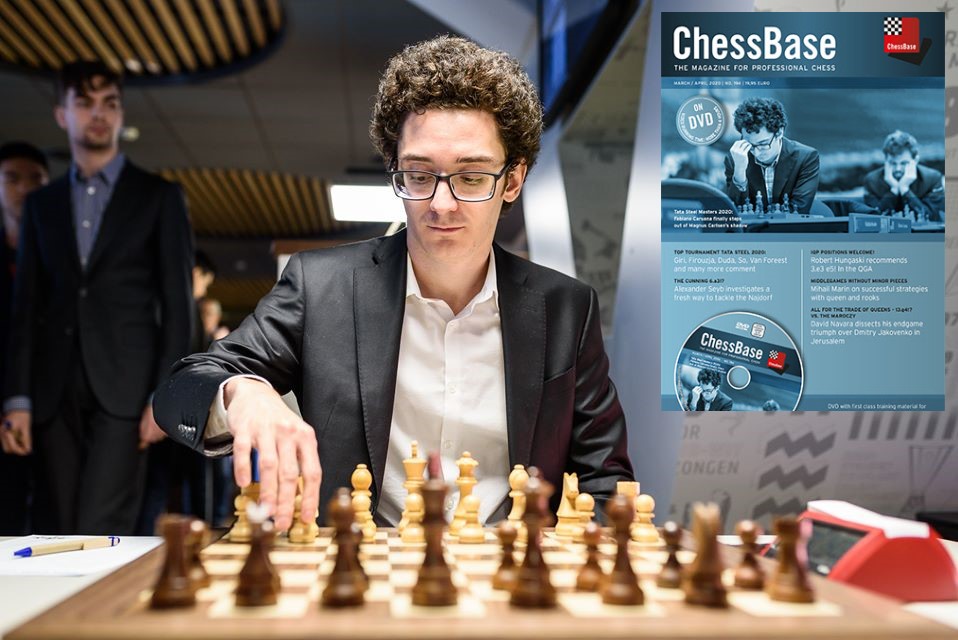
4/13/2020 – ChessBase offers a window to the world of professional chess. The current issue offers a bird’s eye view of three major events, Jerusalem Grand Prix, London Grand Chess Tour and Wijk aan Zee 2020, including 1249 games, 11 opening surveys, demo lectures and exercises for training. Games annotated by Jan-Krzysztof Duda, Romain Edouard, David Navara, Alireza Firouzja, Anish Giri, Wesley So, Igor Stohl, Jorden van Foreest and Peter Heine Nielsen, to mention a few. PROF. NAGESH HAVANUR takes a look. | Photo: Alina l'Ami
new: Fritz 20
Your personal chess trainer. Your toughest opponent. Your strongest ally. FRITZ 20 is more than just a chess engine – it is a training revolution for ambitious players and professionals. Whether you are taking your first steps into the world of serious chess training, or already playing at tournament level, FRITZ 20 will help you train more efficiently, intelligently and individually than ever before.
Tata Steel 2020 with analyses by Giri, Firouzja, So, Duda, Navara, Van Foreest and many more. Videos by Daniel King, Mihail Marin and Simon Williams. 11 opening articles with new repertoire ideas and training sessions in strategy, tactics and endgame!
If you're looking for a dynamic alternative to the Slav, Queen's Gambit Declined, or other mainstream systems, the Chigorin Defence offers exactly what modern tournament players need.
€34.90
“I am under house arrest!”
The phone rang. It was my friend Max.
“I am under house arrest!”, he complained. “My daughter is not letting me out.”
The most popular chess program offers you everything you will need as a dedicated chess enthusiast, with innovative training methods for amateurs and professionals alike.
I stay nearby and it’s a quiet place with few people around. My friend’s daughter looked relieved when she saw me. Chess would keep her dad occupied. Ever since the pandemic hit the world, his generous heart has thought of nothing but help. Left to himself, he would have rushed to join a relief effort, never mind that he is past seventy.
“They also serve who stand and wait.”(1) I assured him. “Some day our turn will come and then we can also help. Meanwhile give your heart some rest.”
He didn’t believe me, “They think I am too old to help, and I am not. What to do? Any way, what have you got for me?”
I pulled out the recent issue of ChessBase Magazine and soon we were transported to a world that was still real weeks before. Among others, this issue carries games from Jerusalem Grand Prix, 11th London Chess Classic and Wijk aan Zee Tournaments.
A battle of generations
We started with games from the Jerusalem Grand Prix in this issue. As is known, this was the last in the series to determine places in the Candidates’ Tournament. It was a strong field that included Vachier-Lagrave, Nepomniachtchi, Gelfand, Wei Yi and Karjakin, among others.
Ian Nepomniachtchi came first, beating Wei Yi 1½:½ in the last round. I was curious to see how he got past Gelfand — an experienced campaigner — in the first round. In this issue. Igor Stohl annotates his fighting draw with Boris, who dominated the position from the word go. I would like to draw the attention of readers to one more game, the last of the mini-match, when Gelfand was trailing by one point and it was imperative for him to win.
Nepomniachtchi went on to win the fourth stage of the Grand Prix — he knocked out Gelfand in round one | Photo: Niki Riga
Reti would have been pleased
The 11th London Chess Classic was held as the final stage of the Grand Chess Tour. Ding Liren beat Maxime Vachier-Lagrave in the final, World Champion Magnus Carlsen finished third by beating Levon Aronian. Now that bald summary can hardly do justice to the battles of this tournament.
Perhaps readers should look up the news stories once again to see how the drama unfolded before the spectators.
In this issue, Romain Edouard annotated quite a few encounters from the event. Here we shall see the last of these games, Ding Liren versus Vachier-Lagrave. For the sake of completeness, I have also checked commentaries by others, not to mention annotations by Ding Liren himself.
A model game that would have pleased Reti! [Pictured]
Ding Liren won the 2020 Grand Chess Tour after beating ‘MVL’ in the final of the London Chess Classic | Photo: Lennart Ootes / Grand Chess Tour
Caruana calls it a miracle!
The Wijk aan Zee Tournament was the most prestigious among them all, with the participation of Magnus Carlsen. As is known, Caruana won the event with a score of 10/13, two points ahead of Magnus, who finished with 8/13. The World Champion was bogged down by some tough draws.
Here, young Duda analyses Caruana's game with Carlsen, and you will see how both players were courting danger throughout in their quest for victory. Magnus had his way with another young player, Alireza Firouzja, and with a touch of jujitsu brought him down. The game would have delighted Aron Nimzowitsch, the apostle of Hypermodern chess. In this issue it is annotated by Peter Heine Nielsen. My own favourite is the eighth-round battle between Caruana and Anand.
The Ruy Lopez is one of the oldest openings which continues to enjoy high popularity from club level to the absolute world top. In this video series, American super GM Fabiano Caruana, talking to IM Oliver Reeh, presents a complete repertoire for White.
Fabiano called his victory a miracle
Anand took great risks in this tournament and suffered another defeat in the hands of Wesley So in a sharp battle. The latter has annotated the game in this issue.
This brings me to the rest of the DVD. Apart from standard features on middlegame tactics, endgame play and training this issue has as many as 11 opening surveys ranging from the Caro-Kann to the Queen’s Gambit Accepted. Among them, I would single out the articles on Two Knights’ Defence and the Anti-Marshall Variation in the Spanish.
In this second part of the series(2) on the Two knights’ Defence, Renato Quntiliano deals with the Main Line and indeed it is up to date. However, I would have liked to see his own annotations to the following classic instead of citing analysis by others.
The Bohemian Caesar speaks
Both Steinitz and Chigorin were passionate seekers of truth and fought whole World Championship matches on principled positions. The Two Knights’ Defence was a major battleground between these two legendary players. The following game was a turning point between those matches, and for a change we are going to see it through the eyes of the loser.(3)
Admittedly, engines today would see it all differently. But then let us remember those wise words of Isaac Newton, “If I have seen further, it is by standing on the shoulders of Giants.”
Mikhail Chigorin, from Saint Petersburg, and Wilhelm Steinitz, from New York, conducted a telegraph match from October 23, 1890 to April 28, 1891
The Anti-Marshall under attack
The second opening survey that interested me was on the line 8.a4 d5!? in the Ruy Lopez, analysed by Krisztian Szabo with inputs from Simon Williams. For a moment you begin to wonder if it works for Black, then White has to look for other lines in this opening. However, there are some drastic remedies here as shown in the sideline below. I have kept it simple for readers not familiar with current theory.
For now, the Anti-Marshall has survived.
Apart from these surveys, there are regular sections on opening traps, middlegame tactics and endings. There is much else in this DVD that deserves to be explored. The main database of the issue has 1249 recent games, of which 30 are deeply annotated. Apart from the GMs I have already mentioned, the commentators include Anish Giri, David Navara and Igor Stohl. A major contribution is made by Romain Edouard, who has annotated 11 games. It may be noted that there are more annotated games in the sections on opening theory and training.
Tata Steel 2020 with analyses by Giri, Firouzja, So, Duda, Navara, Van Foreest and many more. Videos by Daniel King, Mihail Marin and Simon Williams. 11 opening articles with new repertoire ideas and training sessions in strategy, tactics and endgame!
Notes
(1) Readers of course know the line, “They also serve who stand and wait.” It’s from John Milton’s poem “On his blindness”. (2) The first part of the series in CBM 194 dealt with the Traxler Counterattack (1.e4 e5 2.Nf3 Nc6 3.Bc4 Nf6 4.Ng5 Bc5 !?). (3) The annotations to the Steinitz-Chigorin 1890 Cable Match are taken from the International Chess Magazine that Wilhelm Stenitz edited. A selection of his writings is available from The Collected Works of Wilhelm Steinitz (DVD)published by Sid Pickard.
Nagesh HavanurProf. Nagesh Havanur (otherwise known as "chessbibliophile") is a senior academic and research scholar. He taught English in Mumbai for three decades and has now settled in Bangalore, India. His interests include chess history, biography and opening theory. He has been writing on the Royal Game for more than three decades. His articles and reviews have appeared on several web sites and magazines.
Dear friend,
Thank you for the kind words.
I take this opportunity to draw the attention of new readers to the system of notation. If they scroll down the page, on the left they will find two scores of the same game. The first is unannotated. Here can see the game and analyse on their own. Then they can compare their work with the second that is annotated. This arrangement is readily available for the first three GM games.
It is not there for the Steinitz-Chigorin 1890 game in the end. I have requested ChessBase Editors to offer an unannotated score here also. In case you don’t see one right away, do try to see it without annotations and draw your own conclusions. Then you can have a treat with the words of Steinitz himself.
YOUR PERSONAL CHESS COACH - Whether you’re taking your first steps into the world of club chess, or already playing at a tournament level: with FRITZ, you can train more efficiently, intelligently and with a more personalised approach than ever before.
Keep it simple. Stay objective. Watch the clock. Sometimes take the risk. GM Loek van Wely explains the ten principles that decide real games. They aren’t about theory. They’re about what you do at the board when it counts.
2026 Chess Olympiad with analyses by Abdusattorov, Donchenko, Duda, So and many more – ‘Rooks love open files’: Tactics training with Oliver Reeh – ‘Don’t underestimate it’: Caruana’s blitz weapon 1.e4 e5 2.d3 – Total Video playing time: over 6 hours!
Most players don’t lack the urge to attack, they just strike at the wrong moment, and GM Sipke Ernst shows you which signals tell you to go for the king and which tell you to choose another plan.
How grandmasters win without fireworks: GM Jan Markos shows you 11 very practical tips from "How to play in a lost position" to "Be patient like Carlsen" that will improve your tournament chess.
The Nimzo-Indian has stood the test of time for over a century: Still a top choice for elite players today, from Magnus Carlsen to Praggnanandhaa, it remains one of Black's most reliable ways to fight for real chances against 1.d4 2.c4 3.Nc3.
1.c4 e5 2.Nc3 Bb4!? is an opening idea well worth considering. Black immediately threatens to double the pawns on c3 in the style of the Trompowski or Sicilian Grand Prix attack.
In this 60-minute video course you’ll learn how to use the Austrian Defence as a practical weapon for Black!
€9.90
We use cookies and comparable technologies to provide certain functions, to improve the user experience and to offer interest-oriented content. Depending on their intended use, analysis cookies and marketing cookies may be used in addition to technically required cookies. Here you can make detailed settings or revoke your consent (if necessary partially) with effect for the future. Further information can be found in our data protection declaration.
Pop-up for detailed settings
We use cookies and comparable technologies to provide certain functions, to improve the user experience and to offer interest-oriented content. Depending on their intended use, cookies may be used in addition to technically required cookies, analysis cookies and marketing cookies. You can decide which cookies to use by selecting the appropriate options below. Please note that your selection may affect the functionality of the service. Further information can be found in our privacy policy.
Technically required cookies
Technically required cookies: so that you can navigate and use the basic functions and store preferences.
Analysis Cookies
To help us determine how visitors interact with our website to improve the user experience.
Marketing-Cookies
To help us offer and evaluate relevant content and interesting and appropriate advertisement.












 The