
Zoran Petronijevic is an IM with FIDE rating 2405 (highest 2430). Lives in the town of Nis, Serbia. For many years he played for various teams, mostly in the first division in former Yugoslavia and Serbia. His occupation is a teacher of Philosophy and Logic. Since 2003 he has worked as a chess coach. In 2004 he made a CD for ChessBase about Caro-Kann (B13-B14). He was an editor for Encyclopedia of chess endgames: pawn, and Rook Endgames for Chess Informant. His passion is literature. In chess, he is interested in history and endgames.
12/18/2025 – In his article IM Zoran Petronijević raises some fundamental questions: How relevant is Steinitz’s legacy today, does it still speak to modern chess, or does it belong to a bygone, almost “dinosaur” era? Does the analysis of his creative work possess genuine practical value, or do we study it merely for its historical significance? Equally important is the question: What, in concrete terms, did Steinitz contribute to chess?
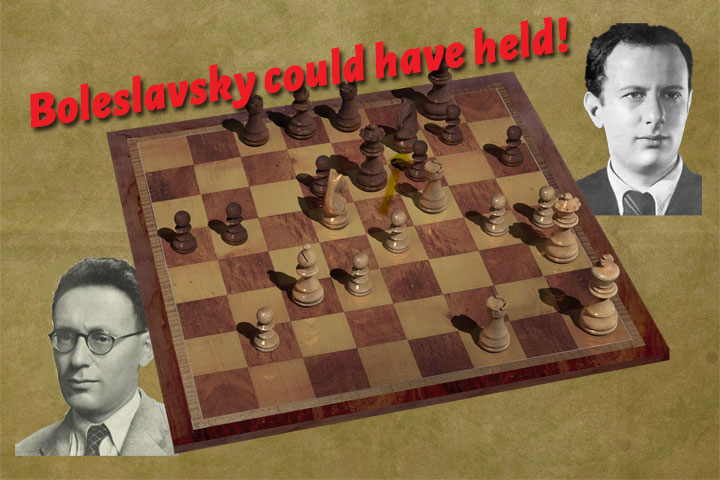
9/3/2025 – Some time ago, we invited our readers to help us unravel a long-standing mystery in the famous game Botvinnik–Boleslavsky, played in 1943 (during World War II!). The response was overwhelming, and in a relatively short time, we reached a conclusion: Boleslavsky could have held the balance – a draw was within reach – despite Botvinnik’s claim in his (usually precise!) commentary that his position was winning.
8/17/2025 – Mikhail Moiseyevich Botvinnik is undoubtedly one of the towering figures in the entire history of chess, from the birth of modern chess (circa 1495) to the present day. The subject of this article is a game Botvinnik played in 1943 (while World War II was still raging) against one of the great hopes of Soviet chess at the time - and a true innovator - Isaac Boleslavsky. Botvinnik awarded his pawn sacrifice in the middlegame an exclamation mark in all his annotations. But was he correct? | Help us unravel this riddle.
5/14/2025 – In the fourth world championship match between Garry Kasparov and Anatoly Karpov, played in Seville in 1987, the score was 12–11 in Karpov’s favor, putting Kasparov in a must-win situation to retain his title. This game was the subject of our previous article. We invited our readers to analyze with us, to solve a historical riddle. Here are the results.
4/17/2025 – Garry Kasparov and Anatoly Karpov played five matches for the world championship. The fourth match was played in Seville in 1987. After 23 games, the score was 12–11 in Karpov’s favor, putting Kasparov in a must-win situation to retain his title. The final game was adjourned after five hours of play, to be resumed the next day. The sealed position is the subject of this article.
2/17/2025 – Recently, the game Thomas-Alekhine, Baden 1925, from move 34...Qc4, was published on this site, with a request that readers get involved to help solve this riddle. Was the position really lost for White? And did Black maintain his winning advantage until the end of the game? Today we give the solution.
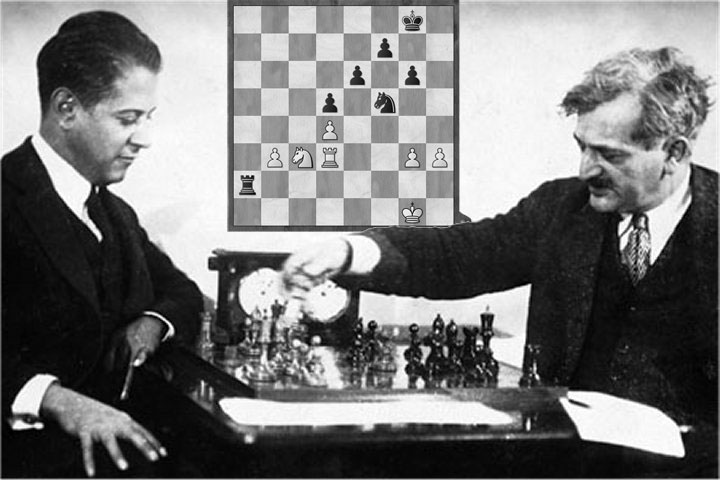
7/31/2024 – The tenth game of the 1921 match saw challenger José Raúl Capablanca gain an advantage with the black pieces, but with limited material on the board, World Champion Lasker had chances of survival. We gave our readers several interesting riddles we want to solve. Here is the definitive solution to the historic game.
In this course, you’ll learn how to take the initiative against the London and prevent White from comfortably playing their usual system by playing 1.d4 Nf6 2.Bf4 Nh5.
London System Powerbase 2026 is a database and contains in all 11 285 games from Mega 2026 and the Correspondence Database 2026, of which 282 are annotated.
The London System Powerbook 2026 is based on more than 410 000 games or game fragments from different opening moves and ECO codes; what they all have in common is that White plays d4 and Bf4 but does not play c4.
In this course, Grandmaster Elisabeth Pähtz presents the London System, a structured and ambitious approach based on the immediate Bf4, leading to rich and dynamic positions.
Opening videos: Open Spanish (Sipke Ernst) and Classical Sicilian (Nico Zwirs). Endgame Special by Igor Stohl: ‘Short or long side’ – where should the defending king be placed in rook endgames? ‘Lucky bag’ with 35 master analyses.
YOUR EASY ACCESS TO OPENING THEORY: Whether you want to build up a reliable and powerful opening repertoire or find new opening ideas for your existing repertoire, the Opening Encyclopaedia covers the entire opening theory on one product.
In this course, you’ll learn how to take the initiative against the London and prevent White from comfortably playing their usual system by playing 1.d4 Nf6 2.Bf4 Nh5.
London System Powerbase 2026 is a database and contains in all 11 285 games from Mega 2026 and the Correspondence Database 2026, of which 282 are annotated.
The London System Powerbook 2026 is based on more than 410 000 games or game fragments from different opening moves and ECO codes; what they all have in common is that White plays d4 and Bf4 but does not play c4.
In this course, Grandmaster Elisabeth Pähtz presents the London System, a structured and ambitious approach based on the immediate Bf4, leading to rich and dynamic positions.
Opening videos: Open Spanish (Sipke Ernst) and Classical Sicilian (Nico Zwirs). Endgame Special by Igor Stohl: ‘Short or long side’ – where should the defending king be placed in rook endgames? ‘Lucky bag’ with 35 master analyses.
YOUR EASY ACCESS TO OPENING THEORY: Whether you want to build up a reliable and powerful opening repertoire or find new opening ideas for your existing repertoire, the Opening Encyclopaedia covers the entire opening theory on one product.
€169.90
We use cookies and comparable technologies to provide certain functions, to improve the user experience and to offer interest-oriented content. Depending on their intended use, analysis cookies and marketing cookies may be used in addition to technically required cookies. Here you can make detailed settings or revoke your consent (if necessary partially) with effect for the future. Further information can be found in our data protection declaration.
Pop-up for detailed settings
We use cookies and comparable technologies to provide certain functions, to improve the user experience and to offer interest-oriented content. Depending on their intended use, cookies may be used in addition to technically required cookies, analysis cookies and marketing cookies. You can decide which cookies to use by selecting the appropriate options below. Please note that your selection may affect the functionality of the service. Further information can be found in our privacy policy.
Technically required cookies
Technically required cookies: so that you can navigate and use the basic functions and store preferences.
Analysis Cookies
To help us determine how visitors interact with our website to improve the user experience.
Marketing-Cookies
To help us offer and evaluate relevant content and interesting and appropriate advertisement.