At the time this encounter was played, Botvinnik was already an established star. He had been a national champion multiple times and scored excellent results at international tournaments. Just to mention a few highlights: he tied for first in Moscow 1935, took second place behind Capablanca in Moscow 1936, shared first in Nottingham with Capablanca, and secured third at the legendary AVRO tournament in 1938. His collection of victories included great names, most notably two memorable wins against Capablanca and Alekhine. The former is still considered one of the most beautiful games of all time, while the latter was a model of positional brilliance. Clearly, Botvinnik was a world-class contender for the crown – a goal he eventually achieved, reigning as World Champion from 1948 until 1963, with only brief interruptions in 1957 and 1960.
As for Boleslavsky, he was hardly an unknown. In 1938, as a young and almost completely unheralded student, he won the Ukrainian Championship in Kiev (then part of the USSR). He finished 5th at the USSR Championship in 1940, took 4th at the Absolute Soviet Championship in 1941, and won the Kuybyshev tournament in 1942. His reputation rested on originality and creativity: he was brimming with fresh ideas, many of which (especially in the King’s Indian Defence and the Sicilian) are still known today. His theoretical preparation was outstanding, his grasp of opening theory profound. Later, he would come even closer to the very summit: in 1950, he tied for first place in the Candidates Tournament in Budapest, only to lose the playoff match against Bronstein – and thus missed the chance to challenge for the world title. In short: this was a battle between two heavyweights.
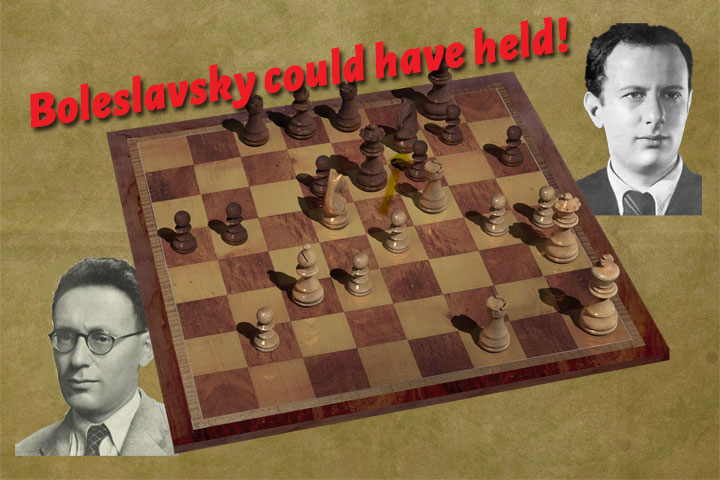
And the game lived up to expectations. It was a remarkable struggle, eventually won by Botvinnik. He clearly valued it highly himself – he annotated it in all of his major game collections (1949, 1966, and 1985) – which speaks volumes. Early in the middlegame, Botvinnik sacrificed a pawn for lasting positional initiative. For us, the critical position arose after 29.Bxf6.
At this moment, Botvinnik claimed the game was essentially decided in his favor. In fact, the position remained dynamically balanced – provided Black played with precision. With the help of our readers, we now agree that the decisive slip came with 31…Qd7?. Instead, the correct defense was 31…Qe5!, which would have secured equality.
After 33…Kxf7, a fascinating and practically important endgame appeared on the board: queen versus two rooks. Even today, this type of ending is considered tricky – every tempo counts, and subtlety is required. Botvinnik himself admitted that his next move, 34.g5?, was an error: “The pawn is quickly won, but Black manages to cut off the white king on the kingside, making the King’s position unsafe.” He suggested 34.Kg2 as the winning path, and in fact 34.Qe3 seems to be an even simpler and faster solution.
Botvinnik also regarded 42…Rcf2 as the decisive mistake, recommending instead 42…Rxb2. Yet this is not correct: even after 42…Rcf2, Black can still hold the draw. The true losing move came a bit later with 43…R2f7?. Black should have played 43…R8f3, which holds the balance. In fact, there were other defensive resources as well – for instance, 43…Kh7 or 43…R2f3.
After the slip, White struck powerfully with 44.Qd5!!, and from then on Botvinnik handled the position with perfect precision.
Let us now take a closer look at the detailed commentary of this remarkable battle.
With this analysis, we have come closer to another truth – one that does not criticize the players for occasional inaccuracies, but instead seeks to deepen our understanding of such positions. Of course, analysis is never final. Perhaps the next generation will discover further subtleties in this game. That is how chess mastery advances: from one layer of truth to the next.